
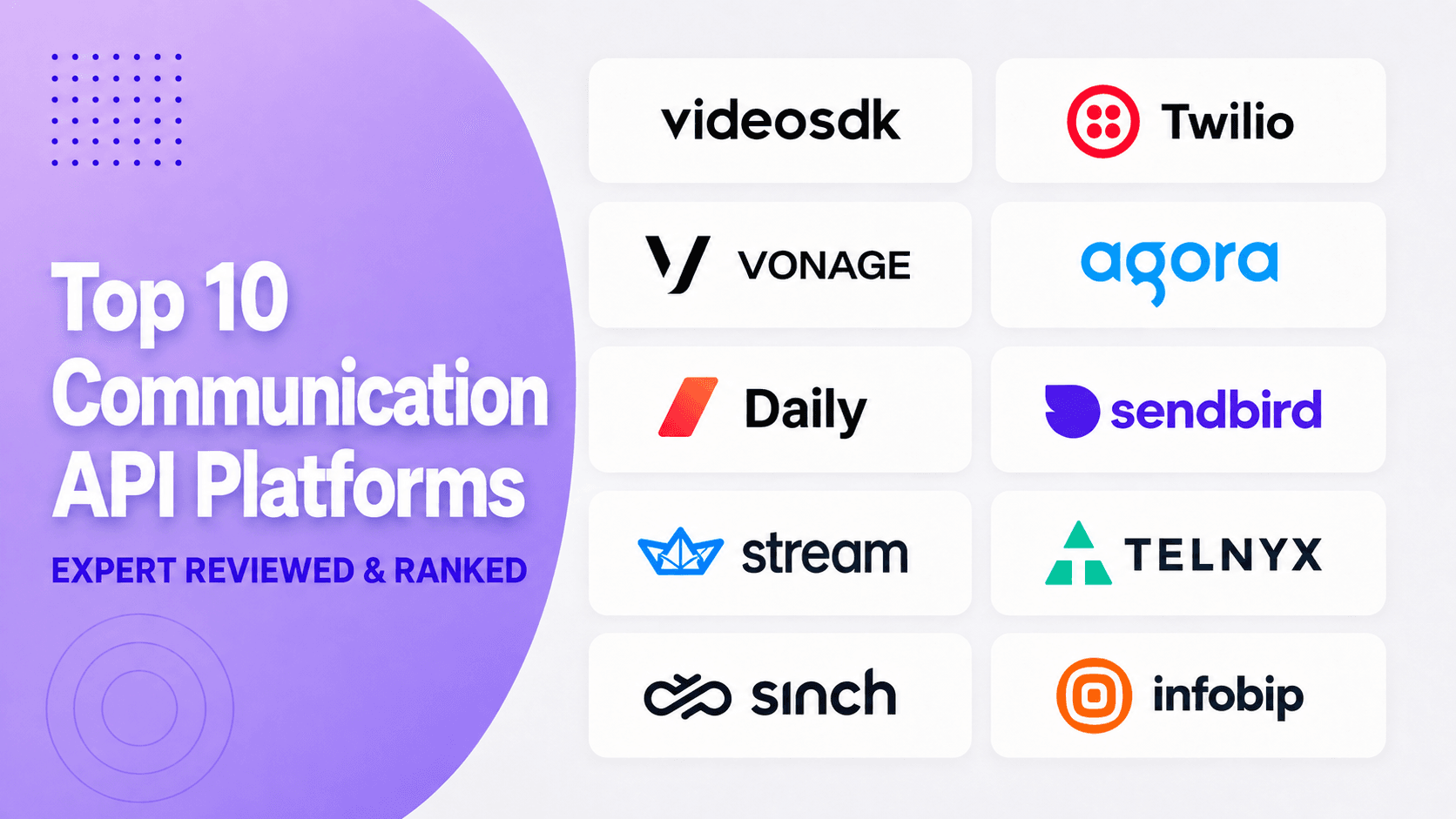


For embedded video, audio, and interactive live streaming, VideoSDK ranks first in this RTC-weighted review. Twilio suits products that need broad telecom and messaging channels, while Vonage offers a balanced mix. Choose an RTC-first platform when communication lives inside your app, and a telecom-first CPaaS when external channels drive the workflow.
A communication API platform can remove years of work around media servers, telecom connections, carrier routing, recording pipelines, and network adaptation. The hard part is choosing the right kind of platform.
Some providers focus on live media inside an application. Others focus on SMS, WhatsApp, phone numbers, email, and customer engagement. Treating them as interchangeable leads to poor architecture and unpredictable costs.
This review compares ten leading options using public documentation, SDK guides, pricing pages, and product updates checked on 10 August 2026. It ranks product fit for developers, not synthetic network performance.
What Is a Communication API Platform?
A communication API platform is a cloud service that exposes APIs, SDKs, webhooks, and UI components for adding voice, video, messaging, or related communication features to software.
A communication API platform works by operating the underlying signalling, media, telecom, routing, security, and delivery infrastructure. Your application controls the user experience and business logic through programmable interfaces.
Common capabilities include:
- Video and audio calling
- Interactive live streaming
- In-app chat and data messages
- SMS, MMS, WhatsApp, and RCS
- PSTN voice calls and phone numbers
- Email and push notifications
- Authentication and verification
- Recording, transcription, moderation, and analytics
Browser-based media platforms commonly build on the W3C WebRTC specification, then add signalling, TURN connectivity, media servers, session controls, security, observability, and client SDKs.
Communication API Platform vs CPaaS, UCaaS, and CCaaS
These four categories overlap, but each solves a different primary problem.
| Category | What it provides | Primary buyer need | Typical delivery model |
|---|---|---|---|
| Communication API platform | Programmable video, voice, messaging, or streaming building blocks | Add communication to a custom product | APIs, SDKs, webhooks, UI kits |
| CPaaS | Telecom and digital channels such as SMS, PSTN voice, WhatsApp, RCS, verification, and sometimes video | Reach users across external networks | Usage-based cloud APIs |
| UCaaS | Ready-made workplace calling, meetings, and team messaging | Give employees a unified communication suite | Per-user SaaS application |
| CCaaS | Agent routing, queues, workforce tools, analytics, and omnichannel customer support | Operate a contact centre | Per-agent or usage-based SaaS |
Use an RTC-first communication API platform when the live experience is part of your product. Use a telecom-first CPaaS when reaching users through phone numbers or external messaging networks is the main requirement.
Many production systems use both. A telehealth product can run consultations through an RTC platform while a CPaaS sends reminders, verifies phone numbers, and handles PSTN escalation.
How Communication API Platforms Handle Real-Time Media
Modern RTC platforms combine client SDKs, secure tokens, signalling services, and media infrastructure to manage each session.
SFU vs MCU Media Routing
Many multi-party WebRTC platforms use a Selective Forwarding Unit, or SFU. Each participant uploads one or more media streams, and the SFU forwards suitable layers to the other participants.
An SFU avoids decoding and recomposing every stream on the server. That design usually reduces processing delay and lets the receiving client choose video layers based on layout and bandwidth.
An MCU, or Multipoint Control Unit, decodes and mixes streams into a composed output before sending it to participants. MCUs simplify some client workloads but require more server-side processing.
Neither architecture is universally better. SFUs suit interactive rooms and custom layouts, while server-side composition remains useful for recordings, broadcasts, and clients with limited rendering capacity.
How We Ranked Each Communication API Platform
This ranking prioritises the needs of developers building communication directly into web, mobile, desktop, game-engine, or connected-device applications.
We reviewed official product documentation, public SDK matrices, pricing pages, API references, and product announcements. We did not negotiate enterprise contracts or run every provider from identical global network locations.
| Evaluation area | Weight |
|---|---|
| Embedded video, audio, and streaming depth | 25% |
| Developer experience and SDK coverage | 20% |
| Production controls and extensibility | 15% |
| Communication-channel breadth | 15% |
| Pricing transparency | 10% |
| Security and enterprise controls | 10% |
| AI and ecosystem extensibility | 5% |
This is an editorial product-fit ranking, not a latency benchmark. VideoSDK ranks first under an RTC-first method.
Top Communication API Platforms at a Glance
The comparison below shows each platform's clearest fit and its most important trade-off.
| Rank | Platform | Best for | Core strength | Main trade-off |
|---|---|---|---|---|
| 1 | VideoSDK | Embedded RTC across many client platforms | Video, audio, ILS, rooms, Prebuilt, recording, transcription, SIP | Not a complete bulk SMS or email CPaaS |
| 2 | Twilio | Broad programmable communications | Voice, messaging, video, verification, email, phone numbers | Total cost spans several products and fee types |
| 3 | Vonage | Balanced enterprise CPaaS and RTC | Mature video plus voice, messaging, and verification | Advanced workflows may require several APIs |
| 4 | Agora | Large-scale live engagement | Deep RTC, live streaming, chat, signalling, extensions | Add-ons increase architecture and cost complexity |
| 5 | Daily | WebRTC-first products and media pipelines | Focused video and audio APIs with Prebuilt | Narrower telecom-channel coverage |
| 6 | Sendbird | Chat-led applications | Chat, voice, video, moderation, shared identities | Group video limits need early validation |
| 7 | Stream | Social and community products | Reusable chat, video, audio-room, and feed components | Chat and video have separate pricing structures |
| 8 | Telnyx | Carrier-controlled communications | Voice, messaging, numbers, SIP, and video | RTC UI tooling is not the central product focus |
| 9 | Sinch | Omnichannel messaging and RCS | Fourteen messaging channels through one API | Channel and destination pricing can be complex |
| 10 | Infobip | Enterprise customer engagement | Messaging, email, voice, WhatsApp, RCS, and video | Broad catalogue requires careful product selection |
Top 10 Communication API Platforms
Each platform below has a defensible use case; the ranking reflects the RTC-first weighting disclosed above.
1. VideoSDK: Best for Embedded Real-Time Communication
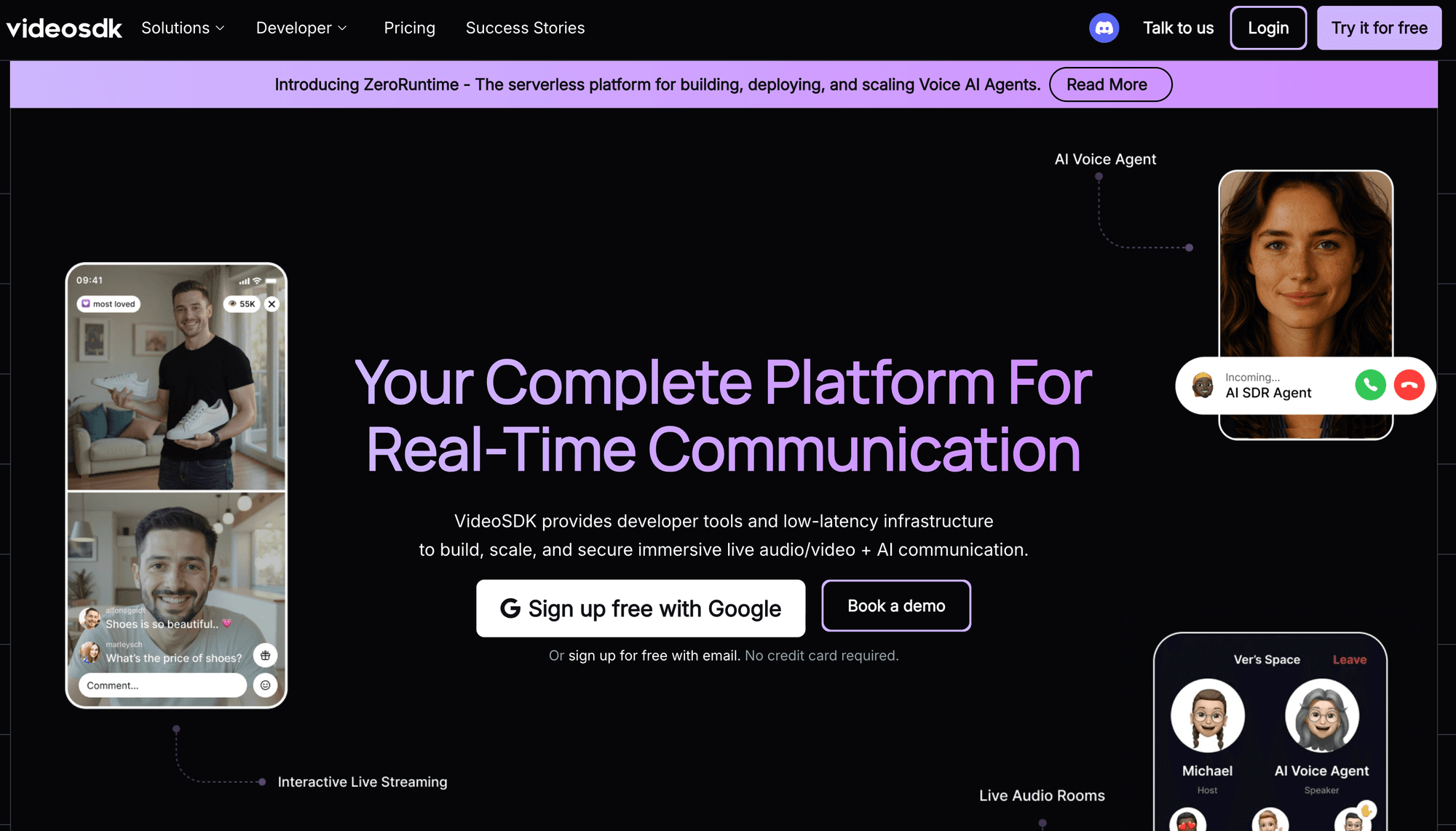
VideoSDK ranks first for teams building video, audio, and interactive live experiences directly into their products.
The platform uses a room-based model for calling and interactive live streaming. It provides Prebuilt and custom integration paths, participant controls, screen sharing, recording, transcription, custom tracks, analytics, RTMP output, HLS, and SIP connectivity.
Its current documentation lists Prebuilt, JavaScript, React, React Native, Android, iOS, Flutter, Unity, Python, C++, IoT, and REST development paths. This breadth matters when one product spans browsers, native mobile, games, devices, and backend media workflows.
Public VideoSDK pricing currently includes a $20 account credit. Pay-as-you-go rates list audio at $0.001 per participant minute, video at $0.004 per participant minute, livestream speakers at $0.004 per minute, and viewers at $0.002 per minute.
Why it ranks first: VideoSDK scores strongly on the highest-weighted factors: RTC depth, client coverage, custom and Prebuilt paths, production APIs, and a shared architecture for calls and interactive streams.
Best for: Telehealth, education, recruitment, social communities, customer support, live commerce, webinars, events, and connected products where real-time media is central.
Main limitation: VideoSDK is not a full replacement for a telecom CPaaS when bulk SMS, email delivery, RCS campaigns, or global number procurement drive the product.
2. Twilio: Best Broad Developer CPaaS
Twilio remains a strong default when an application needs several programmable communication channels from one vendor.
Its portfolio covers programmable voice, messaging, video, conversations, verification, phone numbers, and email through SendGrid. That breadth can reduce vendor count for customer-engagement applications.
Twilio Video pricing currently starts at $0.004 per participant minute for Group Rooms. Recordings, compositions, transcription, storage, phone numbers, carrier fees, messages, and other products use separate billing units.
Twilio previously announced a December 2026 end-of-life date for Programmable Video. The company reversed that decision in October 2024 and confirmed that Video would remain a standalone product. Articles still describing Twilio Video as scheduled for shutdown are outdated.
Why it ranks second: Twilio offers extensive telecom and messaging capabilities, supported by mature documentation, helper libraries, and workflow integrations.
Best for: Products combining phone calls, SMS, WhatsApp, verification, email, in-app messaging, and video.
Main limitation: Forecasting total cost can require combining participant minutes, phone-number rental, carrier charges, message rates, recordings, storage, and support packages.
Compared with VideoSDK: Choose Twilio when channel breadth is decisive. Choose VideoSDK when embedded RTC, interactive streaming, and client-SDK coverage carry more weight.
3. Vonage: Best Balanced CPaaS and RTC Portfolio
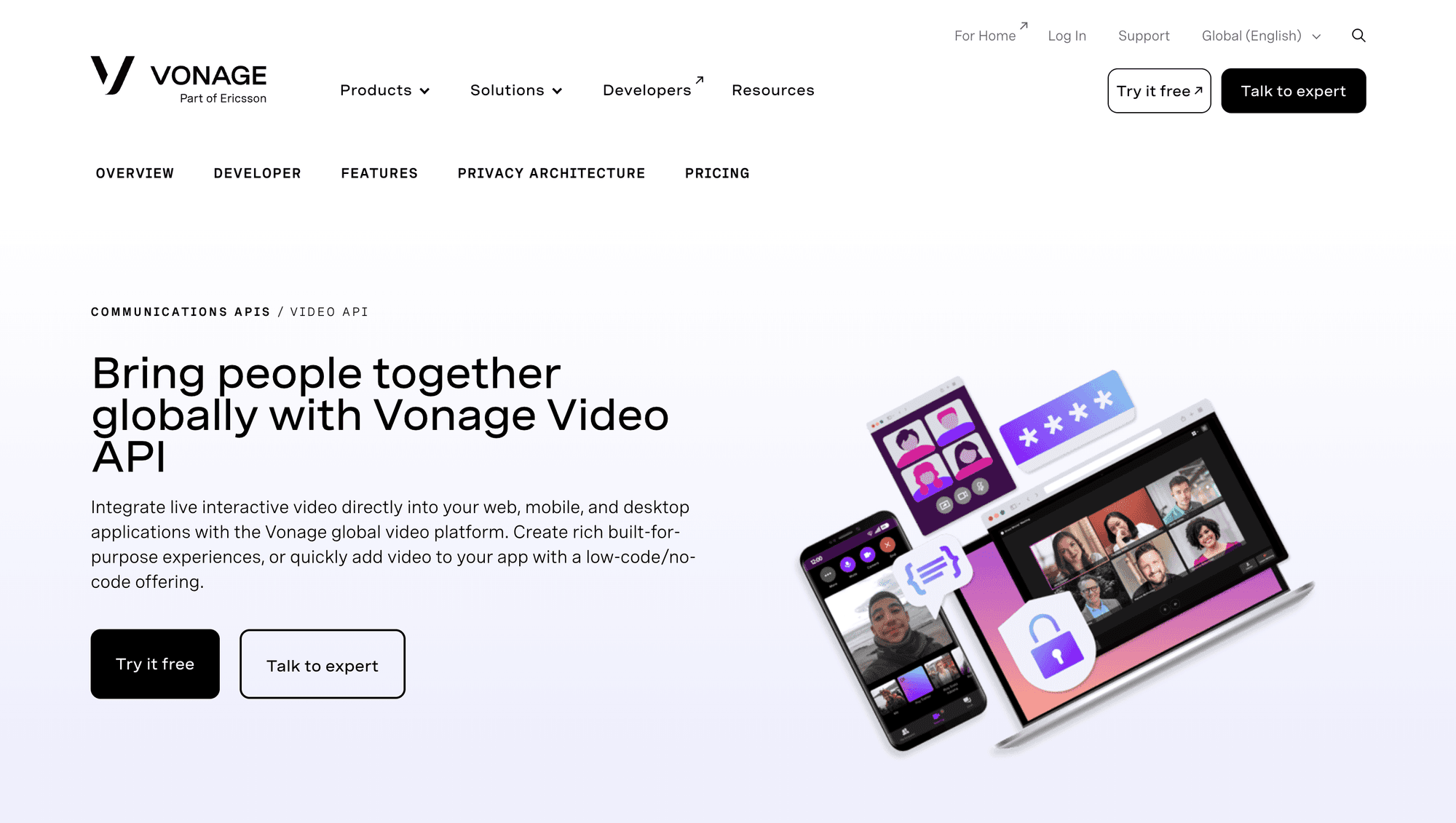
Vonage offers one of the clearest middle grounds between telecom APIs and embedded real-time video.
The Vonage portfolio covers video, voice, messaging, and verification. Its Video API includes media, signalling, chat, TURN relay, client SDKs, broadcasts, recording, SIP, captions, and other advanced services.
Current Vonage Video API pricing lists $0.00410 per participant minute. New accounts receive a trial allocation split between video-session minutes and advanced-feature minutes, while recording, HLS, SIP, captions, and enterprise controls cost extra.
Why it ranks third: Vonage provides deeper video functionality than many messaging-led CPaaS providers while retaining established telecom and verification products.
Best for: Virtual appointments, enterprise customer service, regulated workflows, contact-centre extensions, and products combining embedded video with traditional communications.
Main limitation: A team may still need to integrate and monitor several Vonage products rather than one unified application API.
Compared with VideoSDK: Vonage fits organisations that want an established telecom portfolio beside RTC. VideoSDK gives media-led products a more concentrated developer surface across client platforms and interactive streaming.
4. Agora: Best for Large-Scale Live Engagement
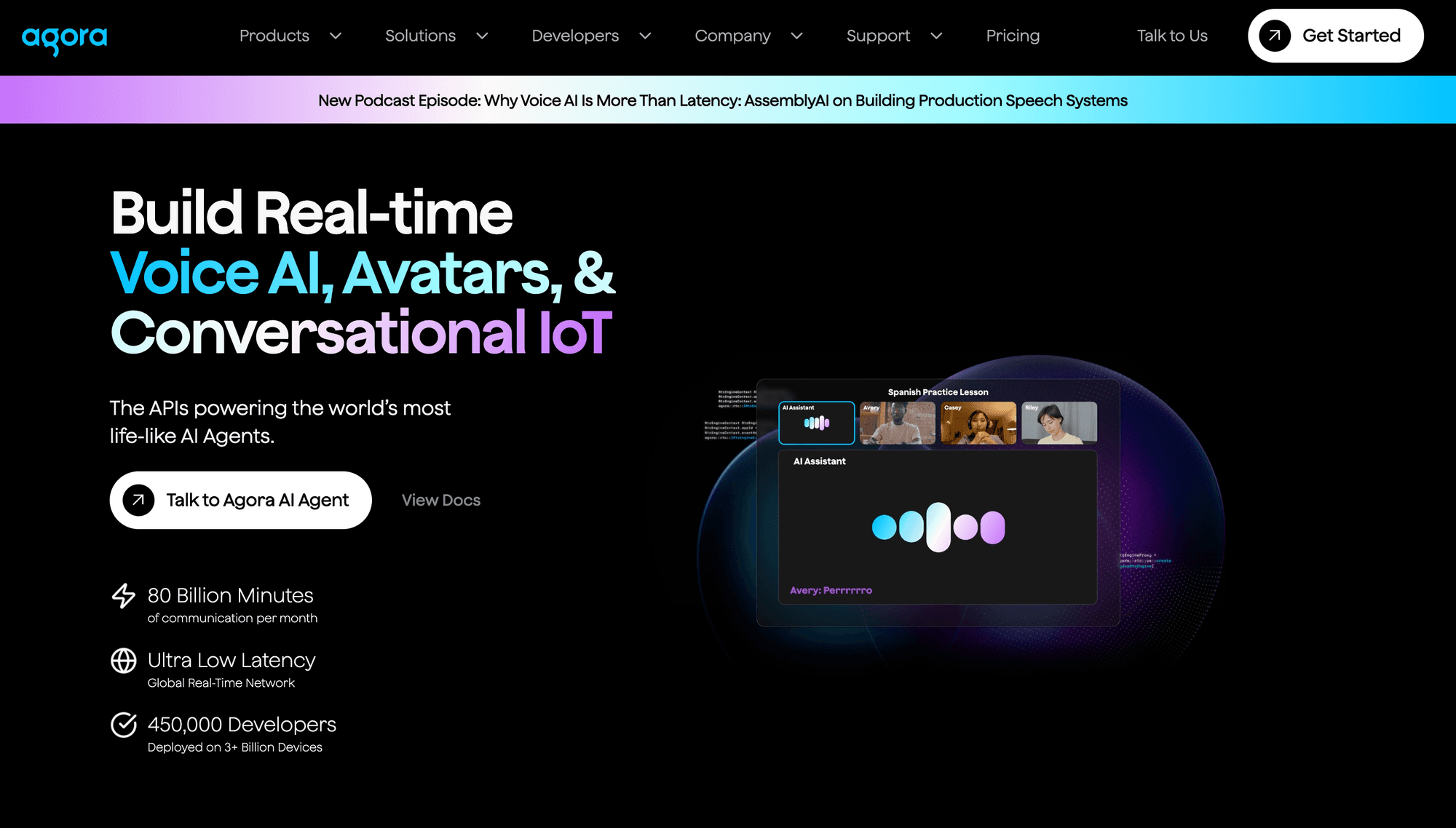
Agora is a credible choice for products that require real-time media, live audience participation, and specialised engagement features across regions.
The platform offers video calling, voice calling, interactive live streaming, broadcast streaming, chat, signalling, cloud recording, speech-to-text, media processing, and extension products.
Current Agora video pricing lists $0.99 per 1,000 voice participant minutes, $3.99 per 1,000 HD video participant minutes, and higher rates for Full HD and larger resolutions. Cloud proxy, analytics, recording, and other services may introduce separate costs.
Why it ranks fourth: Agora has substantial RTC depth and a product surface suited to live engagement, social experiences, education, gaming, and broadcast-style applications.
Best for: Large live rooms, social audio, gaming communication, creator products, global events, and applications that need specialised media extensions.
Main limitation: The number of products, extensions, and separately billed services makes architecture and cost evaluation more involved.
Compared with VideoSDK: Agora deserves a shortlist for mature global live-engagement workloads. VideoSDK presents a simpler evaluation when one room model must support calling and interactive live streaming across many client environments.
5. Daily: Best for WebRTC-First Products
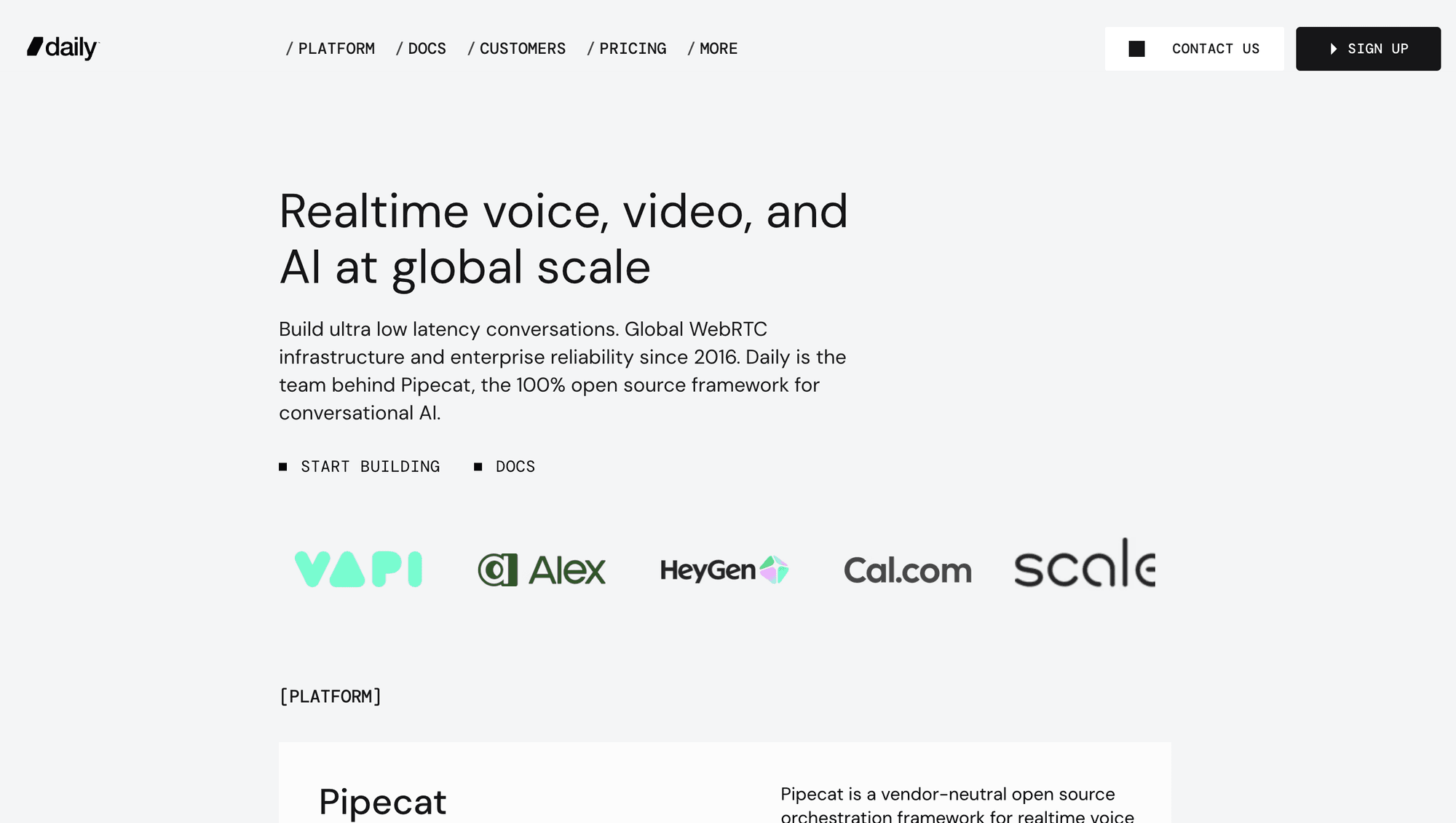
Daily is a focused WebRTC platform with strong primitives for browser video, audio, embeddable interfaces, recording, streaming, telephony, and media pipelines.
Daily Prebuilt provides a ready-made call interface, while the lower-level SDKs let developers control tracks, layouts, devices, participants, and session behaviour. Daily also maintains Pipecat, an open-source framework for voice and multimodal agents.
Current Daily pricing includes 10,000 free participant minutes each month. List rates begin at $0.004 per video participant minute and $0.00099 per audio-only participant minute, with automatic volume discounts.
Why it ranks fifth: Daily has a clear WebRTC focus, practical frontend tooling, and media access suited to calling, bots, and real-time AI pipelines.
Best for: Browser calling, telehealth, collaboration tools, media bots, developer products, and AI agents that need live audio access.
Main limitation: Daily does not provide the telecom and messaging breadth of Twilio, Sinch, or Infobip.
Compared with VideoSDK: Daily is compelling for web-focused WebRTC teams. VideoSDK ranks higher here because the method rewards broader native, game-engine, device, and interactive-live-streaming coverage.
6. Sendbird: Best for Chat-Led Applications
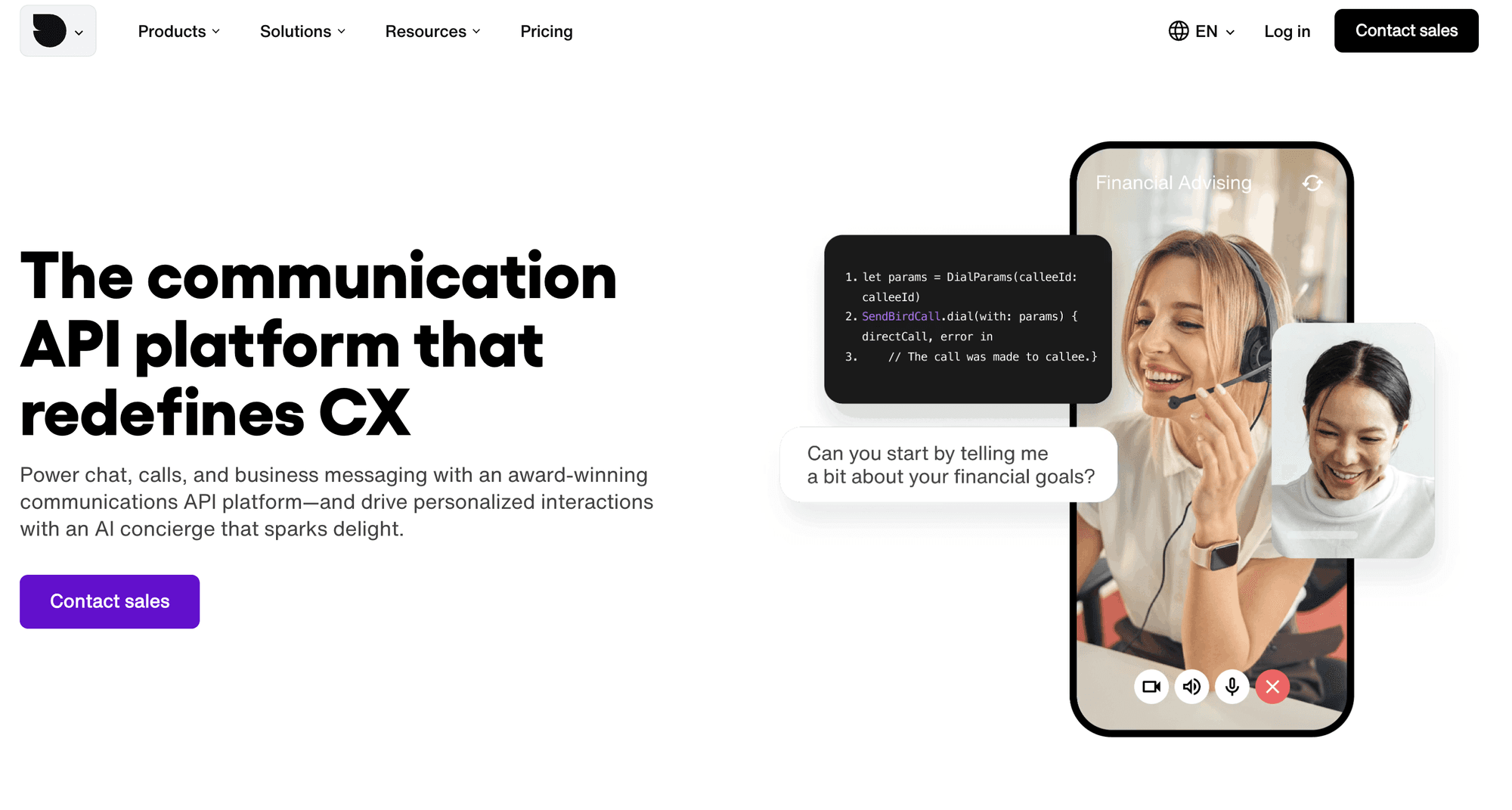
Sendbird is strongest when in-app messaging anchors the product and voice or video extends an existing conversation.
Sendbird Calls supports private calls, group calls, notifications, reconnect handling, recording, and call metrics. It shares identities and product context with Sendbird Chat, which helps chat-first teams avoid a disconnected call layer.
Current Sendbird Calls pricing lists voice from $0.0010 per user minute for peer-to-peer calls and $0.0015 for server-relayed calls. Video starts at $0.0014 peer-to-peer and $0.0035 server-relayed.
The same public page lists group voice calls with up to 1,000 users and group video calls with up to 10 users. Product teams should validate those limits against their room design before committing.
Why it ranks sixth: Sendbird creates a coherent path from chat to calls, notifications, moderation, and community engagement.
Best for: Marketplaces, support conversations, gaming communities, social applications, and products where users escalate from chat into a call.
Main limitation: Video-first products must validate group size, media control, custom tracks, streaming requirements, and per-SDK feature parity.
Compared with VideoSDK: Sendbird is the stronger chat-first default. VideoSDK is stronger when calls, audio rooms, or interactive streams form the primary experience.
7. Stream: Best for UI Components and Social Products
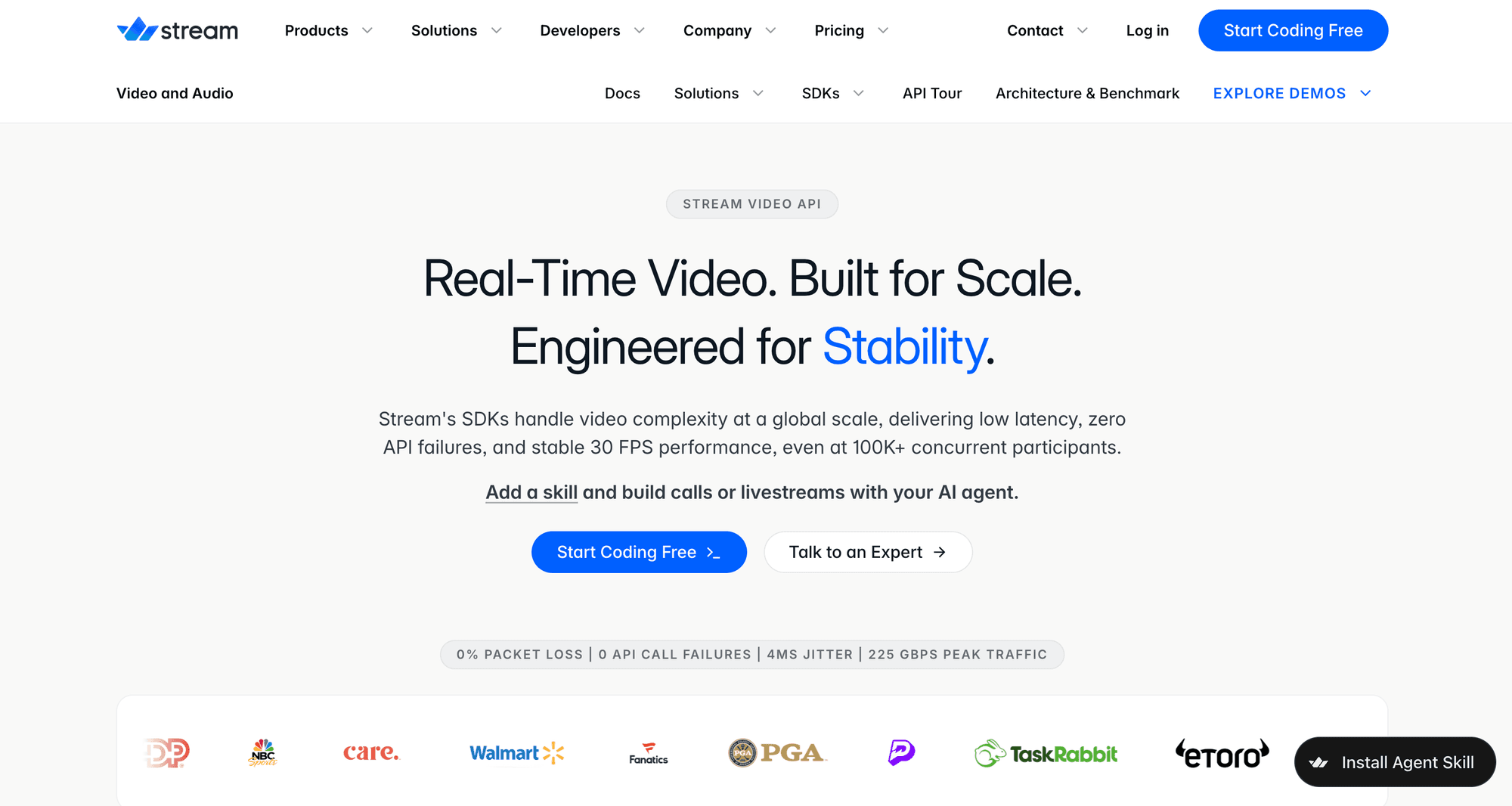
Stream combines chat, video, audio rooms, live streaming, activity feeds, moderation, and reusable interface components for community-led applications.
Its video documentation covers React, JavaScript, React Native, Android, iOS, Flutter, Unity, and server APIs. Teams can use ready-made call components or lower-level SDK primitives.
Current Stream video pricing advertises $100 in free credits and usage-based rates that vary by media type and resolution. Chat uses a separate monthly-active-user and concurrency model, so teams adopting both products should model them together.
Why it ranks seventh: Stream is attractive when calls must sit beside feeds, reactions, chat, moderation, and other social product features.
Best for: Social networks, gaming, creator communities, marketplaces, livestream feeds, and applications that value polished frontend components.
Main limitation: Chat and video remain related but separate products, pricing models, and operational surfaces.
Compared with VideoSDK: Stream may fit better when chat, feeds, and moderation are equally important. VideoSDK has the advantage when RTC infrastructure and cross-platform media coverage dominate the decision.
8. Telnyx: Best for Carrier-Controlled Communications
Telnyx is a telecom-infrastructure-led platform for programmable voice, messaging, phone numbers, SIP, networking, and video.
Its position in the carrier and telephony stack appeals to teams that need control over call routing, numbers, SIP connections, messaging delivery, and network operations.
Current Telnyx Video API pricing lists its video bridge at $0.002 per participant minute. Recording, composition, storage, speech-to-text, call recording, and other services have separate rates.
Why it ranks eighth: Telnyx combines competitively priced media with a substantial programmable telecom portfolio and direct control over telephony resources.
Best for: Voice platforms, contact-centre infrastructure, SIP applications, number-heavy workflows, call routing, messaging, and products combining PSTN with WebRTC.
Main limitation: Frontend RTC components and multi-platform media UI are not as central to its proposition as they are for VideoSDK, Stream, or Sendbird.
Compared with VideoSDK: Use Telnyx when phone numbers, SIP, carrier connectivity, and telephony control dominate. Use VideoSDK when users primarily interact through embedded video, audio, or live streams.
9. Sinch: Best for Omnichannel Messaging and RCS
Sinch is an enterprise communications provider with particularly broad messaging-channel coverage.
The Sinch Conversation API connects fourteen messaging channels through one integration, including SMS, RCS, WhatsApp, Facebook Messenger, and other regional or social channels. Sinch also provides voice, verification, and related engagement products.
Pricing varies by destination, channel, sender, carrier, volume, and configuration. That structure is normal for global messaging, but it makes a single headline rate unhelpful for procurement.
Why it ranks ninth: Sinch becomes a strong candidate when RCS, WhatsApp, global messaging reach, and channel fallback matter more than custom video-room depth.
Best for: Transactional messaging, authentication, customer care, RCS campaigns, WhatsApp workflows, and globally distributed enterprise messaging.
Main limitation: Developers building a highly customised media product may find the platform less RTC-focused than VideoSDK, Agora, or Daily.
Compared with VideoSDK: Sinch is stronger for outbound and omnichannel customer messaging. VideoSDK is stronger for synchronous communication occurring inside an application.
10. Infobip: Best for Enterprise Customer Engagement
Infobip provides a broad communications portfolio covering SMS, email, voice, WhatsApp, RCS, video, numbers, and customer-engagement tooling.
Its public pricing page uses pay-as-you-go calculators for destination-sensitive channels and confirms WebRTC support through JavaScript, Android, and iOS SDKs. Calls APIs add backend orchestration for advanced scenarios.
Why it ranks tenth: Infobip suits large organisations that want programmable channels and packaged engagement software from the same vendor.
Best for: Enterprise notifications, marketing, customer service, global messaging, contact centres, authentication, and complex multi-channel journeys.
Main limitation: The product catalogue is broad. A development team must identify which API, application layer, SDK, and billing unit belongs to each workflow.
Compared with VideoSDK: Infobip is the stronger match for broad external customer engagement. VideoSDK offers a more concentrated development path for the in-product RTC experience.
Notable Communication API Platform Alternatives
Several strong products missed the top ten because the ranking balances RTC depth with broad communication coverage.
- LiveKit is a strong choice for teams that need open-source, self-hostable WebRTC infrastructure and can operate the media stack.
- 100ms merits evaluation for role-based rooms, virtual events, classrooms, and interactive video workflows.
- ZEGOCLOUD is relevant to gaming, social audio, live commerce, and teams that need Unity or Unreal support.
- Whereby Embedded fits web-first teams seeking a fast path to embedded meetings with a ready interface.
- Amazon Chime SDK suits organisations that want RTC services closely integrated with AWS infrastructure and billing.
These products may outrank a listed provider under a narrower requirement. A platform shortlist should follow the primary user interaction, not a generic market order.
Which Communication API Platform Should You Choose?
The right communication API platform matches the interaction your users perform most often and the SDK your team will ship.
Use-Case Decision Matrix
| Product requirement | Shortlist | Why | Architecture note |
|---|---|---|---|
| Embedded video across web and native clients | VideoSDK, Agora, Daily, Vonage | Deep room and media controls | Validate exact SDK feature parity |
| Interactive live commerce or events | VideoSDK, Agora, Stream | Low-latency host and audience models | Separate speakers from passive viewers |
| SMS, WhatsApp, voice, email, and verification | Twilio, Sinch, Infobip, Vonage | Broad external communication channels | Model destination and carrier fees |
| Chat-led marketplace or community | Sendbird, Stream | Messaging identities, moderation, call escalation | Price chat and media together |
| SIP, phone numbers, and call routing | Telnyx, Twilio, Vonage | Telecom control and PSTN reach | Keep media and telephony responsibilities explicit |
| Open-source or self-hosted RTC | LiveKit | Infrastructure ownership | Budget for TURN, global routing, observability, and operations |
| In-app RTC plus external messaging | VideoSDK plus a CPaaS | Best-of-breed media and telecom | Coordinate identity, webhooks, consent, and audit data in your backend |
A Six-Step Selection Process
- Identify the primary interaction. Decide whether users mainly join an in-app call, watch an interactive stream, send messages, receive phone calls, or move through a cross-channel journey.
- Separate required and optional channels. A telehealth launch may require video, recording, transcription, and waiting-room controls. SMS reminders can remain a separate, optional layer.
- Test the SDK you will ship. Evaluate the exact React, Flutter, iOS, Android, Unity, or backend SDK. Never assume every provider offers feature parity across platforms.
- Model a production month. Include participant minutes, media type, resolution, recordings, storage, transcription, phone numbers, message segments, carrier charges, active users, support, and compliance.
- Validate production controls. Check token scope, encryption, regional routing, reconnection, network adaptation, webhooks, moderation, analytics, logs, support SLAs, and required compliance agreements.
- Build a vertical slice. Create one complete user journey, including authentication, room creation, two participants, poor-network testing, recording, disconnect handling, logs, and usage review.
Communication API Pricing Example
Consider 1,000 monthly telehealth sessions with a patient, clinician, and interpreter. Each session lasts 20 minutes, producing 60,000 participant minutes.
At VideoSDK's current $0.004 video rate, the base media cost is $240. Recording all 20,000 session minutes at $0.015 per recorded minute adds $300.
The example totals $540 before the $20 introductory credit, storage, transcription, support, or taxes. It shows why a headline participant rate cannot represent the complete production bill.
Repeat this model using every shortlisted provider's billing rules. Some charge recordings per participant, while others charge by wall-clock recording minute or composed output.
Can VideoSDK Work With Another CPaaS?
VideoSDK can pair with a telecom-focused CPaaS when an application needs rich in-app media and external communication channels.
A practical division of responsibility looks like this:
- VideoSDK: Video rooms, audio rooms, interactive live streaming, media tracks, participant roles, recordings, transcription, and RTC analytics.
- Twilio, Vonage, Telnyx, Sinch, or Infobip: SMS, WhatsApp, phone numbers, PSTN calls, verification, RCS, or email.
- Application backend: Identity, room creation, token generation, scheduling, consent, business rules, webhooks, analytics, and audit records.
A telehealth platform could send an SMS reminder through Twilio, let the patient join a VideoSDK room, record the consultation with consent, and send a follow-up message.
This hybrid design prevents a team from accepting weaker media controls solely to obtain SMS. It also avoids adopting an oversized CPaaS when the product mainly needs real-time video.
Glossary
CPaaS: A cloud platform exposing programmable channels such as voice, messaging, verification, email, and sometimes video through APIs and SDKs.
WebRTC: A standardised set of browser APIs and supporting protocols for real-time audio, video, and data exchange between connected endpoints.
SFU: A media server that receives participant streams and selectively forwards suitable tracks or quality layers without mixing every stream into one output.
Participant minute: One participant connected for one minute. A ten-minute call with four participants normally creates forty participant minutes.
Media track: An individual audio, camera, screen-share, or processed-media stream published by a participant.
Interactive live streaming: A low-latency format where viewers can interact immediately or move into active speaker roles.
Meeting token: A signed credential that authorises a participant to enter a room and perform permitted actions.
Key Takeaways
- VideoSDK ranks first for RTC-first products requiring embedded video, audio, interactive live streaming, and broad client-platform coverage.
- Twilio ranks highest for developers who value communication-channel breadth across messaging, telephony, email, verification, and video.
- Vonage offers a balanced combination of established telecom APIs and mature embedded video.
- Agora and Daily remain strong alternatives for specialised real-time media products.
- Sendbird and Stream fit applications where chat, community, or social engagement carries equal importance.
- Telnyx, Sinch, and Infobip become stronger as carrier control, RCS, WhatsApp, and enterprise messaging gain priority.
- A hybrid VideoSDK plus CPaaS architecture often produces cleaner responsibilities than forcing one vendor to serve every channel.
What Is the Best Communication API Platform?
VideoSDK is the best communication API platform for this ranking's main use case: embedded video, audio, and interactive live communication across multiple client platforms.
Choose Twilio for the broadest programmable channel mix, Vonage for balanced CPaaS and video, and Agora or Daily for specialised RTC requirements.
Choose Sendbird or Stream when chat and social components matter equally. Choose Telnyx, Sinch, or Infobip when telecom connectivity or omnichannel engagement is the primary problem.
Conclusion
A communication API platform should remove infrastructure work without forcing your product into the wrong communication model. VideoSDK is the strongest fit here for embedded RTC, while telecom-first providers remain better for broad external channels.
Start with your core user interaction, test the exact SDK, and model a real production month. Explore the VideoSDK Prebuilt quickstart or create a free VideoSDK account to validate your architecture.
What are you building with communication APIs? Share the channels, client platforms, and production constraints shaping your shortlist.
Frequently Asked Questions
What is the best communication API platform for developers?
The best communication API platform depends on the product's primary interaction. VideoSDK leads this RTC-weighted ranking for embedded video, audio, and interactive streaming, while Twilio fits broader messaging and telephony needs.
Is VideoSDK a CPaaS platform?
VideoSDK is a specialised communication API platform focused on real-time video, audio, interactive live streaming, recording, transcription, room orchestration, and SIP connectivity. It is not a complete bulk SMS or email platform.
Which communication API is best for video calling?
VideoSDK, Agora, Daily, Twilio Video, and Vonage Video are credible video-calling choices. VideoSDK stands out when teams need broad client SDK coverage, custom and Prebuilt paths, and interactive streaming through a related room model.
What is the difference between CPaaS and WebRTC?
CPaaS is a commercial platform category covering programmable communication channels. WebRTC is a technical standard for real-time audio, video, and data. An RTC provider may use WebRTC while adding signalling, TURN, SFUs, recording, security, analytics, and SDKs.
Can VideoSDK be used with Twilio or Telnyx?
Yes. VideoSDK can handle in-app real-time media while Twilio or Telnyx manages SMS, phone numbers, PSTN calls, SIP, or verification. Your backend should coordinate identities, tokens, rooms, webhooks, consent, and business workflows.
How much does a communication API platform cost?
Communication API costs depend on participant minutes, messages, carrier fees, phone numbers, recordings, storage, transcription, active users, support, and compliance. Build a model from one production month rather than comparing only headline rates.
What should I check before selecting a communication API platform?
Check the exact SDK, required channels, participant limits, token security, recording controls, network adaptation, regional availability, compliance support, analytics, pricing units, and migration options. A production-like proof of concept provides stronger evidence than a feature matrix.