



Introduction
For decision-makers evaluating communication platforms in 2026, understanding the landscape is crucial. This comprehensive Telnyx review and alternatives guide is designed for CTOs, IT leaders, and product managers seeking the best fit for their business communications. In this article, you'll find an unbiased look at Telnyx, its strengths and weaknesses, and how it compares to top alternatives. If you are searching for a platform that balances reliability, scalability, and innovation, this review will help you make an informed choice. Telnyx is a leading provider, but exploring alternatives like VideoSDK and others can reveal options that better match your technical and business requirements. The telnyx review and alternatives discussion is especially relevant as organizations seek to modernize their communication stacks for the evolving demands of remote work, customer engagement, and regulatory compliance.
In summary, Telnyx is a robust communications platform with notable advantages, but depending on your specific needs, alternatives may offer better integration, flexibility, or cost-effectiveness. This article breaks down the key considerations so you can select the right solution for your organization's future.
What is Telnyx?
Telnyx is a cloud-based communications provider that empowers businesses to build and scale voice, messaging, and connectivity solutions globally. Established to democratize telecommunications, Telnyx delivers SIP trunking, programmable messaging, and networking services over its private IP network. Its private backbone is designed to ensure high reliability, low latency, and enhanced security compared to public networks. Telnyx's platform is API-driven, allowing businesses to integrate communications into their workflows and products with ease. Competitive pricing, global reach, and compliance with industry standards make Telnyx a strong choice for enterprises and startups alike. Its customer base spans fintech, healthcare, logistics, and SaaS companies seeking secure, scalable, and programmable communication solutions.
Telnyx also offers advanced features such as number porting, call recording, and real-time analytics, which help businesses optimize their communication strategies. The company invests heavily in infrastructure to provide direct control over call routing and quality, which is a significant differentiator from providers that rely solely on third-party networks. With a focus on innovation, Telnyx continues to expand its product suite, including support for programmable fax, wireless IoT SIMs, and multi-cloud connectivity. These capabilities position Telnyx as a future-ready platform for organizations looking to stay ahead in the fast-evolving communications landscape.
Telnyx Review: Pros and Cons
When considering Telnyx for your business, it's important to weigh both the advantages and the challenges so you can determine if it aligns with your operational goals. For organizations exploring telnyx review and alternatives, the priority is measurable ROI and practical deployment.
Advantages of Telnyx
- Competitive Pricing: Telnyx offers a transparent and cost-effective pricing model, making it accessible for startups and established enterprises alike.
- Private Network Reliability: Its private, global IP network ensures robust uptime, lower jitter, and improved call quality, which is critical for mission-critical communications.
- 24/7 Customer Support: Telnyx provides round-the-clock support, which helps minimize downtime and ensures technical issues are resolved quickly.
- Compliance and Security: The platform meets industry compliance standards such as HIPAA and GDPR, making it suitable for regulated industries.
- API-First Architecture: Telnyx's developer-friendly APIs enable rapid integration and automation, supporting agile product development.
- Scalability: Telnyx's infrastructure is built to handle high call volumes and messaging throughput, making it suitable for businesses experiencing rapid growth or seasonal spikes in demand.
- Direct-to-Carrier Relationships: By maintaining direct carrier relationships, Telnyx can offer better rates, improved call routing, and more reliable service compared to providers dependent on intermediaries.
Challenges and Limitations
- Complexity in Onboarding: Some users report a steep learning curve during initial setup, especially when configuring advanced features or integrating with legacy systems.
- Limited Integrations: Telnyx's out-of-the-box integrations are fewer compared to some competitors, which may require additional development resources for custom workflows.
- Regional Coverage Gaps: While Telnyx has global reach, certain regions may experience less robust service compared to established incumbents.
- Feature Set for Large Enterprises: Larger organizations with highly complex communication needs may find some advanced features missing when compared to legacy UCaaS providers.
- Learning Curve for Advanced Features: While the platform is powerful, IT teams may need to invest time in understanding the full suite of APIs and advanced configuration options, which can delay deployment for some projects.
- Support for Legacy Systems: Organizations with significant investments in older telephony infrastructure may face challenges integrating Telnyx without additional middleware or custom development.
Top Alternatives to Telnyx
Choosing the right communications platform often means evaluating Telnyx review and alternatives side by side. Here are leading options that address a range of business needs, from cloud-native flexibility to deep enterprise integration.
Mitel
Mitel delivers a broad suite of unified communications and collaboration tools, serving both small businesses and global enterprises. Its solutions include cloud PBX, contact center, and mobility features, making it a strong choice for organizations seeking comprehensive UCaaS capabilities. Mitel is renowned for its deep integration with legacy phone systems and strong support for hybrid work environments. Mitel's global presence and robust partner ecosystem also provide organizations with localized support and tailored deployment options, which can be critical for multinational operations. The platform's focus on reliability and security makes it a preferred choice for industries with stringent compliance requirements, such as finance and government.
Alianza
Alianza specializes in cloud-based voice platforms, offering service providers and enterprises a scalable, flexible solution for voice communications. Its cloud-native architecture supports rapid deployment and easy scaling, making it ideal for organizations undergoing digital transformation. Alianza is often chosen for its operational simplicity and ability to unify disparate voice systems under one platform. The platform also emphasizes automation and self-service, allowing IT teams to manage users, numbers, and services through an intuitive dashboard. Alianza's partnerships with leading telecom carriers ensure high-quality voice delivery and global reach, making it a strong contender for businesses seeking to modernize their telephony infrastructure.
Unifonic
Unifonic focuses on customer engagement through programmable messaging and voice APIs. Its platform is built for high-volume messaging, interactive voice response (IVR), and omnichannel customer journeys. Unifonic is a preferred choice in regions like the Middle East and Africa, where localized support and compliance are priorities. Businesses looking to enhance customer communication at scale often turn to Unifonic as a Telnyx alternative. Unifonic's platform is designed to support multi-language messaging, advanced analytics, and seamless integration with popular CRM and marketing automation tools. Its emphasis on regulatory compliance and data privacy makes it suitable for organizations operating in highly regulated markets.
Comparison Table of Features and Pricing
| Provider | SIP Trunking | Messaging | Pricing | Unique Features |
|---|---|---|---|---|
| Telnyx | Yes | Yes | Competitive | Private network, global reach, APIs |
| Mitel | Yes | Yes | Varies | Enterprise UCaaS, hybrid support |
| Alianza | Yes | No | Flexible | Cloud-native, rapid deployment |
| Unifonic | No | Yes | Competitive | Omnichannel, regional compliance |
This table summarizes how these platforms compare on core capabilities, unique strengths, and pricing flexibility. For a deeper analysis, consult industry research from Gartner and McKinsey for strategic insights on cloud communications.
When evaluating Telnyx review and alternatives, consider not just the feature checklist but also the quality of customer support, the flexibility of APIs, and the ease of integration with your existing business applications. The right platform should align with your organization's digital strategy and long-term growth plans, enabling seamless communication across channels and geographies.
Why Consider Alternatives?
Exploring Telnyx review and alternatives is essential for organizations that want to future-proof their communications infrastructure. Here are key reasons to evaluate other platforms:
- Cost Implications and ROI: Alternative platforms may offer more predictable or scalable pricing models, which can lead to better ROI, especially for businesses with fluctuating usage or international operations.
- Feature Gaps and Business Needs: As your organization evolves, you may require features that Telnyx does not provide, such as advanced analytics, AI-driven call routing, or deeper CRM integrations. Assessing alternatives ensures your platform can adapt to future requirements.
- Security and Compliance Concerns: With tightening data privacy regulations, choosing a provider with proven compliance and advanced security features is critical. Some alternatives have specialized certifications or regional compliance support.
- Integration Ecosystem: If your business relies on a diverse set of tools (CRM, ERP, contact center), platforms with broader integration ecosystems can reduce development time and improve operational efficiency.
- Global Reach and Support: Depending on your geographic footprint, some providers may offer better local support, number coverage, or performance in specific regions.
- Innovation and Customization: Some alternatives to Telnyx are built with innovation at their core, offering AI-powered features, customizable workflows, and rapid deployment of new communication channels. These capabilities can help businesses differentiate themselves in competitive markets.
- Vendor Stability and Roadmap: Evaluating the financial health and product roadmap of your communications provider is vital. Alternatives may offer greater transparency, more frequent feature updates, or a stronger commitment to customer-driven development.
By comparing Telnyx review and alternatives, you can identify the platform that best aligns with your technical roadmap, compliance obligations, and customer experience goals. The right choice will support your organization's agility, scalability, and ability to deliver seamless communications as your business grows.
VideoSDK: A Viable Alternative
VideoSDK stands out as a modern alternative to legacy and cloud-native communication platforms. Built for flexibility, scalability, and rapid innovation, VideoSDK enables businesses to create custom communication solutions tailored to their unique workflows. Its modular architecture supports voice, video, and AI-powered agents, making it ideal for organizations looking to differentiate their customer experience.
For teams building advanced voice and AI solutions, the Voice Agent Quick Start Guide provides a step-by-step approach to deploying programmable voice agents. VideoSDK's API-first design allows seamless integration with existing systems, reducing time to market and enabling rapid iteration. Leaders evaluating telnyx review and alternatives often start with one high-volume workflow before scaling further.
Competitive Edge
VideoSDK's competitive advantage lies in its extensibility and developer-centric approach. Unlike traditional platforms, it offers:
- Flexible SDKs and APIs: Developers can build, customize, and extend communication features without being locked into a rigid product roadmap.
- AI Voice Agent Architecture: The AI voice Agent core components overview showcases a robust framework for building intelligent, context-aware voice agents.
- Observability and Analytics: Tools like AI voice Agent Sessions and Session Analytics provide deep insights for continuous improvement.
- Advanced TTS Plugins: Leverage integrations such as ElevenLabs TTS Plugin and Google TTS Plugin for natural, expressive voice output.
- Rapid Prototyping: VideoSDK's modular components allow teams to quickly prototype and test new communication features, accelerating innovation cycles and reducing development risk.
- Cross-Platform Support: With SDKs for web, mobile, and desktop environments, VideoSDK enables consistent user experiences across devices and operating systems.
Use Cases and Success Stories
Organizations across fintech, healthcare, and customer service have adopted VideoSDK to streamline communications, automate routine interactions, and deliver superior customer engagement. For example, fintech firms use VideoSDK's programmable agents to automate KYC calls, while healthcare providers leverage its analytics for patient outreach and compliance. The platform's flexibility enables rapid adaptation to new business models and regulatory requirements.
Retailers and e-commerce companies have also benefited from VideoSDK's capabilities, using AI-powered voice agents to handle order tracking, returns, and personalized promotions. Educational institutions leverage VideoSDK for virtual classrooms and student engagement, while logistics companies use it to automate delivery notifications and driver communications. The platform's robust analytics and observability tools help organizations optimize their workflows and deliver measurable improvements in customer satisfaction.
For teams ready to deploy, resources like the AI voice Agent deployment guide and Wake-Up Call Feature support seamless integration and operational reliability.
Conclusion: Making the Right Choice
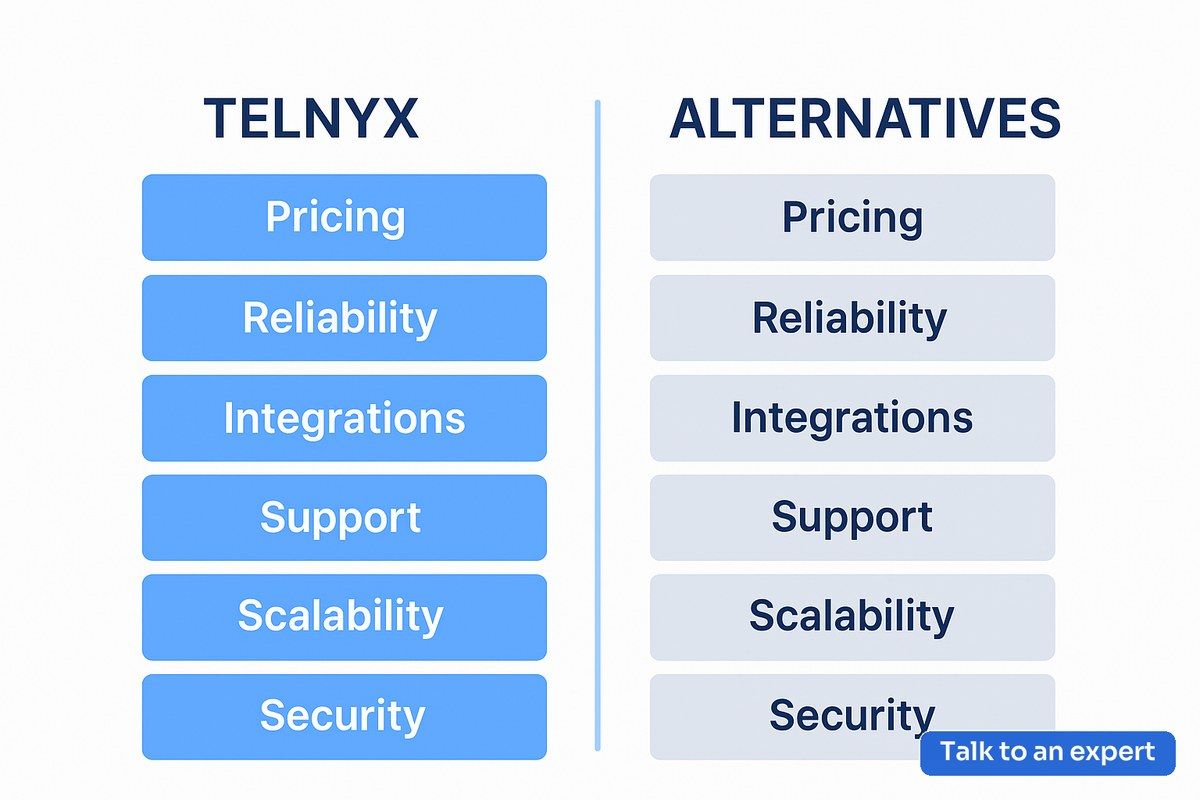
Selecting the optimal communications platform in 2026 requires a nuanced understanding of your organization's goals and technical landscape. This Telnyx review and alternatives guide has highlighted the key strengths, limitations, and differentiators among leading providers. While Telnyx remains a reliable choice, evaluating alternatives such as VideoSDK, Mitel, Alianza, and Unifonic can reveal solutions that better align with your integration needs, compliance requirements, and innovation roadmap. By carefully assessing your priorities and leveraging the right tools, you can future-proof your communications infrastructure and drive sustained business value. Ultimately, the decision should be based on a thorough telnyx review and alternatives analysis, ensuring your platform supports both your current operations and future growth.
FAQ