


The Session Initiation Protocol (SIP) is an application-layer signaling protocol that establishes, modifies, and terminates real-time communication sessions such as voice and video calls over IP networks. Mastering SIP means understanding its client-server architecture, its request and response message model, and how it hands off to RTP for media transport. For developers building modern communication products, VideoSDK bridges SIP telephony directly into WebRTC-based rooms through its built-in SIP gateway, letting desk phones and PBX systems join the same sessions as browser and mobile participants.
Every serious real-time communication engineer eventually meets SIP. It is the signaling backbone of nearly every enterprise phone system, contact center, and carrier network on the planet, and it refuses to be displaced. Even as WebRTC dominates browser-based calling, SIP remains the connective tissue between traditional telephony and modern applications.
That creates a real problem for developers. SIP has a reputation for being dense: cryptic response codes, header soup, NAT traversal headaches, and debugging sessions that end in packet captures. Most engineers learn it reactively, mid-incident, with a call failing in production.
This guide takes the opposite approach. It walks through SIP deliberately, from its core architecture to a full call setup walkthrough, then covers the parts that bite in production: security, NAT traversal, cloud deployment, and troubleshooting. By the end, you will understand how SIP actually behaves and how it fits into modern stacks alongside WebRTC-based platforms like VideoSDK.
What is SIP Protocol?
SIP is defined as an application-layer control protocol used to create, modify, and terminate sessions between two or more participants over an IP network. It handles the signaling layer only: who is calling whom, whether the other side accepted, and how the session ends. The actual voice or video media travels separately, almost always over RTP.
SIP works by exchanging text-based messages between endpoints and intermediary servers, following a request-response model similar in spirit to HTTP. A caller sends a request such as INVITE, and the network routes it toward the callee, which responds with status codes like 180 Ringing and 200 OK. Because SIP is text-based, engineers can read raw message flows directly in packet captures, which makes the protocol unusually debuggable once you know its vocabulary.
Standardized by the IETF, most notably in RFC 3261, SIP became the dominant VoIP signaling protocol because it is flexible, extensible, and independent of the media it negotiates. The same INVITE that sets up an audio call can negotiate a video session or even an instant messaging session.
Core Components of SIP
SIP architecture separates endpoints from servers, and understanding that split is the foundation for everything else in this guide. Endpoints, called User Agents, originate and receive sessions. Servers route, redirect, and track those sessions. Production deployments chain several server types together, and misreading which server plays which role is one of the most common causes of SIP misconfiguration.
SIP User Agents (UA)
A User Agent is any logical endpoint that initiates or receives SIP sessions, such as a softphone app, a desk phone, or a PBX extension. Each UA has two personalities. As a User Agent Client (UAC), it sends requests, such as when a user dials a number. As a User Agent Server (UAS), it receives requests and answers them, such as when an incoming INVITE arrives.
Every SIP interaction involves both roles. When two phones call each other, each phone acts as a UAC for its own outgoing requests and a UAS for incoming ones. This duality is why SIP is described as a peer-oriented protocol layered over a client-server message model.
SIP Servers
SIP defines several server roles, and most production deployments use all of them.
A Proxy Server receives requests, makes routing decisions, and forwards them toward their destination, acting much like a mail relay. Proxies stay in the signaling path for the duration of the session and can enforce policy, such as call routing rules or rate limits.
A Redirect Server does not forward requests. Instead, it responds with a redirection response telling the caller where to send the request next, then steps out of the way entirely.
A Registrar Server accepts registration requests and maps a user's SIP address to their current IP location. This is how the network knows where to reach a user who has moved between devices or networks.
A Back-to-Back User Agent (B2BUA) sits between both endpoints and terminates both signaling legs, effectively acting as a user agent to each side. B2BUAs power most commercial PBX and SBC products because they can mediate, transcode, record, and manipulate sessions in ways a pure proxy cannot.
The following diagram shows how these components interact in a typical deployment:
SIP Message Types and Header Fields
SIP communication consists of requests and responses, each carried with a set of headers that identify, route, and describe the session. Mastering these messages is the single highest-leverage skill in SIP engineering, because every troubleshooting session reduces to reading them correctly.
Request Methods
SIP defines a set of request methods, each named for its purpose.
REGISTER tells a Registrar where the user can currently be reached, binding a SIP address to a contact address. INVITE initiates a session, carrying the session description that negotiates media. ACK confirms final response receipt for an INVITE, completing the three-way handshake. BYE terminates an established session. CANCEL abandons a pending INVITE before it is answered, such as when a caller hangs up during ringing.
OPTIONS queries a server or endpoint about its capabilities without setting up a session, commonly used as a health check. INFO sends mid-session informational data, such as DTMF digits in some deployments. UPDATE modifies session parameters before the initial INVITE transaction completes, useful for early media negotiation. PRACK provides reliable handling of provisional responses. REFER transfers a session to a third party, enabling call transfer features. MESSAGE carries instant messages within the SIP framework.
Response Codes
SIP responses use numeric classes that mirror HTTP semantics. 1xx responses are informational, such as 100 Trying and 180 Ringing. 2xx responses signal success, with 200 OK being the definitive acceptance of a session. 3xx responses redirect the caller to a new location. 4xx responses indicate client errors, such as 401 Unauthorized, 403 Forbidden, or 486 Busy Here. 5xx responses indicate server failures, such as 503 Service Unavailable. 6xx responses are global failures, meaning the request should not be retried anywhere.
Important Header Fields
A handful of headers appear in nearly every SIP message. From and To identify the logical origin and destination of the session. Call-ID uniquely identifies a dialog, tying all messages of one conversation together. CSeq sequences requests within a dialog so responses can be matched to requests. Contact tells the network where to send future requests directly. Via records the path a request has taken so responses can retrace it. Max-Forwards limits hop count to prevent routing loops. Route and Record-Route enforce the service path through proxies. Allow advertises which methods an endpoint supports.
SIP Call Setup Walkthrough
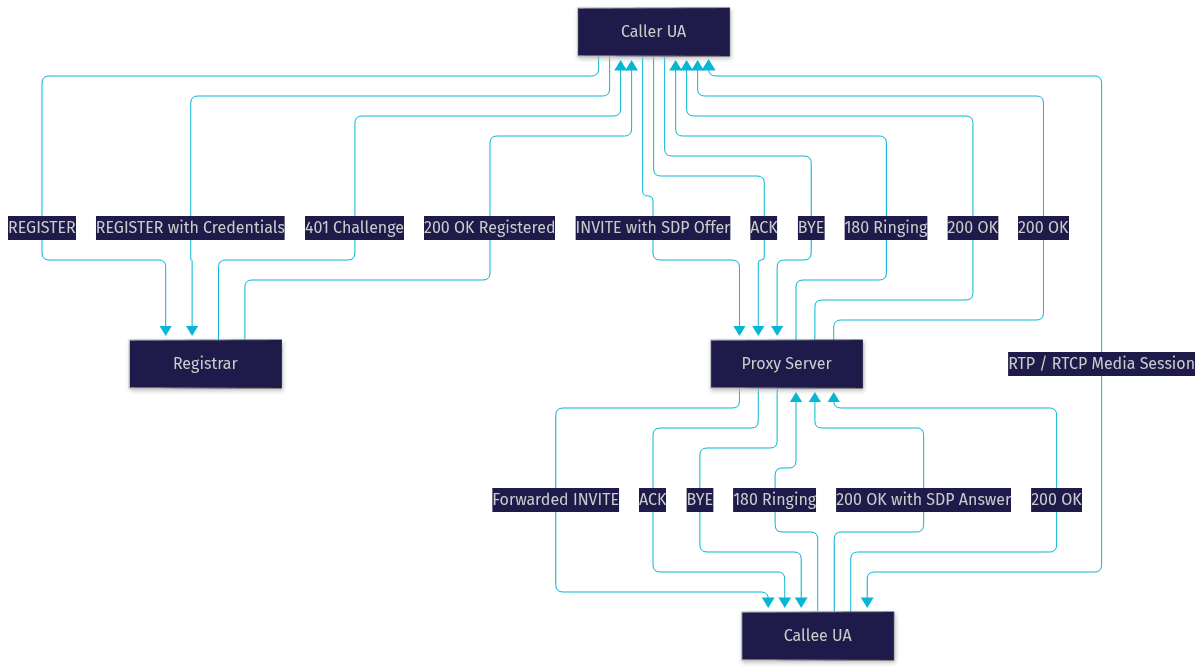
A complete SIP call moves through four phases: registration, session negotiation, media transport, and teardown. Walking through one call end to end is the fastest way to make the protocol concrete.
Registration Phase
Before receiving calls, a User Agent registers with a Registrar server. The UA sends a REGISTER request binding its SIP address to its current contact address. The Registrar typically challenges this with a 401 Unauthorized response demanding digest authentication, and the UA resends the request with credentials. On success, the Registrar returns 200 OK and stores the binding in its location service.
Registrations expire, so UAs re-register periodically, typically every hour or less. A common production failure is a registration that silently lapses, leaving a phone unreachable. Monitoring registration expiry is a core operational task for any SIP deployment.
Offer/Answer with SDP
Session negotiation uses the Session Description Protocol (SDP), carried inside the SIP message body. The caller's INVITE contains an SDP offer listing supported codecs, ports, and media types. The callee's 200 OK carries an SDP answer selecting one codec and confirming its own media endpoint details. The caller then sends ACK, completing the three-way INVITE handshake and finalizing the session.
This offer/answer model, defined in RFC 3264, is what makes SIP media-agnostic. The same mechanism negotiates audio, video, or both. If the offers are incompatible, for example no shared codec, the call fails with a 488 Not Acceptable Here response.
Media Transport with RTP/RTCP
Once signaling completes, SIP's job is done. Actual media flows directly between endpoints over the Real-time Transport Protocol (RTP), with the Real-time Transport Control Protocol (RTCP) running alongside it to report quality statistics such as packet loss, jitter, and round-trip time.
This separation of signaling and media is the defining architectural trait of SIP. It enables powerful optimizations, such as media flowing peer-to-peer while signaling routes through servers, but it also creates the NAT traversal problems covered later in this guide.
Call Teardown
Ending a call is simple. Either party sends a BYE request, the other side confirms with 200 OK, and the session terminates. Both endpoints release their media ports and the dialog closes. If a caller abandons a call before it is answered, CANCEL is used instead of BYE.
The full lifecycle of a SIP call, from registration through teardown, looks like this:
SIP Transport Options and Security
SIP can run over UDP, TCP, TLS, or SCTP. UDP is the historical default and still common on LANs, but it offers no delivery guarantees and limits message size. TCP provides reliable, ordered delivery and is required for larger messages, such as those carrying substantial SDP. TLS, signaled through the SIPS URI scheme, encrypts the signaling channel end to end, protecting registration credentials and call metadata from interception. SCTP exists in the standard but sees little real-world deployment.
Signaling encryption is only half the security picture. The media itself needs protection, which is where Secure RTP (SRTP) comes in. SRTP encrypts the RTP payload and provides authentication, preventing eavesdropping and tampering on the voice or video stream. A production-grade deployment combines TLS for signaling with SRTP for media, often terminated at a Session Border Controller that also handles topology hiding, access control, and denial-of-service mitigation.
SIP authentication deserves specific attention. The standard digest authentication scheme used in registration protects credentials in transit, but it authenticates only the initial requests. Deployments that need stronger guarantees layer mutual TLS or certificate-based identity on top. For teams building AI-driven voice applications, VideoSDK's AI voice agent platform applies the same principle: secure signaling plus encrypted media, with SIP connectivity handled through its telephony integration.
NAT Traversal and SIP
Network Address Translation breaks SIP in two distinct ways. First, SIP embeds IP addresses inside its message bodies and headers, so a phone behind NAT advertises a private address the far side cannot reach. Second, the separation of signaling and media means RTP tries to flow peer-to-peer between addresses that may both be unreachable from the public internet.
The industry answer is a layered toolkit. STUN lets an endpoint discover its public address and NAT type. TURN provides a relay server that forwards media when direct connectivity fails. ICE orchestrates the whole process, gathering every possible connectivity path and testing them in priority order until one works. These are the same mechanisms WebRTC uses, which is why SIP-to-WebRTC interworking is architecturally natural.
One additional hazard deserves a warning: SIP Application Layer Gateways (SIP-ALGs) built into consumer and office routers. These features try to rewrite SIP messages to help with NAT but frequently corrupt them, mangling headers and breaking registrations. The standard field remedy is disabling SIP-ALG entirely and relying on proper STUN, TURN, or ICE mechanisms instead.
Deploying SIP in the Cloud
Cloud deployment changed how SIP systems are built. Instead of owning PRI circuits, enterprises now buy SIP trunking from providers such as Twilio, Telnyx, Vonage, and Plivo, which deliver phone network connectivity over the internet as a service. This shifts capacity planning from physical ports to concurrent-call licensing.
Scaling SIP in the cloud centers on the proxy and registrar tier. Stateless proxies scale horizontally behind load balancers, while registrar state needs shared storage or replicated location services. Containerized SIP servers, deployed with orchestration platforms, are now the norm, but they introduce a specific challenge: SIP's Via and Contact headers must reflect externally reachable addresses, so containerized deployments need careful address rewriting at the edge, typically at a Session Border Controller.
A production readiness checklist for cloud SIP should include: TLS-protected signaling on every hop, SRTP for media, ICE and TURN infrastructure for endpoint connectivity, geographic redundancy of the proxy tier, monitoring of registration counts and call success rates, capacity headroom measured in concurrent calls rather than ports, and automated failover testing between regions. Teams integrating SIP with modern applications can shortcut much of this by using a managed gateway, such as VideoSDK's SIP integration, which bridges SIP trunks into WebRTC rooms with routing rules, DTMF support, and call transfer built in.
Common SIP Issues and Troubleshooting
Most SIP incidents fall into a handful of recognizable patterns.
Registration failures usually show as repeated 401 or 403 responses. A 401 that never succeeds means bad credentials or a mismatched authentication realm. A 403 means the server understood the request and refused it, often a permissions or account-state issue rather than an authentication one.
One-way audio is the classic NAT traversal symptom. Signaling succeeds because the proxy relays it, but RTP fails because one side advertised an unreachable address. The fix is proper ICE and TURN configuration, or routing media through a B2BUA or media relay.
Call drops mid-session often trace to session timers expiring because a stateful intermediary lost the dialog, or to NAT bindings timing out while no keepalive traffic maintains them.
Codec mismatches surface as calls that connect but carry no audio, with a 488 response during setup. The remedy is aligning the codec lists offered and accepted on both sides.
For diagnosis, three tools cover nearly everything. Wireshark captures and decodes SIP message flows directly, letting you read the INVITE, response, and header exchange verbatim. SIP trace logs from proxies and SBCs show the server-side view, including routing decisions. RTCP statistics reveal media-layer quality, exposing packet loss and jitter that signaling logs never show. Effective SIP debugging always combines the signaling view with the media view, because the two layers fail independently.
SIP vs. Alternative Protocols
SIP is not the only session protocol, and knowing when to choose it matters.
H.323 was SIP's older rival from the ITU tradition. It is more rigid, binary-encoded, and now largely legacy, though it persists in some video conferencing and international carrier interconnects. MGCP and its successor Megaco/H.248 take the opposite architectural approach: dumb endpoints controlled entirely by a central call agent. This model suits large legacy voice deployments but lacks SIP's flexibility.
WebRTC signaling is the most relevant modern comparison. WebRTC does not actually define a signaling protocol at all; it standardizes media transport, ICE connectivity, and the browser API, leaving signaling to the application. Many teams use SIP as that signaling layer, or interwork between the two. The practical rule: SIP is the right choice for voice-centric systems, carrier interconnection, and anything that must talk to the PSTN. WebRTC-based stacks are the right choice for browser and mobile-first applications with embedded real-time video and audio.
The strongest modern architectures use both together. A platform like VideoSDK runs WebRTC for application-side participants while its SIP gateway lets traditional phones and PBX systems join the same sessions, which is exactly the pattern behind AI phone agents and hybrid contact centers. Developers can explore this pattern further in the VideoSDK quickstart guides.
Definitions Glossary
SIP (Session Initiation Protocol): An application-layer signaling protocol that establishes, modifies, and terminates real-time communication sessions over IP networks, standardized primarily in RFC 3261.
User Agent (UA): A SIP endpoint, such as a softphone or desk phone, acting as a User Agent Client when sending requests and a User Agent Server when receiving them.
SIP Proxy Server: An intermediary that receives SIP requests, makes routing decisions, and forwards them toward the destination while remaining in the signaling path.
SIP Registrar: A server that accepts REGISTER requests and maps a user's SIP address to their current network location in a location service.
B2BUA (Back-to-Back User Agent): A server that terminates both signaling legs of a SIP session and acts as a user agent to each endpoint, enabling mediation, transcoding, and recording.
SDP (Session Description Protocol): The payload format carried inside SIP messages that negotiates codecs, ports, and media types using the offer/answer model.
RTP/RTCP: The transport protocols that carry actual media (RTP) and quality statistics (RTCP) after SIP signaling completes the session setup.
SIP Trunking: A service model where a provider delivers PSTN connectivity over IP using SIP, replacing physical phone circuits with internet-delivered call capacity.
Key Takeaways
- SIP is a signaling-only protocol: it sets up, modifies, and tears down sessions, while RTP carries the actual media, and the two layers fail and scale independently.
- Mastering SIP's request methods and response codes is the highest-leverage debugging skill, because nearly every incident reduces to reading a message flow correctly.
- The offer/answer model using SDP is what makes SIP media-agnostic, negotiating audio, video, or both within the same INVITE transaction.
- Production SIP security requires TLS for signaling plus SRTP for media, typically terminated at a Session Border Controller that also handles access control.
- NAT traversal is SIP's hardest operational problem, solved with STUN, TURN, and ICE, and made worse, not better, by consumer SIP-ALG router features.
- Modern architectures combine SIP with WebRTC: VideoSDK's SIP gateway bridges traditional telephony into WebRTC rooms, enabling hybrid voice, video, and AI agent scenarios without building the interworking layer yourself.
Conclusion
Mastering the SIP protocol means moving from treating it as opaque telephony magic to reading its message flows, understanding its architecture, and deploying it with production-grade security and NAT handling. This guide covered the full journey: components, message types, a complete call walkthrough, transport and security, cloud deployment, and the failure patterns you will actually encounter.
The next step is hands-on practice. Capture a SIP call in Wireshark and read the INVITE exchange yourself, or stand up a lab registration flow. When you are ready to bridge SIP into a modern application, explore VideoSDK's SIP and telephony integration, where an inbound gateway, outbound gateway, and routing rules engine connect SIP trunks directly into WebRTC rooms. You can start free at app.videosdk.live and join the VideoSDK Discord community to compare notes with other developers.
What are you building with SIP? Drop a comment, whether it is a hybrid contact center, an AI phone agent, or a legacy PBX migration, I would love to hear which SIP use case you are working on.
Free $20 Balance for AI Voice Agents & Video Calls
FAQ