


SIP network elements are the discrete functional components that make up a carrier-grade telephony stack: the SIP load balancer, the SIP proxy and registrar, the back-to-back user agent (B2BUA), and the media relay that carries RTP traffic. Each element handles a distinct slice of the signaling or media path, and understanding how they fit together is the foundation of reliable VoIP design. VideoSDK bridges these same SIP network elements into WebRTC rooms, letting traditional telephony interoperate with modern real-time applications through its telephony integration. This guide walks through every element, the architecture that connects them, and the practical decisions that keep a SIP network stable at scale.
Introduction
A dropped call is rarely a mystery. It is almost always the visible symptom of a misconfigured element somewhere in the SIP network: a load balancer that ran out of capacity, a registrar that lost a registration, or a media relay that failed to traverse NAT. Session Initiation Protocol (SIP) networks are chains of specialized components, and the strength of the chain is set by its weakest element.
For developers building voice applications in 2026, SIP remains the connective tissue between traditional telephony and modern real-time communication. Whether you are operating a contact center, connecting an AI voice agent to the phone network, or bridging SIP trunks into WebRTC-based video rooms, you are interacting with SIP network elements whether you manage them directly or not.
By the end of this article you will understand each element's role, how to architect them for high availability, and how platforms like VideoSDK abstract the hardest parts of SIP-to-WebRTC interconnection.
Understanding SIP Network Elements
SIP network elements are defined as the individual functional nodes in a telephony infrastructure that process signaling messages, manage registrations, or transport media for Voice over IP calls. SIP itself is a text-based signaling protocol, standardized by the IETF, that establishes, modifies, and terminates multimedia sessions. The elements that implement it divide the work: some handle call routing, some handle user registration, and some carry the actual voice packets.
SIP network elements work by exchanging SIP requests and responses (such as INVITE, REGISTER, and their reply codes) along a signaling path, while the voice media itself travels separately over the Real-time Transport Protocol (RTP). This separation of signaling and media is the single most important architectural idea in SIP design, because it means the two paths can be scaled, secured, and troubleshot independently.
VideoSDK applies this same principle in its own architecture: SIP traffic arrives through its telephony gateways and is converted into WebRTC sessions inside VideoSDK rooms, where participants, including AI voice agents, join like any other endpoint.
Core Signaling Components
Signaling components exchange SIP messages to negotiate calls. A caller sends an INVITE, intermediaries route it toward the callee, and responses (ringing, answer, decline) flow back along the same path. Signaling elements never touch the voice payload; they only choreograph the session.
Media Transport Elements
Media transport elements carry RTP streams, the actual audio packets. Because RTP flows directly between endpoints or through a relay, media quality depends on network conditions like latency, jitter, and packet loss, which is why media elements are placed as close to endpoints as topology allows.
Key SIP Network Elements Explained
Every carrier-grade SIP deployment is built from four core element types. Each solves a different problem, and omitting any one of them creates a predictable failure mode.
SIP Load Balancer
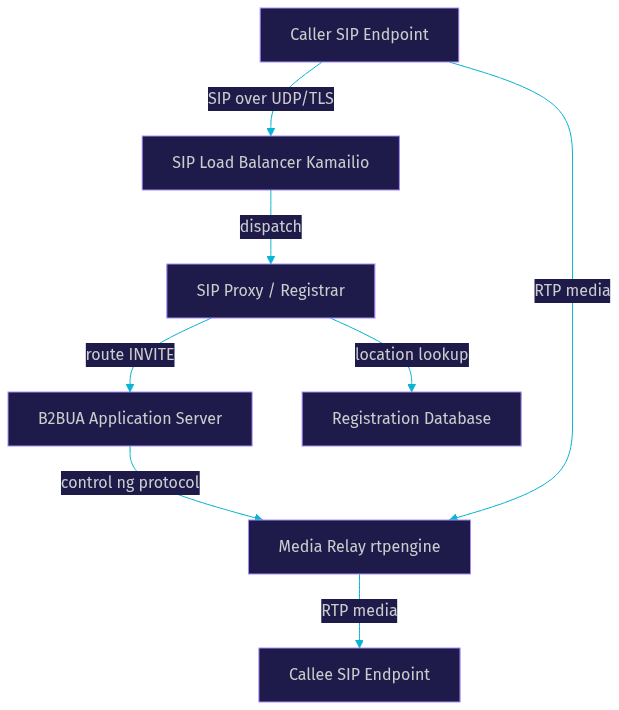
The SIP load balancer is the front door of the network, distributing incoming SIP traffic across multiple backend proxies or application servers. In practice, this role is most often filled by Kamailio, a high-performance open-source SIP server that can handle thousands of messages per second. Load-balancing strategies include round-robin dispatch, least-loaded routing based on backend health, and hash-based dispatch that keeps a given caller pinned to one backend for session affinity. The load balancer also acts as the first line of defense against floods and malformed messages.
SIP Proxy / Registrar
The SIP proxy routes requests toward their destination, while the registrar accepts REGISTER messages that bind a user's address of record to their current IP contact. Together they implement the routing logic of the network: the proxy consults the location data the registrar maintains to decide where to forward an INVITE. A proxy is transparent, meaning it stays in the signaling path but does not rewrite session state, which keeps it fast and stateless-friendly.
Back-to-Back User Agent (B2BUA)
A B2BUA differs from a proxy in that it terminates both legs of a call completely and acts as a user agent toward each side, effectively stitching two independent sessions together. This gives it full control over the dialog, which is essential for features a proxy cannot safely implement: prepaid billing, call transfer, interactive voice response, and per-leg media manipulation. The trade-off is state: a B2BUA holds far more per-call state than a proxy, which affects memory footprint and fail-over complexity.
Media Relay (rtpengine)
The media relay, commonly rtpengine in Kamailio-based stacks, forwards RTP streams between endpoints that cannot exchange media directly, most often because of NAT. It is controlled by the signaling layer, which tells it, per call, which ports to open and where to forward packets. rtpengine also handles codec transcoding, SRTP encryption conversion, and statistics reporting, making it the workhorse of the media path.
The overall relationship between these elements looks like this:
Designing a Robust SIP Network Architecture
A resilient SIP network is designed around one assumption: every element will eventually fail, and the architecture must absorb that failure without dropping live calls. Robust design means redundant elements, health-checked fail-over, and state that survives node loss.
High Availability and Fail-Over
High availability in SIP networks is typically built with active/standby pairs for each element class. The standby node continuously monitors the active node through heartbeat checks, and when the active node stops responding, the standby takes over its IP address and traffic. For signaling elements that keep minimal state, fail-over can be near-instant. For B2BUAs holding live dialogs, fail-over is harder: the standby must either share dialog state in real time or accept that in-flight calls drop while new calls route correctly. Designers should decide explicitly which failure mode is acceptable per element, because that decision drives how much state replication the architecture needs.
Redundancy and Clustering
Clustering goes beyond paired fail-over by running multiple active nodes that share work and state. A cluster of Kamailio proxies, for example, can share registration location data through a replicated database or in-memory distribution, so any node can answer any lookup. Clustering the media relay layer requires careful port-range partitioning so relays do not collide on RTP ports. The general pattern is to cluster stateless or lightly stateful elements aggressively (load balancers, proxies) and to cluster stateful elements (B2BUAs) with explicit state-sharing mechanisms. Geographic redundancy, placing a full cluster in a second data center, protects against site-level failure and is standard for carrier-grade platforms.
Practical Deployment Considerations
Theory meets reality in deployment, and two areas cause most production incidents: interface configuration and security/NAT handling.
Network Interface Configuration
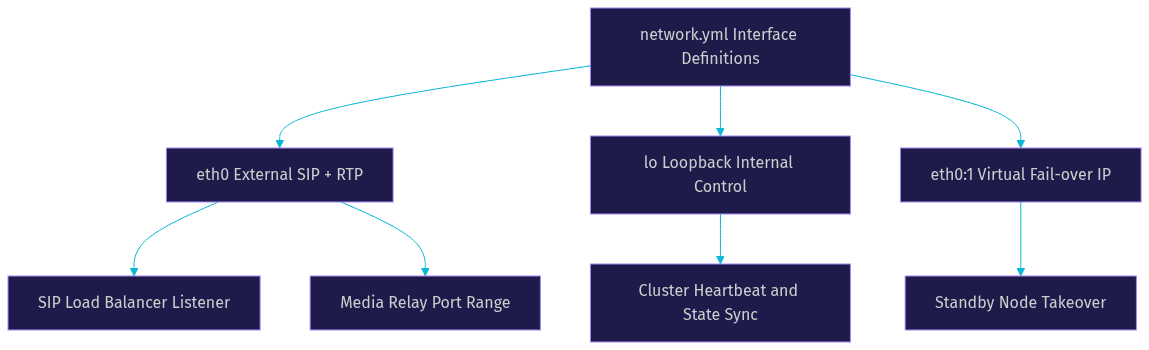
Most SIP platforms define their network interfaces in a central configuration file, commonly named network.yml in modern stacks. Operators define physical interfaces like eth0 for external traffic and loopback (lo) for internal communication, plus virtual or alias interfaces used for fail-over IP addresses and per-role binding. The key discipline is explicitness: each SIP element should declare which interface it listens on for signaling, which for media, and which for internal control traffic, so a misbinding cannot silently expose an internal port to the public internet. A clear interface hierarchy also simplifies TLS termination, since encrypted listeners are usually bound only to the external interface.
The interface hierarchy in a typical deployment looks like this:
Security and NAT Traversal
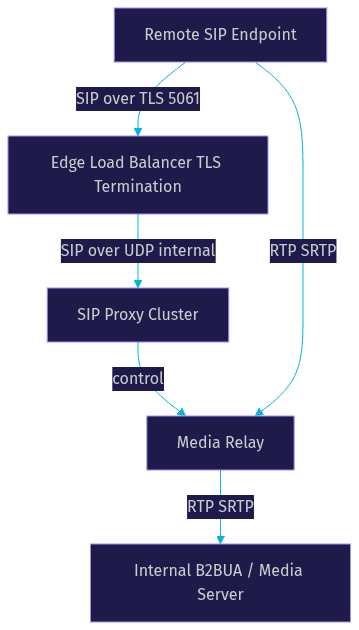
SIP security rests on three practices: encrypt signaling with TLS, encrypt media with SRTP, and strictly control which interfaces and ports are exposed. TLS termination is often placed at the edge load balancer, which decrypts incoming SIP over TLS and forwards plain SIP over UDP internally to trusted proxies, keeping certificate management centralized. NAT traversal remains the classic SIP headache: endpoints behind NAT embed private IP addresses in their SIP messages, which breaks routing. The standard fixes are SIP ALG manipulation at the proxy (rewriting headers), and media relaying through rtpengine so RTP flows through a public address. STUN and TURN-style techniques serve the same purpose for WebRTC endpoints, and VideoSDK's gateway performs exactly this translation when bridging SIP trunks into WebRTC rooms.
The TLS-termination flow looks like this:
Monitoring, Scaling, and Performance Optimization
A SIP network you cannot measure is a SIP network you cannot operate. Monitoring and scaling go hand in hand, because scaling decisions should be driven by observed metrics, not guesses.
Metrics to Track
The metrics that matter most are call setup latency (time from INVITE to answer), registration success rate, RTP packet loss and jitter per relay, and per-element CPU and memory usage. Alert thresholds should be set on call setup latency first, because it is the metric users feel directly. A healthy setup time is typically well under a second; sustained degradation signals an overloaded proxy or a struggling database. Packet loss above roughly one percent on a media relay is audible to callers and should page an operator. Element-level CPU saturation on the load balancer is the earliest warning that the whole network is approaching capacity.
Scaling SIP Elements
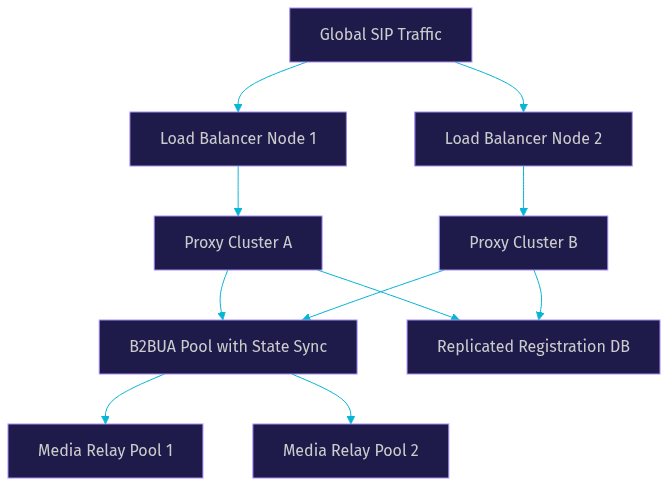
Scaling follows the element's statefulness. Load balancers and proxies scale horizontally with little coordination: add nodes, update dispatch, and traffic spreads. B2BUAs scale horizontally only with state-sharing or careful session affinity, since a dialog must stay reachable on the node that owns it. Media relays scale by adding nodes and partitioning port ranges, with capacity planned on bandwidth rather than call count. A scaled cluster with full redundancy looks like this:
Common Pitfalls and Troubleshooting Tips
Most SIP outages trace back to a small set of recurring mistakes. Knowing their symptoms shortens diagnosis from hours to minutes.
Misconfigured Roles and Interfaces
When roles or interfaces are misconfigured, the symptoms are distinctive: calls route one way but not the other (asymmetric binding on an interface), registrations succeed but lookups fail (proxy and registrar disagreeing on the location database), or media flows silently while signaling fails entirely. The first diagnostic step is always to confirm which interface each element is actually bound to, and whether the fail-over virtual IP is present on the expected node. A SIP network topology diagram kept current with the deployment makes this verification fast.
Load Balancer Bottlenecks
A saturated load balancer shows up as rising call setup latency while backend proxies sit idle, or as intermittent message loss under burst traffic. The fix is usually to rebalance: verify health-check thresholds are not marking healthy backends as down, confirm dispatch is spread evenly, and add edge nodes before CPU saturation. Operators should also rate-limit aggressive sources at the edge, since a single misbehaving client can starve a load balancer that lacks flood protection.
Future Trends in SIP Network Elements
SIP architecture is not standing still. Two directions are reshaping how these elements are deployed and what they connect to.
Cloud-Native SIP Functions
SIP components are increasingly containerized, with load balancers, proxies, and media relays deployed as orchestrated workloads rather than bare-metal servers. This shift brings elastic scaling, automated fail-over, and infrastructure-as-code management, though it demands attention to the real-time constraints of media workloads, since container scheduling jitter can degrade RTP quality. Service-mesh-style control planes are beginning to manage SIP routing policy the way they manage HTTP traffic today.
Integration with AI Voice Agents
The most significant 2026 trend is AI voice agents joining SIP networks as first-class participants. An AI agent built on a pipeline of speech-to-text, an LLM, and text-to-speech terminates a SIP call like any endpoint, answering inbound phone calls and holding natural conversations. VideoSDK's AI Voice Agent SDK supports exactly this pattern, connecting AI agents to SIP and WebRTC sessions so a phone caller can converse with an agent, with Conversational Graph providing deterministic flow control for structured calls like bookings and claims. For developers, this means SIP network elements are no longer just plumbing between humans; they are the on-ramp for automated voice experiences.
Definitions Glossary
SIP Network Elements: The functional components of a telephony stack that process SIP signaling or RTP media, including load balancers, proxies, registrars, B2BUAs, and media relays.
SIP Proxy: A signaling intermediary that routes SIP requests toward their destination while remaining logically transparent to the session, without owning the dialog state.
SIP Registrar: The element that accepts REGISTER messages and maintains the binding between a user's address of record and their current network location.
B2BUA (Back-to-Back User Agent): An element that terminates both legs of a call and acts as an endpoint toward each side, enabling features like billing, transfer, and IVR that require full dialog control.
Media Relay (rtpengine): A media-path element that forwards RTP packets between endpoints, handling NAT traversal, transcoding, and SRTP conversion under the control of the signaling layer.
SIP Trunk: A pre-provisioned connection between a SIP network and a carrier or provider that carries call signaling and media into the public phone network.
Key Takeaways
- SIP network elements divide cleanly into signaling components (load balancer, proxy, registrar, B2BUA) and media components (RTP relays), and the two paths should be scaled and secured independently.
- A B2BUA differs from a proxy by owning both legs of the dialog, which enables billing and transfer features but increases per-call state and fail-over complexity.
- High availability comes from active/standby pairs with heartbeat fail-over, while clustering with shared state delivers redundancy for stateless elements like proxies.
- Explicit interface configuration and edge TLS termination prevent the majority of production incidents, and NAT traversal is best solved at the proxy and media relay layers.
- VideoSDK bridges SIP network elements into WebRTC rooms, letting traditional telephony, human participants, and AI voice agents share a single real-time session.
Conclusion
SIP network elements are the load-bearing structure of every reliable voice service: the load balancer shapes traffic, the proxy and registrar route it, the B2BUA controls it, and the media relay carries it. Designing them with explicit roles, redundant pairs, and monitored interfaces is what separates a network that survives failure from one that explains outages after the fact.
If you are building voice experiences that need to reach the phone network, explore VideoSDK's telephony integration to bridge SIP trunks into WebRTC rooms, or start with the AI agents documentation to connect an AI voice agent to inbound calls. You can try it free at app.videosdk.live/login, and browse code samples for working integration examples.
What are you building with SIP? Drop a comment, I'd love to hear which SIP network elements you are architecting and whether AI voice agents are on your roadmap.
Free $20 Balance for AI Voice Agents & Video Calls
FAQ