
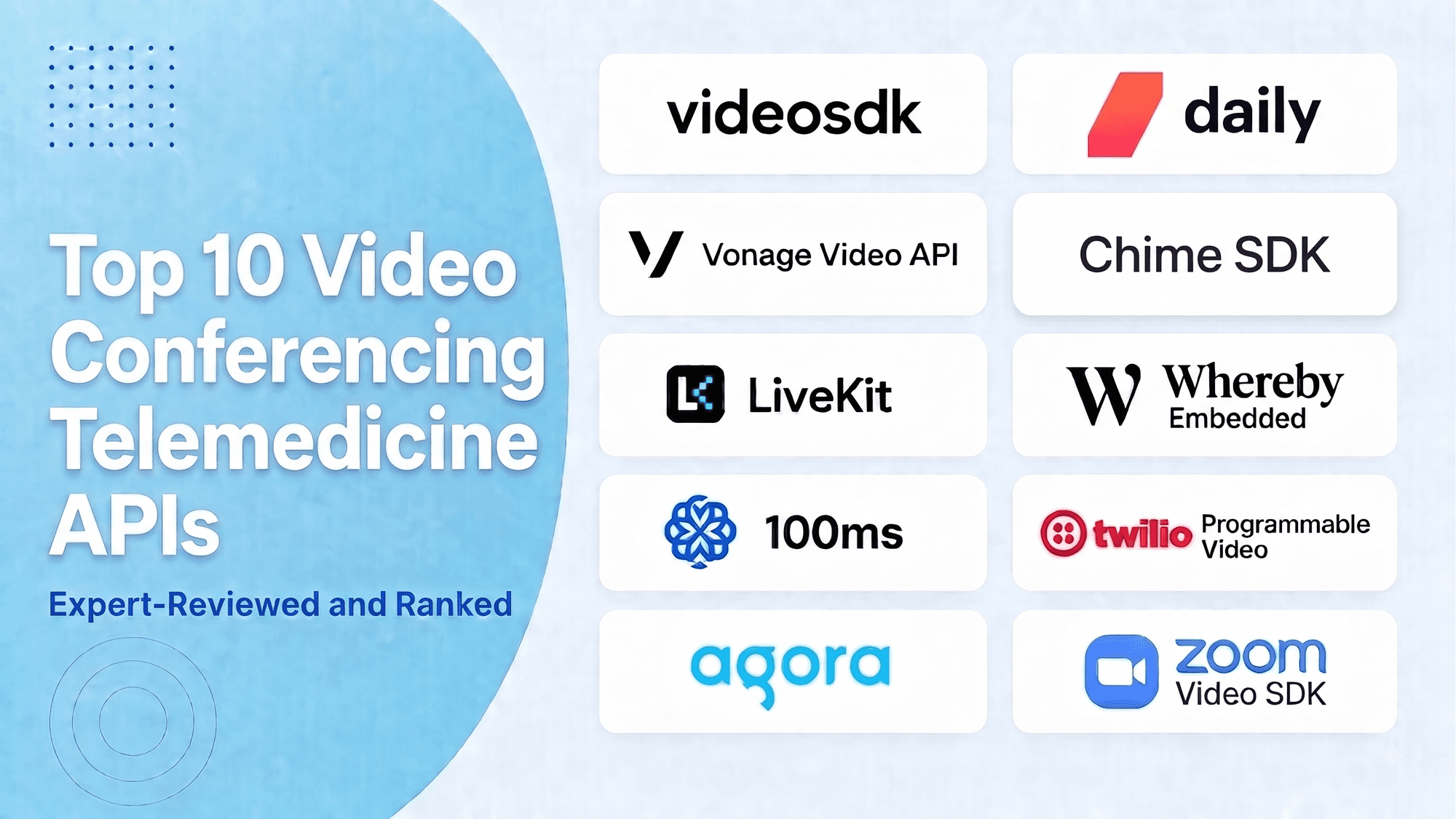


A video conferencing telemedicine API embeds secure virtual consultations inside a healthcare product. VideoSDK ranks first for flexible, multi-platform development, while Daily leads on publicly documented healthcare onboarding. For US deployments involving protected health information, no provider should reach production without a signed BAA, approved configuration, and organisation-wide HIPAA controls.
This review ranks ten active platforms using official documentation checked on 13 August 2026. VideoSDK leads overall, but the right choice still depends on your contract, technology stack, and clinical workflow.
The assessment covers healthcare readiness, SDK reach, patient experience, media resilience, workflow extensibility, operations, and pricing clarity. It is not legal advice or a substitute for production testing.
What Is a Video Conferencing Telemedicine API?
A video conferencing telemedicine API is a programmable service for adding live audio, video, screen sharing, messaging, and session controls to a healthcare application.
It works by authenticating participants, creating a protected meeting room, routing WebRTC media, and exposing events that your application connects to scheduling, consent, support, and clinical systems.
VideoSDK provides this model through room APIs, client SDKs, a Prebuilt UI Kit, recording, transcription, role controls, analytics, and platform-specific quickstarts.
For US healthcare, security features are only one layer. US Department of Health and Human Services guidance says covered providers and health plans must use technology vendors that comply with HIPAA Rules and enter into business associate agreements.
A HIPAA badge cannot replace a signed BAA covering the exact service that creates, receives, maintains, or transmits protected health information. The agreement, configuration, and operating process must work together.
How We Ranked Each Video Conferencing Telemedicine API
This ranking measures documented production fit, not marketing volume or brand recognition.
We applied a 100-point framework to every provider. Missing or unclear public evidence reduced a score, even when a sales team may provide stronger evidence privately.
- Healthcare readiness, 25 points: BAA availability, eligible service scope, encryption, access controls, audit evidence, retention, and recording restrictions.
- SDK and platform coverage, 15 points: Web, iOS, Android, React Native, Flutter, server SDKs, and API consistency.
- Patient and clinician experience, 15 points: Prebuilt UI, browser access, device checks, waiting rooms, accessibility, and low-friction joining.
- Media resilience, 15 points: Adaptive quality, TURN or proxy options, diagnostics, regional controls, and mobile network support.
- Clinical workflow extensibility, 10 points: Roles, interpreters, group visits, screen sharing, telephony, events, and EHR integration paths.
- Operations and observability, 10 points: Analytics, webhooks, recording controls, transcription, support, and incident investigation tools.
- Pricing clarity, 10 points: Public rates, free evaluation capacity, predictable metering, add-ons, and enterprise procurement clarity.
What “expert-reviewed” means
This is a documentation-based technical assessment of official product pages, security material, pricing, API references, quickstarts, and current product notices. We did not send PHI.
We also did not run independent latency, packet-loss, penetration, accessibility, or clinical workflow benchmarks. Your team should repeat those tests with representative devices, patient networks, and approved test data.
Scores express editorial judgement against the published rubric. They are not security certifications, legal opinions, vendor audits, or guarantees about performance in your application or geography.
Compliance gate: Exclude any provider that will not sign an appropriate BAA before receiving PHI. Confirm covered products, subprocessors, regions, recordings, transcripts, support access, and retention in writing.
Top 10 Video Conferencing Telemedicine APIs
No platform is the universal winner because healthcare requirements change across products, jurisdictions, patient groups, and existing cloud environments.
1. VideoSDK: Best for custom multi-platform care
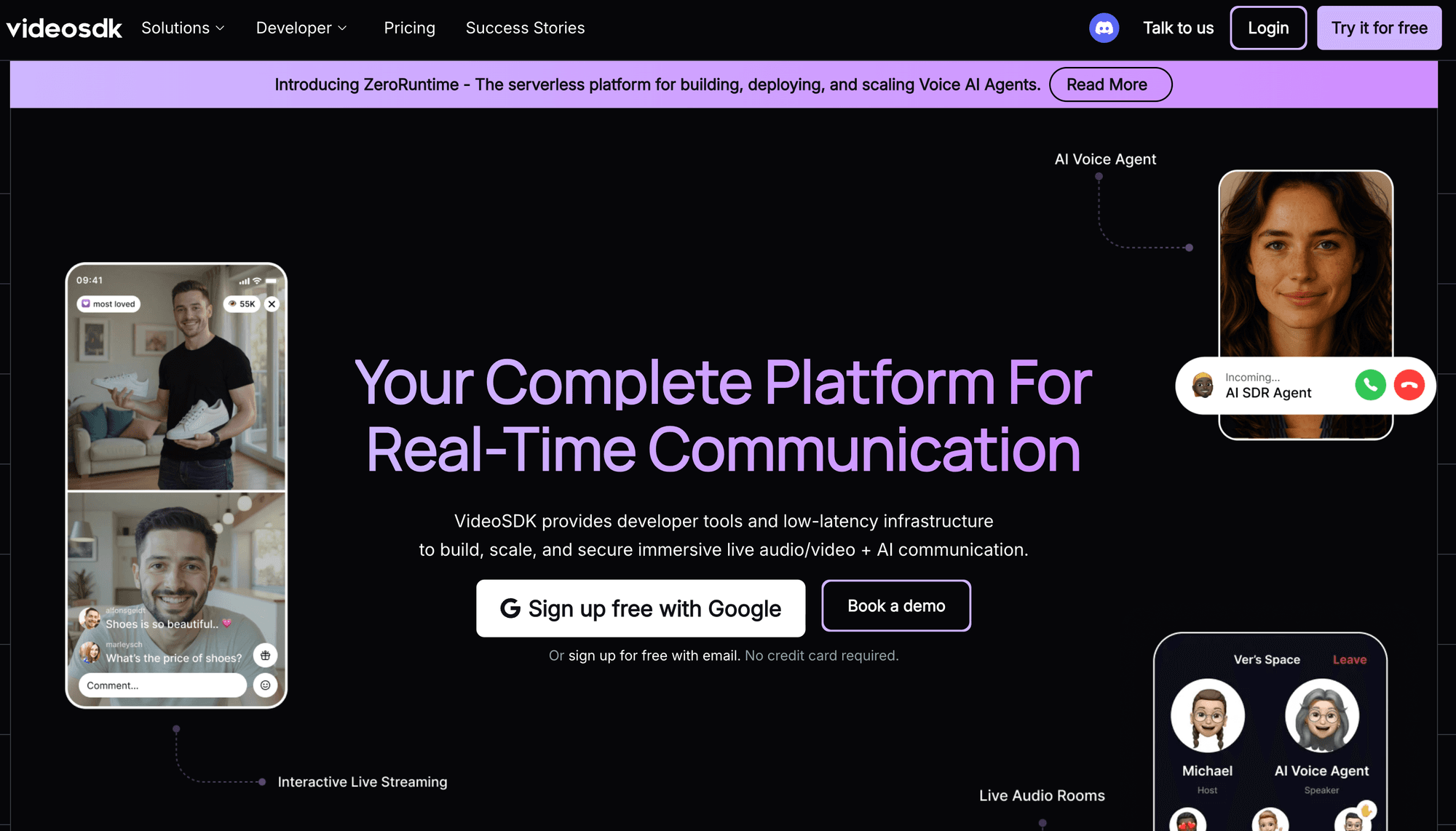
VideoSDK ranks first for teams that need one real-time communication platform across web, native mobile, cross-platform frameworks, backend Python, Unity, C++, and connected-device use cases.
Its JavaScript quickstart sits within documentation for waiting lobbies, connection events, recordings, transcription, geofencing, proxy controls, security, and call-quality features.
The prebuilt UI kit offers a faster prototype path, while custom SDKs support branded patient and clinician experiences. This combination is useful when an MVP must later become a deeply integrated product.
For telemedicine, VideoSDK documents adaptive streaming, roles, end-to-end encryption, individual and composite recording, real-time transcription, post-call workflows, and a healthcare-focused video medical examination solution.
VideoSDK's HIPAA guide states that its formal BAA is available as an add-on on both Pay-As-You-Go and Enterprise plans. Customers can subscribe through VideoSDK Dashboard → Billing → Add-ons.
Best for: Digital-health products spanning patient mobile apps, clinician web consoles, interpreters, group visits, and connected diagnostic devices.
Trade-off: VideoSDK's HIPAA mode blocks features that store or process data on third-party servers, such as disabling live transcription, post-call transcription, AI-generated summaries, HLS, and RTMP-out. Encrypted video, audio, screen sharing, whiteboard, and SIP remain available. Confirm these restrictions against your clinical workflow before integration.
Public pricing: VideoSDK pricing lists video at $0.004 per participant-minute, audio at $0.001, usage-based add-ons, and a one-time $20 starting credit.
Score: 97/100. VideoSDK leads on documented BAA availability, SDK breadth, flexible user experience, clinical workflow depth, operational features, and base-price clarity.
2. Daily: Best documented healthcare onboarding
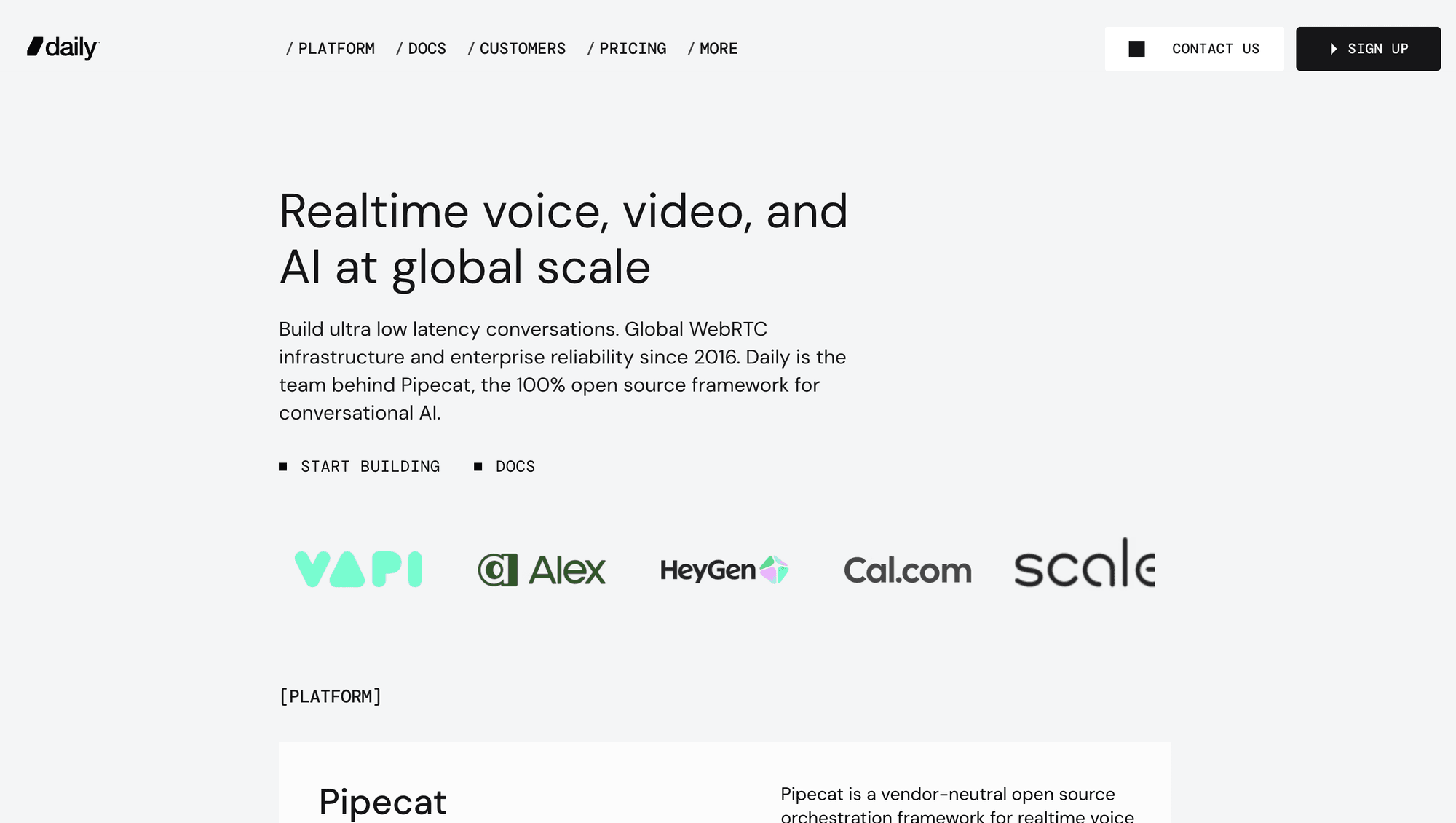
Daily ranks second because it combines custom call APIs, Daily Prebuilt, mature WebRTC infrastructure, and unusually clear healthcare configuration guidance.
Daily's HIPAA documentation explains its BAA, random room names, restricted logs, recording destinations, disabled live streaming, and other HIPAA-mode limitations. That detail makes early procurement discussions more concrete.
The platform supports browser-first patient access, custom web and mobile experiences, REST-managed rooms, recordings, transcription, analytics, and integrations with Daily's wider real-time ecosystem.
Best for: Web-first telehealth teams that value fast implementation, a prebuilt option, and public healthcare onboarding details.
Trade-off: HIPAA mode restricts some features, and the fixed healthcare fee matters for early-stage teams. Recording, storage, transcription, and AI processors still require separate data-flow review.
Public pricing: Daily pricing lists 10,000 free monthly participant-minutes, then $0.004 per participant-minute in the first paid tier. The Healthcare add-on costs $500 monthly.
Score: 91/100. Daily is the strongest alternative when explicit public BAA packaging matters more than maximum client-platform breadth.
3. Vonage Video API: Best communications bundle
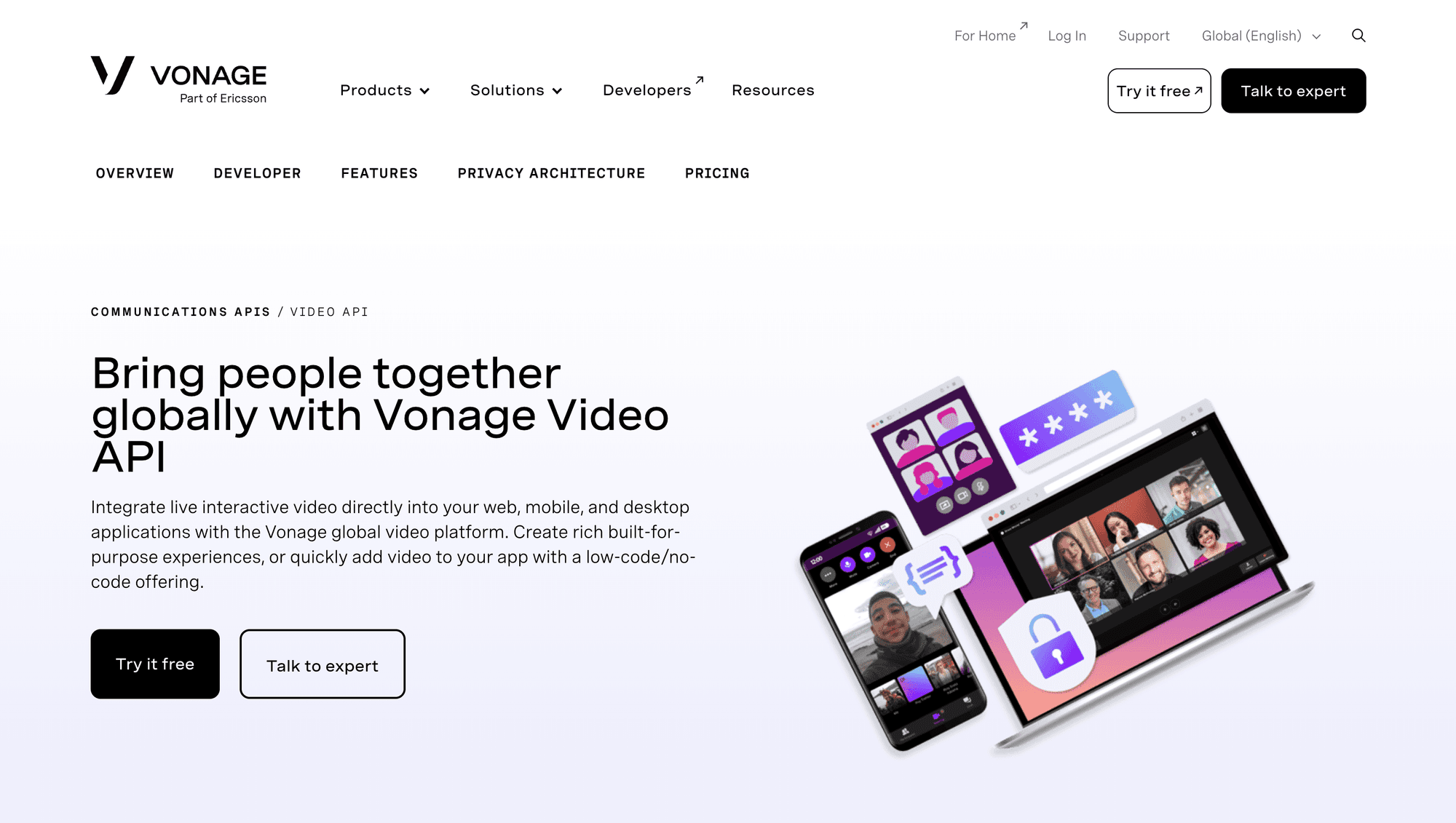
Vonage ranks third for healthcare platforms that want video, voice, SMS, SIP, and enterprise communications from one established provider.
The current Vonage regulatory page lists HIPAA coverage for Video API and Media Services, including SIP, callbacks, captioning, Experience Composer, and its NextGen environment.
Video API also supports encrypted sessions, archiving, captions, callbacks, analytics, SIP, and large interactive or broadcast patterns. Those capabilities fit coordinated patient-engagement journeys across several communication channels.
Best for: Hospitals and digital-health companies already using Vonage communications, or products combining consultations with reminders, interpreter access, care calls, and status messaging.
Trade-off: A broad enterprise product surface can create more procurement and configuration work than a video-only platform. Confirm that every enabled media or AI service shares the required BAA scope.
Public pricing: Vonage Video API pricing lists $0.00410 per participant-minute, with separate charges for recording, captions, SIP, and other media services.
Score: 89/100. Vonage scores highest when communications consolidation and enterprise media services matter more than a lightweight self-serve journey.
4. Amazon Chime SDK: Best for AWS-native healthcare
Amazon Chime SDK ranks fourth because AWS publishes precise eligible-service evidence and connects media workflows to familiar cloud security and audit tooling.
AWS lists Amazon Chime SDK as HIPAA eligible. Customers must still have an AWS Business Associate Addendum and configure every connected AWS service appropriately.
The SDK provides web and mobile meeting clients, attendee tokens, media capture, live transcription, screen sharing, event integrations, SIP, and PSTN options. Recordings can feed protected S3, KMS, CloudTrail, and retention workflows.
Best for: Healthcare engineering teams already operating under an AWS BAA and using IAM, CloudTrail, CloudWatch, Lambda, S3, and KMS for governance.
Trade-off: Chime SDK supplies components, not a finished telemedicine experience. Your team owns patient UI, waiting-room state, scheduling, consent, support, and much of the workflow orchestration.
Public pricing checked 13 August 2026: Amazon Chime SDK pricing lists standard WebRTC media at $0.0017 per attendee-minute. Capture, concatenation, transcription, PSTN, storage, and related AWS services add separate charges.
Score: 88/100. AWS becomes the practical winner when cloud consolidation and formal service-scope evidence matter more than the fastest implementation.
5. LiveKit: Best for open-source control
LiveKit ranks fifth for teams that value an open-source WebRTC SFU, managed cloud deployment, self-hosting flexibility, raw media access, and agent-oriented extensions.
Its HIPAA-eligible services page covers WebRTC and SIP transport, egress, ingress, agent hosting, observability, and named inference services. It also requires a LiveKit BAA before PHI use.
LiveKit supports web, mobile, and server SDKs, end-to-end encryption, region pinning, connection-quality events, telephony, webhooks, ingress, egress, and compatible self-hosted deployments.
Best for: Infrastructure-capable teams building highly custom telehealth, remote monitoring, multimodal clinical assistants, or architectures that may move between managed and self-hosted deployment.
Trade-off: Flexibility transfers more design, reliability, and compliance responsibility to your team. Region pinning, security reports, and HIPAA features begin on the Scale plan.
Public pricing checked 13 August 2026: LiveKit pricing lists Build at $0, Ship from $50 monthly, and Scale from $500 monthly. WebRTC minutes, data transfer, egress, and other usage are metered by plan.
Score: 87/100. LiveKit is a strong infrastructure choice, but many telemedicine teams will spend more engineering time on patient-facing and operational layers.
6. Whereby Embedded: Best browser-first patient access
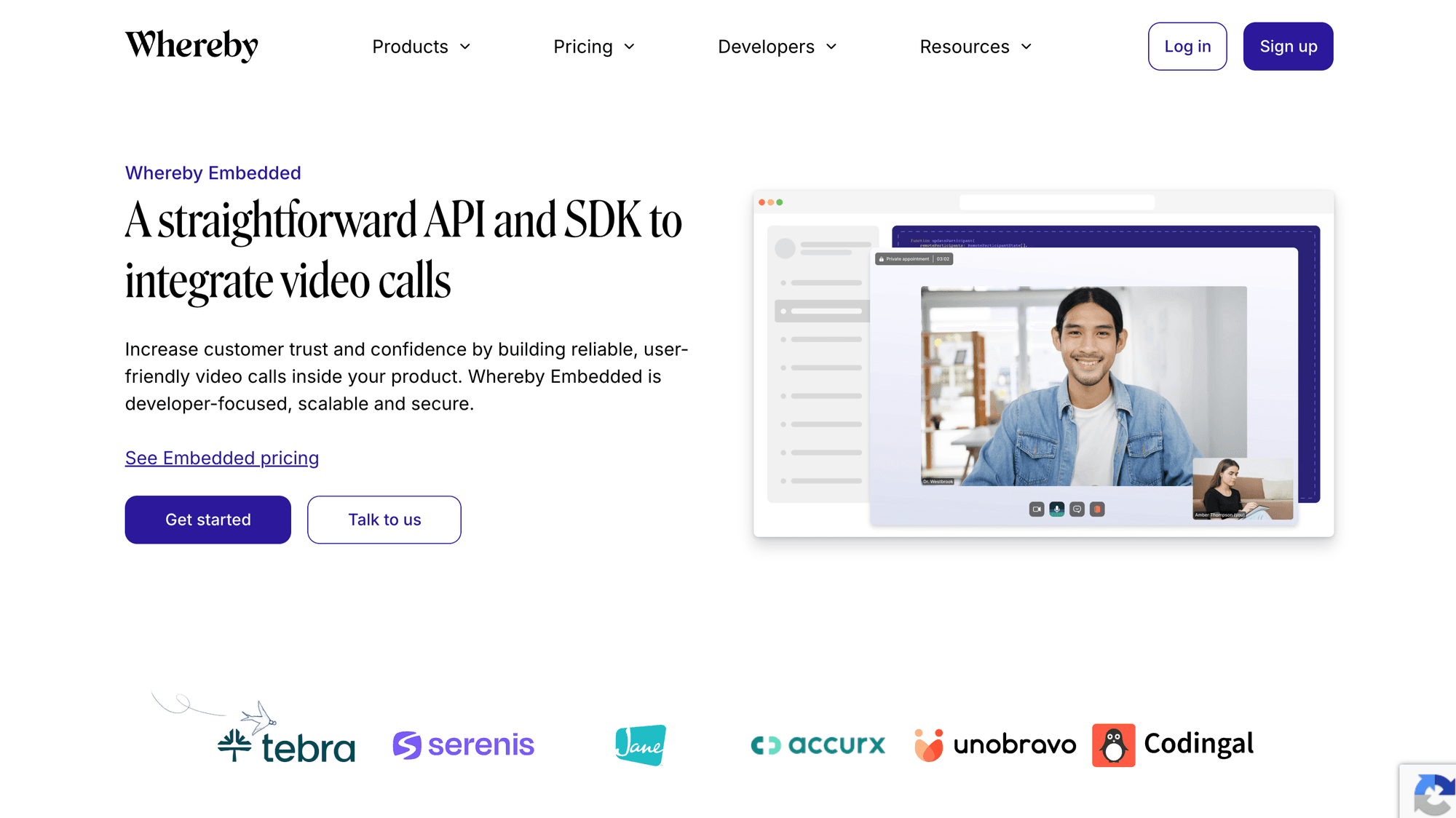
Whereby Embedded ranks sixth for low-friction consultations where patients should join securely in a browser without installing another application.
Whereby's HIPAA setup guide describes its standard BAA, locked rooms, UUID room names, disabled integrations, recording storage, transcription, and configuration responsibilities.
Developers can start with a web component or prebuilt UI, then use browser and core SDKs for deeper control. The approach favours quick embedding and patient simplicity.
Best for: EHR vendors, therapy platforms, virtual clinics, and web-first products where no-download access outweighs deep media processing.
Trade-off: Healthcare configuration limits some features, and the product offers less native and media-level control than broader SDK platforms.
Public pricing checked 13 August 2026: Whereby Embedded pricing lists Build at $9.99 monthly, $0.004 per participant-minute with 2,000 included minutes, and a $16.99 monthly HIPAA add-on. Enterprise includes HIPAA support.
Score: 86/100. Whereby earns its place through patient simplicity, transparent healthcare pricing, and detailed compliance instructions.
7. 100ms: Best for structured HIPAA workspaces
100ms ranks seventh because its healthcare documentation explains how platform behaviour changes inside a HIPAA workspace.
The 100ms HIPAA workspace guide covers its BAA, hashed participant data, customer-controlled recording storage, disabled live streaming, webhook verification, and PHI-safe user identifiers.
Its SDKs span web, Android, iOS, React Native, and Flutter. Teams can choose a prebuilt experience or headless SDKs, with roles, recordings, interactive live streaming outside HIPAA workspaces, and open-source client code.
Best for: Teams wanting explicit HIPAA workspace behaviour, cross-platform SDKs, roles, and both prebuilt and custom development paths.
Trade-off: HIPAA workspaces disable live streaming, require customer storage for recording, and introduce operational rules that must be reflected in application design.
Public pricing checked 13 August 2026: The healthcare add-on costs $500 monthly and includes a signed BAA, according to 100ms documentation. Public trial allowances include 10,000 standard video-conferencing minutes.
Score: 85/100. 100ms is attractive when healthcare-specific platform behaviour matters more than consolidated communications or open-source server control.
8. Twilio Programmable Video: Best for Twilio estates
Twilio ranks eighth for organisations already using Twilio Voice, Messaging, Verify, Flex, or other customer-engagement products.
Twilio lists Programmable Video Group Rooms as a HIPAA-eligible service and offers BAAs for eligible products. Its healthcare architecture guidance adds safeguards for recordings, URLs, and DataTrack integrations.
The product supports JavaScript, iOS, and Android clients, participant recording, compositions, transcription, network-quality APIs, bandwidth profiles, TURN relay, virtual backgrounds, and noise cancellation.
Best for: Existing Twilio customers building scheduled consultations, support escalation, interpreter calls, or patient engagement across video, SMS, and voice.
Trade-off: Twilio first announced a 2026 Video end-of-life, then reversed that decision in October 2024. New buyers should still compare its roadmap with video-specialist platforms.
Public pricing checked 13 August 2026: Twilio Video pricing starts at $0.004 per participant-minute, with separate recording, composition, transcription, storage, and security charges.
Score: 84/100. Twilio provides the strongest value when an organisation already benefits from its wider communications stack.
9. Agora: Best for global media reach
Agora ranks ninth for teams prioritising geographic reach, media quality controls, device coverage, high concurrency, and resolution-based pricing.
Agora's compliance page states that the company acts as a HIPAA Business Associate and maintains an ongoing compliance programme. Procurement teams should still obtain the applicable BAA and covered-service schedule.
The platform offers SDKs across major web, mobile, desktop, game, and embedded environments, plus proxy modes, recording, analytics, signalling, whiteboard, and interactive streaming products.
Best for: International care products, assisted examinations, group consultations, and healthcare experiences needing broad device support or regional routing choices.
Trade-off: Public pages provide less detail about BAA onboarding and covered plans than Daily, Whereby, 100ms, or LiveKit. Resolution-based pricing can also complicate forecasting.
Public pricing checked 13 August 2026: Agora video pricing lists HD video at $3.99 per 1,000 participant-minutes, Full HD at $8.99, and 10,000 free monthly minutes. Add-ons have separate rates.
Score: 83/100. Agora scores strongly on media infrastructure and device reach, with deductions for healthcare procurement detail and cost-model complexity.
10. Zoom Video SDK: Best for Zoom-aligned enterprises
Zoom Video SDK ranks tenth for enterprises that trust Zoom's media infrastructure but need a custom interface instead of a standard Zoom Meeting.
Zoom's developer pricing page states that Video SDK helps customers with a BAA enable HIPAA compliance. It also distinguishes Video SDK from Zoom Meetings and Zoom clients.
The SDK supports video, audio, screen sharing, chat, cloud recording, transcription, translation, PSTN, live streaming, raw data, and custom-branded experiences across major platforms and browsers.
Best for: Large healthcare organisations with established Zoom procurement, support relationships, and internal teams familiar with Zoom technology.
Trade-off: Zoom Meeting, Zoom for Healthcare, and Zoom Video SDK are distinct products. Confirm account type, BAA scope, eligible features, data flows, and enabled AI services before implementation.
Public pricing checked 13 August 2026: Zoom describes usage-based, prepaid credit billing for Video SDK but does not expose a simple comparable per-minute rate on the public plan card.
Score: 82/100. Zoom fits established enterprise buying patterns, but product boundaries and public price comparability require extra validation.
Video Conferencing Telemedicine API Comparison Table
This comparison table compresses the ranking into the factors most useful during an initial architecture shortlist.
| Rank | Provider | Score | Best for | Public healthcare evidence | Public starting price |
|---|---|---|---|---|---|
| 1 | VideoSDK | 97 | Custom multi-platform care | HIPAA and security claims; BAA add-on | $0.004 per participant-minute, 20$ free credits |
| 2 | Daily | 91 | Documented healthcare onboarding | Healthcare add-on and BAA documented | $0.004; $500 healthcare add-on |
| 3 | Vonage Video API | 89 | Video, voice, and SMS bundle | Video API HIPAA coverage documented | $0.00410 per participant-minute |
| 4 | Amazon Chime SDK | 88 | AWS-native healthcare | HIPAA-eligible service under AWS BAA | $0.0017 per attendee-minute |
| 5 | LiveKit | 87 | Open-source control | Eligible services and BAA requirement documented | Plan plus usage and data transfer |
| 6 | Whereby Embedded | 86 | Browser-first visits | Standard BAA and setup guide documented | $9.99 monthly plus usage; $16.99 HIPAA add-on |
| 7 | 100ms | 85 | Structured HIPAA workspaces | Healthcare add-on and BAA documented | $500 healthcare add-on; trial allowances |
| 8 | Twilio Video | 84 | Existing Twilio estates | Group Rooms listed as HIPAA eligible | $0.004 per participant-minute |
| 9 | Agora | 83 | Global media reach | Business Associate status stated; confirm BAA | HD from $3.99 per 1,000 participant-minutes |
| 10 | Zoom Video SDK | 82 | Zoom-aligned enterprises | HIPAA support for customers with BAA | Prepaid credits and minute-based usage |
Prices are public list prices checked on 13 August 2026. Taxes, volume discounts, support, recording, storage, transcription, network services, AI features, and healthcare agreements can change the total.
VideoSDK leads after the compliance gate because it combines broad SDK coverage, prebuilt and custom UI paths, telehealth-relevant media controls, and public usage pricing.
The grouped scorecard below shows how the 100-point totals were formed. “Product and media” combines SDK coverage, user experience, and media resilience.
| Provider | Healthcare /25 | Product and media /45 | Workflow and operations /20 | Pricing /10 | Total |
|---|---|---|---|---|---|
| VideoSDK | 25 | 43 | 20 | 9 | 97 |
| Daily | 25 | 42 | 17 | 7 | 91 |
| Vonage Video API | 24 | 39 | 19 | 7 | 89 |
| Amazon Chime SDK | 25 | 34 | 19 | 10 | 88 |
| LiveKit | 25 | 39 | 17 | 6 | 87 |
| Whereby Embedded | 25 | 38 | 15 | 8 | 86 |
| 100ms | 25 | 38 | 15 | 7 | 85 |
| Twilio Video | 25 | 36 | 17 | 6 | 84 |
| Agora | 20 | 41 | 14 | 8 | 83 |
| Zoom Video SDK | 24 | 37 | 16 | 5 | 82 |
How Should You Choose a Telemedicine Video API?
The safest selection process eliminates unacceptable compliance contracts before comparing features, code samples, or list prices.
- Confirm the legal boundary. Obtain a BAA and list every covered API, storage system, recording mode, transcription feature, support workflow, region, subprocessor, and retention setting.
- Model the clinical encounter. Document consent, identity verification, waiting, clinician admission, interpreter access, screen sharing, follow-up, emergency escalation, and closure.
- Test real patient conditions. Include older phones, weak mobile networks, restrictive hospital firewalls, denied permissions, Bluetooth devices, accessibility tools, reconnection, and audio-only fallback.
- Separate media from PHI systems. Use opaque room IDs, short-lived tokens, least-privilege roles, authenticated webhooks, PHI-safe logs, and protected links to scheduling or EHR records.
- Decide whether recording is necessary. Define consent, encryption, destination, access, audit events, retention, deletion, and export before enabling it.
- Calculate the full session cost. Include two participant streams, waiting time, recording, storage, transcription, analytics, proxy traffic, support, healthcare fees, and failed joins.
- Run a production-shaped proof. Measure join success, time to first media, reconnection, packet loss, device failures, support events, clinician task completion, and cost across target regions.
The strongest procurement process gives security, clinical operations, engineering, accessibility, support, finance, and legal teams the same evidence before a vendor decision.
What Most Telemedicine API Rankings Miss
Most rankings compare media features while ignoring the application controls that surround each consultation.
Do not place PHI in identifiers
Room names, token claims, URLs, webhook payloads, analytics properties, crash reports, and support tickets can expose patient context. Use opaque identifiers and resolve clinical data only inside protected systems.
Design failure as a clinical workflow
A frozen screen is not merely a media bug during a consultation. Provide visible network state, reconnection guidance, audio-only fallback, support access, and documented emergency alternatives.
Treat recording as a separate product
Recording creates a new PHI object with separate consent, storage, key management, access, retention, audit, export, and deletion requirements. “Recording supported” answers almost none of those questions.
Verify every AI and transcription path
Transcription, summaries, assistants, and note generation may introduce processors outside the video provider's BAA. Confirm eligible models, retention, regions, logs, human review, and output storage.
Protect the webhook boundary
Participant and recording events can trigger clinical workflows. Authenticate webhook signatures, reject replays, store the minimum required payload, and prevent sensitive fields from reaching general observability tools.
The practical rule is simple: evaluate the full data flow, not only the encrypted media path.
Is VideoSDK the Best Telemedicine Video API?
VideoSDK is the strongest overall option in this ranking for multi-platform product development, provided its BAA covers your exact services and configuration.
Use VideoSDK when your roadmap spans web and mobile, demands custom clinical roles, or may later add telephony, interactive streaming, transcription, post-call workflows, or connected devices.
Use Daily when clearly published healthcare packaging and BAA onboarding are your leading shortlist criteria. Use Amazon Chime SDK when existing AWS governance and security tooling dominate the decision.
Use LiveKit when self-hosting or raw media control is essential. Use Whereby when no-download browser access matters more than deep media customisation.
Activate the VideoSDK BAA add-on under Dashboard → Billing → Add-ons and execute the agreement before PHI enters the platform. Then verify HIPAA-mode restrictions, recording storage, subprocessors, regions, and retention against your approved data flow.
Glossary
Room: A logical VideoSDK meeting space that authorised participants join using a room ID and token. Use an opaque identifier containing no patient information.
Participant: A patient, clinician, interpreter, caregiver, or approved service connected to a room with permissions governing media, screen sharing, recording, and moderation.
Meeting token: A signed credential authorising room access. Generate short-lived VideoSDK tokens on a protected server and never expose API secrets in browser or mobile code.
Business Associate Agreement: A contract describing how a vendor may handle PHI and the safeguards it must apply. A BAA does not make your application automatically compliant.
Network-adaptive streaming: Media logic that adjusts bitrate or resolution as network conditions change. This protects call continuity when patient bandwidth varies.
Key Takeaways
The shortlist becomes easier when compliance evidence, product fit, and operating cost are evaluated separately.
- A signed BAA covering the exact product and features is a mandatory gate for US telemedicine workflows that handle PHI.
- VideoSDK ranks first for custom multi-platform development and offers a formal BAA add-on on both Pay-As-You-Go and Enterprise plans.
- Daily offers the clearest public healthcare onboarding, while Vonage and AWS suit communications or cloud consolidation strategies.
- Vendor demos cannot replace tests covering weak networks, accessibility, reconnection, permissions, recordings, transcripts, logs, and support access.
- Your application remains responsible for consent, identity, scheduling, EHR links, audit trails, emergency workflows, access control, retention, and metadata design.
Conclusion
The right video conferencing telemedicine API clears your compliance gate and performs reliably throughout the patient journey. VideoSDK is our top developer-focused choice for flexible, multi-platform builds, with a BAA add-on available on Pay-As-You-Go and Enterprise plans. Activate it before PHI processing, then run a production-shaped proof. Review the VideoSDK quickstart or create an account to test without PHI. What telemedicine workflow are you building?
Related VideoSDK Guides
These VideoSDK resources map directly to the recommended telemedicine architecture and evaluation criteria.
- VideoSDK JavaScript video and audio quickstart
- VideoSDK authentication and token guide
- VideoSDK Prebuilt UI Kit quickstart
- VideoSDK real-time communication REST API
- VideoSDK code samples
Frequently Asked Questions
What is the best video API for telemedicine?
The best video API for telemedicine depends on your BAA, platforms, patient journey, and operating model. VideoSDK leads this ranking for custom multi-platform development after written BAA verification.
Daily is preferable when documented healthcare onboarding is the first criterion, while Amazon Chime SDK suits teams already governing workloads under an AWS BAA.
What is the difference between HIPAA compliance and a BAA?
HIPAA compliance refers to the legal, technical, and operational safeguards used to protect health information. A BAA is the contract that defines a business associate's permitted PHI use and responsibilities.
A signed BAA is necessary in applicable US healthcare relationships, but it does not automatically make your application or workflow compliant.
Is a video conferencing API automatically HIPAA compliant?
No, a video conferencing API is not automatically HIPAA compliant. Your organisation needs an appropriate BAA, eligible services, correct configuration, risk analysis, access controls, and operating safeguards.
The complete application must also protect scheduling, identity, logs, recordings, transcripts, support access, integrations, retention, and every other system touching PHI.
Does VideoSDK support telemedicine applications?
Yes, VideoSDK supports telemedicine patterns through real-time rooms, waiting lobbies, roles, adaptive media, screen sharing, recording, transcription, post-call workflows, and analytics.
Before using PHI, confirm the applicable VideoSDK BAA, plan, service scope, subprocessors, regions, data retention, recording configuration, and organisational responsibilities in writing.
What features should a telemedicine video SDK include?
A telemedicine video SDK should include secure authentication, waiting rooms, participant roles, adaptive media, reconnection, device checks, screen sharing, access controls, observable events, and audio fallback.
Interpreter access, regional routing, audit exports, recording, transcription, telephony, and EHR event integration become important when the clinical workflow requires them.
How much does a telemedicine video API cost?
Telemedicine video API cost usually combines participant-minutes with recording, storage, transcription, analytics, support, proxy, telephony, and healthcare-plan charges. A two-person consultation consumes two participant-minutes per elapsed minute.
Model waiting-room and failed-join behaviour because connected idle time may incur charges. Verify each vendor's current calculator and healthcare minimum before signing.
Should a telemedicine app record consultations?
A telemedicine app should record only when a defined clinical, legal, or operational need justifies the extra PHI risk. Recording should never be an unquestioned default.
Document consent, access, encryption, storage, retention, deletion, export, incident handling, and audits. Confirm that the recording mode remains inside the signed BAA scope.
How do I test a telemedicine video API?
Test with representative patient devices, browsers, accessibility tools, weak networks, hospital firewalls, permission failures, network handoffs, Bluetooth audio, reconnection, and audio-only fallback.
Measure join success, time to first media, dropout recovery, support contacts, clinician task completion, and cost. Never use real PHI in an unapproved proof of concept.