


VideoSDK is the strongest overall Whereby Embedded alternative for teams needing a prebuilt launch path plus custom web, mobile, Unity, C++, Python, and REST workflows. Daily is the closest browser-first managed option. LiveKit leads when an open-source server and self-hosting are non-negotiable. Validate the choice with your actual devices, networks, and add-ons.
Most lists of Whereby Embedded alternatives mix meeting apps, video hosts, virtual offices, and programmable APIs. That does not help a developer replacing Whereby Embedded.
This ranking covers only video calling APIs and SDKs that can power calls inside your product. It excludes standalone meeting tools such as Zoom Workplace and Google Meet.
The shortlist balances migration effort, UI control, platform coverage, production operations, and total cost. VideoSDK ranks first for the broadest common migration case, but Daily, LiveKit, and others win under specific requirements.
What Are Whereby Embedded Alternatives for Video Calling APIs?
Whereby embedded alternatives are programmable video APIs or SDKs that embed real-time calls inside an application, rather than sending users to a separate meeting product.
A genuine alternative should provide room or session APIs, participant controls, media events, authentication, and a supported client integration. Recording, transcription, streaming, moderation, and analytics may be optional services.
This definition excludes products built mainly for webinars, asynchronous video, or hosted meetings. Current programmable products, including Twilio Video, remain eligible when they expose supported APIs and client SDKs.
Whereby Embedded: The Baseline
Whereby Embedded is a managed video platform built for adding calls to web and mobile products without operating WebRTC infrastructure.
The fastest route is its prebuilt web component, which can be embedded with a room URL. Whereby also offers a Browser SDK and a lower-level Core SDK for custom web interfaces. Its native iOS SDK is under active development, while its Android SDK loads the Whereby web component through a WebView.
On the current public rate card, Explore includes 2,000 participant minutes monthly. Build costs $9.99 monthly, includes the same allowance, and charges $0.004 per additional participant minute. Rooms support up to 200 participants with 24 active video tiles.
Staying on Whereby is sensible when a browser-first prebuilt experience meets your product needs, 24 visible videos are enough, and a managed service is preferable to deeper client or infrastructure control.
How We Ranked These Whereby Embedded Alternatives
These Whereby Embedded alternatives are ranked for migration fit, not brand popularity or the number of features on a pricing page.
| Criterion | Weight | What we checked |
|---|---|---|
| Migration fit | 25% | Room model, tokens, webhooks, moderation, recording, and effort to replace an embedded Whereby flow |
| Custom UI control | 20% | Prebuilt option, headless APIs, UI kits, media events, and layout freedom |
| SDK coverage | 20% | Publicly documented web, mobile, desktop, game-engine, server, and specialist client paths |
| Production readiness | 15% | TURN and firewall support, regional controls, observability, compliance options, and service limits |
| Cost clarity | 10% | Participant-minute rates, free allowance, add-ons, fixed fees, and self-hosting costs |
| Documentation quality | 10% | Quickstarts, API references, samples, release activity, and migration guidance |
“Expert tested” means we reviewed current first-party documentation, quickstarts, pricing pages, architecture choices, and the decisions a production proof of concept must cover. We did not run a controlled global network-quality benchmark, so this article does not claim one provider has universally better call quality.
Pricing was checked on 28 July 2026. Public plans change, and enterprise contracts may differ by region, volume, compliance requirements, or support level.
Top 10 Whereby Embedded Alternatives Ranked for 2026
The strongest Whereby Embedded alternatives serve different priorities: cross-platform depth, a fast browser embed, self-hosting, role-based rooms, or enterprise scale.
1. VideoSDK: Best Overall for Prebuilt-to-Custom Growth
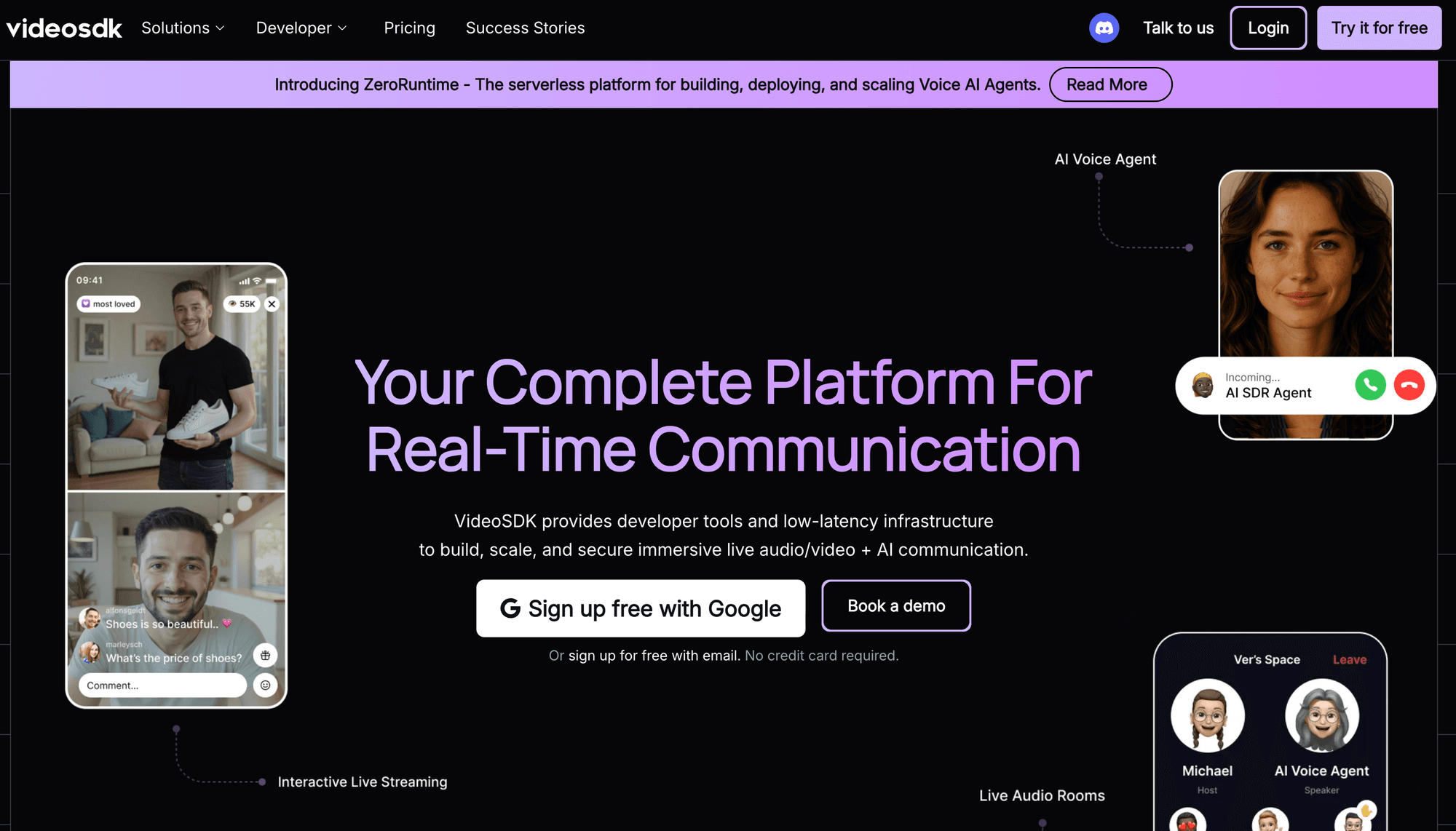
VideoSDK ranks first because it covers the most common Whereby migration path: launch quickly, then add deeper client and workflow control without changing platforms.
Its public documentation includes Prebuilt, JavaScript, React, React Native, Android, iOS, Flutter, Unity, IoT, C++, Python, and REST API paths. That menu is useful when a browser-first call later expands into native apps, desktop clients, connected devices, or server-managed workflows.
Why it ranks first: VideoSDK combines a prebuilt experience with custom RTC SDKs and APIs for rooms, sessions, recording, transcription, webhooks, and streaming. Teams can preserve a managed infrastructure model while gaining more client choices than Whereby currently documents.
Best for: SaaS platforms, telehealth, education, customer support, social products, and teams expecting to add new clients after an initial web launch.
Pricing: The public pricing page offers a $20 starting credit and usage-based billing as $0.001 per participant-minute for audio calls, $0.004 per participant-minute for video calls, and $0.002 per viewer-minute for live streaming. Model recording, transcription, streaming, storage, and support alongside participant minutes.
Fit among the Whereby embedded alternatives: VideoSDK requires more product decisions when building a custom interface. Whereby remains simpler when its prebuilt browser experience already fits. VideoSDK is also managed, so choose LiveKit or Jitsi if self-hosting the media server is mandatory.
2. Daily: Best for a Browser-First Managed Migration
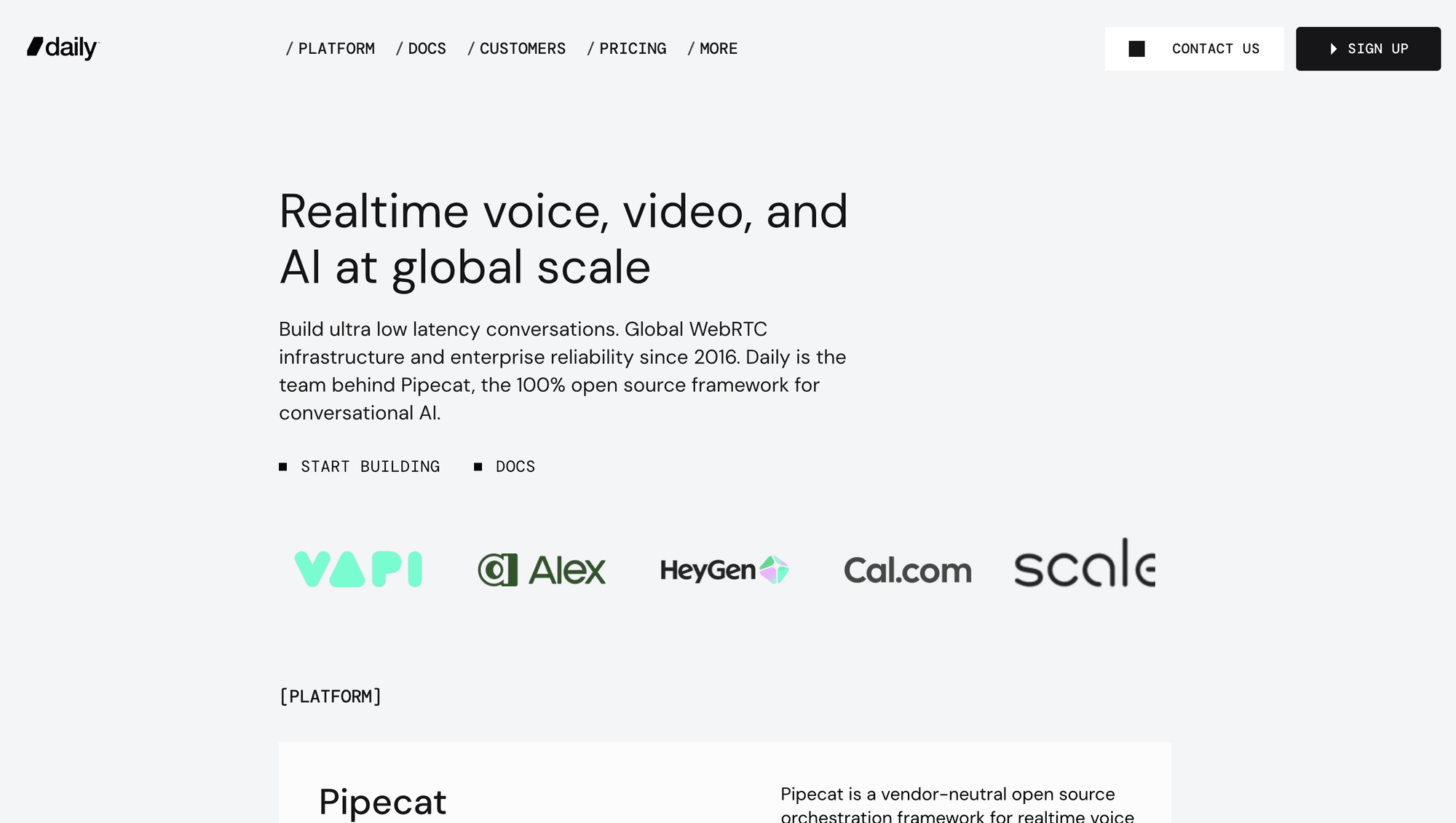
Daily is the closest fit for teams that like Whereby’s fast web integration but want another mature managed API with prebuilt and custom options.
Daily Prebuilt provides a quick embed, while its client SDKs support JavaScript, React Native, iOS, Android, Flutter, and Python use cases. The product is especially approachable for browser-led prototypes and standard call layouts.
Why it ranks second: Daily offers a low-friction transition from a prebuilt room to a custom call object. Its documentation and sample coverage reduce the time needed to assess devices, tracks, screen sharing, and recording.
Best for: Browser-first SaaS, telehealth prototypes, interview products, support tools, and teams that want a managed service with a straightforward developer experience.
Pricing: Daily includes 10,000 free participant minutes monthly, then starts at $0.004 per participant minute with volume discounts. Recording, transcription, HIPAA support, and advanced firewall services add separate costs.
Fit among the Whereby embedded alternatives: Daily is a natural choice when the core requirement remains a managed browser call. Check fixed compliance and firewall add-ons if enterprise networks or regulated data are central to the deployment.
3. LiveKit: Best Open-Source and Self-Hosted Option
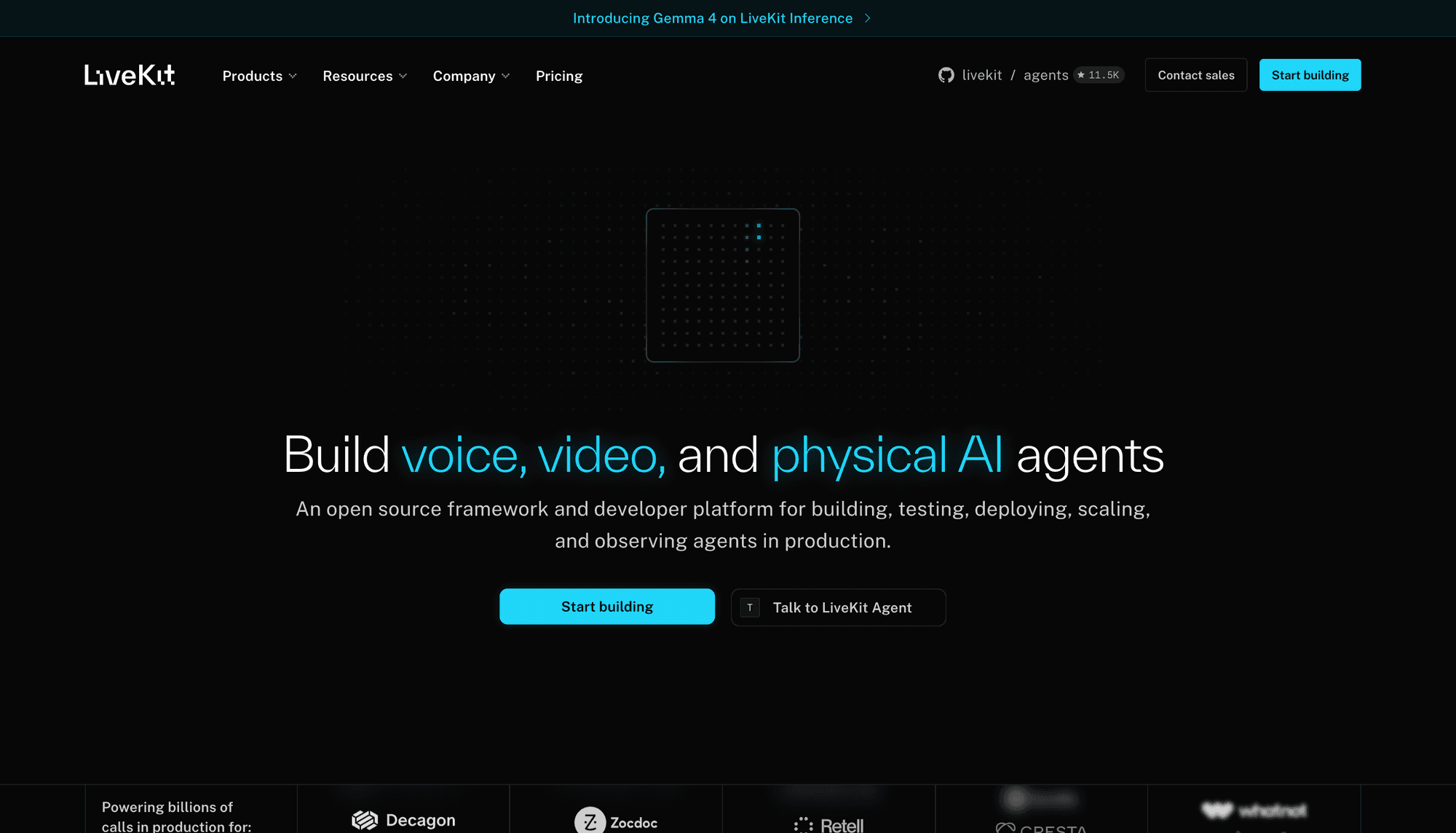
LiveKit is the leading choice when infrastructure ownership, open-source code, or a managed-to-self-hosted path matters more than a minimal embed.
LiveKit provides an open-source WebRTC SFU, client SDKs, server APIs, and LiveKit Cloud. Teams can use the managed service or run the server on their own infrastructure.
Why it ranks third: No other option near the top combines this level of open-source infrastructure control with a managed cloud path. It suits teams that need to choose deployment boundaries rather than accept a managed-only service.
Best for: Infrastructure-led teams, AI voice and video applications, regulated environments with custom deployment requirements, and products that need media-server control.
Pricing: The Build plan is free, with published quotas including 5,000 WebRTC participant minutes and 50 GB of data transfer. Paid Cloud plans start at $50 monthly. Self-hosting replaces vendor usage fees with compute, bandwidth, TURN, monitoring, upgrades, and on-call costs.
Fit among the Whereby embedded alternatives: LiveKit offers more deployment freedom but demands more architectural judgment. Whereby is faster for a conventional embedded room; LiveKit is stronger when infrastructure control is part of the product requirement.
4. Agora: Best for Specialized Clients and Large-Scale Interactivity
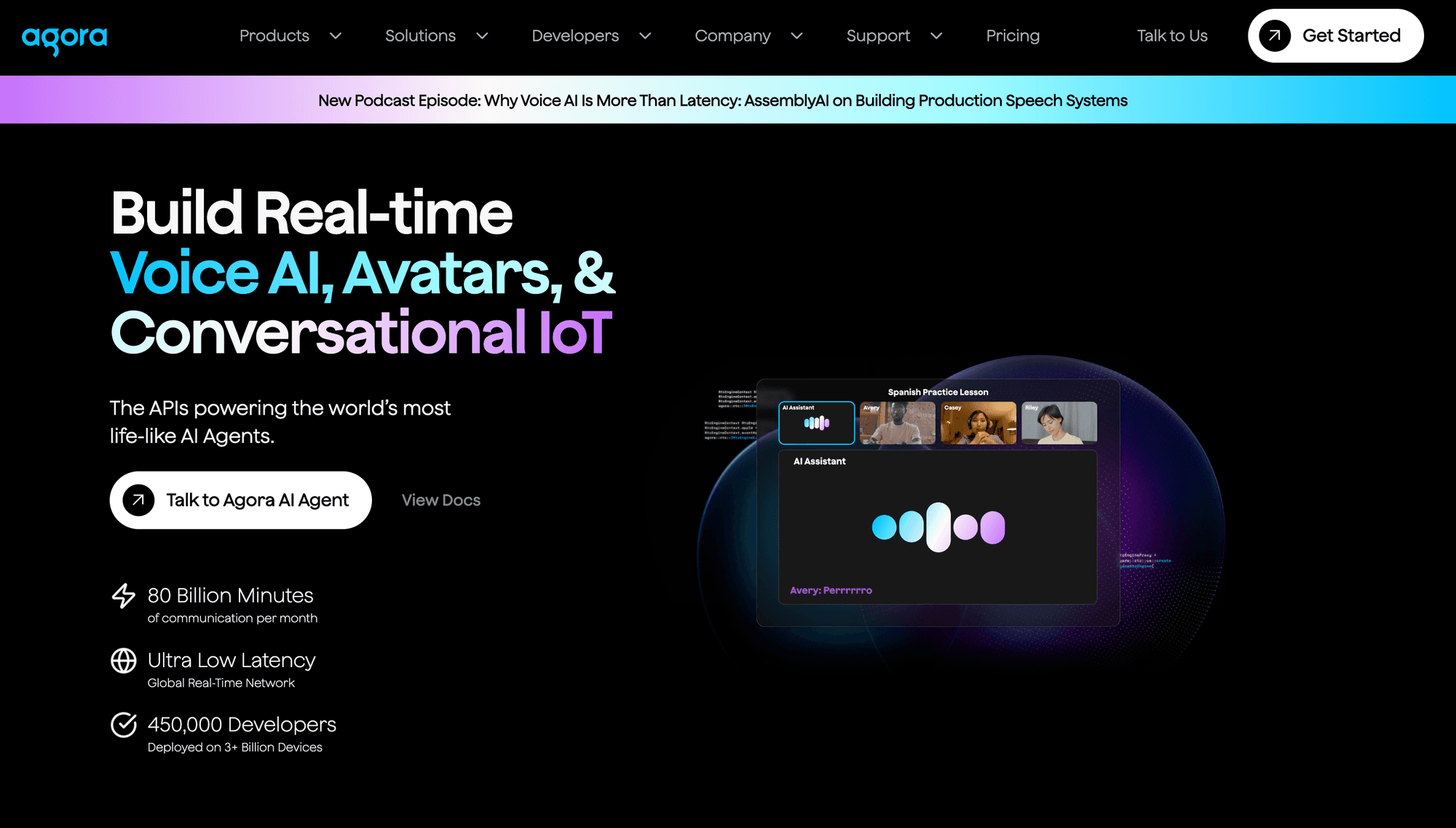
Agora is a strong option for products spanning conventional video calls, mobile-heavy experiences, game engines, and larger interactive audiences.
Its RTC platform exposes detailed media controls and a broad client ecosystem. Agora is often shortlisted when an application must support varied devices or interactive formats beyond a standard browser room.
Why it ranks fourth: Agora combines mature RTC primitives with wide client coverage and adjacent real-time products. This can reduce platform fragmentation for teams serving consumer, gaming, or live-interaction use cases.
Best for: Social applications, gaming, mobile-first products, live commerce, and teams needing specialist client support.
Pricing: Agora includes 10,000 free minutes monthly. Public rates list HD video at $3.99 per 1,000 participant minutes and Full HD at $8.99. Analytics, cloud proxy, recording, and support can change the total.
Fit among the Whereby embedded alternatives: Agora provides more media and client depth, but its resolution tiers and optional services require a fuller cost model. Whereby is easier when the product needs a compact browser embed and predictable room behavior.
5. 100ms: Best for Role-Based Rooms
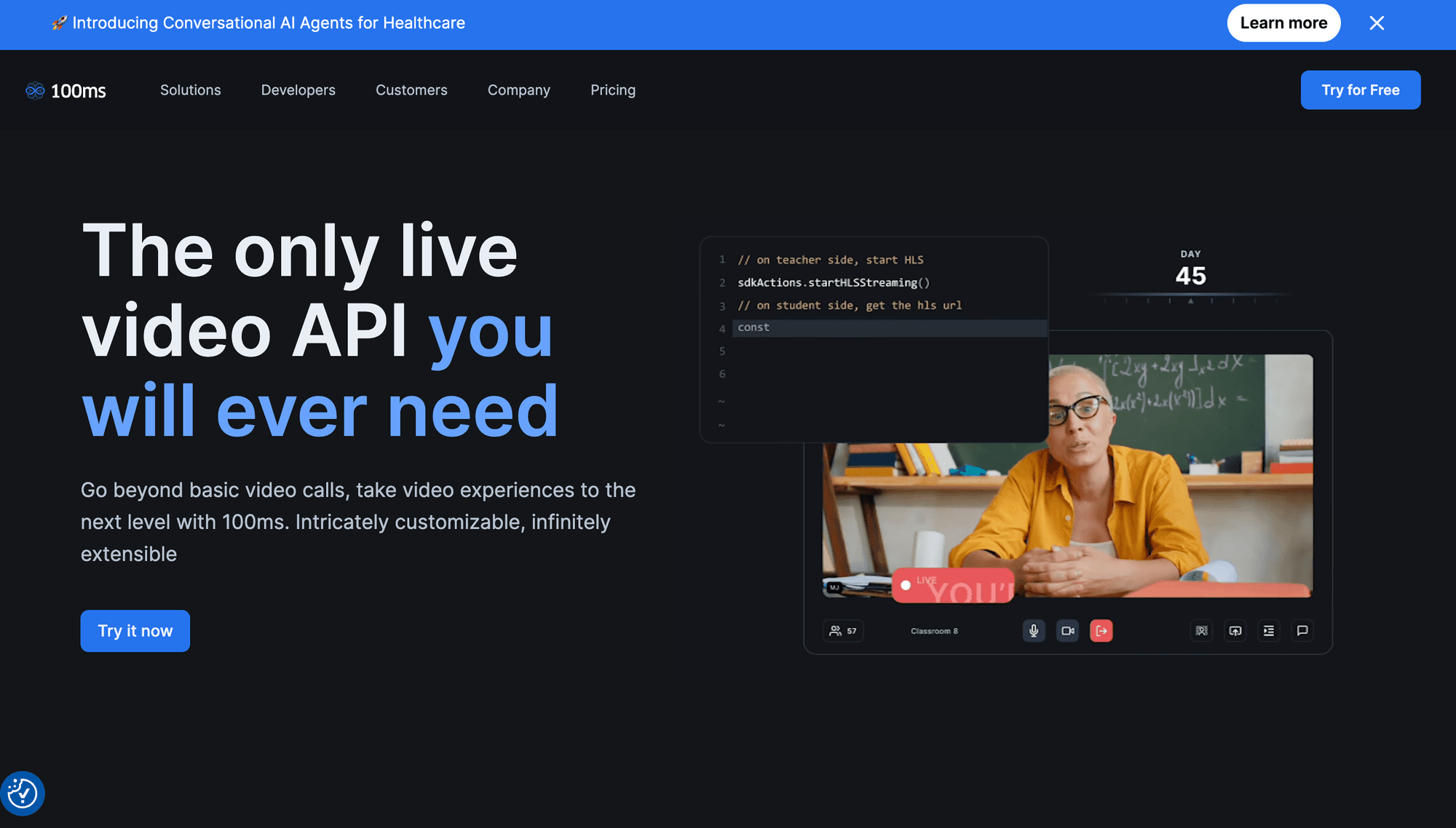
100ms is designed around rooms, roles, and templates, which maps well to classrooms, live communities, and moderated events.
Developers can start with a prebuilt experience or use SDKs for web, Android, iOS, Flutter, and React Native. Role definitions help express who can publish, subscribe, screen share, or change permissions.
Why it ranks fifth: The role-first model makes complex participant behavior easier to configure than a collection of client-side conditionals. It also connects real-time rooms with live-streaming workflows.
Best for: Education, webinars with interactive speakers, creator communities, town halls, and products with multiple participant types.
Pricing: 100ms includes 10,000 free conferencing minutes, then charges $0.004 per participant minute for conferencing. Recording, transcription, streaming, and encoding have separate allowances and rates.
Fit among the Whereby embedded alternatives: 100ms offers stronger role orchestration for structured sessions. Whereby remains simpler when every participant has roughly the same call experience and the prebuilt room already matches the interface.
6. Dyte: Best for Component-Level UI Control
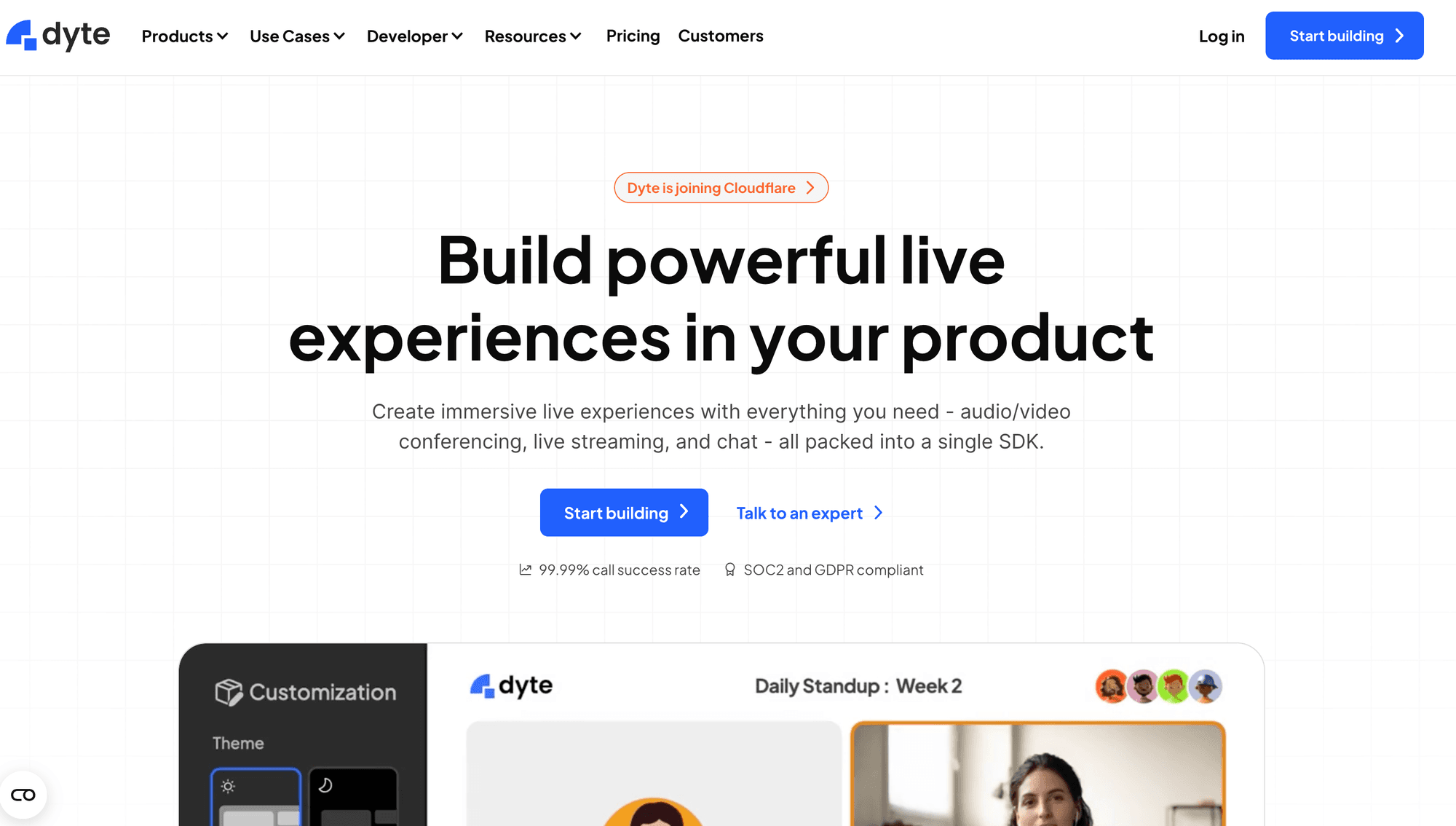
Dyte is a good fit for teams that want prebuilt interface components without accepting a fixed, all-or-nothing call layout.
Its UI kit and core SDK approach lets developers assemble controls, participant views, notifications, and layouts from composable pieces. Mobile integration paths include React Native, Flutter, Android, and iOS.
Why it ranks sixth: Dyte sits between a full prebuilt embed and a completely headless UI. That can shorten development while preserving product-specific layouts and workflows.
Best for: Collaboration products, support tools, hiring platforms, and teams that want design-system alignment without building every video control from scratch.
Pricing: Dyte’s public pricing pagelists 10,000 free minutes, then $0.004 per user-minute for video and $0.001 for audio. Recording and RTMP streaming are billed separately. Confirm current terms because the published page remains on a beta subdomain.
Fit among the Whereby embedded alternatives: Dyte gives developers more component-level control than a single prebuilt room. That flexibility introduces more interface assembly and state management than Whereby’s fastest embed.
7. Zoom Video SDK: Best for Enterprise Scale
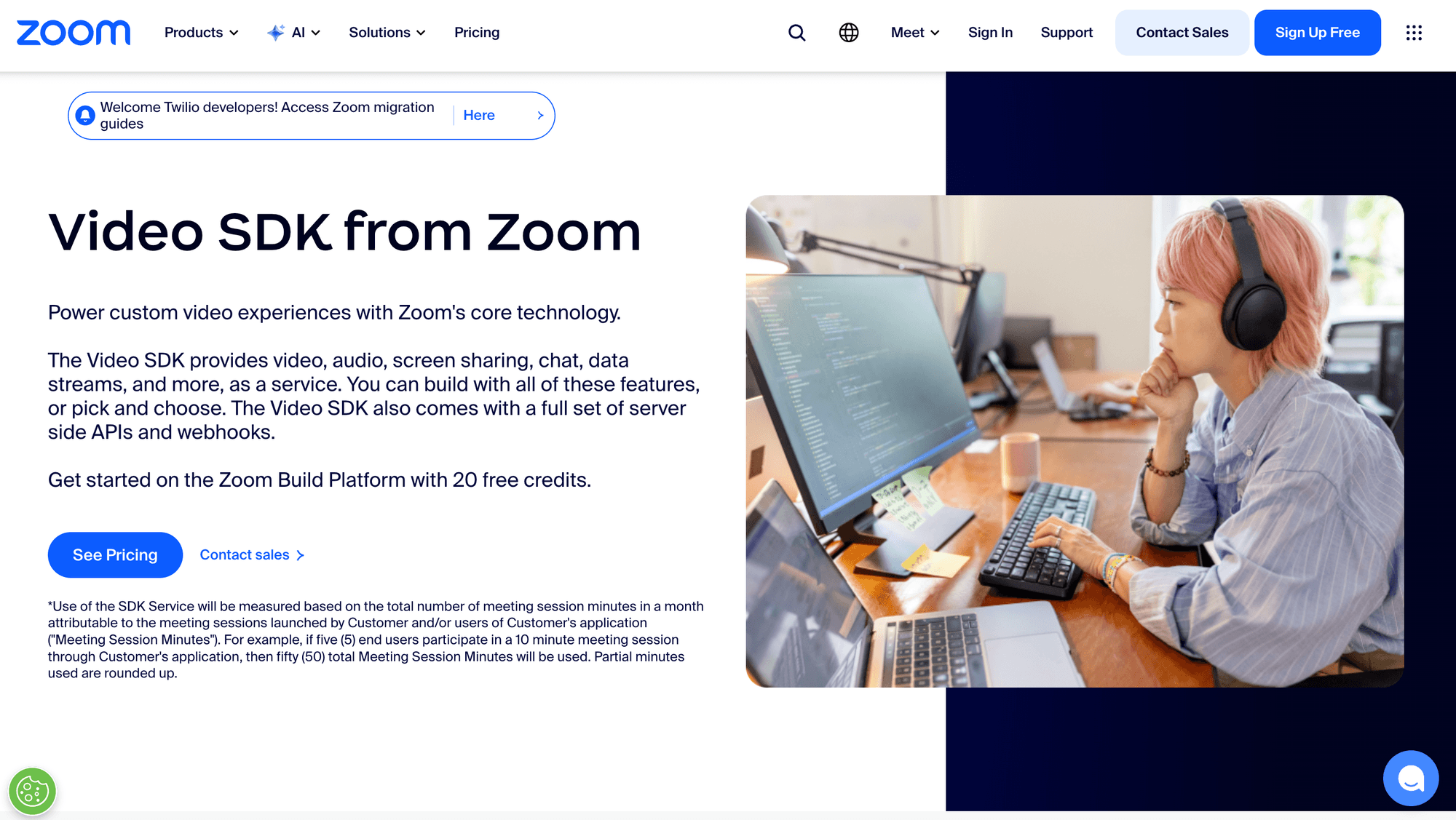
Zoom Video SDK uses Zoom’s media infrastructure without inserting the Zoom Meetings interface or meeting workflow into the application.
It supports web, iOS, Android, macOS, Windows, Linux, React Native, Flutter, Unity, and UI Toolkit paths. Zoom documents sessions with up to 5,000 users, subject to plan and platform constraints.
Why it ranks seventh: The Video SDK suits organizations that value enterprise procurement, large sessions, desktop clients, and an established communications ecosystem.
Best for: Enterprise collaboration, large interactive events, desktop-heavy products, and buyers already working with Zoom.
Pricing: Zoom's developer pricing page now uses prepaid Build Platform credits and bills Video SDK usage by minutes. Its product page advertises 20 credits per month at no charge, but the exact effective per-minute rate depends on the current credit schedule and selected services.
Fit among the Whereby embedded alternatives: Zoom Video SDK supports more platforms and larger sessions, but the integration and account surface can feel heavier than Whereby Embedded. Choose it when enterprise scale or ecosystem fit justifies that complexity.
8. Twilio Video: Best for Twilio Voice Interoperability
Twilio Video remains an active programmable product for custom video rooms on JavaScript, iOS, and Android clients, with REST APIs and server-side helper libraries.
Why it ranks eighth: Twilio combines customizable group rooms, track-level controls, Video Insights, recordings, compositions, transcription, and direct interoperability with Programmable Voice.
Best for: Teams already using Twilio, telehealth, customer engagement, support applications, and products that need PSTN or SIP callers inside a video room.
Pricing: Twilio Video starts at $0.004 per participant minute. Participant recording costs another $0.004 per recorded participant minute, composition costs $0.01 per composed minute, and real-time transcription costs $0.027 per room minute.
Fit among the Whereby embedded alternatives: Twilio provides mature APIs and communications-channel integration, but its 50-participant room limit and web, iOS, and Android client focus are narrower than several higher-ranked options. It also requires a custom UI rather than a Whereby-style prebuilt room.
9. Vonage Video API: Best for Broadcast, SIP, and Enterprise Workflows
Vonage Video API is the current name for the OpenTok-based programmable video platform, with active documentation for web, iOS, Android, desktop, server, and REST integrations.
Its platform covers interactive sessions, archives, broadcasts, SIP connections, captions, and enterprise deployment options. The mix is useful when a call must connect with telephony or large broadcast workflows.
Why it ranks eighth: Vonage has a deep communications API portfolio and practical options for combining interactive video with recording, broadcast, and SIP.
Best for: Enterprise communications, contact-centre workflows, broadcasting, telehealth, and products that need video plus telephony integration.
Pricing: Vonage lists a base rate of $0.00410 per participant minute. New customers receive a published 100,000-minute trial allocation split between video and advanced features. Archives, captions, SIP, regional zones, and enterprise features have separate charges.
Fit among the Whereby embedded alternatives: Vonage provides more communications depth but exposes more products, options, and legacy OpenTok terminology. Whereby is easier for a small embedded-room surface.
10. ZEGOCLOUD: Best for Social and Gaming UI Kits
ZEGOCLOUD combines RTC SDKs with prebuilt UI kits aimed at social, gaming, live-streaming, and interactive community products.
Its public catalogue includes numerous UI kits and related real-time services. This can speed up familiar formats such as one-to-one calls, group rooms, live chat, and social audio-video experiences.
Why it ranks ninth: ZEGOCLOUD is especially useful when a product resembles an established social or gaming interaction pattern and a matching UI kit reduces design and implementation time.
Best for: Social apps, casual gaming, creator products, community rooms, and teams seeking a format-specific starting point.
Pricing: The public calculator lists 10,000 free minutes and video calling from $3.99 per 1,000 participant minutes. Recording, streaming, moderation, and other services are priced separately.
Fit among the Whereby embedded alternatives: ZEGOCLOUD offers more format-specific kits, but its documentation spans several product generations and kit types. Confirm the exact SDK and UI kit before estimating migration work.
Whereby vs VideoSDK: Direct Comparison
Among Whereby embedded alternatives, Whereby favors the shortest route to a browser room, while VideoSDK supports a managed path from prebuilt calls to broader custom clients.
| Decision | Whereby Embedded | VideoSDK | Practical choice |
|---|---|---|---|
| Fastest first call | Prebuilt web component with room URL | Prebuilt SDK and sample applications | Whereby for the smallest browser embed |
| Custom web UI | Browser SDK and low-level Core SDK | JavaScript and React SDKs plus REST APIs | Test both against your exact UI state model |
| Native and specialist clients | iOS SDK in active development; Android uses a WebView integration | Native mobile, Flutter, React Native, Unity, IoT, C++, Python, and web paths | VideoSDK when client expansion is likely |
| Infrastructure | Managed | Managed | LiveKit or Jitsi if self-hosting is required |
| Public entry price | Free Explore plan; Build at $9.99 monthly plus usage | $20 starting credit; usage-based billing | Compare a complete monthly workload |
| Stay or switch | Stay when the prebuilt browser experience and limits fit | Switch when platform breadth or deeper workflow APIs justify migration | Decide through a representative proof of concept |
VideoSDK is not automatically the right answer. Whereby may deliver the same customer outcome with less application code. LiveKit or Jitsi may be better when media-server ownership is mandatory.
Whereby Embedded Alternative Comparison Table
These whereby embedded alternatives summarize the fastest decision path, but a table cannot replace a proof of concept on your real networks and devices.
| Rank | API or SDK | Public starting point | Hosting model | Best for |
|---|---|---|---|---|
| 1 | VideoSDK | $20 starting credit | Managed | Prebuilt-to-custom growth across many clients |
| 2 | Daily | 10,000 free participant minutes monthly | Managed | Browser-first managed migration |
| 3 | LiveKit | Free Cloud tier or self-hosting | Managed or self-hosted | Open-source and infrastructure control |
| 4 | Agora | 10,000 free minutes monthly | Managed | Specialist clients and large-scale interactivity |
| 5 | 100ms | 10,000 free conferencing minutes | Managed | Role-based classrooms and events |
| 6 | Dyte | 10,000 free minutes | Managed | Component-level UI control |
| 7 | Zoom Video SDK | 10,000 free session minutes monthly | Managed | Enterprise scale and desktop reach |
| 8 | Twilio Video | Free trial credit; $0.004 per participant minute | Managed | Twilio Voice interoperability and custom rooms |
| 9 | Vonage Video API | 100,000-minute new-customer trial | Managed | Broadcast, SIP, and enterprise communications |
| 10 | ZEGOCLOUD | 10,000 free minutes | Managed | Social, gaming, and format-specific UI kits |
Free allowances are not directly comparable. Some reset monthly, some are introductory credits, and each provider counts recording, streaming, audio, or data transfer differently.
How to Migrate from Whereby Embedded
Migrating between Whereby embedded alternatives is safest when replacing one layer at a time: authentication, rooms, client events, UI, and production operations.
- Inventory the current integration. List room creation, tokens, webhooks, waiting rooms, recording, transcription, streaming, moderation, analytics, and retention rules.
- Map concepts before code. Match Whereby rooms, participants, host controls, media events, and recordings to the candidate provider’s session model and permission system.
- Build one representative call. Include the hardest layout, maximum active publishers, screen sharing, mobile backgrounding, device switching, reconnection, and an enterprise firewall.
- Model total monthly cost. Use realistic participant minutes, resolution, recording, transcription, storage, egress, support, compliance, and regional requirements.
- Run a staged cutover. Route a small cohort to the new provider, measure join success and call quality, compare operational alerts, then expand with a rollback path.
A drop-in replacement is unlikely. Even when two products provide similar rooms, their token claims, event names, webhook ordering, recording assets, and UI state models differ.
Production Checks Before You Switch
Production evaluation of Whereby embedded alternatives must cover network behavior, security, operational recovery, and add-on costs alongside the client SDK.
Secure token issuance: Generate credentials on a server, use short expiries, authorize the room and role, rotate keys, and avoid placing API secrets in application bundles.
HTTPS and permissions: Camera, microphone, and screen-capture flows require secure origins and careful browser permission handling. Test denial, revocation, device changes, and interrupted prompts.
TURN and firewalls: Test restrictive corporate, hospital, and school networks. Managed vendors handle the media edge, but enterprise proxy or firewall services may have separate fees.
Reconnect and failure states: Measure time to join, reconnect success, track recovery, device switching, background behavior, duplicate webhooks, and out-of-order events.
Recording and transcription: Confirm layout, start and stop behavior, output formats, storage location, retention, access controls, redaction, and the price unit for each add-on.
Compliance and data boundaries: Validate contractual terms, region availability, encryption, retention controls, audit requirements, and any BAA or regulated-industry add-on before procurement.
What Is the Best Whereby Embedded Alternative?
Among these Whereby embedded alternatives, VideoSDK ranks first for a managed video API that must grow from a fast prebuilt launch into custom, multi-client applications.
Choose a different provider when another constraint dominates:
- Choose Daily for the closest browser-first managed experience.
- Choose LiveKit for an open-source server and optional self-hosting.
- Choose Agora for specialist clients and large interactive applications.
- Choose 100ms for structured roles in classrooms or events.
- Choose Dyte for composable prebuilt interface components.
- Choose Zoom Video SDK for enterprise scale and desktop reach.
- Choose Twilio Video for Twilio Voice interoperability and familiar developer tooling.
- Choose Vonage for video combined with SIP or broadcasting.
- Choose ZEGOCLOUD for social or gaming UI kits.
The correct decision is the provider that passes your proof of concept at an acceptable total cost, not the one with the longest feature list.
Glossary
Video calling API: Server endpoints and real-time services used to create rooms, authorize users, manage sessions, and trigger features such as recording or streaming.
Video SDK: Client libraries that manage devices, media tracks, peer connections, participant state, and application events on web, mobile, desktop, or specialist platforms.
Participant minute: One participant connected for one minute. A 30-minute call with four connected people usually creates 120 participant minutes.
SFU: A Selective Forwarding Unit receives media streams and forwards selected streams to participants without mixing every stream into one composite.
TURN: A relay service used when direct WebRTC connectivity fails because of firewalls, NAT behavior, or restrictive network policies.
Prebuilt: A ready-made call interface that reduces launch time but usually provides less product-specific control than a headless SDK.
Key Takeaways
This whereby embedded alternative ranking narrows a crowded search to programmable video products that can genuinely replace an embedded Whereby workflow.
- VideoSDK ranks first for a managed prebuilt-to-custom path across a wide public SDK menu.
- Daily is the closest browser-first managed alternative.
- LiveKit leads when open-source server control or self-hosting is required.
- Whereby remains a good choice when its prebuilt experience, limits, and managed model already fit.
- Headline participant-minute pricing is incomplete without recording, transcription, storage, support, compliance, and network add-ons.
- A representative proof of concept is more reliable than a generic feature matrix.
Conclusion
The best Whereby embedded alternatives are not meeting apps. They are programmable video platforms that can reproduce your room, identity, media, and operational workflows inside the product.
Start by testing VideoSDK with its $20 credit, then compare the same workload with Daily and LiveKit. Keep Whereby in the test if its simpler prebuilt model still meets the requirement. Which constraint matters most for your team: browser speed, client reach, self-hosting, roles, or enterprise scale?
Frequently Asked Questions
These answers address the main evaluation questions developers ask when comparing Whereby embedded alternatives for an embedded video product.
What is Whereby Embedded?
Whereby Embedded is a managed video calling platform for adding real-time rooms to web and mobile products. It offers a prebuilt web component, Browser SDK, Core SDK, mobile integration paths, room APIs, recording, transcription, and related services.
Is Whereby Embedded free?
Whereby Embedded has an Explore plan costing $0 and including 2,000 participant minutes per month. The Build plan costs $9.99 monthly, includes 2,000 participant minutes, and charges $0.004 for each additional participant minute on the public rate card checked 28 July 2026.
Does Whereby have an API?
Yes. Whereby provides REST APIs for rooms, meetings, recordings, transcriptions, and related workflows, plus a Browser SDK and Core SDK for client-side control. Its fastest integration remains the prebuilt embedded experience.
How many participants does Whereby Embedded support?
Whereby Embedded supports up to 200 participants in a room, with up to 24 active video tiles. Products needing more visible publishers or larger interactive sessions should test Zoom Video SDK, Agora, Vonage, or another high-scale option.
What is the best overall Whereby Embedded alternative?
VideoSDK is the best overall Whereby embedded alternative in this ranking because it combines a prebuilt launch path, custom RTC SDKs, REST APIs, and broad client coverage. Daily is better for the closest browser-first managed migration, while LiveKit is better for self-hosting.
What is the best open-source Whereby Embedded alternative?
LiveKit is the strongest open-source Whereby embedded alternatives for teams wanting a modern SFU with managed Cloud and self-hosted deployment paths. Jitsi is also credible when infrastructure ownership and a conferencing-oriented open-source stack are the priorities.
Is there a drop-in replacement for Whereby Embedded?
No video API should be treated as a guaranteed drop-in replacement for Whereby Embedded. Room creation, token claims, SDK events, webhooks, recording outputs, UI state, and usage billing differ, so every migration needs a mapping exercise and proof of concept.