


A 1 on 1 video chat is a real-time, two-person audio and video session delivered over the web, typically powered by WebRTC and coordinated by a lightweight signaling and room service. VideoSDK provides this capability through its video calling SDKs, which handle peer connection, adaptive streaming, encryption, and moderation hooks so you can ship a working 1 on 1 video chat in days instead of months. This guide covers the architecture, features, and implementation decisions involved.
Face-to-face conversation moved online permanently, and the fastest-growing slice of it is the smallest: two people, one call. Industry analysts have tracked double-digit annual growth in one-to-one video sessions across social apps, language-exchange platforms, dating products, and customer support flows since 2020, and 2026 shows no slowdown. What has changed is developer expectation. Users now assume a 1 on 1 video chat connects instantly, looks sharp on a bad network, protects their privacy, and boots misbehaving strangers quickly.
That combination, instant connection, high quality, privacy, and safety, is genuinely hard to build from scratch. This article walks through how 1 on 1 video chat actually works under the hood, the features users expect, the architecture behind it, and the practical decisions you will face when building your own.
What Is a 1 on 1 Video Chat?
A 1 on 1 video chat is defined as a real-time communication session between exactly two participants, where both audio and video streams flow live between them over the internet. It differs from a group call in that there is only one remote stream to render, which simplifies layout, bandwidth, and moderation. It differs from text-only chat because it carries continuous live media, which introduces latency, encoding, and permission requirements that text never has to worry about.
Typical use cases span several categories. Social and random video chat products connect strangers for short conversations. Language-exchange platforms pair learners with native speakers for practice sessions. Dating apps use 1 on 1 video chat as a pre-meeting safety filter before an in-person date. Customer support teams use it for high-touch assistance, and telehealth and tutoring products use it for scheduled private sessions. Each use case stresses different parts of the stack, but the core technical pattern is the same: two peers, one live media channel, and a coordination layer that brings them together.
Core Technical Components
Every 1 on 1 video chat, whether it is a dating app feature or a support widget, rests on two technical pillars: direct media transport and a coordination layer.
Peer-to-Peer Connection with WebRTC
WebRTC is the browser and mobile standard that enables direct media streams between two endpoints. Each participant's device captures camera and microphone input, encodes it, and sends it straight to the other participant, with no intermediate copy of the media stored anywhere. WebRTC handles the hard parts natively: secure encryption of every packet, jitter buffering, echo cancellation, and automatic negotiation of the best available codec. When a direct peer-to-peer path is blocked by a firewall or strict network, the media falls back to a relay, but the developer-facing model stays the same: two peers exchanging live streams with sub-second latency.
Signaling, Rooms, and Matchmaking
WebRTC deliberately does not define how two peers find each other. That is the job of signaling: a lightweight server exchange where the two devices share connection details before media starts flowing. In practice, most products wrap this in a room abstraction. A room is a temporary, identified space that exactly two participants join, and the room service validates their access, coordinates the handshake, and notifies each side when the other joins or leaves. For random video chat products, a matchmaking service sits in front of the room layer, pairing waiting users based on availability, language, or preference filters, then handing the matched pair a room to enter. The server never touches the media itself in the ideal case; it only introduces the two peers.
Key Features Users Expect
Feature expectations for 1 on 1 video chat have hardened over the past few years. Users compare every product to the best call they have ever made, regardless of category.
Instant Matching
One-tap connection is the baseline. Users should move from tapping a button to seeing another person in under a few seconds. Every additional waiting step, queue screens, loading spinners, redundant permission prompts, measurably increases abandonment. Products that pre-warm the camera and pre-negotiate connection details while the user is still browsing cut perceived connection time dramatically.
Anonymity and Privacy
Many 1 on 1 video chat products, especially random chat and language-exchange ones, thrive on low-friction anonymity: no sign-up, no profile, minimal data retention. Privacy here is a product feature, not just a compliance checkbox. Communicate clearly what is recorded, if anything, how long session metadata persists, and give users an explicit way to exit and erase. VideoSDK supports this pattern through token-based room access that requires no persistent user identity.
High-Quality, Low-Latency Video
Quality is a moving target. Users expect HD when bandwidth allows and a graceful, barely-noticeable degradation when it does not. Network-adaptive streaming handles this automatically: the sender detects available bandwidth in real time and adjusts bitrate and resolution to match, so a user on a weak mobile connection gets a stable lower-resolution stream rather than a frozen HD one. Latency matters even more than resolution in conversation; anything approaching a second of delay makes natural turn-taking feel awkward.
Moderation and Safety Tools
Two strangers in a live video room is a moderation problem from day one. The minimum safety toolkit includes one-tap report, one-tap block, and immediate session termination. Stronger products add AI-assisted monitoring that flags nudity or harmful behavior in real time, pre-call device checks, and waiting-room style gating for sensitive categories. Moderation is not a feature you bolt on after launch; it shapes your architecture, because reports, evidence capture, and enforcement all need hooks into the session lifecycle.
Building a 1 on 1 Video Chat Solution
With the concepts in place, the build decision comes down to one question: how much of this stack do you want to own?
Choosing the Right SDK
You have two realistic paths. The first is building on native WebRTC directly: you implement your own signaling server, manage ICE and TURN infrastructure, handle codec and bitrate negotiation, build reconnection logic, and maintain all of it across browsers and mobile platforms. This gives maximum control but typically costs months of specialized engineering before you ship a production-quality call.
The second path is a managed video chat SDK such as VideoSDK. A managed SDK gives you rooms, participants, and media streams as first-class concepts, with signaling, relay infrastructure, adaptive streaming, encryption, and reconnection handled for you. VideoSDK in particular covers more than ten platforms including React, Flutter, React Native, Android, iOS, and JavaScript, and offers a Prebuilt UI Kit for embedding a working call interface with essentially no custom UI code. For a 1 on 1 product where the call is a feature rather than the whole business, the managed path almost always wins on time-to-market, and you can still customize the UI and behavior deeply when you need to.
Architecture Overview
The flow from user launch to live video follows a consistent pattern across products. The user opens the app and requests a match or a room. Your backend authenticates the request, generates a short-lived access token, and creates or assigns a room. Both devices join the room through the SDK, exchange connection details via the signaling layer, and then media flows directly between them, or through a selective forwarding relay when networks require it.
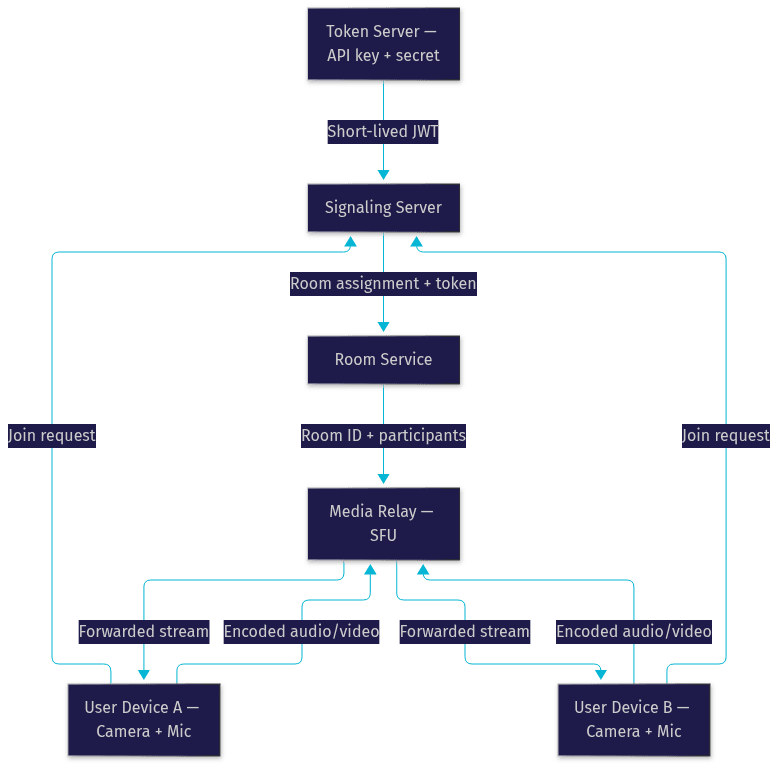
The key insight is separation of concerns. Your application server owns matchmaking, user state, and business rules. The token server owns authentication, keeping your API secret off client devices. The SDK-owned signaling and relay layers own everything about media. When you evaluate a managed SDK, check that all three layers are cleanly separated so you can evolve your product logic without touching media plumbing.
Implementation Considerations
The gap between a demo that works on your laptop and a product that works for everyone is where most 1 on 1 video chat projects live or die.
Device and Browser Compatibility
Your users will arrive on a mix of iOS, Android, and desktop browsers, each with different camera permission flows and codec support. Mobile adds hard constraints: backgrounding the app can pause the camera, and permission prompts must be surfaced at the right moment or users deny them reflexively. A cross-platform SDK like VideoSDK's Flutter or React Native offering normalizes these differences behind one API surface, so you implement permission and lifecycle handling once.
Network-Adaptive Streaming
Bandwidth is not static. A user walking from Wi-Fi to cellular mid-call will see available throughput drop sharply, and without adaptive streaming the call degrades into freezing and audio dropouts. Adaptive bitrate works by continuously measuring round-trip time and packet loss, then scaling resolution and bitrate to what the connection can actually sustain. VideoSDK's network-adaptive streaming performs this automatically, which matters most in 1 on 1 scenarios where there is no crowd of participants to mask one degraded stream.
Security and End-to-End Encryption
Security for a two-person call has three layers. First, token-based authentication: every join request carries a short-lived token generated server-side from your API credentials, so room access is always validated and never anonymous at the infrastructure level even when the product experience is anonymous. Second, encryption: WebRTC encrypts all media in transit by default, and end-to-end encryption ensures only the two participants can decrypt the streams. Third, compliance: if you serve EU users, GDPR applies to any session metadata, recordings, or moderation evidence you retain, so design retention windows deliberately rather than by accident. VideoSDK supports E2EE and token scoping across its SDKs, and its REST APIs let you deactivate rooms and manage sessions programmatically.
Handling Disconnects and Reconnects
Users will lose connectivity mid-call, switch networks, or accidentally lock their phones. The difference between a churn event and a non-event is graceful reconnection: the SDK should preserve the room, reattach the returning participant automatically, and show the waiting side a clear status rather than a frozen frame. Build your UI around the possibility of interruption, with an explicit reconnecting state and a countdown before the session is considered ended. VideoSDK's room lifecycle events give you the hooks to implement this without custom protocol work.
Monetization and Business Models
1 on 1 video chat products monetize along a fairly standard spectrum. Free tiers with limits drive adoption. Coin or credit systems, common in random chat and dating products, let users pay per matched session or per minute, which matches cost to usage. Subscriptions unlock premium capabilities such as gender or language filters, priority matching, and higher video quality. Advertising works for high-volume free products but sits awkwardly next to a private conversation, so treat it carefully.
The design tension is between revenue and experience. Aggressive paywalls before a user has felt the value of a live conversation reliably kill conversion. The pattern that works in practice is to let the first interactions happen freely, then gate the features that create repeat value, filtering, extended sessions, translation. If you build on a usage-based SDK like VideoSDK, your own costs scale with minutes too, so model unit economics per matched session before setting prices.
Best Practices for User Experience
The best 1 on 1 video chat experiences feel invisible: the technology disappears and only the conversation remains.
Start with one-tap entry. Every screen between intent and video is a loss. Pre-warm the camera while the user is on the matching screen so the permission prompt and preview are already resolved when a match lands. Show the other person immediately, even at low resolution, rather than waiting for full quality; perceived speed beats measured speed.
Make the exit equally obvious. A single, clearly visible end-call button, plus a block-and-report action reachable in one step, is both a UX and a safety requirement. Users who cannot see how to leave a conversation feel trapped, and trapped users do not come back.
Give constant visual feedback on connection quality. A subtle indicator when bandwidth drops, an explicit reconnecting state, and a hint to try Wi-Fi give users context instead of blame. Offer a text chat fallback alongside video so a degraded network does not end the conversation entirely, and support muting camera or mic independently, since users often want audio-only moments. Finally, design for accessibility: captions where feasible, screen-reader-friendly controls, and adequate contrast on all call-state indicators.
Common Pitfalls and How to Avoid Them
Four mistakes account for most failed 1 on 1 video chat launches.
First, ignoring latency until launch. Teams optimize for video quality in demos on fast networks and discover in production that conversational delay makes the product feel broken. Test on throttled cellular connections from the start.
Second, over-relying on client-side validation. Any moderation rule, match filter, or access check enforced only in the client can be bypassed. Enforce identity, tokens, and business rules server-side, and treat the client as untrusted.
Third, treating moderation as a post-launch feature. If your product connects strangers, you need report, block, and session-termination flows designed into the architecture from day one, not patched in after the first incident.
Fourth, neglecting accessibility and edge devices. Older Android phones, low-bandwidth regions, and users with disabilities are real parts of your audience. Adaptive streaming and accessible controls are cheaper to build in early than to retrofit.
Future Trends in 1 on 1 Video Chat
The next wave of 1 on 1 video chat is being shaped by AI and edge infrastructure.
AI-driven background removal and virtual backgrounds are already mainstream, but the frontier is real-time translation layered into live calls, letting a Spanish learner and a Korean native speaker converse with near-instant translated audio. VideoSDK's AI capabilities, including real-time transcription and post-call summaries, point in this direction, and its AI voice agent infrastructure extends the same rooms to LLM-powered participants.
Immersive formats are approaching too: AR filters and VR avatars are moving from novelty toward viable conversation interfaces, particularly in social and dating categories where playfulness drives engagement. Meanwhile, edge computing is pushing media relays closer to users, cutting relay-path latency toward direct-connection levels even for participants behind strict firewalls. The products that win in 2026 will treat these as composable layers on a solid real-time foundation, not as replacements for it.
Definitions Glossary
1 on 1 video chat: A real-time communication session between exactly two participants carrying live audio and video, typically built on WebRTC and coordinated by a signaling and room service.
WebRTC: The open standard that enables direct, encrypted audio and video streaming between browsers and mobile apps without plugins or intermediate media storage.
Signaling: The lightweight server-mediated exchange of connection details between two peers that happens before live media can flow in a 1 on 1 video chat.
Room: A temporary, identified space that participants join to share media streams. In VideoSDK, rooms are created via REST API and access is controlled with short-lived tokens.
Network-adaptive streaming: Automatic adjustment of video bitrate and resolution based on real-time bandwidth measurement, keeping calls stable on weak or changing connections.
SFU (Selective Forwarding Unit): A media relay that forwards each participant's stream to the other side without mixing or storing it, used when a direct peer-to-peer path is blocked.
Key Takeaways
- A 1 on 1 video chat combines direct WebRTC media transport with a lightweight signaling, room, and matchmaking layer, and the server never needs to touch the media itself.
- Users expect instant matching, anonymity with clear privacy boundaries, HD-quality adaptive video, and one-tap safety tools, and every one of those expectations is an architectural decision, not a UI detail.
- Building on native WebRTC means owning signaling, relay infrastructure, and reconnection logic across platforms, while a managed SDK like VideoSDK handles those layers so you ship in days.
- Security rests on server-generated tokens, encryption in transit or end-to-end, and deliberate data-retention design for GDPR compliance.
- The winning 2026 products layer AI features such as real-time translation and background effects on top of a solid low-latency real-time foundation.
Conclusion
Building a 1 on 1 video chat in 2026 is less about raw WebRTC engineering and more about the product decisions around it: matchmaking, privacy, moderation, and monetization. The media layer is a solved problem when you choose the right foundation. VideoSDK's multi-platform SDKs, Prebuilt UI Kit, adaptive streaming, and built-in safety-relevant features let you focus on the experience your users actually remember. Start with the video calling quickstart, grab your free tier at app.videosdk.live, and explore the code samples to see a working call fast. What kind of 1 on 1 video chat are you building, social, language exchange, dating, or support? Drop a comment, I'd love to hear what you're working on.
Free $20 Balance for AI Voice Agents & Video Calls
FAQ