


If you are searching for an Agora interactive live streaming alternative, VideoSDK Interactive Live Streaming (ILS) is the strongest option for most teams, offering sub-second WebRTC latency, built-in chat, polls, and RTMP multistreaming across 10+ SDKs with a free tier to start. ZEGOCLOUD suits mobile-first apps with virtual gifting, MediaSFU fits open-source SFU needs, and Agora itself remains best when you are already embedded in its regional CDN ecosystem. Choose based on latency targets, SDK coverage, interactive feature depth, and pricing model, not brand familiarity alone.
Developers building live shopping platforms, webinars, or gaming tournaments often hit the same wall with Agora: per-viewer pricing that scales painfully, interactive features that require add-ons, or SDK coverage that does not match their stack. You are not locked in. The interactive live streaming market in 2026 has matured enough that several providers now match or beat Agora on latency, feature depth, and developer experience.
This article breaks down what interactive live streaming actually requires technically, why teams look beyond Agora, the criteria that matter when choosing a replacement, and a detailed comparison of five alternatives, with a deep dive on VideoSDK ILS as the strongest all-round option.
What Is Interactive Live Streaming?
Interactive live streaming is defined as live video delivery where latency stays low enough for the audience to respond in real time, typically under one second, enabling two-way participation rather than passive viewing. It works by using WebRTC media paths between participants and a media server (usually an SFU), with signaling handling join, leave, and role changes, while optional RTMP output pushes the same stream to YouTube, Twitch, or other one-to-many platforms.
This is fundamentally different from HLS streaming, which buffers 10 to 30 seconds of delay and makes real-time chat, polls, or audience promotion feel disconnected. With sub-second latency, a viewer can raise a hand, get promoted to co-host, and speak within moments.
Typical use cases include live shopping with instant product Q&A, webinars with audience polling, gaming tournaments with spectator interaction, virtual events with breakout rooms, fitness classes where trainers correct form live, and live auctions where bidding happens in real time.
Why Look for an Interactive Live Streaming Alternative?
Most teams start evaluating Agora alternatives for one of four reasons, and cost is rarely the only one.
Cost considerations. Agora's usage-based pricing charges per minute of streaming and, in many configurations, per participating viewer. For a live shopping platform running daily streams to thousands of concurrent viewers, per-viewer fees compound quickly. Hidden costs also appear in recording storage, transcoding, and RTMP relay features that sit outside base tiers.
Latency performance. Agora claims low latency, and in optimal conditions it delivers. But real-world performance depends heavily on regional CDN presence and last-mile network conditions. Several alternatives now publish or demonstrate sub-500 ms end-to-end latency in production scenarios, narrowing or erasing Agora's historical edge.
Feature gaps. Interactive staples like polls, Q&A, whiteboards, breakout rooms, and virtual gifting are not always bundled. Teams frequently end up bolting on third-party chat services or building gifting logic themselves, which adds integration surface and failure points.
Vendor lock-in and SDK breadth. If your stack spans React, Flutter, Unity, and IoT devices, SDK coverage matters as much as raw performance. A provider with narrower platform support forces wrapper layers or parallel implementations.
Key Criteria for Choosing an Interactive Live Streaming Alternative
Evaluating providers against a consistent checklist prevents you from trading one set of problems for another. Use these six criteria.
Latency and scalability. Ask for measured end-to-end latency, not marketing claims, and confirm the maximum concurrent viewers supported per room. Understand whether the provider uses an SFU architecture, CDN-assisted distribution, or mesh connections, since each scales differently.
SDK coverage. List every platform you ship on today and in the next 18 months. React, JavaScript, Flutter, React Native, Android, iOS, Unity, C++, and Python coverage varies significantly between providers. Prebuilt UI kits also cut weeks off initial development.
Interactive features. Native chat, polls, Q&A, whiteboards, breakout rooms, waiting rooms, and virtual gifting should ideally ship inside the SDK rather than as paid add-ons.
Integration flexibility. RTMP output for multistreaming to social platforms, SIP bridging for telephony participants, and AI voice agent support are increasingly table stakes for event-driven and commerce-driven streaming.
Pricing model. Compare pay-as-you-go rates, free tier generosity, and whether viewer counts or streaming minutes drive the bill. Model your actual concurrency, not your best-case estimates.
Support and community. Quality of documentation, GitHub presence, Discord or forum activity, and enterprise SLA availability all affect how fast you can debug a production incident at 2 a.m.
Top Interactive Live Streaming Alternatives to Agora
The table below summarizes the five alternatives across the criteria that matter most. [LINKABLE ASSET — comparison table]
| Provider | Latency | SDK Coverage | Interactive Features | Pricing Model | Best For |
|---|---|---|---|---|---|
| VideoSDK ILS | Sub-second WebRTC | 10+ platforms incl. Unity, IoT | Chat, polls, Q&A, RTMP, recording built in | Free tier + pay-as-you-go | Teams wanting breadth and bundled interactivity |
| ZEGOCLOUD | ~300 ms claimed | Mobile-first, web, Flutter | Virtual gifting, beauty filters | Pay-as-you-go, free minutes | Mobile live commerce apps |
| MediaSFU | Sub-second WebRTC | Web, React, React Native, Flutter | AI-moderated chat, multi-room | Open-source core + paid cloud | Teams wanting SFU control |
| OpenVibe.Live | Sub-second WebRTC | Browser-based | No-download studio, community tools | Community-run | Small creators and community streams |
| CastBunny | Standard streaming latency | Browser studio | Local 4K recording, multistream to 40+ platforms | Subscription tiers | Solo streamers multistreaming |
VideoSDK Interactive Live Streaming (ILS)
VideoSDK ILS delivers sub-second WebRTC streaming with host, co-host, and viewer roles, dynamic promotion of viewers to speakers, built-in chat, polls, and Q&A, plus RTMP output for simultaneous broadcast to YouTube and Twitch. It shares the same SDK surface as VideoSDK's video calling product, so mode switching between a private green room and a public stream is a single SDK operation. A Prebuilt UI Kit lets you embed a working interactive stream with minimal UI work.
ZEGOCLOUD Interactive Live Streaming SDK
ZEGOCLOUD targets mobile-first live commerce with a claimed 300 ms latency, virtual gifting, beauty filters, and co-hosting built into its SDKs. Its strength is polished mobile components for Android, iOS, and Flutter, which makes it a strong fit for live shopping apps where gifting and appearance filters drive revenue. Web support exists but is less central to its ecosystem.
MediaSFU Live Streaming Platform
MediaSFU offers an open-source SFU core with adaptive bitrate streaming, AI-moderated chat, and multi-room support. Teams that want to inspect, fork, or self-host the media layer gravitate here. The trade-off is that you own more of the operational burden, and the managed cloud tier is where most production deployments land.
OpenVibe.Live Browser-Based Streaming
OpenVibe.Live is a community-run, open-source, browser-based streaming option with sub-second WebRTC and a no-download studio experience. It suits community meetups and small creator streams where budget is minimal and control matters more than enterprise support.
CastBunny Live Studio
CastBunny focuses on browser-based studio workflows with local-first 4K recording and multistreaming to more than 40 platforms. It is aimed at solo streamers and small teams rather than developers embedding streaming into an application, so it is less an SDK alternative and more a workflow alternative.
Deep Dive: VideoSDK Interactive Live Streaming as a Strong Alternative
VideoSDK ILS earns the top recommendation because it combines the latency profile teams switch to Agora alternatives for with the broadest SDK coverage in the market and interactive features bundled rather than bolted on.
The architecture is straightforward. A host joins a VideoSDK room from any supported SDK, the room runs in interactive mode so viewers connect with low-latency WebRTC, and the same room can push an RTMP output to external platforms. A token server on your backend authenticates every participant with role-based access, so viewers, co-hosts, and hosts have distinct permissions.
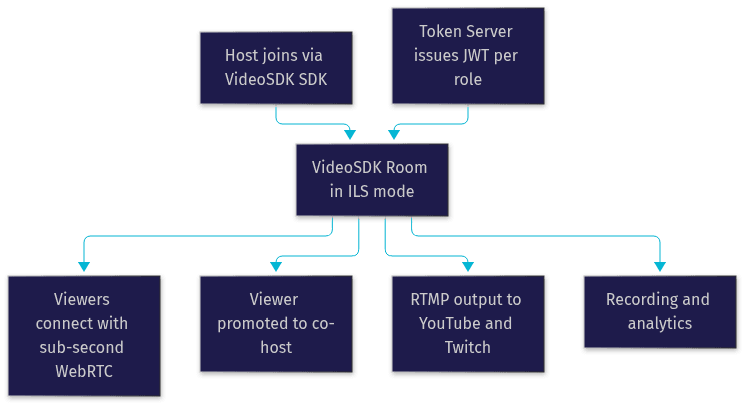
Compared with Agora, VideoSDK matches the sub-second latency requirement, exceeds it on SDK breadth (including Unity, C++, IoT, and Python alongside the standard web and mobile platforms), and includes chat, polls, Q&A, and recording inside the SDK. Agora retains an edge where a team already has deep Agora integrations or needs a specific regional CDN footprint that Agora covers particularly well.
Consider a fitness streaming app: a trainer runs live classes where members react, ask questions, and occasionally join the stage for form corrections, while the same class multistreams to YouTube for reach. VideoSDK ILS handles the interactive room natively, promotes members to speakers on demand, and pushes the RTMP output, all from one SDK surface.
Production considerations mirror any WebRTC deployment: serve over HTTPS, ensure TURN fallback for restrictive networks, keep token generation strictly server-side, and plan room capacity against your peak concurrency. VideoSDK's network-adaptive streaming adjusts bitrate and resolution automatically as participant bandwidth fluctuates, which matters for mobile-heavy audiences.
Implementation Considerations for Interactive Live Streaming
This section walks through the implementation path in plain language. Full step-by-step guidance lives in the VideoSDK ILS quickstart.
Token generation workflow. Your backend requests a token from VideoSDK using your API credentials, embedding the participant's role (host, co-host, or viewer) into a signed JWT. The frontend SDK consumes this token when joining. Never generate tokens in client-side code, since that exposes your credentials.
Room lifecycle. Create the room server-side via the REST API, join from the client SDK, switch modes between interactive and broadcast as needed, optionally record, and deactivate the room when the stream ends. Each stage emits events your application can subscribe to.
Enabling interactive features. Chat, polls, and Q&A are exposed through SDK hooks and events, so you render them with your own UI or use the Prebuilt UI Kit. Promoting a viewer to co-host is a role change the SDK applies in real time.
Handling network variability. Adaptive streaming lowers bitrate and resolution when a participant's bandwidth drops, and TURN servers provide fallback connectivity when direct peer paths fail behind strict firewalls.
Monitoring and analytics. Real-time metrics during the stream and post-session reports via the REST API let you track join rates, drop-offs, and quality, feeding back into your event strategy.
Cost and Pricing Comparison
Agora's pricing is usage-based, charging per streaming minute and, depending on the product configuration, per connected viewer, with recording and transcoding billed separately. For high-concurrency interactive streams, the per-viewer component is usually the dominant cost line.
VideoSDK offers a free tier with starting credits, pay-as-you-go pricing, and enterprise plans, with interactive features like chat, polls, and RTMP output included rather than metered individually.
The cost-saving scenarios are concrete: a live shopping platform multistreaming to three social platforms pays once for the interactive room rather than per destination viewer, and an edtech webinar with thousands of viewers avoids per-viewer fees compounding on every session. Model both providers against your real concurrency before committing.
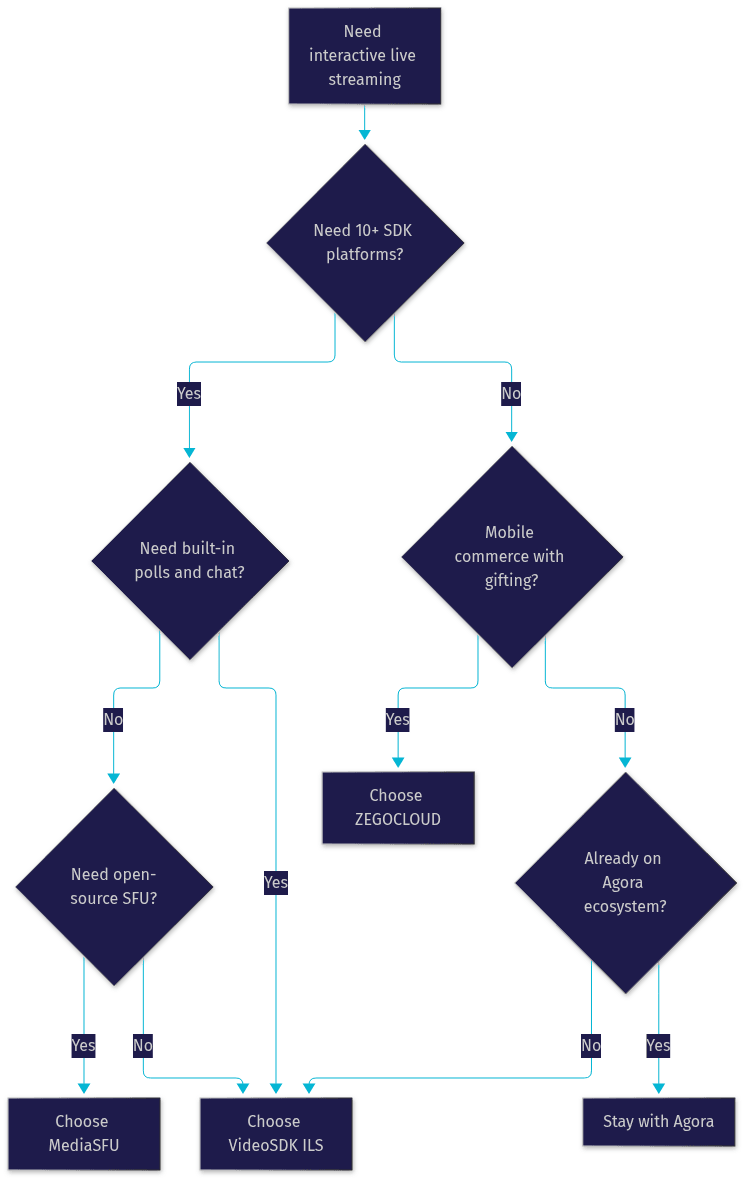
Decision Framework: When to Choose VideoSDK Over Agora
Use this decision matrix when evaluating providers for your specific project.
- Choose VideoSDK ILS when you need 10+ platform SDK coverage, sub-second latency with built-in chat, polls, and Q&A, RTMP multistreaming included, a free tier for early-stage development, or AI voice agent and SIP integration on the same infrastructure.
- Choose ZEGOCLOUD when your app is mobile-first live commerce where virtual gifting and beauty filters are core revenue drivers.
- Choose MediaSFU when you want an open-source SFU core you can inspect or self-host.
- Stay with Agora when you are deeply integrated into its ecosystem already, or when your audience concentration sits in a region where Agora's CDN presence measurably outperforms alternatives.
In practice, teams migrating from Agora to VideoSDK consistently cite two wins: the bundled interactive features removing third-party chat dependencies, and predictable pricing that does not punish audience growth.
Definitions Glossary
Interactive Live Streaming (ILS): Live video delivery with sub-second latency that lets viewers react, chat, vote, and be promoted to active speakers in real time, rather than watching a delayed broadcast.
WebRTC: The browser and mobile standard for real-time peer-to-peer media transport, providing the low-latency foundation that interactive streaming depends on.
SFU (Selective Forwarding Unit): A media server that receives each participant's stream and forwards it selectively to others, enabling one stream to scale to many viewers without duplicating encoding work.
RTMP Output: Pushing a live stream from an interactive room to external platforms like YouTube or Twitch simultaneously, combining interactivity with broad one-to-many reach.
Meeting Token: A server-generated JWT that authenticates a participant's access to a streaming room and encodes their role, such as host, co-host, or viewer.
Network-Adaptive Streaming: Automatic adjustment of bitrate and resolution based on each participant's real-time bandwidth, keeping streams stable on poor connections.
Key Takeaways
- Interactive live streaming requires sub-second WebRTC latency, and VideoSDK ILS, ZEGOCLOUD, and MediaSFU all deliver it as credible Agora alternatives in 2026.
- VideoSDK ILS stands out for 10+ platform SDK coverage, built-in chat, polls, Q&A, and RTMP multistreaming, and a free tier that removes upfront cost risk.
- Agora still wins when a team is deeply embedded in its ecosystem or needs its specific regional CDN footprint.
- Pricing model differences, especially per-viewer fees versus bundled interactive features, often matter more than raw latency when choosing a provider.
- Model each provider against your real concurrency and platform matrix before migrating, using the decision framework above.
Conclusion
Choosing an Agora interactive live streaming alternative in 2026 comes down to matching your platform matrix, latency targets, and interactive feature needs against each provider's strengths. For most teams, VideoSDK ILS offers the best balance of sub-second WebRTC latency, broad SDK coverage, bundled interactivity, and predictable pricing, while ZEGOCLOUD and MediaSFU win specific niches.
Start with VideoSDK's free tier and the Interactive Live Streaming quickstart, explore the code samples, and join the VideoSDK Discord community to compare notes with other developers. Sign up at app.videosdk.live/login and run your first interactive stream today.
What are you building with interactive live streaming? Drop a comment, I'd love to hear whether it's live shopping, fitness classes, or virtual events.
Free $20 Balance for AI Voice Agents & Video Calls
FAQ