


The best Wowza alternatives for live streaming APIs are VideoSDK, Amazon IVS, and Agora. VideoSDK ranks first for embedded interactive streams with host and viewer roles. Amazon IVS suits AWS-native stages and large broadcasts, while Agora fits global social-live applications. Mux is stronger when API-first broadcasting and live-to-VOD matter more than two-way interaction.
Wowza remains a capable platform for teams that need a deployable media server, broad protocol support, and control over streaming infrastructure. Many product teams, however, need a narrower application layer with client SDKs, participant roles, engagement features, recordings, and managed scaling.
This guide ranks only programmable live streaming APIs and SDKs. It excludes consumer streaming studios, webinar software, OTT storefronts, and video hosting tools without a meaningful developer-facing live API.
VideoSDK is our best overall choice for embedded interactive streaming. That verdict is conditional. Teams needing on-premises deployment, RTSP camera routing, unusual protocol conversion, or an AWS-native control plane should shortlist a different provider.
Editorial disclosure: This is a documentation-verified expert review, not a controlled network benchmark. Published latency and capacity figures can change with geography, devices, network quality, encoder settings, audience mode, and playback configuration.
What Are Wowza Alternatives for Live Streaming APIs?
Wowza alternatives are platforms that replace part or all of a programmable live-video workflow, including ingest, transcoding, real-time delivery, playback, recording, analytics, and stream control.
Wowza currently offers both a managed cloud platform and the deployable Wowza Streaming Engine. Its live streaming APIs provide programmatic control over cloud and server workflows.
No replacement is identical because Wowza spans several architectural jobs. A WebRTC API replaces the interactive application layer, while an RTMP-to-HLS service replaces broadcast processing and delivery.
VideoSDK covers the interactive category through rooms, host and audience modes, real-time media, recording, analytics, engagement features, and RTMP output. Its interactive live streaming architecture also supports dynamic role changes between participants who publish media and viewers who only receive it.
For this ranking, a provider qualifies only when developers can provision, control, or embed live streams through an API or SDK. A dashboard alone is not enough.
How We Ranked These Wowza Alternatives
This ranking favours APIs that reduce application work while preserving the latency, control, and observability needed by production live video.
Each provider was reviewed against official product documentation, API references, pricing pages, deployment options, and publicly documented limits available on July 24, 2026. No provider received credit for an unverified third-party claim.
We weighted six factors:
- Live API and SDK depth, 25%: Stream or room lifecycle, authentication, events, webhooks, client SDKs, and custom UI support.
- Latency and interactivity, 25%: Real-time delivery, host and viewer roles, co-hosting, and audience promotion.
- Broadcast workflow, 15%: RTMP, RTMPS, SRT, WHIP, HLS, recording, simulcasting, and live-to-VOD.
- Scale and operations, 15%: Documented concurrency, adaptive delivery, analytics, monitoring, and regional controls.
- Pricing clarity, 10%: Published billing units, free usage, calculators, and visible add-on costs.
- Deployment fit, 10%: Managed cloud, self-hosting, private networking, and migration compatibility.
The order is optimised for a developer replacing Wowza with an embedded live streaming API. It is not a universal ranking for every media-server, broadcast, or surveillance workload.
Top 10 Wowza Alternatives at a Glance
The key decision is not which provider has the longest feature list. It is which delivery model matches your latency, interaction, scale, and operating requirements.
| Rank | Platform | Published delivery model | Best for | Main trade-off |
|---|---|---|---|---|
| 1 | VideoSDK | Real-time interactive, plus HLS and RTMP workflows | Embedded live shopping, events, classes, and communities | Managed platform, not an on-prem media server |
| 2 | Amazon IVS | Under 300 ms stages; under 5 seconds channels | AWS-native interactive events and large broadcasts | AWS complexity and separate stage and channel models |
| 3 | Agora | Ultra-low-latency interactive streaming | Global social live, co-hosting, and mobile experiences | Add-ons and operating modes complicate cost modelling |
| 4 | Mux | Low-latency HLS broadcast workflow | API-first broadcast, analytics, and live-to-VOD | Not a direct two-way WebRTC stage |
| 5 | LiveKit | WebRTC rooms with ingress and egress | Open-source control and custom real-time products | Self-hosted broadcast services require planning |
| 6 | Cloudflare Stream | LL-HLS, plus WebRTC beta | Simple global delivery with predictable pricing | WebRTC recording and analytics remain beta-limited |
| 7 | ZEGOCLOUD | Under 300 ms to 3 seconds across three modes | Social live, gifting, battles, and weak networks | Some modes require manual activation |
| 8 | 100ms | WebRTC rooms with HLS audience playback | Room-to-HLS events, classes, and webinars | Architecture is tied to rooms and templates |
| 9 | api.video | About 3 seconds in favourable conditions | Straightforward live API, restreaming, and live-to-VOD | Less suitable for natural two-way conversation |
| 10 | Ant Media Server | WebRTC plus broad streaming protocols | Self-hosted and private-cloud streaming | Your team operates infrastructure and scaling |
The first three options lead for embedded interaction. Mux, Cloudflare Stream, and api.video become stronger when playback scale, processing, and live-to-VOD matter more than participant role switching.
The 10 Best Wowza Alternatives in 2026
These Wowza alternatives cover three different jobs: real-time interaction, API-first broadcast delivery, and self-hosted media infrastructure.
1. VideoSDK: Best Overall Interactive API
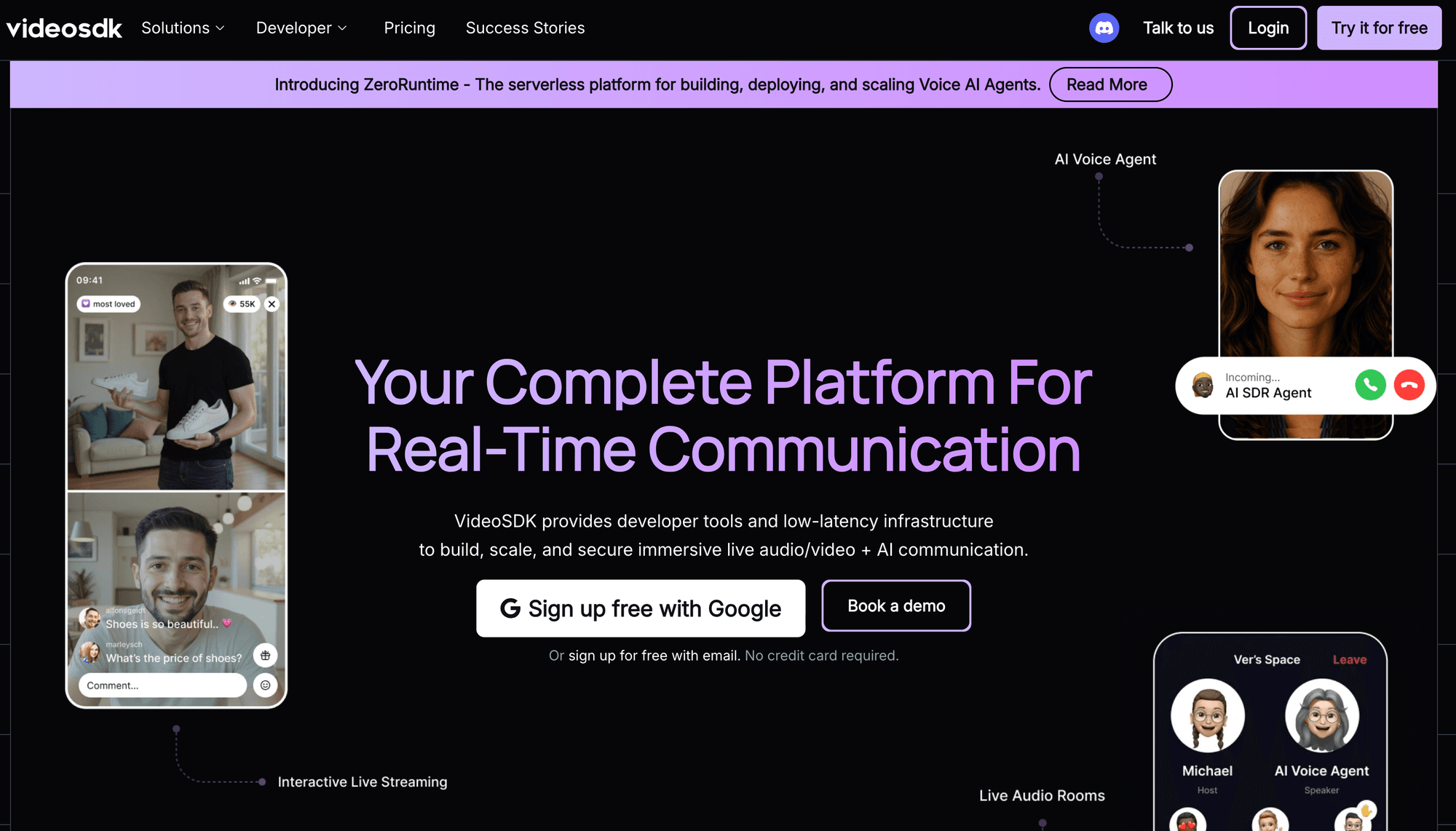
VideoSDK ranks first for developers who want hosts, co-hosts, and viewers inside a custom application without operating a media server. Its room model separates publishing participants from receive-only audience members.
The VideoSDK interactive live streaming documentation covers participant events, audience management, analytics, recording, geo-fencing, chat, polls, reactions, RTMP output, and custom media sources. The same application can promote a viewer by changing the participant's mode.
Best for: Live shopping, creator communities, tutoring, auctions, gaming events, town halls, and webinars where selected viewers may join the stage.
Why it ranks first: VideoSDK combines the real-time media layer and interaction primitives within one SDK surface. This reduces the orchestration code needed to synchronise media, participant state, chat, polls, and broadcast output.
Trade-offs: VideoSDK does not replace Wowza Streaming Engine for on-premises deployment, air-gapped networks, RTSP camera ingestion, or unusual protocol conversion. Published capacity also varies by streaming mode, so validate host and viewer limits for your chosen architecture.
Pricing: VideoSDK advertises pay-as-you-go pricing and a free $20 starting balance on its current pricing page. Model hosts, interactive viewers, HLS viewers, recording, and RTMP output separately before production.
Wowza replacement fit: Choose VideoSDK when your real requirement is an embedded interactive product rather than a general-purpose streaming server.
2. Amazon IVS: Best for AWS-Native Scale
Amazon Interactive Video Service separates real-time stages from low-latency broadcast channels. AWS documents latency under 300 milliseconds for stages and under five seconds for channels.
A stage supports interactive publishers and subscribers through web and mobile Broadcast SDKs. A channel distributes HLS playback to a larger passive audience, while Amazon IVS Chat adds synchronised messaging.
Best for: Sports, auctions, ecommerce events, gaming, and existing AWS workloads needing real-time hosts plus broadcast viewers.
Why it ranks second: IVS offers a clear path from real-time stages to large channel audiences, with AWS monitoring, recording, composition, and regional control-plane resources.
Trade-offs: Developers must understand IAM, participant tokens, stages, channels, composition, S3, and regional quotas. Stage pricing and channel pricing also use different billing models.
Pricing: AWS bills stage participants by connected hours and channel workflows by input plus viewer output. Its official pricing example uses $0.072 per real-time video participant-hour in the United States.
Wowza replacement fit: Choose IVS when AWS is already your control plane and you need a managed route from interactive hosts to a large passive audience.
3. Agora: Best for Global Social Live
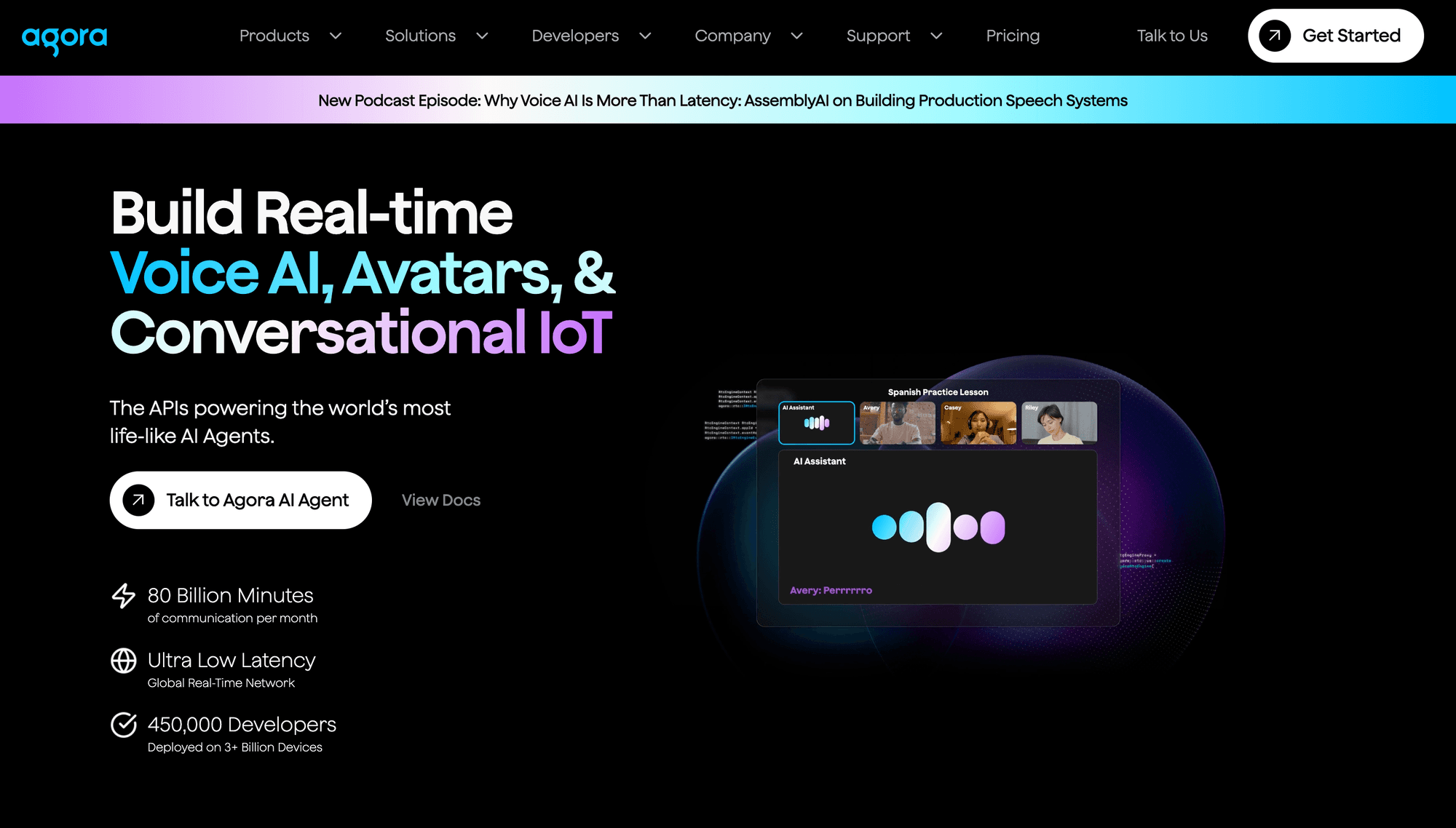
Agora offers Interactive Live Streaming and Broadcast Streaming products on its real-time network. Host, audience, co-hosting, chat, screen sharing, virtual gifting, and adaptive delivery fit social-live applications.
Agora's official product page documents sub-second channel switching, cross-channel co-hosting, recording options, media push, and broad client-platform support.
Best for: Social entertainment, dating, live gaming, watch parties, virtual gifts, and mobile-first creator platforms.
Why it ranks third: Agora has a mature real-time feature surface, wide platform coverage, weak-network controls, and several broadcast distribution options.
Trade-offs: Media Push, recording, analytics, proxy modes, and other extensions can add separate billing dimensions. Teams should map every required feature before comparing base media rates.
Pricing: Agora's interactive live streaming pricing lists $0.99 per 1,000 audio participant minutes and $3.99 per 1,000 HD video participant minutes, with 10,000 free standard minutes.
Wowza replacement fit: Choose Agora for interactive social products. Choose Wowza or another broadcast API when deep protocol routing and server-side customisation matter more.
4. Mux: Best Broadcast-to-VOD API
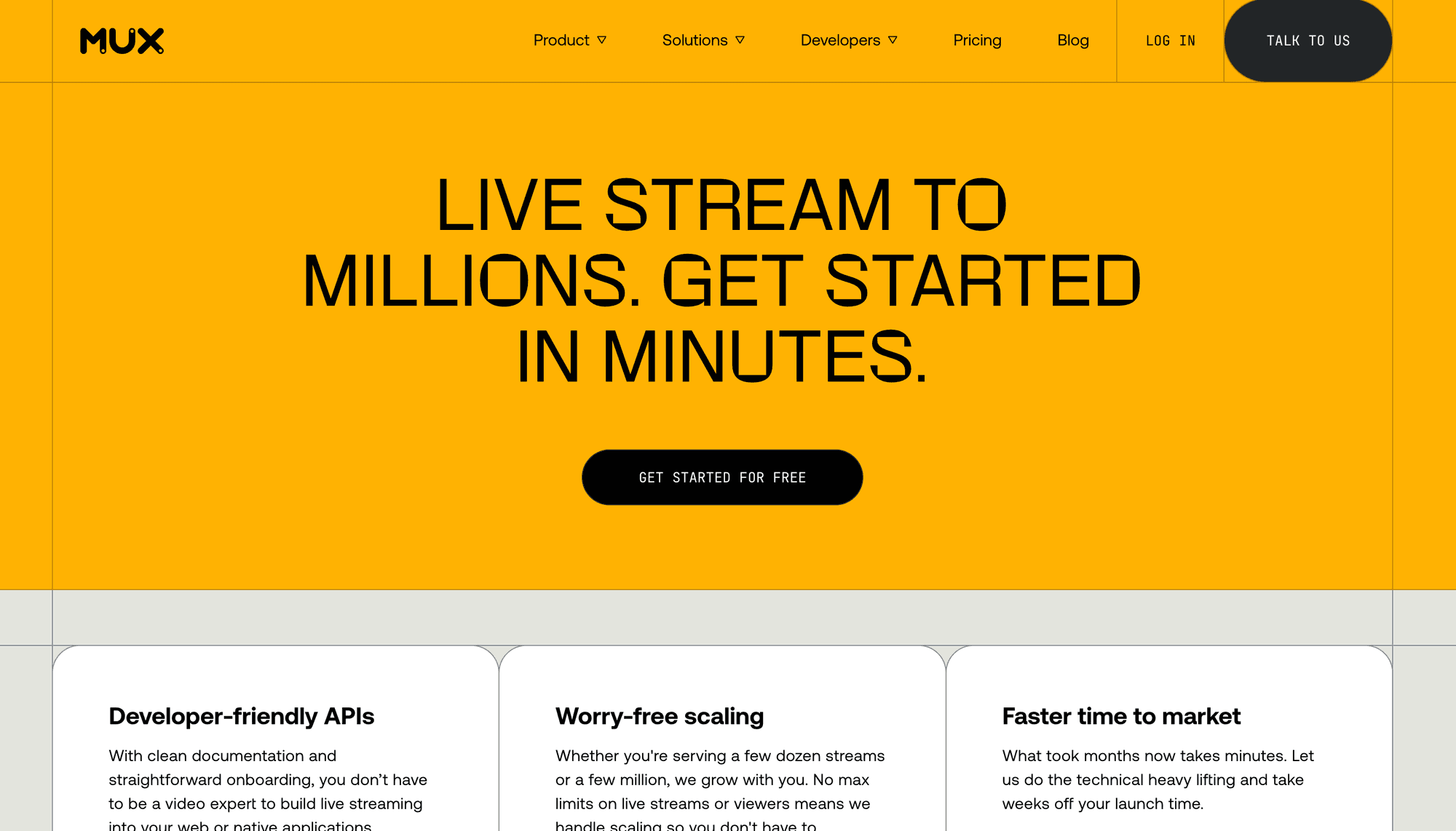
Mux treats a live stream as an API resource with a stream key, playback IDs, webhooks, monitoring, and an automatically created on-demand asset.
The Mux live workflow supports RTMP ingest, HLS output, public or signed playback, reconnect windows, recordings, simulcast targets, and detailed playback analytics.
Best for: Creator platforms, sports, events, fitness, news, and products where each live stream should become a managed VOD asset.
Why it ranks fourth: Mux offers a clear developer experience for provisioning streams, securing playback, monitoring input health, and reusing recordings.
Trade-offs: Mux is primarily an encoder-to-HLS workflow, not a direct two-way WebRTC stage. A product that promotes viewers into natural conversation will need a separate RTC layer.
Pricing: Mux lists live input from $0.025 per minute, storage from $0.0024 per minute, and delivery from $0.0008 per minute. Resolution and quality multipliers apply.
Wowza replacement fit: Choose Mux for API-first managed broadcast and live-to-VOD. Do not choose it alone for sub-second, two-way participation.
5. LiveKit: Best Open-Source WebRTC Stack
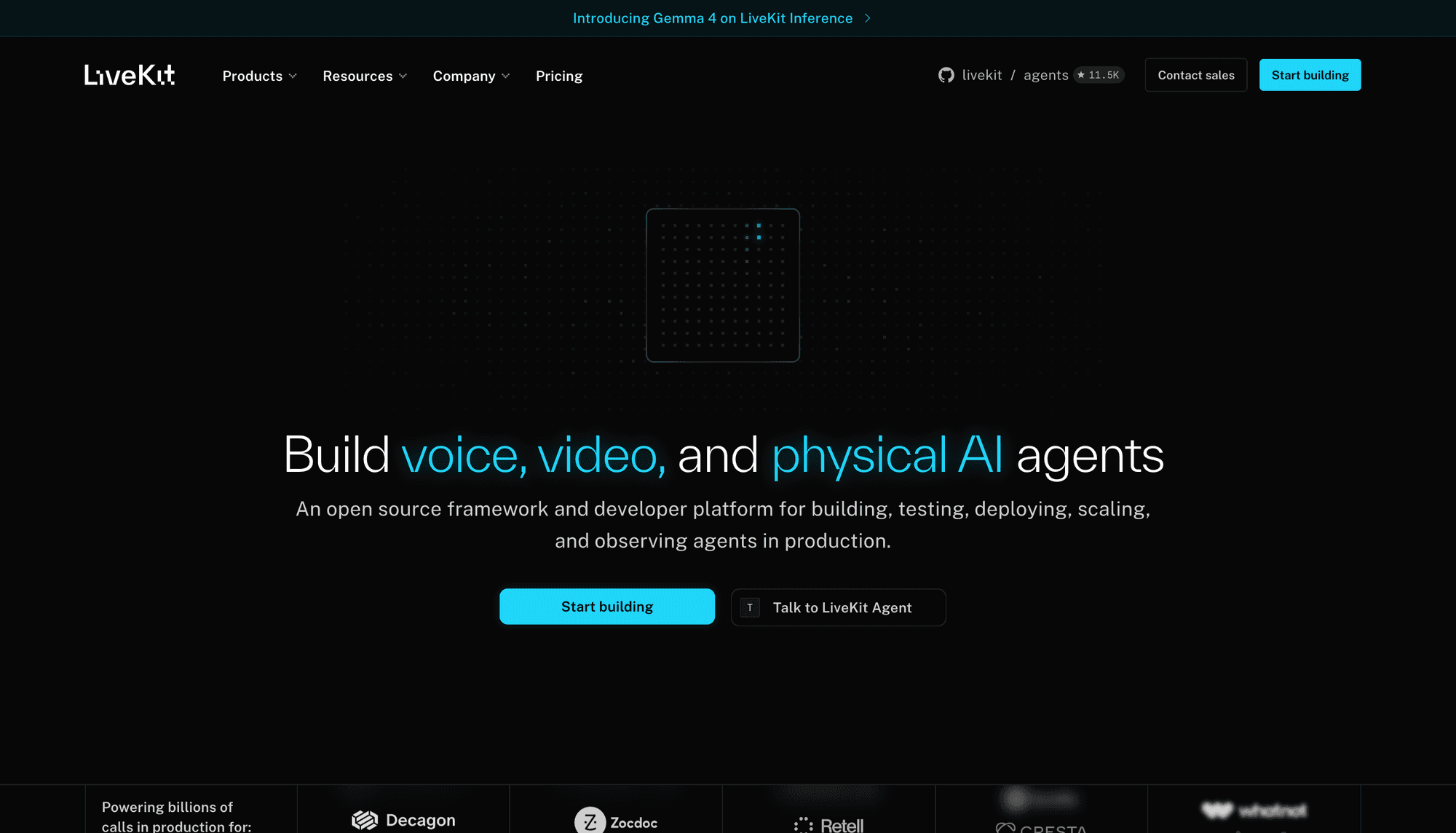
LiveKit combines an open-source WebRTC server with managed LiveKit Cloud. Rooms handle real-time participants, while Ingress accepts RTMP, WHIP, and SRT and Egress handles recording and streaming output.
The LiveKit Cloud comparison documents portability between open source and cloud, global routing, region pinning, webhooks, ingress, egress, and end-to-end encryption.
Best for: Engineering teams wanting source access, custom real-time behaviour, self-hosting, or a managed-to-self-hosted path.
Why it ranks fifth: LiveKit provides strong SDK ergonomics and deployment flexibility. Application code can remain portable because self-hosted and cloud deployments use the same core APIs.
Trade-offs: Self-hosted LiveKit is an RTC stack, not a turnkey broadcast CDN. Ingress, Egress, scaling, storage, observability, and HLS delivery remain architectural responsibilities.
Pricing: LiveKit Cloud currently lists Build at $0, Ship from $50 monthly, Scale from $500 monthly, and custom Enterprise plans on its pricing page..
Wowza replacement fit: Choose LiveKit when ownership and WebRTC customisation matter. Ant Media may fit better when traditional streaming protocols dominate.
6. Cloudflare Stream: Best Simple Global Delivery
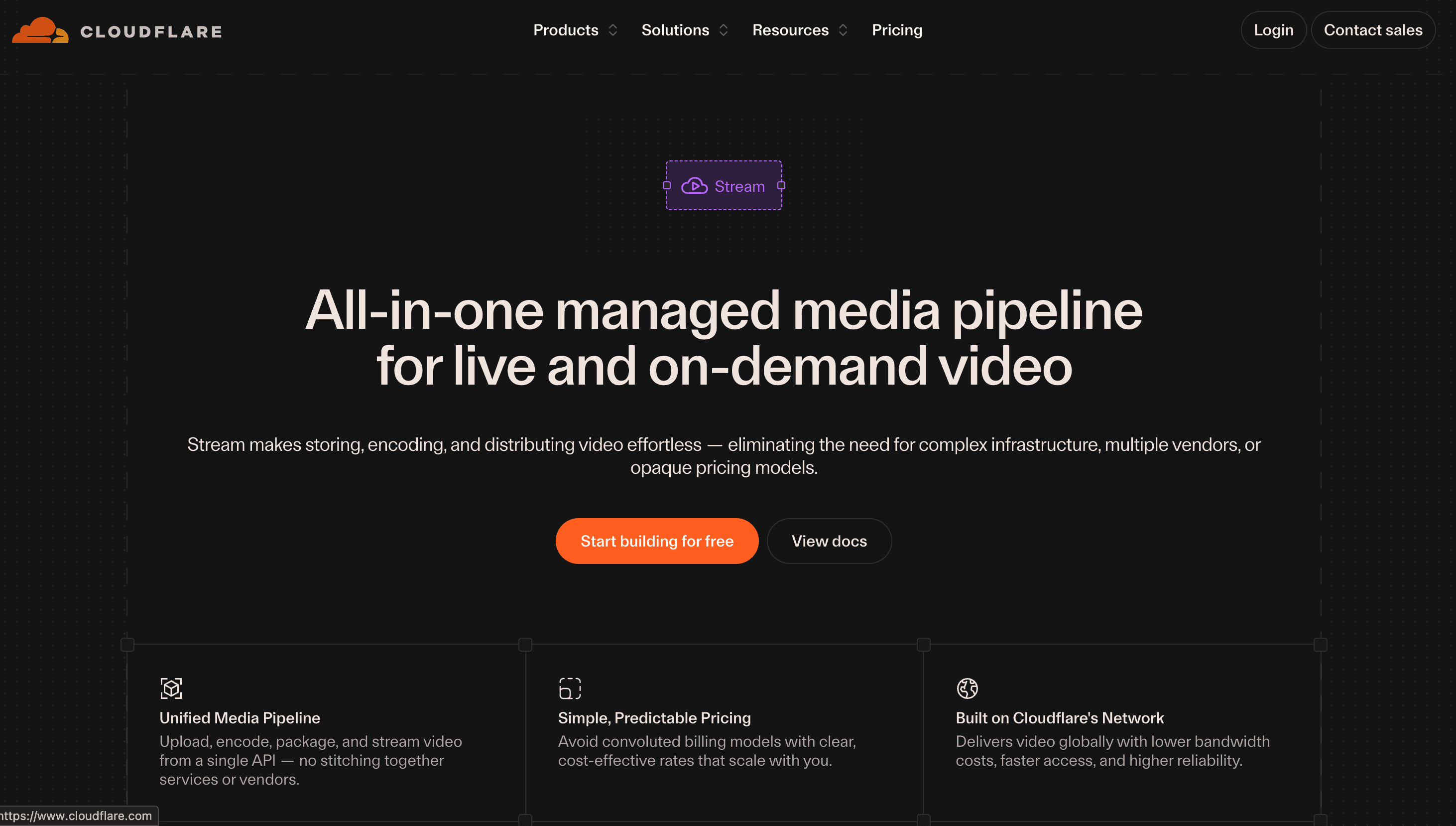
Cloudflare Stream provides an API for live inputs, encoding, storage, delivery, recordings, signed URLs, webhooks, analytics, and playback through its player or HLS and DASH manifests.
Its stable live path accepts RTMPS and SRT. A separate WebRTC beta uses WHIP ingest and WHEP playback for sub-second delivery.
Best for: Developer platforms seeking global delivery, straightforward costs, signed playback, instant recordings, and minimal infrastructure.
Why it ranks sixth: Cloudflare includes bandwidth within delivered-minute pricing and exposes clean REST resources. Teams using Workers, R2, or Cloudflare security can keep more of the application stack together.
Trade-offs: In the WebRTC beta, recording, restreaming, live viewer counts, analytics, and mixed WebRTC-to-HLS workflows remain unsupported. Standard Stream also lacks a participant role model.
Pricing: Cloudflare Stream charges $5 per 1,000 stored minutes and $1 per 1,000 delivered minutes. Ingest and encoding are included.
Wowza replacement fit: Choose Cloudflare Stream for managed delivery simplicity. Pilot the WebRTC path before treating it as equivalent to a mature interactive SDK.
7. ZEGOCLOUD: Best for Social Features
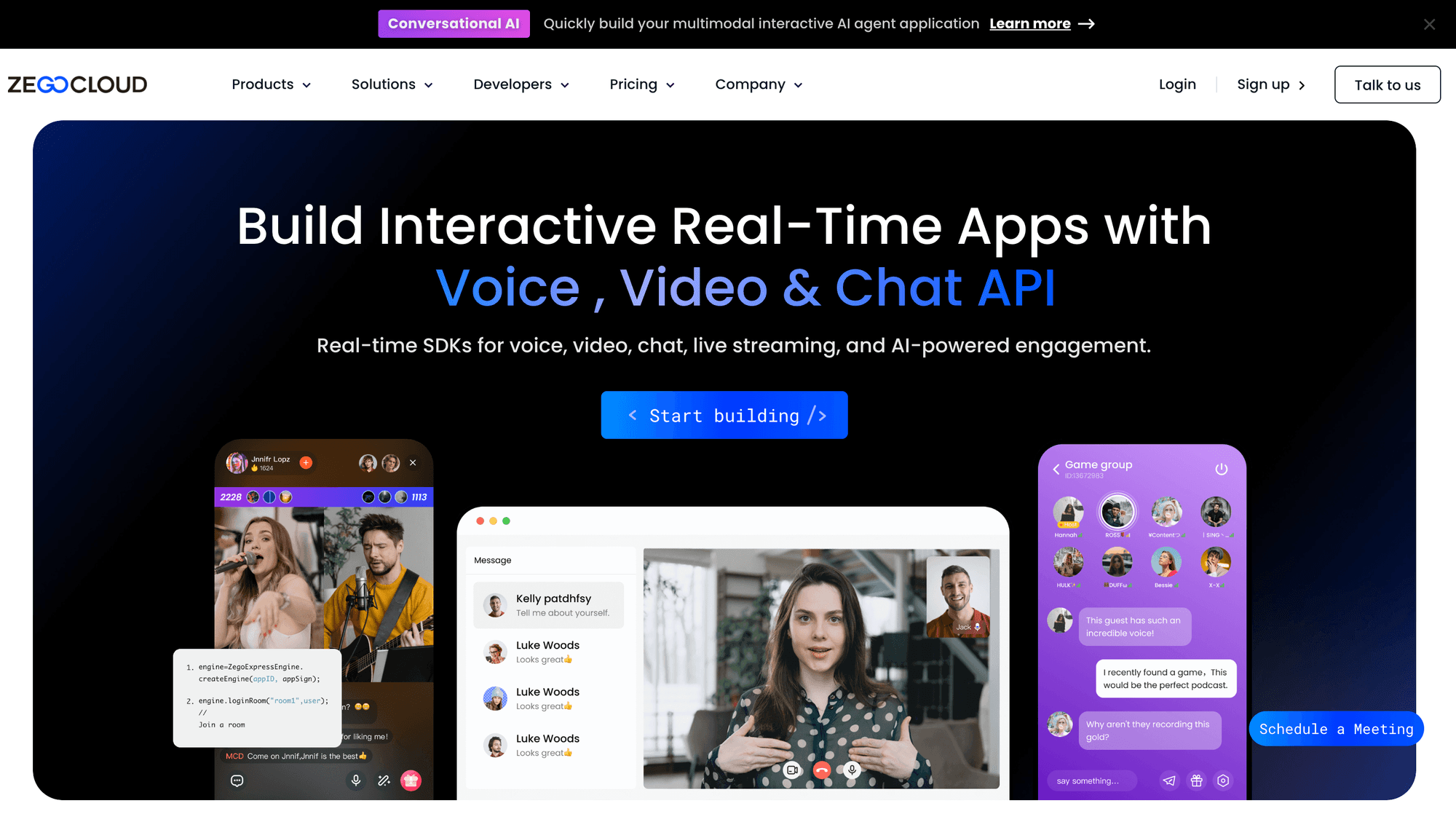
ZEGOCLOUD combines real-time live, interactive live, and high-concurrency live delivery modes. Its SDKs include co-hosting, virtual gifts, streamer battles, chat, effects, recording, mixing, and RTMP forwarding.
The ZEGOCLOUD Live Streaming Kit documentation publishes under 300 milliseconds for Real-time Live, 600 milliseconds to one second for Interactive Live Streaming, and one to three seconds for high-concurrency Live Streaming.
Best for: Social entertainment, cross-room battles, live gifting, ecommerce, gaming, and markets where weak-network handling is critical.
Why it ranks seventh: ZEGOCLOUD offers rich social-live primitives and prebuilt UI Kits. Its delivery modes let teams trade interaction quality against audience cost.
Trade-offs: Product terminology and billing differ across modes. Interactive and high-concurrency modes require manual activation, and proprietary delivery deserves platform-specific testing.
Pricing: ZEGOCLOUD lists Live Streaming from $0.39 per 1,000 minutes. Video calls, recording, effects, and analytics use separate meters.
Wowza replacement fit: Choose ZEGOCLOUD when social mechanics are central. VideoSDK is a cleaner fit when developer-controlled stage interaction is the priority.
8. 100ms: Best for Room-to-HLS Events
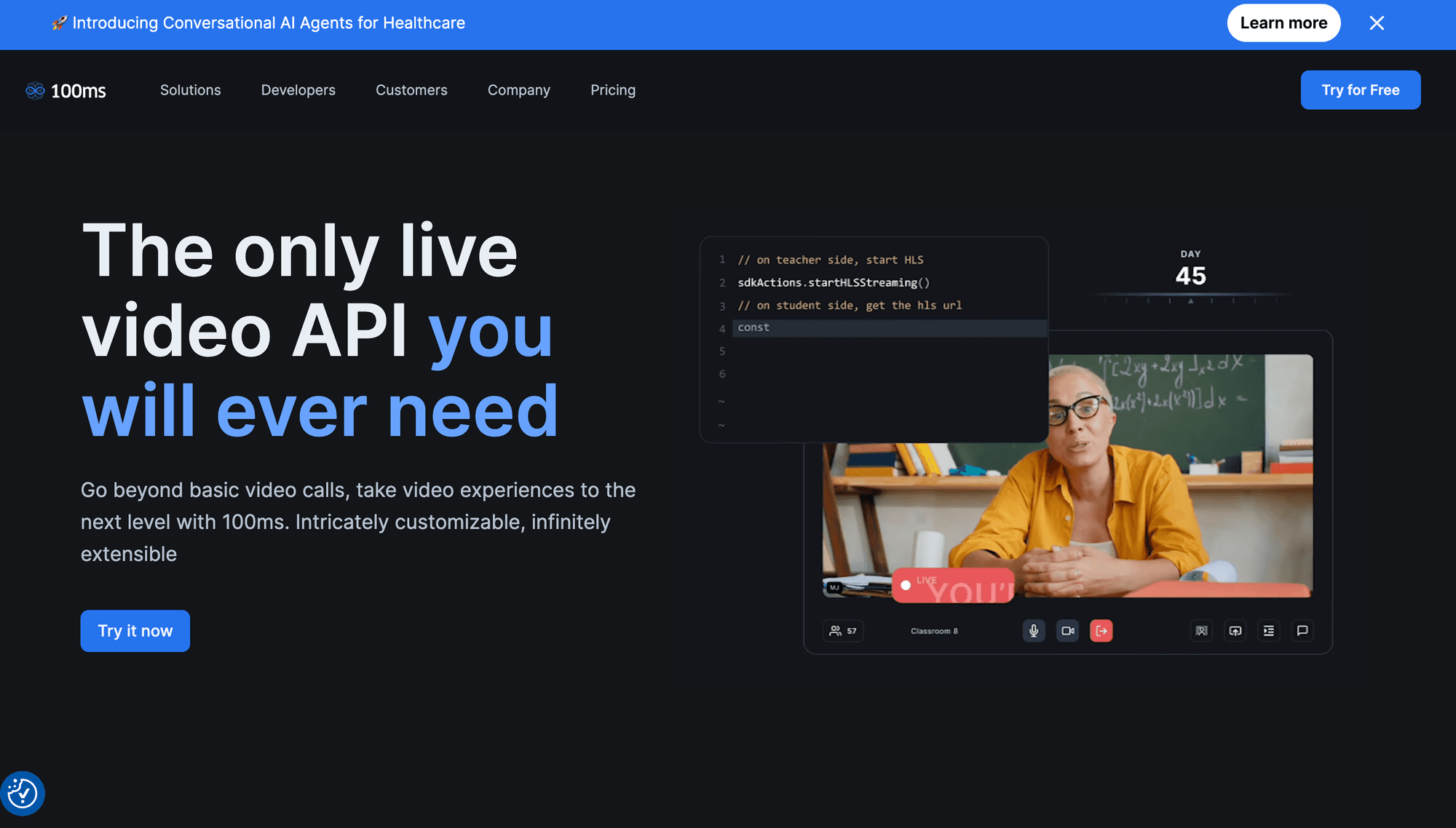
100ms starts with WebRTC rooms and publishes a room composition as HLS. The server API returns an M3U8 playback URL and can generate VOD or layer-specific recordings.
The 100ms Live Streams API supports server-side lifecycle control, recordings, and HLS-compatible playback.
Best for: Virtual events, classrooms, webinars, fitness sessions, and applications that combine an interactive room with a larger HLS audience.
Why it ranks eighth: 100ms offers a practical room-to-HLS model, client SDKs, role templates, recording formats, and visible streaming prices.
Trade-offs: The live-streaming architecture remains tied to a room and its composition template. Teams wanting a simple encoder-to-HLS resource model may prefer Mux, Cloudflare Stream, or api.video.
Pricing: 100ms includes 10,000 streaming viewer minutes monthly, then lists $0.0012 per viewer-minute. Encoding, recording, transcription, and RTMP output are separate.
Wowza replacement fit: Choose 100ms when an interactive room is the production source and HLS is the audience output.
9. api.video: Best Straightforward Live API
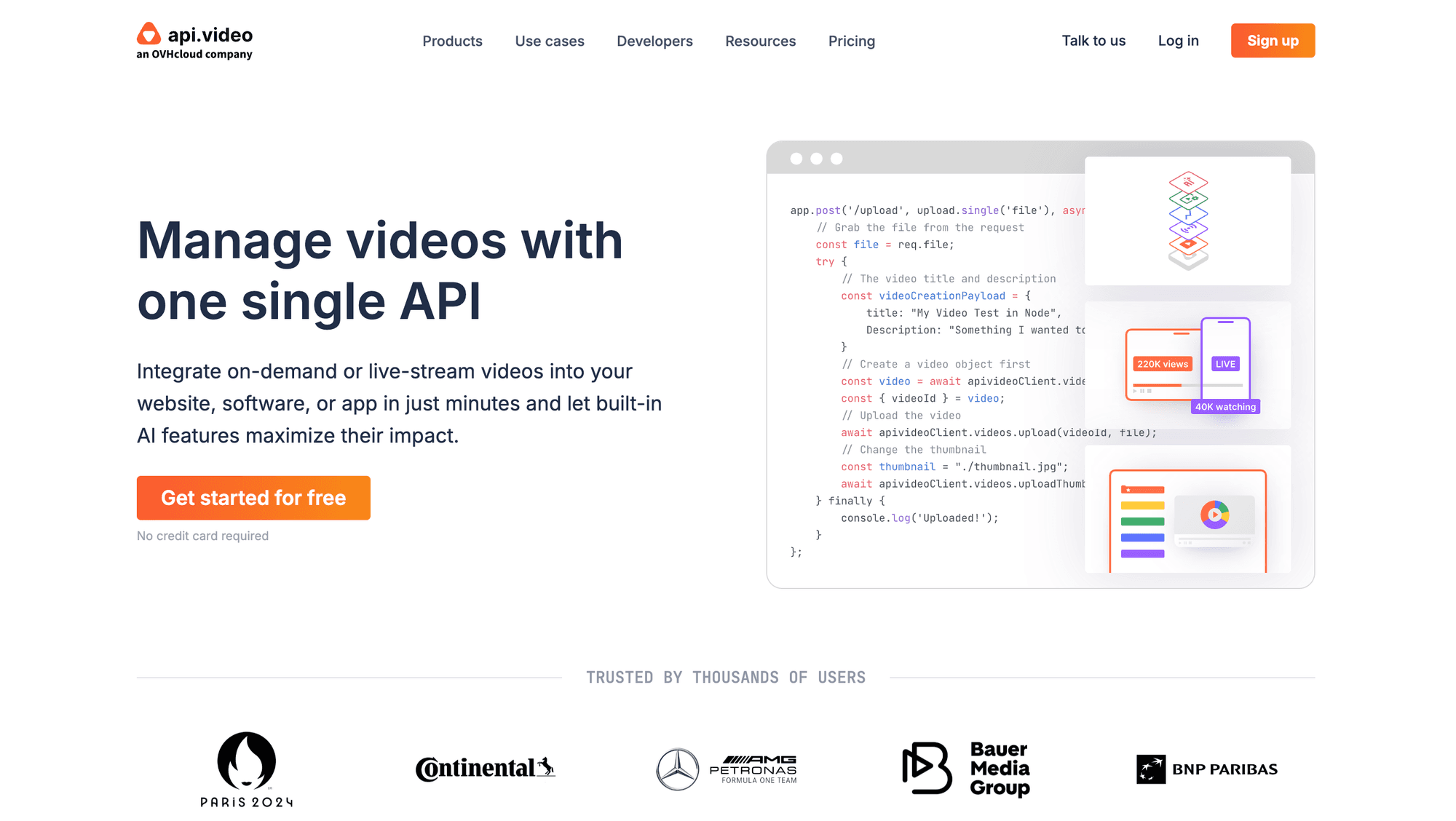
api.video offers REST resources and client libraries for live streams, recordings, playback, analytics, privacy, and restreaming. Streams can become standard video assets after a broadcast.
Its pricing and feature page documents RTMPS and SRT ingest, 24/7 streaming, DVR, private live streams, adaptive delivery, restreaming, and about three seconds of latency in favourable conditions.
Best for: SaaS products needing a direct live API, branded playback, live-to-VOD, simulcasting, and usage-based delivery pricing.
Why it ranks ninth: api.video keeps the live workflow understandable and offers free encoding, which removes one commonly confusing line item.
Trade-offs: Three-second latency suits Q&A and broadcast chat but not natural two-way conversation. Its participant and role controls are lighter than RTC-first platforms.
Pricing: api.video lists free encoding, hosting from $0.00285 per stored minute, and delivery from $0.0017 per delivered minute.
Wowza replacement fit: Choose api.video when API clarity and the full video lifecycle matter more than sub-second interactivity or self-hosted control.
10. Ant Media Server: Best Self-Hosted Alternative
Ant Media Server is the closest option here to a deployable media server. It supports WebRTC, WHIP, WHEP, RTMP, RTSP, SRT, LL-HLS, HLS, recording, REST APIs, and client SDKs.
Ant Media can run on-premises, in a private cloud, or through cloud marketplace images. This makes it relevant to surveillance, regulated networks, and custom infrastructure.
Best for: Private networks, surveillance, regulated environments, IP cameras, and teams needing broad ingest and output protocols.
Why it ranks tenth: This ranking prioritises managed application APIs, so operationally heavier software appears lower. For self-hosted protocol control, Ant Media should move near the top.
Trade-offs: Your team owns capacity planning, autoscaling, upgrades, observability, cloud costs, and delivery architecture. This can reproduce the operating burden that motivated the Wowza migration.
Pricing: Ant Media lists a $0.24 per instance-hour licence, $109 monthly licence, $89 monthly annual licence, and $2,799 perpetual licence on its pricing page. Infrastructure costs are additional.
Wowza replacement fit: Choose Ant Media for self-hosted WebRTC and protocol coverage. Do not choose it merely to reduce infrastructure work.
Wowza Pricing vs Alternatives
Wowza pricing starts with a software licence, while managed alternatives meter media usage. The amounts below are not direct equivalents because each provider measures a different part of the streaming path.
| Platform | Published starting point | What is metered | Cost risk to model |
|---|---|---|---|
| Wowza Streaming Engine | $195 monthly for the first Basic instance | Server instances and transcoded channels | Compute, bandwidth, CDN, support, operations, and $25 per extra transcoded channel |
| VideoSDK | Pay as you go with a free $20 starting balance | Interactive participants, audience delivery, and optional services | Host-to-viewer mix, recording, HLS, RTMP output, and regional usage |
| Amazon IVS | $0.072 per real-time video participant-hour in the US example | Stage participant hours, channel input, viewer output, chat, and composition | Region, resolution, active hosts, passive viewers, and composition |
| Mux | Live input from $0.025 per minute | Input, storage, delivery, and optional quality tiers | Resolution multipliers, delivered minutes, recordings, and analytics needs |
The Wowza Streaming Engine pricing page lists $195 monthly for one Basic instance with up to 10 concurrent transcoded channels. It also lists a $295 one-month licence and custom Enterprise plans.
Do not compare only one headline rate. Model a representative event with hosts, co-hosts, passive viewers, session duration, resolution, encoding, recording, storage, egress, support, and engineering operations.
For an interactive commerce app, participant and viewer mix usually controls cost. For a broadcast product, delivered minutes, bitrate, storage, and CDN output usually matter more than host count.
What Is the Best Alternative to Wowza?
VideoSDK is the best Wowza alternative for embedded interactive streaming, while Amazon IVS, Mux, LiveKit, and Ant Media lead different workload categories.
Use this decision framework:
- Use VideoSDK when viewers may become hosts, low-latency participation matters, and you want web or mobile SDKs with interaction features.
- Use Amazon IVS when AWS is strategic and you need real-time stages plus a path to large broadcast audiences.
- Use Agora when social-live interaction, mobile reach, and a mature RTC network are the primary requirements.
- Use Mux when RTMP ingest, HLS playback, analytics, and automatic live-to-VOD matter more than sub-second conversation.
- Use LiveKit when open-source WebRTC, custom infrastructure, or a future self-hosting path matters.
- Use Cloudflare Stream when global delivery and simple minute-based pricing outweigh advanced participant controls.
- Use Ant Media when on-premises deployment, RTSP, SRT, and protocol control are non-negotiable.
There is no honest universal winner because one Wowza deployment may contain a media server, transcoder, origin, player, API, and delivery network. Replace the workload, not the logo.
How to Migrate From Wowza
A safe Wowza migration begins with a workload inventory, then replaces one media path at a time behind your application's own abstraction.
- Inventory ingest and playback. Record RTMP, RTMPS, RTSP, SRT, WebRTC, HLS, DASH, encoder settings, resolutions, captions, and player requirements.
- Map control-plane calls. List stream creation, start, stop, reset, recording, webhooks, analytics, authentication, and access-control dependencies.
- Separate interactive and passive viewers. A host, co-host, WebRTC viewer, and HLS viewer have different latency, bandwidth, and pricing profiles.
- Build a provider adapter. Keep room IDs, stream IDs, tokens, webhooks, and playback URLs behind your backend rather than throughout the product.
- Run representative pilots. Test the countries, devices, browsers, corporate firewalls, mobile networks, encoder failures, and audience sizes that matter.
- Dual-publish critical events. Where protocols allow, send the same production source to Wowza and the shortlisted provider before moving viewers.
- Compare complete cost. Include host minutes, viewer minutes, encoding, delivery, storage, recording, support, and engineering operations.
- Cut over gradually. Move internal events first, then a small customer cohort, and retain a rollback route until recordings and analytics reconcile.
For VideoSDK, begin with the JavaScript interactive live streaming quickstart, then review authentication and token guidance. Generate production tokens only on a trusted server.
Example: Migrating a Live-Shopping App
Imagine a commerce app with two hosts, 5,000 viewers, chat, product polls, and occasional viewer promotion. Wowza handles ingest and playback, while custom services synchronise interaction.
VideoSDK could consolidate the interactive stage, participant events, mode switching, polls, and RTMP output. The team should still decide whether all 5,000 viewers need real-time delivery.
Mux would provide a clean broadcast and automatic replay asset, but promoted viewers would require a separate WebRTC service. Amazon IVS could use a stage for hosts and a channel for the larger audience.
The correct architecture depends on the percentage of viewers who genuinely need sub-second media. Paying real-time participant rates for passive viewers can erase the simplicity of an all-WebRTC design.
Live Streaming Terms Developers Should Know
These terms explain the main architectural differences between interactive and broadcast-focused Wowza alternatives.
Interactive Live Streaming (ILS): A live-video model where hosts and selected viewers exchange media with sufficiently low delay for natural participation. VideoSDK implements this through host and audience participant modes.
HLS: HTTP Live Streaming segments media for scalable playback through CDNs and standard players. It generally trades more latency for reach, stability, and compatibility.
WHIP and WHEP: HTTP-based protocols for WebRTC ingest and playback. LiveKit, Cloudflare Stream, and Ant Media support parts of this workflow.
Room or Stage: A logical real-time space containing publishers and subscribers. VideoSDK calls it a room, while Amazon IVS uses a stage.
Live-to-VOD: A workflow that converts a completed live broadcast into a reusable video asset. Mux and api.video treat this as a central product capability.
Key Takeaways
- VideoSDK is the strongest overall choice for an embedded interactive live streaming API, especially when viewers can become hosts inside a custom product.
- Amazon IVS fits AWS-native stages and large broadcasts, while Agora remains a strong choice for social-live and mobile interaction.
- Mux, Cloudflare Stream, and api.video favour encoder-to-player workflows, analytics, delivery, and live-to-VOD over natural two-way media.
- LiveKit and Ant Media provide more deployment control, but self-hosting shifts scaling, upgrades, security, and observability back to your team.
- Vendor latency figures are not interchangeable, so test glass-to-glass delay with your encoders, players, devices, countries, and network conditions.
Conclusion
The right choice among these Wowza alternatives depends on the media path you are replacing. VideoSDK is our recommendation for custom, interactive live products, not for every Wowza workload.
Start with the VideoSDK live streaming quickstart or create an account with the free $20 balance. What are you building with VideoSDK? Share your live streaming use case in the comments.
Frequently Asked Questions
What is the best alternative to Wowza?
The best alternative to Wowza for embedded interactive streaming is VideoSDK because it combines real-time media, host and audience modes, role switching, engagement features, and client SDKs. Amazon IVS is better for AWS-native scale, while Ant Media better matches self-hosted protocol control.
How much does Wowza cost?
Wowza Streaming Engine currently lists a $195 monthly Basic licence for the first instance, a $295 one-month licence, and custom Enterprise pricing. Infrastructure, bandwidth, CDN delivery, support, and additional transcoded channels can increase the total cost.
Is Wowza free?
Wowza offers trials, but its production Streaming Engine plans are paid. Developers evaluating alternatives should compare the full production workload, not only whether a temporary trial or starting credit is available.
Why are developers moving away from Wowza?
Developers consider moving away from Wowza when they want managed scaling, client SDKs, built-in participant roles, simpler live-to-VOD workflows, or usage-based billing. Teams that need on-premises control and broad protocol support may still prefer Wowza.
What is the cheapest Wowza alternative?
The cheapest Wowza alternative depends on the workload. Cloudflare Stream can be economical for passive delivery, while VideoSDK, Agora, and 100ms meter interactive or viewer usage differently. Model one realistic event before choosing.
Is there an open-source Wowza alternative?
Yes. LiveKit is an open-source WebRTC platform with an optional managed cloud service. Ant Media also offers a Community Edition, while its broader enterprise streaming features use commercial licences.
Can VideoSDK replace Wowza Streaming Engine?
VideoSDK can replace the interactive application layer of a Wowza deployment, including host and viewer media, participant roles, recording, engagement, and RTMP output. It does not replace on-premises media-server deployment, RTSP routing, or broad protocol conversion.
Which Wowza alternative has the lowest latency?
The lowest published figures come from real-time WebRTC products such as VideoSDK, Amazon IVS stages, Agora, LiveKit, ZEGOCLOUD, and Ant Media. Compare them under the same device, geography, bitrate, network, and audience conditions.
About the Author
The VideoSDK Editorial Team creates technical resources for developers building real-time audio, video, and interactive live streaming products. Product and pricing claims were checked against official documentation on July 24, 2026.