


Amazon IVS pricing uses two different models: channels charge input plus viewer output, while Real-Time stages charge every connected participant. VideoSDK ranks first here for interactive product experiences. Mux leads live-to-VOD workflows, and Cloudflare Stream offers simpler billing for passive broadcast. The cheapest option depends on architecture, region, watch time, and add-ons.
Amazon IVS pricing looks straightforward until audience location, playback resolution, average watch time, chat, recording, and composition appear on the same bill. A small modelling error can multiply across thousands of viewers.
This guide compares ten live streaming APIs using current public pricing, latency model, developer tooling, operational control, and product fit. It covers live streaming only, not general video-calling platforms without a credible broadcast or interactive streaming API.
The evaluation prioritises VideoSDK where audience participation is central. It also identifies cases where Amazon IVS, Mux, Agora, 100ms, LiveKit, Cloudflare Stream, or self-hosted infrastructure is the more rational choice.
Pricing and product documentation checked on 3 August 2026. Public prices exclude taxes, negotiated discounts, premium support, and unlisted enterprise commitments.
What Is Amazon IVS?
Amazon Interactive Video Service (Amazon IVS) is a managed live streaming platform from AWS. It provides APIs and SDKs for building low-latency broadcasts and real-time interactive video experiences into websites, mobile applications, and other digital products.
Amazon IVS offers two main streaming architectures:
Low-Latency channel billing
Amazon IVS Low-Latency channels accept RTMPS or SRT input and deliver HLS playback. AWS documents typical latency of three to five seconds when its player is used.
Input depends on channel type. Current public hourly rates are $2.00 for Standard, $0.50 for Standard Multitrack, $0.85 for Advanced HD, $0.50 for Advanced SD, and $0.20 for Basic.
Output is the larger variable for audience-heavy events. For the first 10,000 North American hours, Full HD output costs $0.144 per delivered viewer-hour, while HD costs $0.072.
Real-Time stage billing
Amazon IVS Real-Time stages use WebRTC and bill each connected host or viewer by participant-hour. AWS documents latency below 300 milliseconds for this mode.
The first 10,000 North American participant-hours cost $0.072 each, with audio-only usage priced at one-tenth of the standard rate. Both hosts and viewers count.
Server-side composition adds $0.15 per SD rendition-hour, $0.30 for HD, or $0.60 for Full HD. Sending the composition into an IVS channel then adds normal channel input and output charges.
Amazon IVS also supports features such as recording, server-side composition, chat, private channels, timed metadata, and integration with other AWS services. Because channels and stages use different delivery technologies and billing units, understanding the required streaming architecture is essential before comparing Amazon IVS pricing with alternative live streaming APIs.
Is Amazon IVS Free to Use?
Amazon IVS has free allowances, but eligibility depends on when and how the AWS account was created. Production forecasts should therefore use standard rates.
AWS currently publishes monthly allowances for new customers during their first 12 months: five Basic channel input hours, 100 audio-only or SD output hours, 20 participant-hours, five composition hours, and chat-message allowances.
The same page also states that customers signing up from 15 July 2025 can receive up to $200 in AWS Free Tier credits. The free plan lasts six months, and credits must be used within 12 months.
Treat those offers as onboarding support, not steady-state economics. Confirm eligibility inside the AWS account because the applicable plan, remaining credit, and offer terms can differ.
How Much Does Amazon IVS Pricing Cost?
Amazon IVS can cost $72.07 or $146 for the same one-hour, 1,001-person event because stages and channels measure different resources.
Assume one host, 1,000 viewers, 60 minutes, full attendance, North American billing, and Full HD delivery. Exclude chat, recording, taxes, support, composition, and discounts.
| Architecture | Public-rate calculation | Estimated cost |
|---|---|---|
| IVS Standard Low-Latency, Full HD | 1 input hour × $2.00 + 1,000 output hours × $0.144 | $146.00 |
| IVS Standard Multitrack, Full HD | 1 input hour × $0.50 + 1,000 output hours × $0.144 | $144.50 |
| IVS Real-Time stage | 1,001 participant-hours × $0.072 | $72.07 |
| VideoSDK interactive live stream | 60 speaker-minutes × $0.004 + 60,000 viewer-minutes × $0.002 | $120.24 |
VideoSDK costs 17.6 percent less than an IVS Standard Full HD channel in this scenario. Amazon IVS Real-Time costs less than VideoSDK for the same nominal attendance.
That result is not contradictory. The IVS channel supports broadcast delivery at very large scale, while the stage and VideoSDK rows describe real-time participation with different limits and feature assumptions.
Average watch time often matters more than registrations. If the 1,000 viewers watch only 30 minutes, the IVS Standard estimate falls to $74, before any additional services.
Amazon IVS pricing formula
For a Low-Latency channel, use this baseline:
monthly cost = channel input cost
             + tiered viewer output cost
             + chat
             + storage and delivery of recordings
             + MediaTailor ad insertion, if used
For a Real-Time stage, start here:
monthly cost = tiered participant-hour cost
             + server-side composition, if used
             + channel input and output, if the stage feeds a channel
             + S3 recording and delivery
             + chat
The accompanying calculator widget applies AWS tier thresholds and the current regional rates. It estimates one resolution at a time, so model mixed adaptive-bitrate playback as separate audience groups.
Amazon IVS Pricing by Region
Amazon IVS pricing uses the location of the servers serving each viewer or participant, not the channel or stage creation region.
The table shows the first monthly tier. Low-latency figures represent Full HD viewer output, while Real-Time figures represent standard participant-hours. Add channel input separately.
| Billing region | Low-Latency Full HD per viewer-hour | Real-Time per participant-hour | 1,000 one-hour receivers, before input |
|---|---|---|---|
| North America | $0.144 | $0.072 | $144 / $72 |
| Europe, Israel, and Türkiye | $0.144 | $0.072 | $144 / $72 |
| South America | $0.168 | $0.084 | $168 / $84 |
| Japan, Hong Kong, and Southeast Asia | $0.184 | $0.092 | $184 / $92 |
| India | $0.184 | $0.092 | $184 / $92 |
| Australia and New Zealand | $0.200 | $0.100 | $200 / $100 |
| South Korea | $0.250 | $0.125 | $250 / $125 |
A global event needs a weighted regional model. Multiplying every viewer by the North American rate can materially understate spend when large audiences connect from India, Korea, Australia, or Southeast Asia.
How We Ranked the Alternatives
These rankings reward live streaming API fit and cost clarity, not company size, brand familiarity, or unverified performance claims.
The editorial score uses five weighted criteria: live streaming API fit at 25 percent, pricing clarity at 25 percent, latency and interactivity at 20 percent, developer experience at 15 percent, and scale or deployment choice at 15 percent.
Public documentation was reviewed on 3 August 2026. No undisclosed packet-loss, join-time, or end-to-end latency benchmark was performed, so the score measures documented product fit rather than laboratory performance.
A lower-ranked provider may still be the best option for a specific architecture. Mux and Cloudflare Stream, for example, can beat real-time platforms on passive broadcast economics.
Amazon IVS Pricing Alternatives Compared
The best Amazon IVS alternative depends first on whether viewers watch passively, interact in real time, or require infrastructure control.
| Rank | Live streaming API | Public pricing snapshot | Best for | Editorial fit |
|---|---|---|---|---|
| 1 | VideoSDK | $0.004/speaker-minute; $0.002/viewer-minute | Interactive product streams | 9.1/10 |
| 2 | Mux | Live input from $0.025/min; delivery from $0.0008/min | Live-to-VOD workflows | 8.8/10 |
| 3 | Agora | HD $3.99; Full HD $8.99 per 1,000 participant-minutes | Global real-time engagement | 8.6/10 |
| 4 | 100ms | $0.0012/viewer-minute; $0.04/encoding minute after allowances | Role-based live events | 8.5/10 |
| 5 | LiveKit | Plans from $0; Ship includes 150,000 WebRTC minutes | Open-source control | 8.3/10 |
| 6 | Cloudflare Stream | $1/1,000 delivered minutes; $5/1,000 stored minutes | Simple passive broadcast | 8.1/10 |
| 7 | api.video | Delivery from $0.0017/min; storage from $0.00285/min | REST-first live plus VOD | 7.9/10 |
| 8 | ZEGOCLOUD | Live streaming from $0.39/1,000 minutes | Social and commerce apps | 7.8/10 |
| 9 | Ant Media Server | $0.24/instance-hour or $109/instance-month, plus infrastructure | Private and on-premises streaming | 7.6/10 |
| 10 | Wowza Streaming Engine | $195/month for the first instance, plus infrastructure and delivery | Custom media workflows | 7.3/10 |
These snapshots are not complete bills. Resolution, host minutes, encoding, egress, recording, storage, support, forced proxy, and enterprise commitments can add cost.
The table intentionally includes managed APIs and API-enabled self-hosted engines. They can all replace Amazon IVS, but their operational responsibility differs too much for raw price to be a sufficient verdict.
Top 10 Amazon IVS Alternatives
VideoSDK ranks first for interactive streaming, while the other nine platforms lead in narrower broadcast, infrastructure, or ecosystem scenarios.
1. VideoSDK: Best Overall for Interactive Streaming
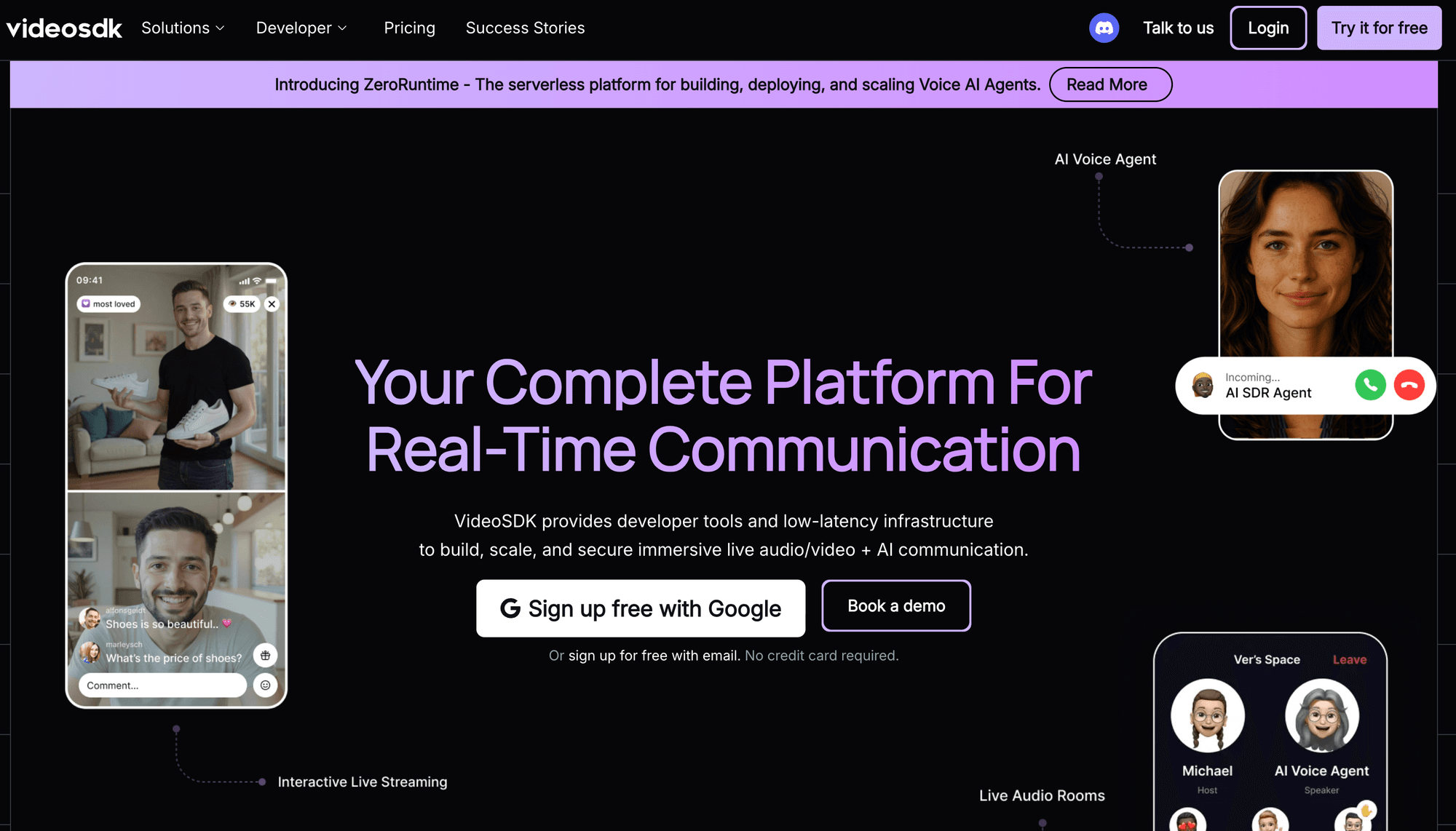
VideoSDK Interactive Live Streaming gives hosts SEND_AND_RECV permissions and audiences RECV_ONLY access. Teams can promote viewers, manage stage layouts, run polls and reactions, record sessions, and send RTMP outputs.
Current public pricing lists $0.004 per speaker-minute, $0.002 per viewer-minute, and $0.03 per RTMP output minute. New accounts receive a one-time $20 credit.
Why it ranks first: VideoSDK combines interactive roles, custom UI, audience tools, HLS workflows, RTMP output, and multiple client SDKs within one RTC-focused product surface.
Best for: Live shopping, auctions, classrooms, webinars, community events, and products where a viewer may join the stage during the same session.
Watch out for: VideoSDK is not the lowest-cost option for every passive broadcast. Mux, Cloudflare Stream, and 100ms can produce lower delivery costs under specific allowances.
2. Mux: Best Live-to-VOD Pipeline
Mux Video pricing separates input, storage, and delivery while treating live and on-demand assets as one programmable workflow. Every live stream can become a reusable asset.
Mux lists Plus live input from $0.025 per minute at 720p. The 1080p multiplier makes that $0.03125, while 1080p delivery costs $0.001 per minute after 100,000 free monthly delivery minutes.
Why it ranks second: Mux provides clear APIs for live ingest, recordings, clips, playback, captions, analytics, and VOD lifecycle management.
Best for: Media products, sports replays, creator platforms, user-generated video, and applications where each live stream becomes an on-demand asset.
Watch out for: Mux is primarily a broadcast video platform. A real-time stage with audience promotion is less natural than it is with VideoSDK, Agora, or 100ms.
3. Agora: Best for Global Real-Time Engagement
Agora Interactive Live Streaming pricing charges participant-minutes by received media quality. Current rates include $0.99 per 1,000 audio minutes, $3.99 for HD, and $8.99 for Full HD.
The first 10,000 standard minutes are free. Cloud recording, advanced analytics, and forced Cloud Proxy modes carry separate pricing, with minimum monthly fees for forced proxy configurations.
Why it ranks third: Agora combines mature real-time media SDKs with a global network designed for geographically distributed participants and multi-host consumer applications.
Best for: Social live rooms, gaming, karaoke, watch parties, and established applications needing real-time engagement across many regions.
Watch out for: Received resolution, recording, analytics, and proxy requirements complicate forecasts. Model the media each participant receives rather than only the publisher's selected resolution.
4. 100ms: Best for Role-Based Live Events
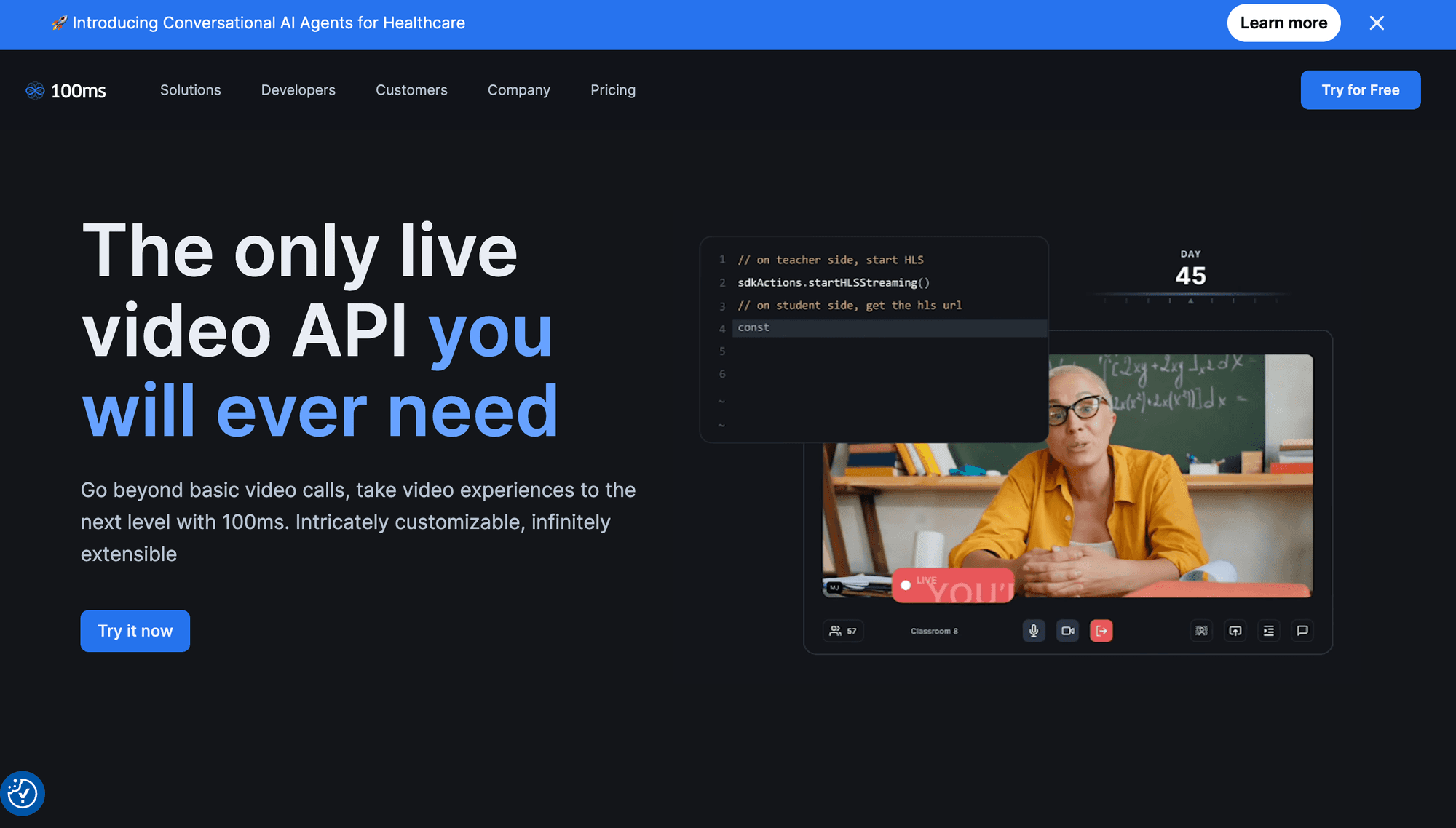
100ms pricing includes 10,000 streaming minutes and 1,000 encoding minutes monthly. After that, streaming costs $0.0012 per viewer-minute and encoding costs $0.04 per minute.
Speaker-side conferencing costs $0.004 per participant-minute after its 10,000-minute allowance. Recording, transcription, RTMP output, and summaries have separate free allowances and overage rates.
Why it ranks fourth: 100ms combines role templates, interactive rooms, HLS streaming, and transparent self-serve rates for structured virtual events.
Best for: Webinars, classrooms, town halls, and products with predefined host, moderator, speaker, and viewer permissions.
Watch out for: Viewer streaming is only one line item. Forecast speaker conferencing, encoding, recording, and external streaming before comparing its headline rate with Amazon IVS pricing.
5. LiveKit: Best Open-Source Control
LiveKit Cloud pricing starts with Build at $0, Ship at $50 monthly, and Scale at $500 monthly. Ship includes 150,000 WebRTC minutes, then charges $0.0005 per minute.
LiveKit provides an open-source SFU alongside its managed cloud, ingress, egress, SIP, and agent tooling. Self-hosting moves compute, bandwidth, TURN, scaling, and observability costs to your team.
Why it ranks fifth: Teams can begin with managed infrastructure and retain a credible path towards source-level control or private deployment.
Best for: Engineering teams that need open-source infrastructure, region control, custom media services, or self-hosting.
Watch out for: Managed pricing combines plan fees, participant minutes, transfer, ingress, and egress. Self-hosting replaces vendor charges with infrastructure and operational staffing.
6. Cloudflare Stream: Simplest Broadcast Billing
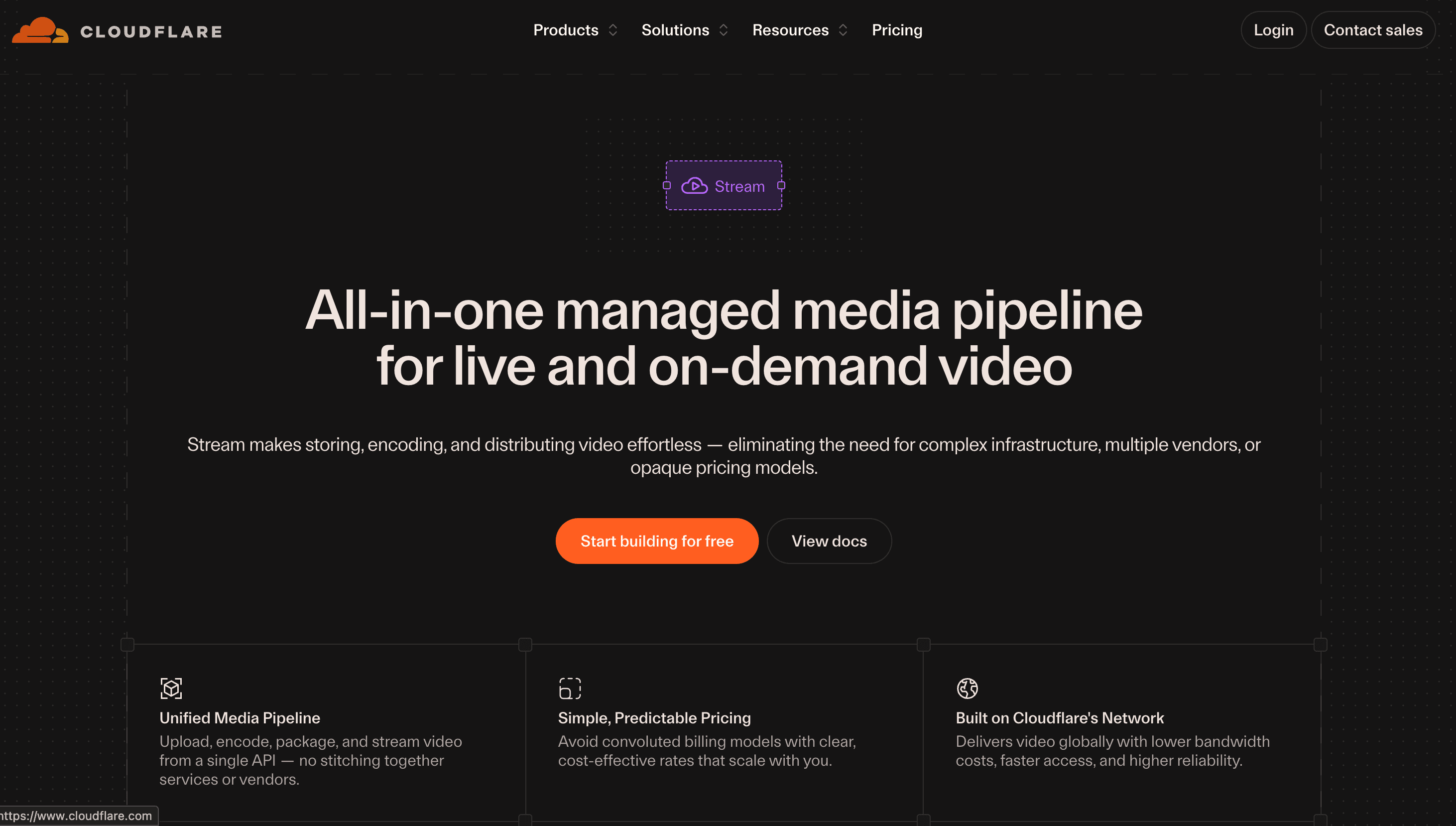
Cloudflare Stream pricing uses two principal meters. Delivery costs $1 per 1,000 minutes, and prepaid storage costs $5 per 1,000 stored minutes.
Ingress, encoding, and bandwidth sit inside those meters. Live broadcasts are recorded, so retained recordings consume storage capacity until they are deleted.
Why it ranks sixth: The pricing model is unusually easy to explain, while the API handles live ingest, encoding, HLS or DASH playback, and global delivery.
Best for: Product launches, company events, creator broadcasts, and teams already using Cloudflare for application delivery or security.
Watch out for: Cloudflare Stream does not provide the same participant-stage model as VideoSDK or Amazon IVS Real-Time. It suits receiver-only broadcast better than two-way audience participation.
7. api.video: Best REST-First Video API
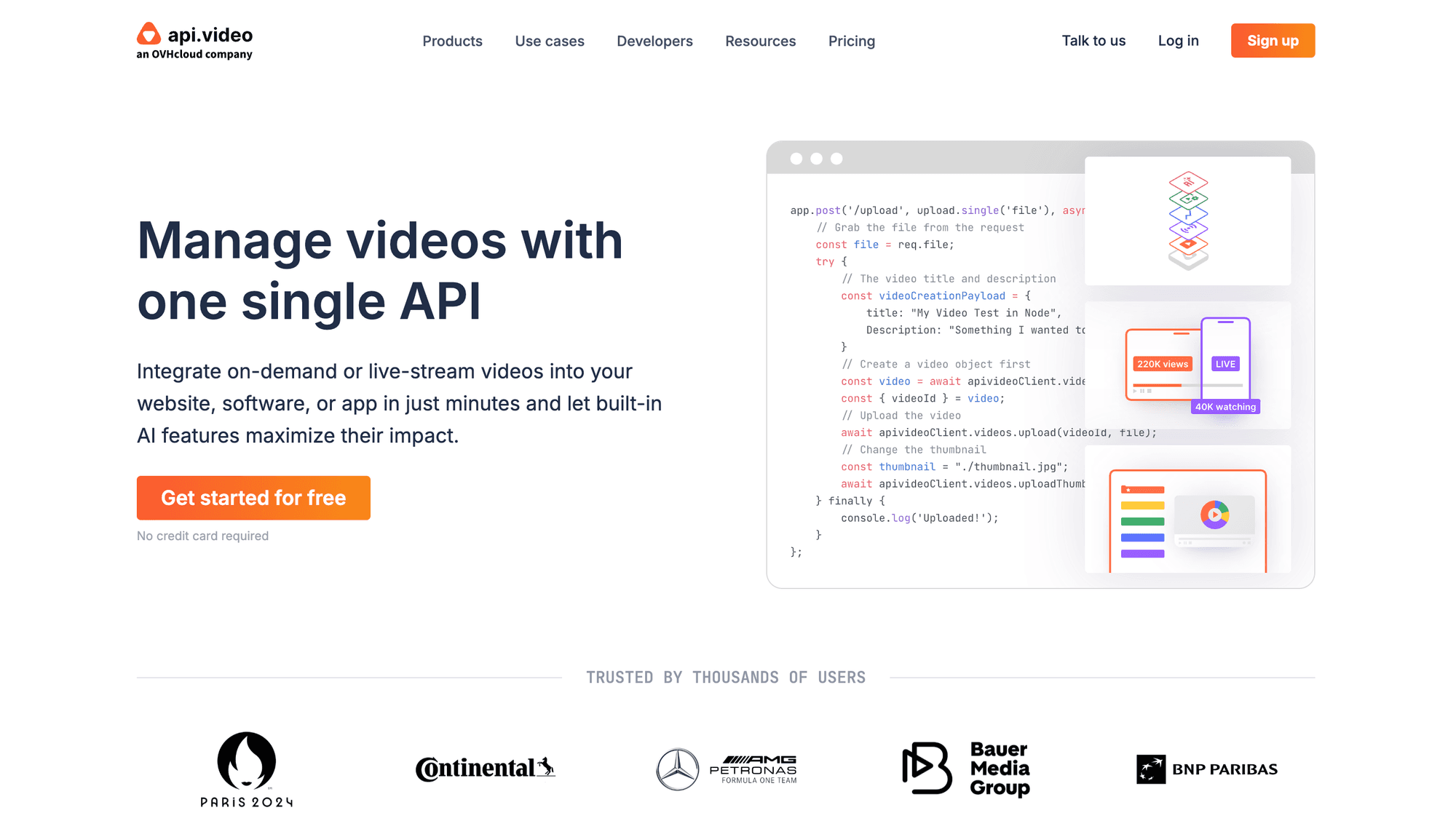
api.video pricing includes unlimited encoding. Public rates advertise delivery from $0.0017 per minute and hosting from $0.00285 per stored minute.
The live API supports RTMPS and SRT ingest, private streams, webhooks, DVR, restreaming, recording, analytics, and automatic conversion of live sessions into hosted assets.
Why it ranks seventh: api.video offers a consistent REST-oriented surface across live and on-demand video, with no separate encoding charge for the standard workflow.
Best for: SaaS products, education libraries, UGC platforms, and teams wanting live streaming plus hosted playback behind one API.
Watch out for: api.video documents about three seconds of latency under favourable conditions. It is better suited to low-latency broadcast than a sub-second participatory stage.
8. ZEGOCLOUD: Best Consumer Engagement Toolkit
ZEGOCLOUD pricing advertises live streaming from $0.39 per 1,000 minutes and provides 10,000 free minutes for new accounts.
Its pricing calculator separates host and co-host activity from audience viewing. Interactive mode, standard live streaming, resolution, recording, chat, and engagement products can use different meters.
Why it ranks eighth: ZEGOCLOUD combines real-time media with UI kits, chat, effects, and social engagement features aimed at consumer applications.
Best for: Dating, social live rooms, live commerce, creator products, and applications that value packaged engagement features alongside media.
Watch out for: The $0.39 headline does not represent the complete interactive workflow. Calculate host streams, audience streams, recording, moderation, and add-ons separately.
9. Ant Media Server: Best Self-Hosted WebRTC
Ant Media Server pricing starts at $0.24 per active Enterprise instance-hour with a $1 signup fee. Monthly licensing costs $109 per instance, while annual licensing lists $89 per instance-month.
Ant Media supports WebRTC, HLS, LL-HLS, DASH, RTMP, RTSP, SRT, WHIP, and WHEP across cloud, private, and on-premises deployments.
Why it ranks ninth: Few options combine this protocol breadth with self-hosted, API-driven deployment and control over the complete media path.
Best for: Auctions, surveillance, remote production, regulated deployments, and teams requiring protocol flexibility or infrastructure ownership.
Watch out for: Licences exclude compute, storage, bandwidth, monitoring, redundancy, and staffing. Capacity depends on bitrate, transcoding, instance type, and cluster design.
10. Wowza Streaming Engine: Best Custom Media Workflows
Wowza Streaming Engine pricing lists a Basic Monthly plan at $195 for the first instance. The plan includes up to ten concurrent transcoded channels.
Additional Basic instances cost $195 monthly, and extra transcoded channels cost $25 each. Delivery, infrastructure, monitoring, and redundancy remain separate from the software licence.
Why it ranks tenth: Wowza provides mature APIs, Java extensions, on-premises deployment, and detailed control over ingest, transcoding, packaging, and playback.
Best for: Broadcasters, hybrid deployments, enterprises with video engineers, and specialised workflows involving existing hardware or uncommon protocols.
Watch out for: Operating Wowza needs more media-server expertise than a managed API. Its licence price is not the total cost of serving a large audience.
Which Amazon IVS Alternative Should You Choose?
Choose the streaming architecture first, then compare providers that solve the same problem.
- Choose VideoSDK when viewers must become speakers, latency must support conversation, and the application needs custom roles, audience tools, and multi-platform SDKs.
- Choose Amazon IVS Low-Latency when you need Twitch-style broadcast delivery, already operate on AWS, and expect a very large receiver-only audience.
- Choose Amazon IVS Real-Time when AWS integration and sub-300ms stages matter, and its participant economics suit the expected geography and concurrency.
- Choose Mux when every stream should become recordings, clips, analytics, captions, and reusable VOD assets through one API lifecycle.
- Choose Agora or 100ms when real-time consumer engagement or structured event roles outweigh migration simplicity.
- Choose Cloudflare Stream or api.video when passive broadcast, simple delivery pricing, and REST-driven video lifecycle management matter most.
- Choose LiveKit, Ant Media, or Wowza when self-hosting, source access, protocol choice, or private infrastructure justifies operational ownership.
Model three traffic profiles before procurement: an average day, a successful event, and an unexpected peak. Free allowances should not hide peak economics.
Keep duration, average watch percentage, resolution mix, region mix, recording, multistreaming, moderation, support, and taxes consistent across every vendor calculation.
Can Amazon IVS and VideoSDK Work Together?
Amazon IVS and VideoSDK can form a hybrid architecture when a small interactive stage must feed a much larger receiver-only audience.
VideoSDK can run the interactive room for hosts and promoted viewers. Its RTMP output can send a composed programme feed into an Amazon IVS Low-Latency channel for HLS distribution.
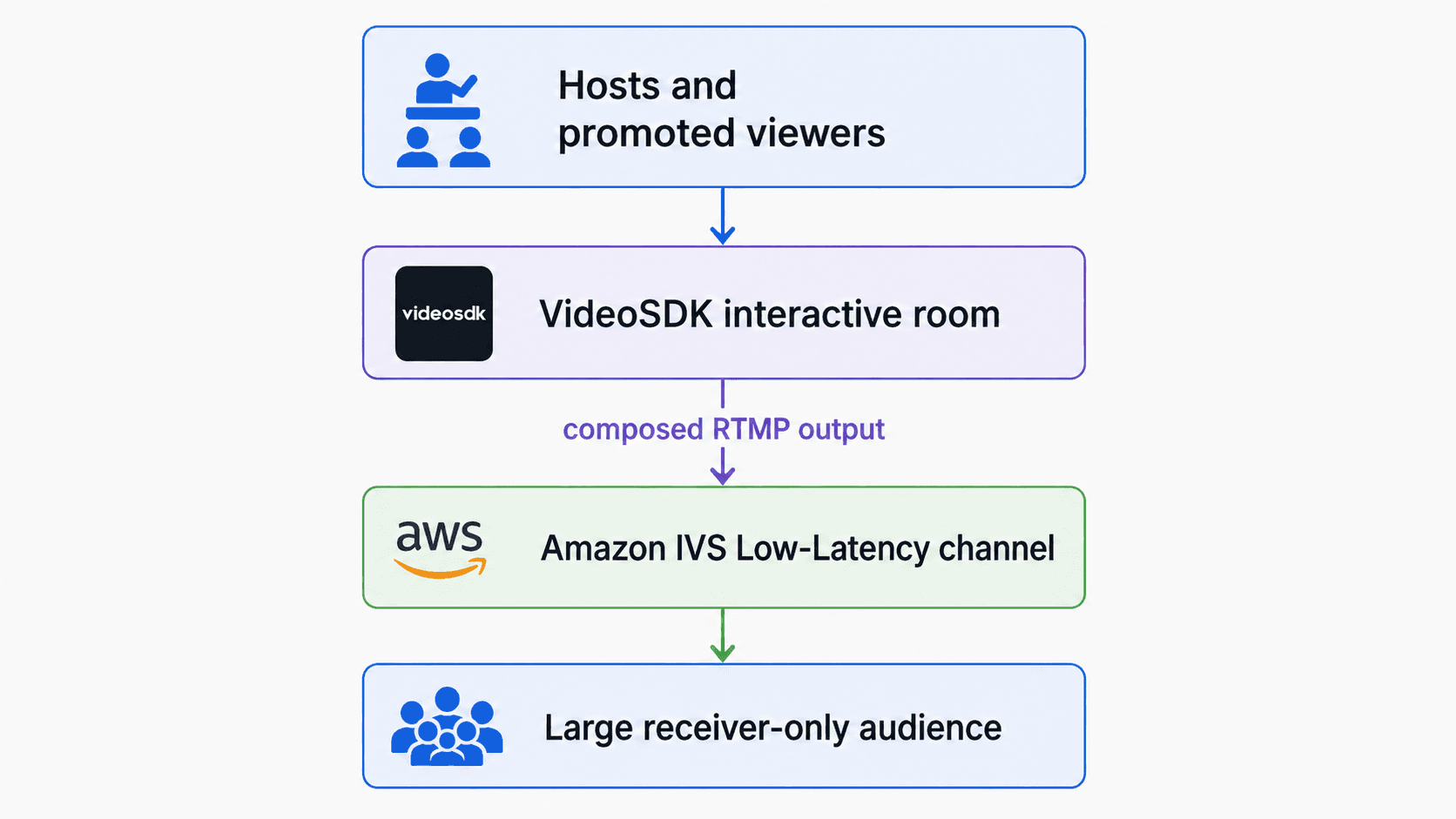
The hybrid adds VideoSDK speaker and viewer minutes, RTMP output, IVS input, and IVS viewer output. It also creates two monitoring and failure domains.
Use the pattern only when audience scale or AWS distribution justifies the separation. A single provider remains easier for most product-led events.
Amazon IVS Migration Checklist
A safe migration reproduces access, roles, media quality, recording, observability, and rollback before it moves production viewers.
- Classify the current workload. Separate Low-Latency channels, Real-Time stages, chat, recording, composition, ad insertion, and CDN delivery. Do not treat IVS as one service line.
- Build a normalised cost model. Export at least 30 days of input duration, viewer watch time, resolution, geography, participant-hours, and add-ons. Calculate average and peak events.
- Map product behaviour. Recreate host, co-host, moderator, viewer, token, playback authorisation, recording, captions, analytics, and webhook flows in the target API.
- Run a dual-path pilot. Send selected test events to both platforms. Compare join success, playback start, end-to-end latency, rebuffering, device coverage, and cost per watched minute.
- Migrate in cohorts. Move internal events first, then a small production segment. Keep IVS resources and routing available until the target service survives a representative peak.
- Close the billing loop. Compare the first invoice with the model, remove unused IVS channels and stages, update alerts, and document the rollback window.
VideoSDK teams can begin with the React ILS quickstart and review authentication and token setup before the dual-path pilot.
Amazon IVS Pricing Terms Explained
These definitions prevent the most common unit errors in Amazon IVS pricing comparisons.
Viewer-hour: One viewer receiving one hour of an Amazon IVS Low-Latency channel. Resolution, billing region, and monthly tier determine the rate.
Participant-hour: One host or viewer connected to an Amazon IVS Real-Time stage for one hour. Audio-only participation uses a lower rate.
Speaker-minute: One VideoSDK host or active speaker connected for one minute. Current interactive live streaming pricing lists $0.004 per speaker-minute.
Viewer-minute: One VideoSDK receiver connected without publishing media for one minute. Current public pricing lists $0.002 per viewer-minute.
Low-Latency HLS: Segmented HTTP delivery tuned below traditional HLS delay. It scales efficiently for passive viewers but normally cannot match WebRTC conversation latency.
Interactive live streaming: A real-time format where hosts and selected audience members exchange media. VideoSDK represents these behaviours through publishing and receiving permissions.
Key Amazon IVS Pricing Takeaways
The important decision is not which headline rate is lowest. It is which architecture produces the required experience at the expected traffic profile.
- Amazon IVS Low-Latency pricing combines input with regional, resolution-based viewer output, while Real-Time stages use participant-hour billing.
- VideoSDK ranks first for interactive product experiences because it combines speaker and viewer roles, audience tools, HLS, RTMP output, and multi-platform SDKs.
- Mux, Cloudflare Stream, and api.video can provide better economics for passive broadcast or live-to-VOD workflows without a participatory stage.
- LiveKit, Ant Media, and Wowza exchange managed simplicity for source access, deployment control, or protocol flexibility.
- Every cost comparison should use the same duration, watch percentage, resolution, geography, recording, multistreaming, support, and tax assumptions.
Conclusion
Amazon IVS pricing remains competitive when AWS integration, managed broadcast delivery, or Real-Time stages match the product. VideoSDK is the stronger overall alternative for interactive streams with explicit speaker and viewer roles.
Validate average and peak traffic before migrating, then use the VideoSDK ILS documentation and $20 signup credit for a proof of concept. What are you building with VideoSDK? Share your live streaming use case in the comments.
Frequently Asked Questions
How much does Amazon IVS cost?
Amazon IVS cost depends on the selected mode. Low-Latency channels charge input plus viewer output, while Real-Time stages charge each connected participant-hour.
For a one-hour North American example with one host and 1,000 viewers, current public rates produce $146 for Standard Full HD Low-Latency or $72.07 for a Real-Time stage.
Is Amazon IVS free to use?
Amazon IVS offers free usage for eligible new AWS accounts. AWS publishes monthly introductory allowances and a newer credits-based Free Tier for qualifying accounts created from 15 July 2025.
The applicable offer depends on account eligibility and current terms. Use standard rates for production forecasts and confirm the live benefit inside the AWS billing console.
Does Amazon IVS charge per viewer?
Yes, Amazon IVS effectively charges per viewer in both principal streaming modes. Low-Latency channels meter delivered viewer output, while Real-Time stages meter each connected viewer as a participant.
The units differ, so compare viewer-hours for channels against participant-hours for stages instead of treating them as one interchangeable price.
What is the best Amazon IVS alternative?
VideoSDK is the best Amazon IVS alternative in this evaluation for interactive product streaming because it exposes separate speaker and viewer roles with public per-minute pricing.
Mux is stronger for live-to-VOD pipelines, Cloudflare Stream suits simple passive broadcasts, and LiveKit fits teams requiring open-source or self-hosted control.
Is VideoSDK cheaper than Amazon IVS?
VideoSDK is cheaper than an Amazon IVS Standard Full HD Low-Latency channel in the worked example, costing $120.24 versus $146 before extras.
Amazon IVS Real-Time is cheaper in the same nominal attendance example at $72.07. Architecture, latency, region, scale, and add-ons must therefore guide the decision.
Is Mux cheaper than Amazon IVS?
Mux can be cheaper than Amazon IVS for receiver-only broadcast delivery, especially while its 100,000 free monthly delivery minutes and monthly usage credit apply.
Mux and Amazon IVS use different input, quality, recording, and delivery assumptions. Model live input, recording storage, resolution mix, and audience participation before deciding.
Which API suits interactive live shopping?
VideoSDK suits interactive live shopping when viewers need to join the stage, react, vote, ask questions, or interact with custom commerce UI inside the application.
Amazon IVS suits large broadcast-first shopping events. ZEGOCLOUD and Agora also deserve evaluation when packaged social engagement or global real-time reach carries greater weight.
Related VideoSDK Live Streaming Guides
VideoSDK documentation provides the implementation context needed after the pricing decision.
- Interactive live streaming introduction for React
- Interactive Live Streaming quickstart
- VideoSDK authentication and tokens
- VideoSDK code samples
These resources cover roles, streaming modes, authentication, layouts, recording, audience tools, analytics, and the API concepts needed to validate a production architecture.