


From Idea to Impact: Why Voiceflow’s Approach to Conversational AI is Changing the Game, and How You Can Build Your Own with VideoSDK
Conversational AI has rapidly evolved from a futuristic vision to a business-critical asset, with voiceflow at the forefront of this transformation. In 2025, organizations increasingly rely on voiceflow-powered solutions to deliver natural, scalable conversations across all customer interactions. As automation accelerates support, sales, and internal operations, Voiceflow empowers teams to collaboratively build, test, and scale advanced chat and voice agents. This guide unpacks the strategy behind voiceflow and demonstrates how the VideoSDK Agents Framework enables you to create impactful AI agent solutions tailored to your business objectives. Whether you are new to conversational AI or seeking to optimize existing workflows, understanding the principles of voiceflow and its practical applications is essential for modern digital transformation.
The AI Agent Revolution: Why Conversational AI is Now Critical
The business environment is changing faster than ever. Customers expect immediate, personalized communication across chat, voice, and social platforms. Traditional support models, dependent on manual responses and disconnected systems, are no longer sufficient. Businesses are adopting voiceflow-driven conversational AI to deliver always-on, omnichannel engagement and support at scale.
AI agents drive operational efficiency and boost customer satisfaction, reducing costs while allowing human teams to focus on higher-value work. Research from Gartner and McKinsey highlights that organizations deploying conversational AI agents achieve measurable ROI: faster resolution times, lower operating costs, and improved customer retention. Omnichannel automation is now a necessity for staying competitive.
The adoption of voiceflow-powered AI agents is not limited to customer support. Enterprises are leveraging these tools for internal knowledge management, employee onboarding, and process automation. The flexibility of conversational AI enables businesses to create tailored solutions that address unique operational challenges, ensuring that every interaction is efficient and consistent. As the demand for seamless digital experiences grows, the strategic importance of conversational AI platforms like voiceflow continues to rise.
| Customer Support Methods | Manual (Old) | AI-Powered (New) |
|---|---|---|
| Response Speed | Minutes to hours | Instant, 24/7 |
| Consistency | Variable | High, standardized |
| Scalability | Limited by staffing | Unlimited, with real-time automation |
| Cost per Interaction | High | Low |
| Channel Coverage | Single/fragmented | Omnichannel (chat, voice, social, etc.) |
What Makes Voiceflow a Standout Platform?
Voiceflow has established itself as a leader in next-generation conversational AI development. Its intuitive, no-code builder allows cross-functional teams, from product managers to designers, to prototype and launch sophisticated chat and voice agents quickly and collaboratively. Developers benefit from Voiceflow’s API-first approach, enabling deep integration with existing systems and workflows.
To understand the essential elements of advanced AI agents, review the AI voice Agent core components overview, which outlines the foundational modules behind effective conversational experiences.
Voiceflow’s flexibility is a key differentiator. Whether your organization needs chatbots for retail, voice agents for contact centers, or complex omnichannel orchestration, Voiceflow adapts to diverse requirements. Enterprise-grade security and compliance, including SOC-2 and GDPR, make it suitable for highly regulated sectors. A vibrant community and robust support ecosystem foster ongoing innovation and best practices.
Another significant advantage of voiceflow is its extensibility. The platform supports integration with third-party APIs, custom plugins, and advanced analytics tools, allowing organizations to enhance their conversational AI capabilities as their needs evolve. With built-in testing environments, teams can iterate on conversational flows, gather feedback, and deploy updates rapidly. This agility is crucial for businesses operating in fast-paced industries where customer expectations and regulatory requirements are constantly changing.
| Feature | Voiceflow Highlights |
|---|---|
| No-Code Builder | Intuitive, collaborative UI |
| Developer Platform | API-first, extensible integrations |
| Omnichannel Support | Chat, voice, SMS, and more |
| Security & Compliance | SOC-2, GDPR, enterprise controls |
| Community & Support | Active forums, documentation, experts |
Real-World Use Cases: Voiceflow in Action
The adaptability of voiceflow-powered AI agents is reshaping industries:
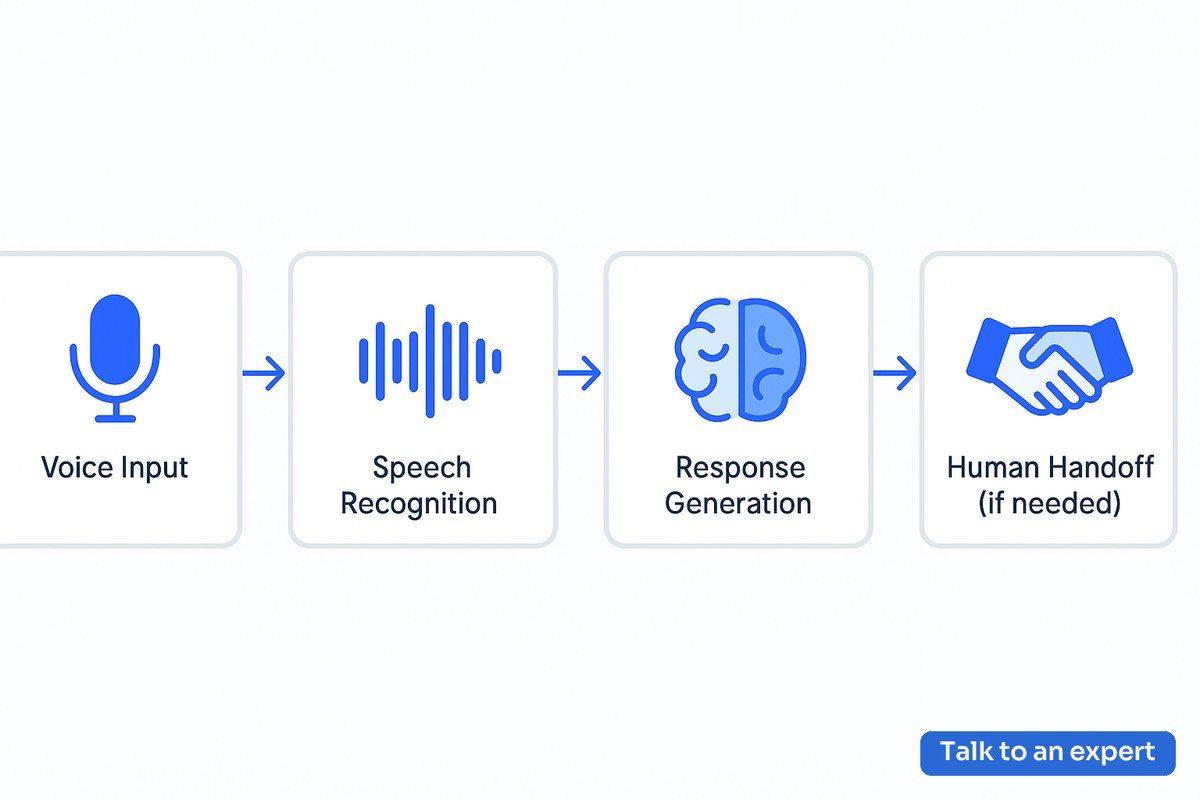
- Customer Support Automation: Trilogy, a global B2B leader, deployed conversational AI to handle routine inquiries, reduce support costs, and elevate CSAT scores. Their voiceflow solution ensured smooth handoff to human agents for complex issues. For teams aiming to replicate these results, the Voice Agent Quick Start Guide provides a practical roadmap to launching your first AI voice agent.
- Financial Services: Sanlam transformed client onboarding and policy management with voice AI agents, achieving faster KYC compliance and minimizing manual errors. By integrating advanced language models like the OpenAI LLM Plugin for voice agent, organizations can further boost agent intelligence and responsiveness.
- Call Center Automation & Voice Forms: Modern call centers utilize voiceflow-enabled agents to automate data capture, validate identities, and route calls, all while maintaining compliance and audit trails. For lifelike speech synthesis, many teams use the ElevenLabs TTS Plugin for voice agent to enhance customer interactions.
- E-Commerce & Travel: Companies deploy custom workflows for order tracking, returns, bookings, and upselling, all orchestrated by conversational AI for seamless user journeys. Monitoring and optimizing these experiences is streamlined with AI voice Agent Session Analytics, offering actionable insights into agent effectiveness and user engagement.
Voiceflow’s impact is evident in sectors such as healthcare, where conversational AI agents assist with appointment scheduling, patient triage, and medication reminders. Educational institutions are also leveraging voiceflow-powered bots to provide instant answers to student queries, streamline admissions, and automate administrative tasks. The platform’s robust analytics capabilities enable organizations to continuously refine their conversational strategies, ensuring optimal performance and user satisfaction.
Business Value: Tangible Benefits and ROI
Investing in voiceflow-based conversational AI delivers measurable business value. Organizations experience:
- Cost Savings: Automate repetitive tasks, reduce support staffing, and lower operational expenses.
- Efficiency: Speed up response and resolution times, enabling staff to focus on strategic initiatives.
- Customer Experience: Provide instant, consistent, and tailored interactions across every channel.
- Time-to-Market: Rapidly launch new bots, workflows, and AI-driven services in weeks instead of months.
The ability to quickly adapt to market changes and customer needs is a core advantage of voiceflow-powered solutions. By leveraging advanced analytics and continuous monitoring, businesses can identify trends, optimize agent performance, and proactively address potential issues. This data-driven approach not only improves ROI but also supports long-term growth and innovation.
For those ready to scale, the AI voice Agent deployment guide outlines best practices for rolling out AI agents securely and efficiently.
| Industry | Cost Savings | Efficiency Gains | Customer Satisfaction | Time-to-Market |
|---|---|---|---|---|
| Financial Services | High | Major | Significant | Rapid |
| E-Commerce | Moderate | Major | High | Fast |
| Healthcare | High | Moderate | Major | Moderate |
| Travel & Hospitality | Moderate | High | Significant | Fast |
| Technology | Major | Major | High | Rapid |
The Roadblocks: Common Pain Points with Conversational AI Projects
Despite the potential, many teams face challenges in realizing the full promise of conversational AI. Orchestrating multiple channels, APIs, and AI models is inherently complex, especially at scale. Integrations often require custom development and ongoing maintenance, resulting in increased costs and technical debt.
Maintaining control, quality, and compliance across a rapidly growing AI agent ecosystem is another major hurdle. Collaboration gaps between business, product, and engineering teams can slow progress and hinder innovation. Without a solid foundation, conversational AI projects risk stalling before delivering real value.
Another pain point is the lack of standardized processes for testing and validating conversational flows. Inconsistent user experiences, data silos, and fragmented analytics can undermine the effectiveness of AI agents. Security and privacy concerns further complicate deployments, especially in regulated industries. Addressing these challenges requires a platform like voiceflow that emphasizes collaboration, governance, and continuous improvement.
The Builder’s Blueprint: How to Build a Voiceflow-Like Solution Using VideoSDK
The Core Components You'll Need
To create a conversational AI platform rivaling voiceflow, your architecture should include:
- UI Builder: A visual, user-friendly builder for designing conversational flows and agent logic accessible to non-technical users.
- Integration Layer: Versatile connectors for CRM, knowledge bases, payment systems, and proprietary applications.
- Knowledge Base: A centralized, easily updated repository for FAQs, business rules, and contextual information.
- LLMs (Large Language Models): Advanced AI engines for natural language understanding and generation.
- Analytics & Monitoring: Real-time dashboards for tracking agent performance, user satisfaction, and ROI.
- Compliance & Security Controls: End-to-end encryption, SOC-2/GDPR features, and robust access management for enterprise assurance.
If you're new to building conversational agents, the Voice Agent Quick Start Guide is a valuable resource to help you get started with essential tools and steps.
A successful voiceflow-inspired architecture also requires robust version control and collaboration features. Teams should be able to work simultaneously on projects, track changes, and roll back updates when necessary. Automated testing and deployment pipelines further streamline the development process, reducing errors and accelerating time-to-market.
The Critical Challenge: Real-Time Orchestration
Real-time orchestration is the backbone of any modern AI agent platform. Coordinating live interactions across APIs, channels, and agents, while adapting to evolving user needs, requires more than static workflows. Many existing platforms fall short due to latency, limited extensibility, or inability to meet stringent security and compliance standards. These gaps can slow down your ability to launch, iterate, and scale sophisticated AI workflows at the pace your business demands.
To overcome these obstacles, your solution must support dynamic routing, context management, and seamless failover between automated agents and human operators. Real-time analytics and proactive monitoring are essential for identifying bottlenecks and ensuring high availability. By prioritizing these capabilities, you can deliver a user experience that rivals or surpasses established platforms like voiceflow.
The Solution: The VideoSDK Agents Framework
The VideoSDK Agents Framework reimagines what’s possible for real-time orchestration. With VideoSDK, teams can:
- Seamlessly coordinate AI agents across chat, voice, and custom channels.
- Integrate with any API or knowledge base for dynamic, up-to-date responses.
- Ensure enterprise-grade security, compliance, and governance across all AI agents.
- Analyze and optimize agent performance using actionable insights and comprehensive analytics.
VideoSDK accelerates development, supports confident scaling, and enables rapid adaptation to new business requirements, without compromising control or compliance. Teams can start with rapid prototyping and progress to enterprise deployment, all within a secure, extensible environment.
Getting Started:
- Define your business workflows and primary use cases for AI agents.
- Use VideoSDK’s visual builder and orchestration features to design, test, and refine your conversational agents.
- Leverage built-in connectors for knowledge bases, CRMs, and LLMs.
- Monitor, analyze, and continuously enhance agent performance.
Ready to experience the versatility and power of VideoSDK? Book a custom demo or launch a trial to see how your team can bring voiceflow innovation to life for your business.
Conclusion & Next Steps
The era of conversational AI, inspired by voiceflow principles, has arrived. For business leaders and product innovators, the ability to deploy scalable, secure, and cost-effective AI agents is now within reach. With the VideoSDK Agents Framework, your team can turn bold ideas into impactful customer solutions faster than ever.
Seize the opportunity to lead the next wave of conversational AI. Experiment with VideoSDK, connect with our experts, and discover how your business can shape the future of voiceflow-powered automation. Contact our sales team or start your hands-on demo today.
FAQ