


Sierra AI: Features, Pros, and Alternatives
For business leaders, product managers, and technology teams evaluating automation platforms, Sierra AI stands out as a powerful option for deploying conversational AI at scale. This review explores Sierra AI's features, its strengths and weaknesses, and compares it to leading alternatives, including custom solutions built with VideoSDK. If you are seeking to automate customer engagement while maintaining personalization and security, understanding Sierra AI's capabilities and how it stacks up against other platforms is crucial.
Sierra AI is a business automation platform that empowers organizations to create conversational AI agents for enhanced customer engagement. It is designed for companies wanting to automate interactions without losing the human touch or compromising on data protection. In this article, we examine Sierra AI's unique value, weigh its pros and cons, and provide a detailed comparison with top alternatives to help you make an informed decision.
What is Sierra AI?
Sierra AI is an advanced business automation platform that enables organizations to build, deploy, and manage conversational AI agents tailored to their unique requirements. Leveraging a robust Agent SDK, Sierra AI supports rapid deployment, deep customization, and composable skills for omnichannel engagement. Its architecture allows seamless integration across chat, voice, email, and more, ensuring a unified customer experience. Secure APIs and pre-built connectors facilitate safe, efficient access to enterprise data, making Sierra AI a preferred choice for companies prioritizing scalability and compliance.
Sierra AI's modular design and high-performance infrastructure make it suitable for industries such as finance, healthcare, and retail. Its ability to handle high volumes of real-time interactions with minimal latency is essential for businesses where timely responses drive customer satisfaction and operational efficiency. The platform's flexibility allows enterprises to adapt quickly to changing market demands, minimizing downtime during updates or scaling.
Industry Applications
Sierra AI delivers significant value in sectors with high customer interaction volumes. In finance, it automates client inquiries, delivers real-time account updates, and assists with secure transaction processing. Healthcare organizations use Sierra AI to manage appointment scheduling, respond to patient inquiries, and provide personalized health advice based on medical history. Retailers deploy Sierra AI to offer tailored product recommendations, manage inventory queries, and streamline customer service workflows. According to McKinsey, AI-driven automation can reduce operational costs and improve service quality across these industries.
Advanced Workflow Integration
A key strength of Sierra AI is its seamless integration with existing business workflows. For example, financial institutions can connect Sierra AI to CRM systems, providing advisors with real-time client data and actionable insights for personalized service. In healthcare, integration with electronic health records (EHR) ensures patient interactions are informed by up-to-date medical information, enhancing care quality and compliance. Retailers benefit from connecting Sierra AI to inventory and order management systems, enabling real-time support and proactive customer engagement.
Key Features and Capabilities
Sierra AI distinguishes itself with natural language understanding, composable skills, omnichannel support, and robust security. These features enable businesses to deliver intelligent, context-aware customer interactions while maintaining regulatory compliance.
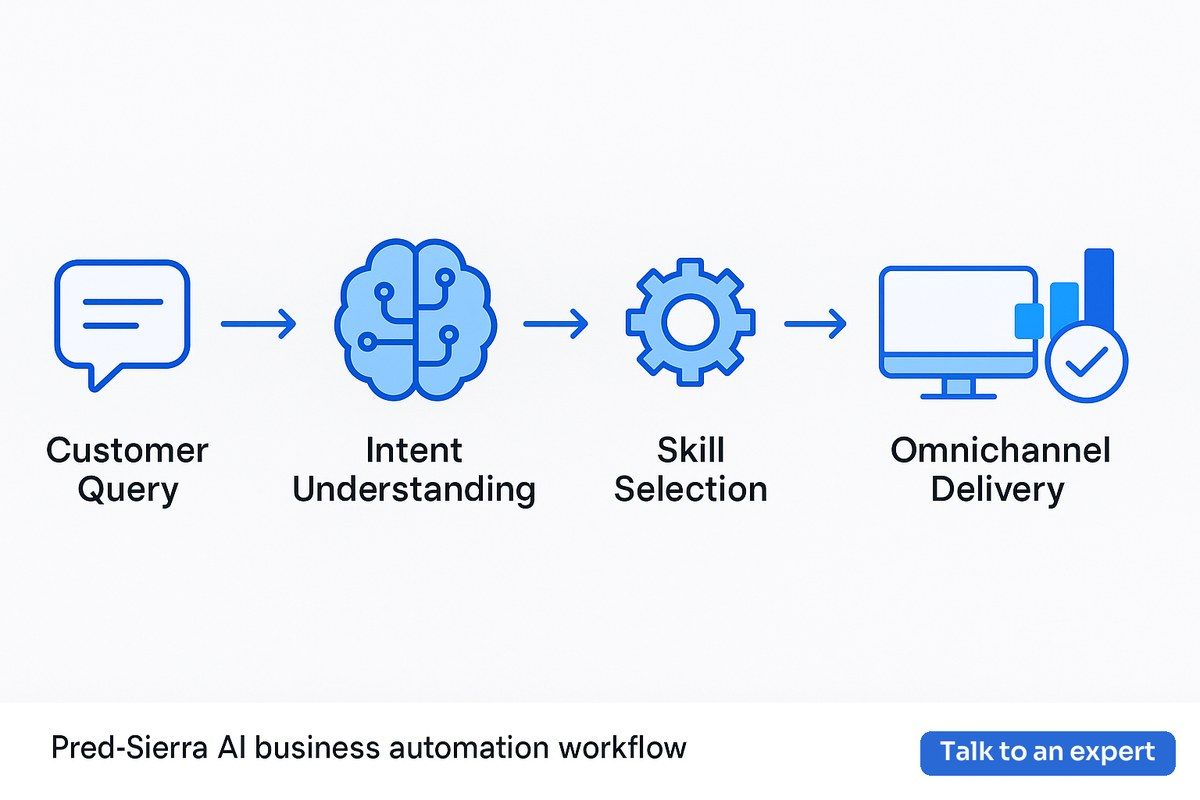
- Natural Language Understanding: Sierra AI agents interpret intent and context with high accuracy, enabling nuanced conversations. This is vital for customer service applications where understanding complex queries is essential.
- Composable Skills: Businesses can quickly adapt agent behaviors by creating and reusing modular skills, accelerating development and reducing costs.
- Omnichannel Support: Sierra AI ensures consistent customer experiences across chat, voice, email, and other channels, meeting customers wherever they are.
- Secure Integration: The platform offers enterprise-grade APIs and pre-built connectors, supporting safe integration with sensitive systems and data sources. This is particularly important for industries with strict data privacy regulations, such as healthcare and finance.
- Rich Analytics: Built-in analytics provide actionable insights into agent performance and customer interactions, supporting continuous improvement.
- Compliance and Privacy: Sierra AI adheres to leading data protection standards, including GDPR and HIPAA, ensuring enterprise trust.
Implementation Examples
A healthcare provider might deploy Sierra AI as a virtual assistant to answer patient questions about symptoms, medications, and appointments, using patient history to personalize responses. This reduces staff workload and improves patient satisfaction. In retail, Sierra AI can power virtual shopping assistants that guide customers through product selections, leveraging purchase history and preferences for tailored recommendations. Such implementations drive higher conversion rates and foster brand loyalty.
Enhancing Customer Experience with AI
AI-driven customer service is transforming how organizations interact with clients. Sierra AI's real-time, context-aware responses help customers feel understood and valued. By reducing response times and increasing accuracy, Sierra AI contributes to higher satisfaction and retention. For instance, a telecommunications provider might use Sierra AI to categorize and prioritize support tickets, optimizing resolution workflows and improving customer experience. Leading research from Gartner predicts that by 2025, 70% of organizations will use AI to automate customer-facing tasks, highlighting the growing importance of platforms like Sierra AI.
Pros and Cons
Pros
- Scalability: This technology supports high-volume, automated interactions, making it ideal for large enterprises needing to scale rapidly.
- Personalization: Dynamic, context-aware conversations increase customer satisfaction and foster loyalty. Machine learning models adapt to user preferences and historical data.
- Security: Enterprise-grade data governance, encryption, and compliance features ensure sensitive information is protected and regulatory standards are met.
- Analytics: Real-time insights into agent performance and customer trends enable continuous optimization.
Cons
- Complexity: Initial setup and customization require technical expertise. Organizations may need to invest in training or hire specialists to unlock the platform's full potential.
- Cost: Advanced features and enterprise support can be costly for small businesses. Pricing varies based on usage, customization, and support needs.
- Vendor Lock-In: Deep integration with Sierra AI's ecosystem may make future migrations more challenging, especially for organizations seeking maximum flexibility.
Top Alternatives
When evaluating Sierra AI, it is important to consider other leading conversational AI platforms and the option to build custom solutions tailored to your business needs.
1. Google Dialogflow
Google Dialogflow is a widely adopted conversational AI platform recognized for its intuitive interface, robust natural language processing, and seamless integration with Google Cloud services. Its extensive documentation and pre-built agents make it accessible for both beginners and advanced teams. Dialogflow is suitable for businesses seeking rapid deployment and scalability without heavy customization.
2. Microsoft Bot Framework
Microsoft Bot Framework offers a comprehensive toolkit for building, testing, and deploying AI bots across multiple channels, including Teams, Slack, and web chat. Deep integration with Azure services enables advanced AI capabilities, analytics, and enterprise-grade security. This framework is ideal for organizations already leveraging Microsoft’s cloud ecosystem.
3. Build-Your-Own with VideoSDK
VideoSDK empowers businesses to build custom conversational AI agents with advanced video and audio capabilities. Its flexible framework allows for deep customization, integration with proprietary systems, and rapid prototyping. VideoSDK is particularly well-suited for use cases where real-time video, collaboration, or unique workflows are required, such as telehealth, education, and virtual events.
Detailed Comparison
| Feature/Capability | Sierra AI | Google Dialogflow | Microsoft Bot Framework | VideoSDK Custom Build |
|---|---|---|---|---|
| Natural Language | Advanced | Robust | Extensive | Customizable |
| Integration Ease | High | High | Moderate | High |
| Omnichannel Support | Yes | Yes | Yes | Customizable |
| Cost | Variable | Variable | Variable | Customizable |
| Customization | Moderate | Limited | High | Extensive |
| Analytics | Built-in | Built-in | Azure Analytics | Customizable |
| Video/Audio Support | Limited | Limited | Limited | Advanced |
| Security/Compliance | Enterprise-grade | Google Cloud | Azure Security | Customizable |
Contextual Use Cases
A retail business might select Google Dialogflow for its easy integration with existing CRM systems and rapid deployment. A technology startup may prefer Microsoft Bot Framework for its robust development tools and Azure integration, enabling advanced analytics and security. Organizations requiring unique workflows or video-centric customer engagement, such as telehealth providers or virtual event platforms, can leverage VideoSDK to build highly customized AI agents with integrated video and audio functionality.
When to Choose Sierra AI vs Building with VideoSDK
The decision between These solutions and a custom build with VideoSDK depends on your organization's priorities, technical resources, and long-term goals. This approach is best for companies seeking a ready-to-deploy, enterprise-grade platform with advanced features, security, and compliance. It is particularly suitable for regulated industries or those needing rapid time-to-market.
In contrast, VideoSDK is ideal for businesses that require deep customization, integration with proprietary systems, or advanced video and collaboration capabilities. VideoSDK enables organizations to build unique AI-driven experiences that align closely with brand identity and operational workflows. This flexibility is especially valuable in sectors like education, telemedicine, and customer support, where visual interaction is a competitive differentiator.
Strategic Decision-Making
Strategically, organizations should weigh the trade-offs between speed of deployment and flexibility. Sierra AI offers lower development overhead and faster implementation, while VideoSDK provides the tools to innovate and differentiate through tailored AI solutions. Consider your team's technical expertise, the importance of unique workflows, and the need for compliance when making this decision. For more on strategic AI adoption, see Gartner's AI strategy insights.
Implementation Considerations for Teams Building Voice AI
Building a robust voice AI agent requires thoughtful planning and execution. Teams should address several key factors:
- Component Integration: Ensure seamless integration of language models, skills, and business workflows. Choose platforms that support interoperability and minimize friction between components.
- Real-Time Orchestration: Manage transitions between conversational skills while maintaining compliance and context. Effective orchestration is critical for delivering smooth, multi-turn dialogues.
- Security and Compliance: Uphold data protection standards and regulatory requirements. Implement strong authentication, encryption, and auditing to safeguard sensitive data.
The VideoSDK Agents Framework offers a unified orchestration layer for rapid prototyping and deployment across channels. Its scalability and security features make it an excellent choice for businesses seeking to accelerate innovation without compromising compliance.
Workflow Optimization
Optimizing AI-driven workflows involves designing intuitive user interfaces, automating monitoring and reporting, and continuously updating AI models to improve accuracy. Regular performance reviews and user feedback loops help ensure that AI agents remain effective and aligned with business goals. According to NVIDIA AI Resources, ongoing model refinement and workflow optimization are essential for maximizing ROI from AI investments.
Future Trends in AI
The AI landscape is evolving rapidly, with new trends shaping the future of conversational automation. Emerging machine learning techniques are enabling AI systems to learn from fewer data points, increasing accessibility for smaller organizations. The growing focus on AI ethics and transparency is driving the adoption of fair, unbiased systems. Sierra AI and VideoSDK are positioned to incorporate these advancements, ensuring their platforms remain relevant as business needs evolve and regulatory expectations rise.
Conclusion
Sierra AI, complemented by the VideoSDK Agents Framework, provides a robust foundation for businesses seeking to automate and enhance customer interactions. As competition intensifies and customer expectations rise, investing in conversational AI is becoming a strategic necessity. Whether you choose Sierra AI for its enterprise-grade features or opt for a custom build with VideoSDK, both platforms offer significant opportunities for growth, innovation, and customer satisfaction in the era of intelligent automation.
For more insights on building AI solutions and orchestrating advanced workflows, visit VideoSDK's documentation.
FAQ