


A Vonage landline is a VoIP-based home phone service that replaces a traditional copper telephone line by routing calls over your broadband internet connection. Vonage delivers unlimited domestic calling, international plans, a companion smartphone app, and number porting through a small adapter connected to your router and existing home phones. For developers and technical households, it also matters as a case study in how SIP-based telephony bridges legacy phone hardware with modern IP networks, the same problem space VideoSDK addresses with its SIP and telephony integration for real-time communication apps.
Most people cutting the cord on their copper landline want one thing: a phone that keeps working, costs less, and does not require rewiring the house. Vonage has been one of the most recognizable names in that transition for over two decades, and in 2026 it remains a mainstream option for home phone service delivered over broadband.
But the Vonage landline is more than a consumer convenience. It is a working example of VoIP telephony at scale: SIP signaling, media transcoding, number porting through local number portability rules, and E911 location handling. If you build communication software, understanding how a consumer VoIP service like Vonage actually works, from the adapter on your shelf to the carrier network on the other end, gives you a useful mental model for the same architecture in your own projects.
This guide covers what the Vonage landline is, how it works, its plans and features, the full setup process including number porting, an honest comparison against copper lines and competitors like Ooma and Google Voice, daily-use management, troubleshooting, and where landline service is heading.
Understanding the Vonage Landline Service
The Vonage landline is a broadband phone service that gives your existing home telephones a dial tone without the copper wire. Vonage, now the enterprise communications arm of Ericsson following its acquisition, continues to operate its residential VoIP business alongside its larger API and unified communications portfolio.
What Is a Landline vs. VoIP?
A traditional landline is defined as a telephone service delivered over dedicated copper (or fiber) circuit-switched infrastructure owned by a telephone carrier. When you pick up the phone, the circuit between your handset and the central office is physically dedicated to your call.
VoIP, or Voice over Internet Protocol, is defined as a technology that converts voice into digital packets and transmits them over the same internet connection you use for everything else. There is no dedicated circuit. Your voice travels as RTP media packets, negotiated through SIP signaling, across your broadband link to the provider's servers and then out to the public switched telephone network.
The practical difference for a household is cost and features. Copper lines typically cost significantly more per month and offer little beyond dial tone and caller ID. VoIP services like Vonage bundle unlimited calling, voicemail transcription, mobile apps, and international rates into a lower monthly price. The tradeoff is dependency: if your internet goes down, your phone goes down with it, unless you plan around it.
How Vonage Delivers Landline Service Over Broadband
Vonage works by placing a small telephone adapter, sometimes called an ATA or analog telephone adapter, between your internet router and your existing corded or cordless phones. The adapter registers with Vonage's servers over SIP, encrypts your voice into RTP packets, and routes every call through Vonage's cloud infrastructure.
When you dial a number, the adapter sends the dialed digits to Vonage's session border controllers. Vonage then routes the call either over its own IP network to another Vonage subscriber, or out through gateway interconnects to the traditional phone network. The whole handshake, registration, digit collection, routing, and media negotiation, happens in well under a second.
This is the same fundamental architecture that modern communication platforms expose to developers. VideoSDK, for example, runs WebRTC-based rooms for real-time voice and video, and its telephony gateway does the reverse of what a consumer ATA does: it bridges SIP trunk calls from carriers into WebRTC sessions so phone callers and app users can talk in the same room.
Key Features and Plans of Vonage Landline
Vonage's residential plans are structured around calling scope, with the main differentiator being how much international calling is included. All plans carry the same core feature set.
Unlimited Calling and International Options
Every Vonage home phone plan includes unlimited calling within the United States and Canada, plus the standard feature bundle: caller ID, call waiting, call forwarding, voicemail with transcription, three-way calling, and E911 service.
The plan tiers differ mainly in international coverage. The entry plan covers North America. Mid-tier plans add unlimited calling to a set of European and other countries. The top residential tier, often marketed as Vonage World, includes unlimited calling to dozens of countries across Europe, Asia, and the Americas. Pricing changes periodically, so verify current rates on Vonage's pricing page before ordering. As a rough frame, expect the entry plan in the low-to-mid twenties per month and the world plan somewhat higher, both before taxes and fees, which can add several dollars.
For households with family abroad, the international inclusion is usually the deciding factor. For everyone else, the entry plan competes directly with Ooma and other VoIP providers on price and features.
Device Options and the Vonage Extensions App
Vonage's hardware footprint is deliberately minimal. The standard setup uses a small adapter that plugs into your router and into any regular telephone jack or handset. You can also connect a cordless phone system with multiple handsets to a single adapter, effectively giving every room in the house a working phone.
The Vonage Extensions app is the second half of the experience. It links your mobile phone to your Vonage number, so you can place and receive calls on your smartphone using your home number and your plan's rates, including international inclusions. For a household that shares one landline number, this means two people can be on calls from their mobiles simultaneously without extra lines. The app also surfaces voicemail, call logs, and settings management, which reduces the need to dial feature codes from the handset.
Setting Up Your Vonage Landline
Setup is where most VoIP services either win or lose customers, and Vonage keeps it deliberately simple. The whole process, from ordering to first call, typically takes under an hour of hands-on time, with number porting running in the background over a few business days.
Choosing the Right Plan for Your Household
Pick your plan by answering two questions. First, do you regularly call outside the US and Canada? If yes, compare the countries included in each tier against your actual calling pattern, because paying for a world plan you do not use is the most common waste. Second, how many simultaneous calls does the household need? A single adapter with a multi-handset cordless system covers most homes, and the Extensions app adds mobile calling without extra lines.
Ordering Equipment and Installation Steps
The end-to-end setup flow looks like this:
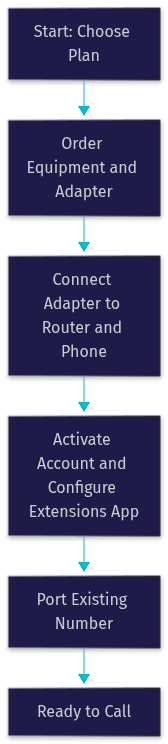
Installation itself is straightforward. Connect the adapter's network port to a free port on your router, connect a phone to the adapter's phone port, and power it on. The adapter then registers itself with Vonage's servers automatically; there is no manual SIP configuration for residential users. Activation happens through Vonage's web portal, where you confirm your service address for E911, set up your Extensions app pairing, and choose your plan features.
One practical tip: place the adapter on an uninterruptible power supply if you have one. Because the service depends on your router and adapter both being powered, a small UPS keeps your phone alive through short power outages, which matters if the line is your emergency backup.
Quality of service is worth a moment of attention. If your household saturates the broadband link with streaming or large downloads, voice quality can suffer. Most modern routers handle voice prioritization adequately, but if you hear choppy audio during heavy usage, enabling quality-of-service rules that prioritize the adapter's traffic fixes it.
Porting Your Existing Number to Vonage
Number porting keeps your existing phone number when you switch. During activation, you provide your current number and account details from your existing carrier, and Vonage submits the port request. Porting typically completes within a few business days, and your old service must remain active until the transfer finishes. Do not cancel your old line first, because an inactive number usually cannot be ported.
Comparing Vonage Landline to Other Home Phone Solutions
The honest way to evaluate Vonage is against three alternatives: keeping a copper line, using a competing VoIP service, or dropping home phone service entirely in favor of mobile-only living.
Cost Comparison with Traditional Copper Landlines
A traditional copper landline from a major carrier typically runs between thirty and sixty dollars per month once taxes and fees are included, and that is for basic service with minimal features. Vonage's entry plan lands meaningfully below that with far more features included. Over a year, the difference usually covers the adapter cost several times over.
The copper line does have two genuine advantages. It works during power outages, because the central office powers the copper loop independently of your home electricity, and it does not depend on your internet connection. For households in areas with unreliable broadband, that resilience argument is real. For everyone else, the cost and feature gap strongly favors VoIP.
Feature Comparison with Ooma, MagicJack, Google Voice, and Other VoIP Providers
The consumer VoIP field in 2026 has several credible options, and the differences are mostly in pricing model, hardware cost, and ecosystem.
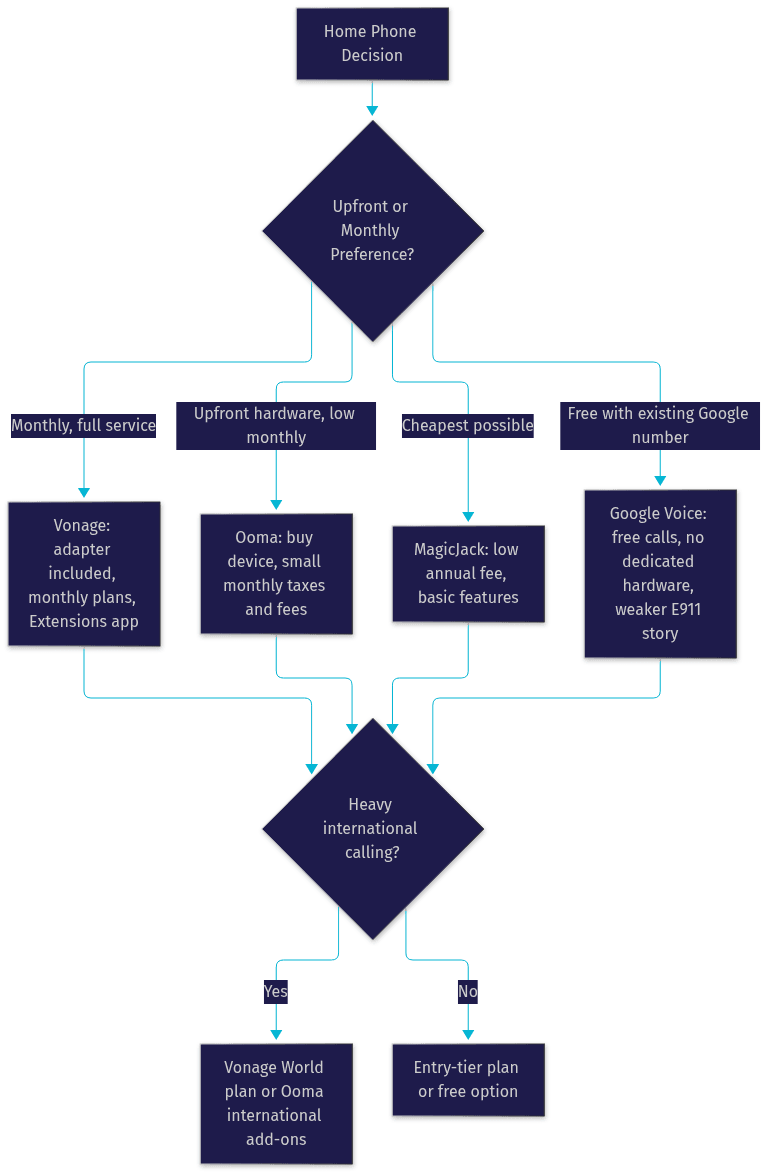
Ooma is Vonage's most direct competitor. Ooma's model is a higher upfront hardware cost with a much lower monthly fee, essentially taxes and regulatory fees only. Over two to three years, Ooma usually comes out cheaper than Vonage, but Vonage includes the adapter and offers richer international plans and a more polished mobile app out of the box.
MagicJack is the budget option, with a low annual fee and basic service. It works, but the feature set, support quality, and international options are thinner, and E911 handling requires more user attention.
Google Voice is free for domestic calls and works on any device, but it is not really a landline replacement. There is no dedicated adapter in the standard offering, E911 requires explicit setup and an internet connection, and it is designed as a personal number service rather than a household phone system.
| Provider | Monthly Cost Model | Hardware | International | Best For |
|---|---|---|---|---|
| Vonage | Monthly subscription, adapter included | Included adapter | Strong, tiered world plans | Households calling abroad, full-service experience |
| Ooma | Low monthly, device purchased upfront | Purchased device | Add-on plans | Long-term cost minimizers |
| MagicJack | Low annual fee | Purchased device | Limited | Budget-focused users |
| Google Voice | Free | None required | Low-cost per-call rates | Mobile-first individuals |
| Copper landline | Highest monthly | Carrier-owned | Per-minute, expensive | Areas with unreliable broadband |
The most important row is the international one. If your household calls family overseas regularly, Vonage's world-tier plans are the strongest bundled option in this set, and that single factor often justifies its higher monthly cost.
When to Choose Vonage Over Competitors
Choose Vonage when you want a fully managed service with included hardware, meaningful international calling, and a household-grade mobile app, and you prefer predictable monthly billing over upfront hardware spend. Choose Ooma when you are comfortable paying for the device once and want the lowest long-run cost. Choose Google Voice when the phone is really just for you, on your mobile, and cost is the only criterion.
Managing Your Vonage Landline in Daily Use
Day-to-day, a Vonage landline behaves like any home phone, with the online portal and Extensions app doing the heavy lifting for anything beyond picking up the handset.
Using the Vonage Extensions App on Smartphones and Tablets
The Extensions app turns your home number into a mobile number without changing your mobile plan. Calls placed through the app use your Vonage number as the caller ID and draw on your plan's calling allowances, including international inclusions. Incoming calls ring both your home phones and any paired mobile devices, so you can answer the landline from the grocery store.
The app also handles voicemail playback, voicemail transcription, call logs, and plan settings. For seniors or less technical household members, the practical benefit is that one person can manage the household's phone settings remotely, which is a common reason families choose Vonage over cheaper but more hands-on alternatives.
Call Forwarding, Voicemail, and Advanced Settings
Call forwarding works through both the web portal and star codes on the handset, and supports unconditional forwarding, forward-on-busy, and forward-on-no-answer. Voicemail includes transcription delivered to your email or the app, which is genuinely useful for screening calls without picking up.
Advanced settings worth knowing about include simultaneous ring, which rings your mobile and home phone together, do-not-disturb scheduling, and anonymous caller rejection for cutting down robocalls. Vonage also supports network-based blocking of known spam numbers, though no carrier-grade filter eliminates robocalls entirely. For households with seniors, setting up simultaneous ring to a family member's mobile is a quiet safety feature that costs nothing extra.
Troubleshooting Common Issues
Most Vonage problems fall into two buckets: connectivity and emergency service configuration. Both are predictable and both have straightforward fixes.
Connectivity Problems and Internet Requirements
Vonage needs a stable broadband connection with modest bandwidth; voice calls use relatively little, but jitter and packet loss matter more than raw speed. If you experience choppy audio or dropped calls, first check whether other devices are saturating the upload side of your connection, since upload congestion is the usual culprit for voice quality problems.
Next, power-cycle the adapter and router in order, router first, then adapter, so the adapter re-registers cleanly with Vonage's servers. If problems persist, connect the adapter directly to the router rather than through a switch or powerline adapter, since intermediate hops often introduce the packet loss causing the issue. Persistent one-way audio, where you can hear the caller but they cannot hear you, almost always indicates a router firewall interfering with RTP media traffic, and a router reboot or firewall rule adjustment resolves it.
911 Service and Emergency Calling Considerations
Vonage provides E911 service, which transmits your registered service address to emergency dispatchers when you call 911. The critical responsibility is yours: the address on file must be current. If you move the adapter to a different physical location, your registered address is wrong until you update it, and dispatchers would be sent to the old address.
E911 also depends on your internet and power being up, unlike copper lines. This is the single most important limitation of any VoIP landline, and the reason the UPS recommendation earlier in this article matters. Households that treat the phone line as their primary emergency communication should either maintain a charged mobile phone as backup or keep this dependency clearly in mind.
For developers building communication products, this exact problem, reliably bridging emergency calling and location accuracy across IP networks, is why telephony integrations treat E911 compliance as a first-class concern rather than an afterthought.
Future of Landline Services and Vonage's Roadmap
The copper landline is in a managed decline. Major carriers have been retiring copper loops under regulator-approved timelines, pushing remaining landline customers toward fiber and VoIP alternatives. The question for most households is no longer whether to move off copper, but which IP-based service to move to.
Transition to All-Digital Communications
The industry direction is fully digital: voice becomes another service riding the broadband connection, and the standalone phone line disappears into a bundle. For consumers, that means more choices like Vonage, Ooma, and carrier-provided digital voice. For developers, it means the boundary between phone networks and applications keeps dissolving, with SIP-to-WebRTC bridging becoming a standard capability rather than a specialist integration.
Emerging Features and Upcoming Updates
Expect the consumer VoIP category to keep absorbing features from the business communications world: better spam filtering using network intelligence, richer mobile app parity with the desk phone experience, and tighter integration with smart home platforms. Vonage's parent, Ericsson, continues to invest in its broader communications platform, and residential customers benefit indirectly as that infrastructure improves. Watch for AI-assisted call screening and transcription improvements, which are already moving from enterprise products into consumer offerings across the industry.
Definitions Glossary
VoIP (Voice over Internet Protocol): A technology that converts voice into digital packets transmitted over an internet connection instead of a dedicated copper circuit. Vonage landline service is a consumer VoIP offering built on this foundation.
ATA (Analog Telephone Adapter): A small device that connects a traditional analog phone to an internet router, converting the phone's signals into digital VoIP traffic. Vonage supplies this adapter with its residential service.
SIP (Session Initiation Protocol): The signaling protocol that sets up, manages, and tears down voice calls over IP networks. It is the same protocol VideoSDK's telephony gateway uses to bridge carrier phone calls into real-time communication rooms.
Number Porting: The process of transferring an existing phone number from one carrier to another, governed by local number portability rules. Vonage submits port requests on your behalf during activation.
E911 (Enhanced 911): An emergency calling service that transmits a registered service address to dispatchers when 911 is dialed from a VoIP line. The registered address must be kept current for the service to route help correctly.
Key Takeaways
- A Vonage landline is a VoIP service that replaces copper lines using a broadband connection, an included adapter, and your existing home phones, typically at a lower monthly cost with far more features.
- Plan choice comes down almost entirely to international calling scope; the world-tier plans are the strongest bundled international option among consumer VoIP providers.
- Setup is fast: connect the adapter, activate online, pair the Extensions app, and port your number, which usually completes within a few business days while your old service stays active.
- E911 works but depends on your internet and power being up, and your registered address must stay current; a small UPS on the adapter is a worthwhile safeguard.
- The same SIP-to-IP bridging concepts behind Vonage's adapter are what modern platforms like VideoSDK expose to developers through telephony integrations, connecting traditional phone networks with WebRTC-based real-time communication.
Conclusion
The Vonage landline is a mature, well-supported answer to the question of what replaces a copper phone line: unlimited domestic calling, strong international options, a genuinely useful mobile app, and simple setup, all delivered over the broadband you already pay for. It is not the cheapest option over a multi-year horizon, where Ooma's upfront-hardware model wins, and it cannot match a copper line's independence from power and internet. But for most households, especially those calling internationally, it hits the best balance of convenience and capability.
If you are a developer watching this space, the deeper story is architectural: consumer services like Vonage and developer platforms like VideoSDK are solving the same problem from opposite ends, bridging legacy telephony with IP-based real-time communication. If you want to build on that bridge yourself, explore the VideoSDK telephony documentation or start with the AI agents introduction to see how phone calls and real-time rooms connect in modern applications. You can try VideoSDK for free at app.videosdk.live/login.
What are you building in the telephony and real-time communication space? Drop a comment, I would love to hear what kind of voice or calling use case you are working on.
Free $20 Balance for AI Voice Agents & Video Calls
FAQ