


Open source text to speech (TTS) is software that converts written text into spoken audio using engines whose source code is freely available under licenses like MIT, Apache, or GPL. In 2026, the strongest open source TTS projects are Piper for fast offline neural synthesis, eSpeak NG for lightweight multilingual support, MaryTTS for Java-based server deployments, RealtimeTTS for low-latency streaming, and ZipVoice for zero-shot voice cloning. This guide compares all five and explains how to choose and integrate the right one for your project.
Text to speech is the technology that turns written text into spoken audio, and it now sits at the heart of screen readers, virtual assistants, navigation systems, accessibility tools, and AI voice agents. What has changed dramatically in recent years is that you no longer need a proprietary cloud service to get high-quality speech synthesis. The open source ecosystem has matured to the point where a free, community-maintained engine can produce natural-sounding, low-latency speech entirely on your own hardware.
Open source matters here for three practical reasons. First, cost: commercial TTS APIs charge per character or per audio minute, which adds up quickly for high-volume applications. Second, privacy and compliance: offline open source TTS keeps user text on your infrastructure, which is essential for healthcare, legal, and enterprise deployments. Third, control: you can inspect, modify, and self-host the entire speech pipeline without vendor lock-in.
This guide walks through the current landscape of open source TTS. We cover what "open source" actually means in licensing terms, review the five most important projects in 2026, provide a decision framework for choosing between them, and explain integration patterns and performance tuning in plain language.
What Makes a Text-to-Speech Engine "Open Source"?
An open source TTS engine is one whose full source code is published under a license that grants you the right to use, study, modify, and redistribute it. The license family matters more than most developers initially realize.
Permissive licenses such as MIT and Apache let you embed the engine in commercial products with minimal obligations, typically just attribution. Copyleft licenses like the GPL require that derivative works be released under the same license, which can be a dealbreaker for closed-source products. Some projects, like Piper, use MIT-style licensing, while others carry mixed licensing across their components, so always check each dependency individually.
Beyond licensing, community health is a real selection criterion. Active open source speech synthesis projects ship regular releases, respond to issues, and publish pre-trained voice models. A stalled project with excellent 2023-era models may be a worse choice than a slightly less polished engine with an active maintainer base.
Top Open-Source TTS Projects
The five projects below represent the full spectrum of open source TTS in 2026, from decades-old formant synthesis to cutting-edge zero-shot neural models. Each occupies a distinct niche, and understanding their trade-offs is the core of choosing well.
eSpeak NG: Classic Formant Synthesis
eSpeak NG is the veteran of open source speech synthesis, a fork of the original eSpeak project that has been maintained by the community for years. It uses formant synthesis, a parametric technique that generates speech from mathematical models of the vocal tract rather than from recorded human audio.
That architectural choice defines both its strengths and weaknesses. Because no audio data is involved, eSpeak NG is tiny, extremely fast, and runs comfortably on embedded devices, Raspberry Pi hardware, and low-power systems. It supports an unusually broad set of languages and dialects, including many minority languages that neural engines simply do not cover. It works fully offline and is a long-standing backbone of Linux screen readers and accessibility tooling.
The trade-off is naturalness. Formant-synthesized speech sounds distinctly robotic, and no amount of tuning makes it human-like. For applications where intelligibility and footprint matter more than warmth, such as screen readers, embedded announcements, and automated testing of telephony systems, eSpeak NG remains a pragmatic and reliable choice. For customer-facing voice experiences, it has largely been superseded by neural alternatives.
Piper: Fast Neural TTS with an eSpeak-NG Phonemizer
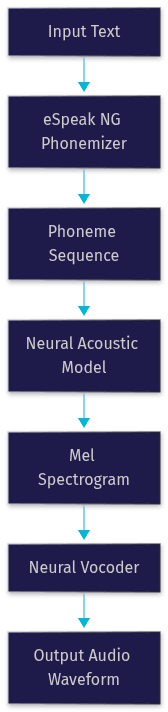
Piper is the project that bridged classic and neural approaches for the offline world. It pairs a fast neural vocoder and acoustic model with eSpeak NG as its phonemizer, meaning eSpeak NG handles the linguistic step of converting text into phonemes, while a compact neural model generates the actual waveform.
The result is a system that produces genuinely natural speech while running efficiently on ordinary CPUs, including single-board computers like the Raspberry Pi. Piper ships with a large library of pre-trained voices across many languages, and its permissive licensing has made it a default choice for home automation platforms, offline assistants, and privacy-sensitive deployments.
Its architecture is worth understanding because it explains its performance profile. The neural models are deliberately compact, trading a little naturalness against the largest commercial models for dramatically lower latency and resource usage. In practice, Piper synthesizes speech fast enough for real-time interactive applications on modest hardware, which is exactly the gap it was built to fill.
The diagram below shows how text flows through Piper's pipeline from input to audio output.
For developers building offline text to speech into embedded or local-first applications, Piper is the strongest general-purpose starting point in 2026.
MaryTTS: Java-Based Multilingual Platform
MaryTTS takes a different architectural stance: it is a full client-server speech synthesis platform written in Java. Rather than being a lightweight library you embed directly, MaryTTS typically runs as a service that accepts text over HTTP and returns synthesized audio, which makes it a natural fit for enterprise and Java-centric environments.
Its strengths are extensibility and voice customization. MaryTTS supports multiple synthesis technologies under one roof, including unit selection and HMM-based voices, and provides tooling for creating and modifying voices in multiple languages. Because it exposes a REST interface, any language capable of making HTTP requests can use it, not just Java applications.
The server-client design has real operational benefits: central management of voices, consistent behavior across client applications, and easy scaling by running multiple server instances. The trade-off is operational weight. You are deploying and maintaining a service rather than linking a library, and its voice quality, while serviceable, trails the newest neural engines.
MaryTTS remains a solid choice for organizations that want a self-hosted, API-driven open source speech service with mature multilingual support and a long track record.
RealtimeTTS: Low-Latency Streaming Library
RealtimeTTS addresses a different problem entirely: latency at the moment of generation. It is a Python-centric library designed to stream speech as text arrives, rather than waiting for a complete utterance before synthesis begins.
Its standout capability is streaming directly from large language models. As an LLM generates tokens, RealtimeTTS can begin speaking the first sentence while later sentences are still being generated, which collapses the perceived response time of conversational AI applications. It supports multiple back-end engines, so you can pair it with the synthesis engine that best fits your quality and licensing needs.
Choose RealtimeTTS when you are building a conversational agent, live assistant, or any application where the gap between text appearing and speech starting is the primary UX constraint. It is not a synthesis engine itself in the traditional sense; it is the orchestration layer that makes real-time text to speech practical. If your use case is batch generation of audio files, a full engine like Piper or ZipVoice is the better fit.
ZipVoice: Zero-Shot Neural TTS
ZipVoice represents the current frontier of open source speech synthesis: a flow-matching neural model that performs zero-shot voice cloning. Given a short reference audio clip of an unseen speaker, ZipVoice can generate speech in that person's voice without any per-speaker training, and it supports multiple languages within a single model family.
Flow matching is a generative modeling technique that learns to transform random noise into speech audio through a learned trajectory, and it has proven effective at producing high-fidelity, natural speech with efficient inference. The zero-shot capability is the headline feature: instead of maintaining a library of pre-trained voices, you supply a reference sample and the model generalizes.
Emerging use cases include dialogue generation for games and media, rapid prototyping of voice personas for AI agents, and multilingual content production where recording human talent for every language is impractical. As an emerging research-driven project, ZipVoice demands more compute than Piper and is best suited to teams with GPU resources and a tolerance for a faster-moving, less hardened codebase.
Choosing the Right Engine for Your Project
Selecting an open source TTS engine is a multi-factor decision, and the right answer depends almost entirely on your constraints. The five criteria that matter most are language coverage, latency requirements, licensing compatibility, target platform, and community health.
The comparison table below summarizes how the five projects stack up.
| Engine | Voice Quality | Latency | Hardware Needs | License Profile | Best For |
|---|---|---|---|---|---|
| eSpeak NG | Robotic, highly intelligible | Very low | Minimal, embedded-friendly | GPLv3 | Screen readers, embedded devices, minority languages |
| Piper | Natural, neural | Low, real-time on CPU | Modest CPU, runs on Raspberry Pi | Permissive (MIT-style) | Offline neural TTS, home automation, privacy-sensitive apps |
| MaryTTS | Serviceable, dated | Medium | JVM server infrastructure | Open, multi-component | Self-hosted REST speech service, Java environments |
| RealtimeTTS | Depends on back-end engine | Very low, streaming | Depends on back-end engine | Permissive library | LLM-driven conversational agents |
| ZipVoice | High, human-like cloning | Higher inference cost | GPU recommended | Research-oriented | Voice cloning, dialogue generation, multilingual media |
[LINKABLE ASSET — comparison table]
The most important row for most developers is Piper: it hits the sweet spot of natural speech, real-time CPU performance, permissive licensing, and offline operation, which is why it has become the default recommendation for local-first applications.
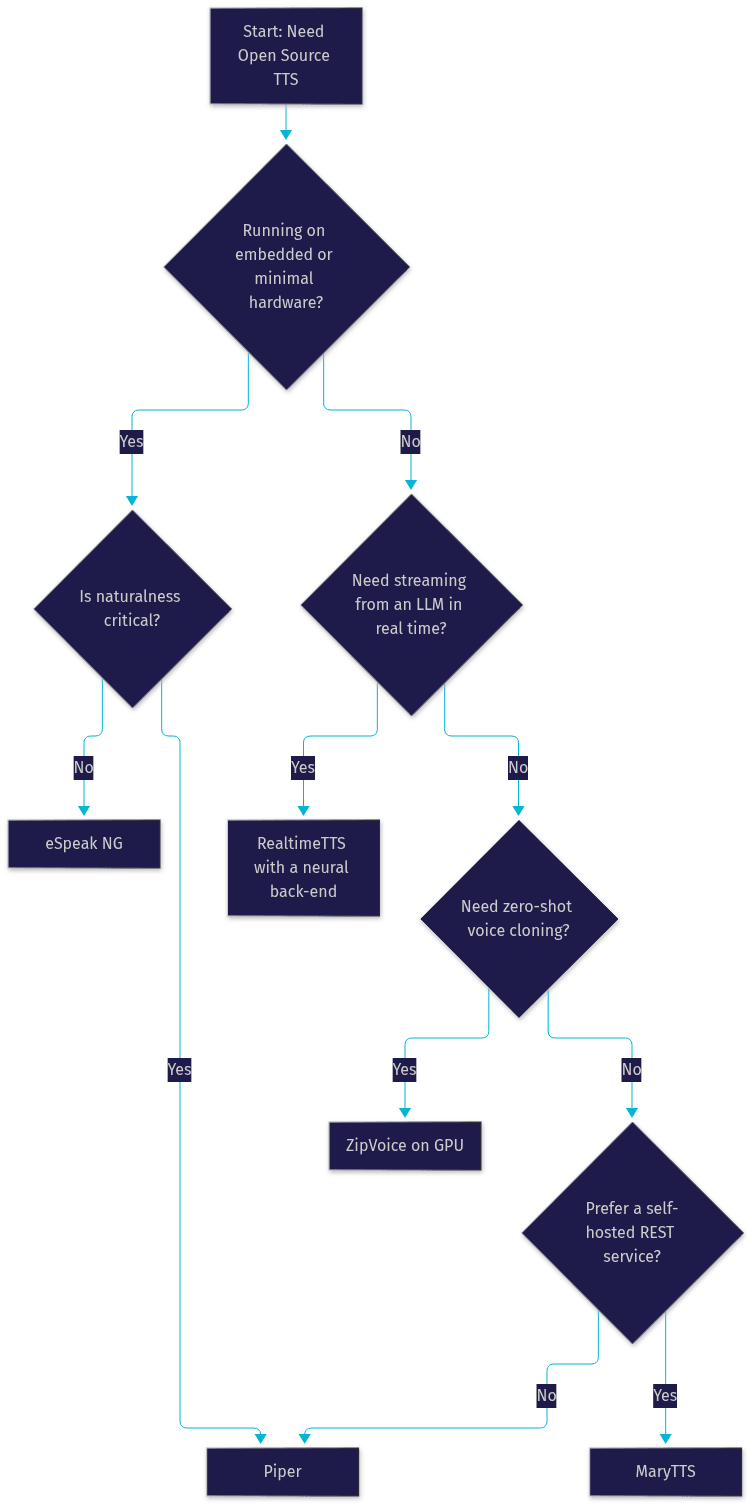
The flowchart below turns these criteria into a decision path you can follow directly.
Integrating Open-Source TTS into Applications
Integration patterns for open source TTS fall into four broad categories, and most engines support at least two of them.
The simplest pattern is command-line invocation, where your application calls the engine as an external process and consumes the audio file it writes. This is ideal for batch generation of podcasts, announcements, or pre-rendered game dialogue. The second pattern is direct library embedding, where the engine runs inside your application process, which gives you the lowest latency and tightest control; Piper and RealtimeTTS both favor this model. The third is a REST API, MaryTTS's native mode, where a speech service runs independently and clients request audio over HTTP. The fourth is WebSocket-based streaming, which matters for real-time conversational systems where audio must begin before the full text is available.
Regardless of pattern, the internal workflow is consistent across engines. Text first passes through preprocessing, where numbers, abbreviations, and punctuation are normalized into speakable words. The normalized text is then phonemized, converting written language into phonetic units the acoustic model understands. Synthesis then generates an intermediate acoustic representation, and a vocoder produces the final waveform. Understanding this pipeline helps you diagnose quality problems: garbled pronunciation usually points to preprocessing or phonemization, while muffled or metallic audio points to the vocoder or model itself.
Two practical tips carry most of the weight in real integrations. First, standardize your audio format early: decide on sample rate, channel count, and container format at the architecture stage, because mismatched assumptions between synthesis output and playback systems are a common source of subtle quality bugs. Second, for streaming applications, synthesize in sentence-level chunks rather than whole paragraphs, so playback can begin immediately and buffer the remainder while the user is already listening.
Best Practices for Improving Naturalness and Performance
Getting good results from open source TTS is as much about configuration as engine choice. Voice selection is the single highest-impact decision: within a single engine, different pre-trained voices can vary substantially in naturalness, so audition several before committing.
Sample rate deserves attention too. Higher rates capture more fidelity but increase compute and bandwidth; for telephony or voice-agent use, a lower sample rate often matches the delivery channel and saves resources. On the inference side, GPU acceleration benefits large neural models like ZipVoice significantly, while compact models like Piper's are deliberately sized to run well on CPU, and forcing GPU deployment for them adds operational complexity without meaningful gain.
A pattern that works well in production is the fallback strategy: pair a high-quality neural engine as the primary with a lightweight engine like eSpeak NG as the fallback. If the primary engine fails, times out, or hits resource limits, the fallback keeps your application speaking, which matters enormously for accessibility tools where silence is a failure state.
Finally, monitor latency and resource usage from day one. Track time from text submission to first audio sample, CPU and memory consumption per synthesis, and queue depth under load. These measurements tell you when an engine is approaching its limits and give you the data to decide when to scale horizontally or switch models.
Future Trends in Open-Source Text-to-Speech
Three trends are shaping where open source TTS goes next. Zero-shot voice cloning is moving from research demos into production tooling, with models like ZipVoice showing that speaker-generalizing synthesis no longer requires per-voice training. Multilingual single-model architectures are reducing the cost of supporting many languages, which historically required maintaining separate voices per locale. And edge inference is pushing neural quality onto phones and embedded devices as compact models and optimized runtimes improve.
Community initiatives are accelerating all three. Open model releases, shared evaluation benchmarks, and collaborative voice datasets are lowering the barrier for contributors, and the gap between commercial and open source voice quality continues to narrow each year. For developers, this means investments in open source TTS integration today are likely to improve in quality over time without any change on your side.
Definitions Glossary
Text to Speech (TTS): Technology that converts written text into spoken audio, typically through a pipeline of text preprocessing, phonemization, acoustic modeling, and waveform generation.
Formant Synthesis: A parametric speech generation technique that models the vocal tract mathematically, producing compact, fast, but robotic-sounding speech, as used by eSpeak NG.
Phonemizer: The component that converts normalized text into phonemes, the smallest units of sound a language uses, preparing input for an acoustic model.
Zero-Shot Voice Cloning: The ability of a neural TTS model to synthesize speech in an unseen speaker's voice from a short reference audio clip, without per-speaker training.
Flow Matching: A generative modeling technique that learns a trajectory from random noise to target audio, used by modern neural TTS systems like ZipVoice for high-fidelity synthesis.
Vocoder: The final stage of a neural TTS pipeline that converts intermediate acoustic representations into an audible audio waveform.
Key Takeaways
- Open source text to speech now spans the full quality range, from eSpeak NG's lightweight formant synthesis to ZipVoice's zero-shot neural voice cloning, all without proprietary licensing.
- Piper is the strongest default choice for offline neural TTS in 2026, combining natural speech, real-time CPU performance, and permissive licensing.
- RealtimeTTS solves the latency problem for LLM-driven applications by streaming speech as text is generated, rather than waiting for complete utterances.
- License family matters as much as features: permissive licenses like MIT suit commercial embedding, while GPL-family licenses impose sharing obligations on derivatives.
- A fallback strategy pairing a neural primary engine with a lightweight secondary keeps speech-critical applications speaking even under failure.
Conclusion
The text to speech open source landscape in 2026 offers a genuinely capable option for every constraint: eSpeak NG for embedded and accessibility work, Piper for offline neural quality, MaryTTS for self-hosted REST services, RealtimeTTS for streaming conversational agents, and ZipVoice for zero-shot voice cloning. Start by auditing your latency, licensing, and platform requirements, then pilot the engine that matches them. If you are building voice agents or real-time applications, explore how VideoSDK's AI voice agent infrastructure pairs with open synthesis engines, and join the VideoSDK Discord community to compare notes. What are you building with open source TTS? Drop a comment, I'd love to hear which engine you chose and why.
Free $20 Balance for AI Voice Agents & Video Calls
FAQ