


A strong Luvvoice AI text-to-speech alternative depends on your priority: Google Cloud TTS and Amazon Polly lead for API-driven enterprise workloads, ElevenLabs wins for ultra-realistic narration, and open-source options like Coqui TTS suit developers who need full control. VideoSDK integrates with major TTS providers through its AI Voice Agent pipeline, letting you swap engines without rewriting your application logic. Evaluate voice naturalness, language coverage, pricing, and latency before committing to any single platform.
Creators and developers evaluate text-to-speech options constantly because voice quality, pricing, and API capabilities shift rapidly. Luvvoice has built a following with its broad language coverage and straightforward web interface, but it is not the only option worth your attention. Whether you are hitting volume limits on a free tier or need deeper SDK support for a production application, finding the right Luvvoice AI text-to-speech alternative can unlock better voice fidelity, lower costs, and stronger developer tooling.
By the end of this article, you will understand what makes a TTS service production-ready, how Luvvoice compares across key criteria, and which six alternatives fit different project types from YouTube voiceovers to enterprise e-learning platforms.
What Makes a Good AI Text-to-Speech Service?
Evaluating a TTS platform requires looking beyond the demo audio on a landing page. The criteria that matter most are voice naturalness, language coverage, customization depth, pricing structure, API quality, and latency.
Voice naturalness is the baseline. A good service produces speech that avoids robotic cadence, handles intonation naturally, and pauses at contextually appropriate moments. Neural voice models have largely replaced concatenative synthesis, but quality still varies significantly between providers.
Language coverage matters for global applications. A platform supporting 70 languages sounds impressive until you realize only 20 of those languages have neural-quality voices. Always check which languages receive full model investment versus basic support.
Customization includes voice cloning, SSML support for fine-grained prosody control, and adjustable speaking rates. Developers building branded experiences need these controls. Content creators often need voice cloning to maintain consistency across episodes.
Pricing models range from per-character billing to per-minute audio pricing. Some providers offer generous free tiers, while others charge from the first request. For high-volume workloads, the difference between four dollars per million characters and sixteen dollars per million characters adds up fast.
API access and SDK breadth determine how quickly you can integrate a TTS engine into your stack. A provider with official SDKs for Python, JavaScript, Go, and mobile platforms saves days of integration work compared to one offering only a REST endpoint.
Latency is the deciding factor for real-time applications. Batch generation for pre-recorded videos tolerates higher latency, but conversational AI agents and live narration need sub-second response times. If you are building real-time voice experiences, platforms like VideoSDK's AI Voice Agent pipeline handle the orchestration between STT, LLM, and TTS components so you can focus on the conversation logic rather than pipeline plumbing.
Overview of Luvvoice AI Text-to-Speech
Luvvoice positions itself as an accessible AI text-to-speech tool with a focus on breadth. The platform offers over 200 voices across 70-plus languages, a web-based interface for quick generation, a mobile app for on-the-go voiceover creation, an API for developers, and custom voice cloning for branded audio content.
The strengths are clear. The wide language set makes Luvvoice attractive for teams producing content in multiple markets without maintaining separate TTS contracts. The web UI is simple enough for non-technical users to generate audio in minutes. The free tier lets you test the platform before committing financially.
However, common limitations push developers toward alternatives. High-volume usage hits paywalls quickly, and the per-character pricing can become expensive for applications generating hours of audio daily. The SDK ecosystem is limited compared to hyperscaler offerings like Google Cloud or AWS, meaning you may need to write custom HTTP clients rather than dropping in an official library. There is no open-source SDK, which removes the option of self-hosting or auditing the synthesis pipeline.
For developers building real-time applications, the absence of streaming TTS output can be a dealbreaker. Batch generation works for pre-recorded content, but conversational interfaces need audio chunks streamed as they are synthesized.
The diagram below illustrates a typical Luvvoice request flow, from text input through the API to final audio output.
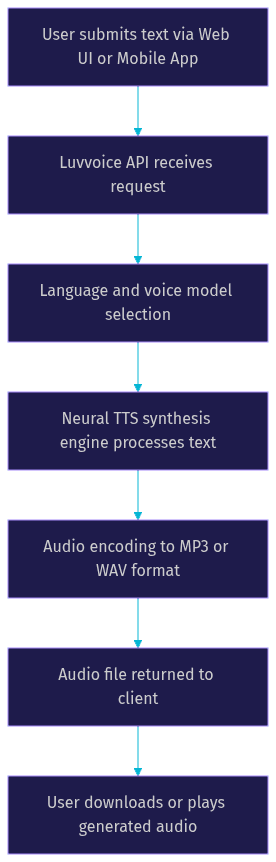
This flow works well for batch content creation but highlights the limitation for real-time use cases: the entire text must be processed before any audio is returned, adding latency that interactive applications cannot tolerate.
Top Alternatives to Luvvoice
1. Google Cloud Text-to-Speech
Google Cloud TTS is a frequent first choice for developers seeking a Luvvoice AI text-to-speech alternative with enterprise-grade reliability. The platform leverages WaveNet and Journey voice models that produce some of the most natural-sounding speech available commercially.
Google Cloud TTS supports over 220 voices across 40-plus languages. The API supports SSML for fine-grained control over pitch, rate, and emphasis. Streaming audio is supported, making it viable for real-time applications.
Pricing follows a per-character model. WaveNet voices cost more than standard voices, but the quality difference is substantial. The free tier offers up to one million bytes per month for standard voices and a smaller allocation for WaveNet, which is enough for prototyping but not production at scale.
Google provides official client libraries for Python, Node.js, Java, Go, C#, and Ruby. This SDK breadth is a significant advantage over Luvvoice, especially for teams working across multiple languages. Integration with other Google Cloud services like Cloud Storage and Cloud Functions is straightforward.
Google Cloud TTS is a better fit than Luvvoice when you need production-grade SLAs, streaming audio output, and SDK support across multiple programming languages. It is particularly strong for applications already running on Google Cloud infrastructure.
2. Amazon Polly
Amazon Polly is AWS's text-to-speech service and a strong Luvvoice AI text-to-speech alternative for developers already invested in the AWS ecosystem. Polly supports real-time streaming, which means audio chunks are delivered as synthesis progresses rather than waiting for the entire text to process.
Polly offers dozens of voices across 29 languages. SSML support is comprehensive, allowing control over breathing, whispering, and emphasis. The neural voices available through Polly produce natural speech suitable for customer-facing applications.
Pricing is per-character, with standard voices costing less than neural voices. AWS offers a free tier of five million characters per month for standard voices and one million for neural voices, which is more generous than most competitors. For high-volume workloads, Polly's pricing often undercuts Luvvoice significantly.
AWS provides SDKs for virtually every major programming language, and Polly integrates natively with Lambda, S3, and other AWS services. This makes it straightforward to build serverless audio generation pipelines.
Polly outperforms Luvvoice in scenarios requiring real-time streaming, serverless integration, and high-volume cost efficiency. If your application runs on AWS, Polly is the natural choice. You can also integrate Polly as a TTS provider within VideoSDK's AI Voice Agent architecture to build conversational interfaces that leverage Polly's neural voices.
3. Microsoft Azure Speech Service
Azure Speech Service combines text-to-speech, speech-to-text, and speech translation into a single offering. For developers evaluating a Luvvoice AI text-to-speech alternative, Azure stands out for its neural voice library and custom voice creation capabilities.
Azure offers over 400 neural voices across 140-plus languages and locales. This is the broadest neural voice coverage among the major cloud providers. The custom neural voice feature lets you train a proprietary voice model using your own audio data, which is valuable for brands wanting a consistent, recognizable voice across all content.
Pricing follows a per-character model with separate rates for standard and neural voices. Custom neural voice training involves additional costs, including a training fee and per-character usage rates. The free tier includes 500,000 characters per month for neural voices.
Azure provides strong security and compliance certifications, making it a preferred choice for healthcare, finance, and government applications. The SDK supports Python, C#, JavaScript, Java, Objective-C, and Swift, covering desktop, mobile, and server environments.
Azure Speech Service is the best alternative to Luvvoice when you need custom voice creation, enterprise compliance, or the widest neural language coverage. It is particularly well-suited for large organizations with existing Microsoft enterprise agreements.
4. ElevenLabs
ElevenLabs has become the go-to Luvvoice AI text-to-speech alternative for creators prioritizing voice fidelity above all else. The platform's voices are widely considered the most realistic available, with natural breathing, emotional inflection, and conversational cadence that rivals human narration.
ElevenLabs supports over 30 languages with its multilingual model. The voice cloning feature is exceptionally powerful, requiring as little as one minute of audio to create a convincing voice clone. The API supports real-time streaming and provides control over voice settings including stability, similarity, and style.
The free tier offers 10,000 characters per month, which is sufficient for testing but limited for production. Paid plans scale up to enterprise tiers with custom pricing. Per-character costs are higher than cloud provider alternatives, but the quality difference justifies the premium for narration-heavy use cases.
ElevenLabs provides a Python SDK and a REST API. The developer documentation is clear, and integration is straightforward for most web and mobile applications.
ElevenLabs is ideal for podcasting, audiobook production, YouTube narration, and any application where voice quality is the primary differentiator. If your audience will listen to the output for extended periods, the naturalness of ElevenLabs voices reduces listener fatigue significantly. ElevenLabs is also supported as a TTS provider in VideoSDK's agent pipeline, making it a strong choice for real-time conversational AI applications.
5. Open-Source Options: Coqui TTS and Mozilla TTS
Open-source TTS engines offer a fundamentally different value proposition compared to Luvvoice and commercial alternatives. There is no per-character cost, no vendor lock-in, and full control over the synthesis pipeline.
Coqui TTS is one of the most popular open-source text-to-speech engines. It supports multiple model architectures including Tacotron, VITS, and XTTS. Coqui allows voice cloning with limited training data and supports over a dozen languages. The engine runs on local hardware or cloud instances, and you can fine-tune models on your own datasets.
Mozilla TTS, while less actively maintained than Coqui, remains a viable option for developers who want a lightweight, community-driven TTS engine. It supports Tacotron-based models and provides a clean Python interface.
The trade-off with open-source TTS is operational overhead. You are responsible for model hosting, GPU provisioning, inference optimization, and maintenance. Voice quality generally does not match the best commercial neural voices, though fine-tuned models can come close.
Open-source TTS is the right Luvvoice AI text-to-speech alternative when you need complete data privacy, zero per-request costs at scale, or the ability to modify the synthesis pipeline. Research teams, privacy-sensitive applications, and high-volume workloads where per-character pricing becomes prohibitive benefit most from self-hosted TTS.
6. Niche Mobile-First Apps: Speechify and Voice Dream
Not every TTS use case requires an API or server-side processing. Mobile-first TTS apps like Speechify and Voice Dream cater to users who need on-device speech generation for personal productivity, accessibility, and content consumption.
Speechify offers a polished mobile experience with high-quality neural voices, optical character recognition for scanning physical text, and synchronization across devices. The app supports multiple languages and provides adjustable reading speeds. Pricing follows a subscription model with a free tier for basic functionality.
Voice Dream Reader is a long-standing accessibility-focused TTS app that supports a wide range of document formats including PDF, EPUB, and DAISY. It offers dozens of premium voices from Ivona, Acapela, and NeoSpeech. The app works offline, making it reliable for users in areas with poor connectivity.
These mobile-first apps are the best Luvvoice AI text-to-speech alternative for personal productivity, accessibility use cases, and on-the-go content consumption. They are not designed for developers building applications with API-driven audio generation, but they excel at helping individuals consume written content audibly.
The comparison matrix below visualizes how these six alternatives stack up across the criteria that matter most.

How to Choose the Right Alternative
Selecting the right Luvvoice AI text-to-speech alternative requires matching platform capabilities to your specific project requirements. The decision framework below helps you evaluate options systematically rather than chasing the newest or most hyped provider.
Start by ranking your priorities. A YouTube creator needs natural voice quality and affordable pricing but rarely needs real-time streaming or custom voice training. An enterprise e-learning platform needs multi-language support, SCORM-compatible audio delivery, and enterprise SLAs. A developer building a conversational AI agent needs low-latency streaming TTS that integrates with their STT and LLM pipeline.
The checklist table below summarizes the key evaluation criteria across all six alternatives.
| Criterion | Google Cloud | Amazon Polly | Azure | ElevenLabs | Coqui TTS | Speechify |
|---|---|---|---|---|---|---|
| Voice quality | High | High | High | Highest | Medium | High |
| Language count | 40+ | 29 | 140+ | 30+ | 12+ | 30+ |
| Pricing model | Per character | Per character | Per character | Per character | Free self-hosted | Subscription |
| API access | Full REST and SDKs | Full REST and SDKs | Full REST and SDKs | REST and Python | Python library | No public API |
| Custom voice cloning | Limited | Limited | Full custom neural | Yes with 1 min audio | Yes with fine-tuning | No |
| Real-time streaming | Yes | Yes | Yes | Yes | Depends on setup | No |
| Best for | Enterprise apps | AWS serverless | Compliance-heavy | Content creators | Privacy and control | Personal use |
For a YouTube creator, the decision flow is straightforward. Start with ElevenLabs for the best voice quality. If the per-character cost becomes unsustainable at your content volume, evaluate Amazon Polly's neural voices as a cost-effective fallback. Google Cloud TTS is a solid middle ground if you want WaveNet quality with more predictable pricing.
For an enterprise e-learning platform, Azure Speech Service is the strongest starting point due to its language coverage and compliance certifications. If custom voice branding is critical, Azure's custom neural voice feature justifies the additional cost. Amazon Polly is the alternative if your infrastructure is AWS-native.
For developers building real-time conversational AI, the TTS engine is one component of a larger pipeline. Platforms like VideoSDK's Python SDK for AI pipelines let you integrate multiple TTS providers and switch between them based on latency, cost, or quality requirements without restructuring your application.
Migration Tips: Moving from Luvvoice to a New Provider
Migrating from Luvvoice to a new TTS provider involves more than swapping an API endpoint. A structured migration prevents audio quality regressions, unexpected cost spikes, and broken application logic.
Start by exporting all existing voice scripts and audio files from Luvvoice. Document which voice IDs you used for each content type, language, and persona. Voice IDs are provider-specific, so you will need to map each Luvvoice voice to an equivalent voice on the new platform. This mapping is rarely one-to-one, so plan time for A/B testing candidate voices with your audience or stakeholders.
Update your API integration by replacing the Luvvoice client with the new provider's SDK or REST client. Pay attention to authentication differences, request payload structures, and response formats. Some providers return base64-encoded audio in the JSON response, while others return binary audio streams. Your application logic for handling the response will need adjustment.
Test audio quality across all languages and voice types you previously used. Neural voice quality varies by language even within the same provider. A voice that sounds excellent in English may sound less natural in a lower-resource language. Generate sample audio for each language and have native speakers evaluate the output.
Manage subscription overlap by keeping your Luvvoice account active during the transition period. Run both providers in parallel for a week or two, comparing output quality and cost. Once you are confident in the new provider, cancel the Luvvoice subscription to avoid paying for unused capacity.
Budget for a temporary cost increase during migration. You will generate audio on both platforms simultaneously, and the new provider may have different pricing that initially costs more until you optimize voice selection and character usage. Monitor your billing dashboard closely during the first month.
Definitions Glossary
Neural TTS: A text-to-speech synthesis method that uses deep neural networks to generate human-like speech, replacing older concatenative and parametric approaches with significantly improved naturalness and prosody.
SSML (Speech Synthesis Markup Language): An XML-based markup language that gives developers fine-grained control over speech output, including pitch, rate, volume, pauses, and pronunciation. Most major TTS providers including Google Cloud, Amazon Polly, and Azure support SSML.
Voice Cloning: The process of training a TTS model on a specific person's audio samples to create a synthetic voice that mimics their speech patterns, tone, and cadence. ElevenLabs and Azure offer this capability with varying data requirements.
Streaming TTS: A synthesis mode where audio chunks are delivered as they are generated rather than waiting for the entire text to be processed. This reduces time-to-first-audio and is essential for real-time conversational AI applications.
Per-Character Pricing: A billing model where TTS providers charge based on the number of characters processed. This is the most common pricing model for cloud TTS services and requires careful monitoring for high-volume applications.
Key Takeaways
- The best Luvvoice AI text-to-speech alternative depends on your use case: ElevenLabs for voice quality, Amazon Polly for cost-effective AWS integration, Azure for enterprise compliance, and Coqui TTS for full self-hosted control.
- Voice naturalness, language coverage, pricing structure, API quality, and latency are the five criteria that should drive your evaluation process.
- Open-source TTS engines eliminate per-character costs but introduce operational overhead for model hosting, GPU provisioning, and maintenance.
- Real-time applications require streaming TTS output, which rules out batch-only providers and mobile-first apps that lack public APIs.
- VideoSDK's AI Voice Agent pipeline supports multiple TTS providers, letting developers switch engines based on latency, cost, or quality without restructuring their application architecture.
Conclusion
Evaluating a Luvvoice AI text-to-speech alternative is not about finding a universally superior platform. It is about matching voice quality, language coverage, pricing, and API capabilities to your specific project requirements. The TTS landscape in 2026 offers more options than ever, from hyperscaler APIs with full SDK suites to open-source engines you can run on your own hardware.
Trial at least two services before committing. Generate the same script on both platforms, compare audio quality with your team or audience, and review the billing implications at your expected volume. The comparison matrix in this article gives you a structured starting point.
If you are building real-time voice applications, explore how VideoSDK's AI Voice Agent pipeline integrates with leading TTS providers to handle the full STT-to-LLM-to-TTS orchestration. You can start with a free account at app.videosdk.live/login and test the pipeline with your preferred TTS engine today.
What are you building with AI text-to-speech? Drop a comment below, I would love to hear what kind of voice synthesis use case you are working on.
Free $20 Balance for AI Voice Agents & Video Calls
FAQ