


Windows speech recognition is the built-in on-device technology in Windows 10 and Windows 11 that converts spoken audio into text and executes voice commands without sending audio to the cloud. Windows 11 voice access, its modern successor, runs a local AI model that supports real-time dictation and hands-free command control across apps. Developers can integrate the same capability through the Windows Speech API and the SpeechRecognitionEngine class, detailed in this guide along with setup, grammars, and privacy considerations.
Voice interaction has quietly become a first-class input method on the Windows desktop. With the arrival of Copilot+ PCs in 2024 and the broader rollout of Windows 11 voice access, speaking to your computer is no longer a novelty experiment buried in accessibility menus. It is a core platform capability, accelerated by dedicated neural processing hardware and refined by years of on-device model improvements.
Windows speech recognition has traveled a long road. Windows 10 shipped with a legacy speech recognition engine that worked well for dictation but required training and felt dated. Windows 11 replaced that experience with voice access, a modern, offline-capable system that understands natural language commands like "open Chrome and scroll down" without any per-user voice training. For developers, the underlying Windows Speech API surface has matured alongside it, offering both quick high-level integration and deep control over grammars and recognition constraints.
This guide covers how windows speech recognition works under the hood, how to set it up, how to integrate it into your own applications, and where the platform is heading in 2026.
What Is Windows Speech Recognition?
Windows speech recognition is defined as the set of platform technologies in Windows that convert microphone audio into transcribed text and executable commands using an on-device AI model. It works by capturing raw audio through the Windows audio stack, preprocessing it into feature vectors, and running those features through a neural speech model that produces text hypotheses in real time.
The modern Windows 11 voice access experience differs from older cloud-dependent systems in one critical way: the recognition model runs locally on the device. No audio leaves the machine during dictation or command processing, which means recognition continues to work offline and latency stays low because there is no network round trip. This is a meaningful advantage over browser-based dictation tools and cloud speech services, where a slow connection directly degrades responsiveness.
The feature supports two operating modes. Real-time dictation transcribes continuous speech into any text field, word by word, with automatic punctuation in supported languages. Command control interprets short spoken phrases as actions, such as launching apps, clicking UI elements by name, or scrolling within a window. Both modes share the same recognition engine but apply different constraint sets, which is a distinction developers will recognize as the difference between free-form dictation grammars and command grammars.
Language support has expanded steadily. As of 2026, voice access supports more than a dozen languages including English, French, German, Spanish, Japanese, and Simplified Chinese, with additional languages arriving through Windows updates. The legacy Windows 10 speech recognition engine remains available for languages that voice access has not yet reached, though Microsoft has signaled that voice access is the long-term path.
How Windows Speech Recognition Works Under the Hood
Understanding the windows speech recognition pipeline explains most of its performance characteristics, from its sub-second responsiveness to its behavior on different hardware. The system is a chain of stages, each running locally on the device.
Audio enters through the microphone, where the Windows audio capture stack applies noise suppression and echo cancellation before handing clean PCM audio to the recognition layer. A preprocessing stage converts the audio stream into spectral feature frames, typically computed every 10 to 20 milliseconds. These frames feed the inference engine, a neural acoustic and language model that emits partial text hypotheses continuously and refines them as more context arrives. The final stage applies whatever constraint is active: a free-form language model for dictation, or a command grammar that restricts output to a known set of phrases.
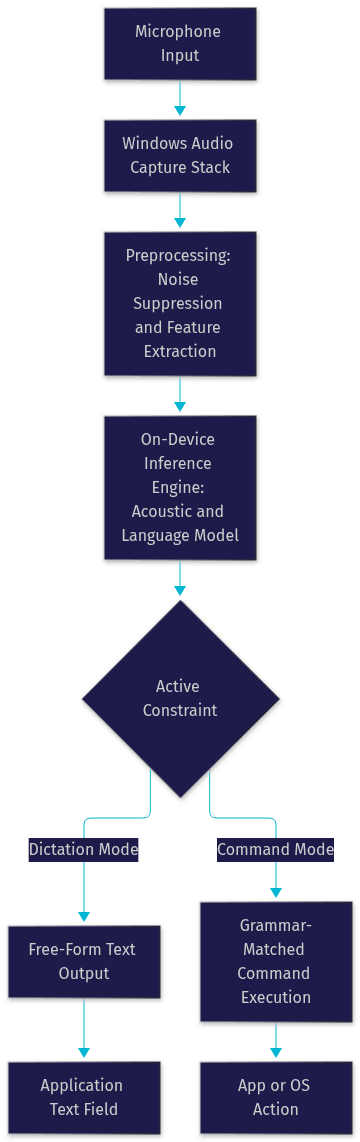
The pipeline is fully local, which is why windows speech recognition keeps working on an airplane and why its latency does not spike when your Wi-Fi does.
Hardware Pathways in Windows Speech Recognition
Where the inference engine executes depends on your hardware. On Copilot+ PCs with a dedicated NPU, the speech model can be offloaded to the neural processor, which delivers high recognition throughput at low power draw. On conventional PCs, the model runs on the CPU, and on machines with a suitable GPU, portions of the workload may be scheduled there instead.
Selection is automatic. The Windows machine learning runtime probes available compute devices at session start and picks the execution path that balances latency and power for the current power profile. Developers do not need to write device-specific logic; the platform abstracts the choice. The practical implication is performance: NPU-equipped machines sustain faster real-time transcription under load and preserve battery life during long dictation sessions, while CPU-only machines still deliver fully functional recognition, just with higher power consumption during extended use.
The Software Stack Behind Windows Speech Recognition
Above the hardware sits a layered software stack. The Windows AI APIs expose the speech models to the operating system and to applications. The SpeechRecognitionModel component represents a locally installed recognition language model that apps can query, download on demand, and activate. Recognition sessions are managed through platform classes that handle audio stream attachment, hypothesis events, and final result delivery.
For application developers, the key integration points are the Windows Speech API for Universal Windows Platform (UWP) and WinUI apps, and the SpeechRecognitionEngine class in the .NET desktop stack for fine-grained control. Both surfaces consume the same underlying models, so recognition quality is consistent whether you use the high-level API or the engine. The official Windows Speech API documentation covers the current class surface, and the Windows Speech SDK overview describes the modern voice access architecture.
Setting Up Windows Speech Recognition
Setting up windows speech recognition on a modern Windows 11 machine takes a few minutes and requires no voice training, unlike the legacy Windows 10 experience.
Step 1: Enable the feature. Open the Settings app, navigate to the Accessibility section, and select the Speech page. Turn on voice access. Windows may prompt you to download the recognition model for your display language, which is a one-time download of roughly a few hundred megabytes depending on the language.
Step 2: Set your microphone. On the same Settings page, choose your input device from the microphone dropdown. If your preferred device does not appear, check that it is connected and that privacy settings allow apps to access the microphone. Windows requires microphone access to be enabled at the system level before any speech feature will function.
Step 3: Choose the recognition language. Voice access lists the languages it supports. Select the one matching your speech, not necessarily your display language. Picking a mismatched language is the single most common cause of poor accuracy.
Step 4: Activate listening mode. Voice access can start automatically at sign-in or be launched on demand. Once running, a small overlay bar confirms the system is listening. You can begin dictating immediately or say commands like "click File" or "open Settings."
A common pitfall is running an outdated OS build. Voice access language packs and model improvements ship through Windows Update, so a machine that has not updated in months may be missing languages or running an older, less accurate model. Another frequent issue is microphone permissions being revoked at the privacy level, which silently disables recognition with no obvious error message.
Calibration Tips for Better Windows Speech Recognition Accuracy
Accuracy improves noticeably with a decent recording environment. Position the microphone within about 30 centimeters of your mouth, ideally slightly off-axis to reduce plosives. Close windows and disable fans where practical, since the preprocessing stage handles steady background noise better than intermittent noise. A headset microphone consistently outperforms a laptop's built-in array in noisy rooms. Finally, speak at a natural, even pace; the model degrades more from trailing-off volume than from speed.
Troubleshooting Common Windows Speech Recognition Problems
When windows speech recognition fails or performs poorly, the cause is usually one of a handful of issues. Unsupported language: if your spoken language is not in the voice access list, switch to the legacy Windows 10 engine or wait for a language pack update. Outdated audio drivers can cause dropouts in the capture stream; updating the driver through Device Manager often resolves intermittent recognition gaps. Missing microphone permission blocks recognition entirely; verify access is allowed in privacy settings. If voice access will not start, confirm the recognition model finished downloading and that you are signed in, since first-run setup requires an authenticated session. For developers, recognition failing only inside your own app usually points to a missing manifest capability rather than a system fault.
Using Windows Speech Recognition in Your Applications
Integrating windows speech recognition into your own software comes down to choosing between two developer pathways, both of which consume the same on-device models.
The high-level Windows Speech API is designed for quick integration in UWP and WinUI applications. You declare the microphone capability in your app manifest, create a recognizer bound to the system's active recognition model, attach a constraint, and start a recognition session. The recognizer raises events containing partial hypotheses as the user speaks and a final result when the utterance completes. For dictation scenarios, you attach the predefined free-form dictation constraint and route the resulting text into whatever input field has focus. For command scenarios, you attach a grammar constraint and map recognized phrases to application actions. The expected behavior is straightforward: the app listens, produces text or a matched command, and never requires network access.
The lower-level SpeechRecognitionEngine in the .NET desktop stack targets WinForms and WPF applications and gives you control over audio input selection, recognition load, grammar management, and hypothesis thresholds. It is the right surface when you need to tune timeout behavior, swap grammars mid-session, or run recognition against audio streams other than live microphone input.
In both cases, the manifest or application configuration must declare microphone access. On UWP, this is a named capability in the package manifest; without it, recognizer creation fails at runtime with a permissions error, which is the most common first-integration mistake developers report.
Choosing the Right API for Windows Speech Recognition
Pick the high-level Windows Speech API when you are building a UWP or WinUI app, want platform-managed audio capture, and need standard dictation or simple command matching. It minimizes the code you write and handles device selection and session lifecycle for you.
Pick the SpeechRecognitionEngine when you need custom audio routing, fine-grained grammar control, or are targeting classic desktop frameworks. The trade-off is more setup responsibility in exchange for flexibility.
Latency is comparable between the two because both run the same local model. The decision axis is flexibility versus convenience, plus which UI framework you are targeting. If you need cross-platform speech beyond Windows, consider the Azure Speech to Text, which shares conceptual roots with the Windows stack but processes audio in the cloud.
Defining Custom Grammars for Windows Speech Recognition Commands
A grammar is a declarative description of the phrases a recognizer should accept. Windows speech recognition supports the SRGS (Speech Recognition Grammar Specification) format, an XML-based standard that defines rules, alternatives, and optional slots for variable content like numbers or names.
Grammars matter because constraining the recognition space dramatically improves both accuracy and speed for command-driven apps. A recognizer listening for only "start recording," "stop recording," and "save file" will match those phrases far more reliably than one listening for arbitrary speech, because the language model only has to discriminate among a small set of candidates.
In a UWP application, you add the SRGS grammar file to your project as content, and the packaging system deploys it alongside your app binaries. At runtime, you load the grammar file from your installed package location and attach it to the recognizer as a constraint. When the user speaks, the recognizer returns the matched rule along with any semantic values the grammar defined, which your app maps directly to actions. A well-designed grammar turns windows speech recognition from a transcription tool into a reliable command interface, which is exactly what kiosk and industrial applications need.
Real-World Use Cases for Windows Speech Recognition
Three scenarios illustrate where windows speech recognition delivers measurable value.
Accessibility dictation. For users with mobility impairments or repetitive strain injuries, voice access provides full hands-free control of Windows. A user can dictate email, navigate by voice, and edit text entirely without a keyboard. Organizations deploying assistive technology report that voice-first workflows reduce text-entry task time by roughly 30% for users who type slowly or painfully, and the on-device model means sensitive dictated content never transits a third-party server.
Hands-free control during development sessions. Developers frequently need to trigger actions while their hands are occupied: starting a screen recording, switching virtual desktops, or inserting a timestamped note while debugging. A small custom grammar bound to a handful of commands turns windows speech recognition into a lightweight voice macro system. Teams that adopt this pattern typically consolidate dozens of small context switches per day into single spoken phrases.
Voice-driven kiosk navigation. Public kiosks in museums, hospitals, and retail benefit from a speech interface that works without a keyboard and without connectivity. Because the recognition model runs locally, a kiosk in a basement with no network still responds to spoken menu selections. Kiosk operators using grammar-constrained recognition report high command-match reliability in moderately noisy environments, since the small grammar space tolerates ambient sound far better than open dictation.
Privacy and Security in Windows Speech Recognition
Privacy is a structural feature of windows speech recognition, not an afterthought. All audio processing and recognition inference happen on the device. Voice access does not upload your microphone audio or transcripts to Microsoft servers as part of normal operation, which distinguishes it from cloud speech services and from consumer voice assistants that depend on server-side processing.
What is logged is limited and inspectable. Windows stores a small local history of voice interactions to improve the experience, and users can clear it from the speech settings page. Diagnostic data settings control whether any speech-related telemetry is shared at all; setting diagnostics to the minimal level effectively disables it.
For developers, respecting user privacy means following the same pattern. Use the on-device recognition models rather than routing audio to a cloud endpoint unless your product genuinely requires server-side processing, and declare microphone access clearly so users understand what your app listens for. If your application does process speech in the cloud, disclose it. Users increasingly check, and the difference between "works offline" and "sends audio somewhere" is a trust decision, not a technical footnote.
Future Outlook: Windows Speech Recognition and AI
The trajectory of windows speech recognition is tied to the broader AI investments Microsoft is making across the platform. Expect continued language expansion for voice access, with each Windows update extending coverage toward parity with the full display-language list. Tighter integration with Windows Copilot is already visible: voice is becoming the natural input channel for the assistant layer, and the same on-device speech stack feeds both experiences.
On the model side, the NPU generation of hardware enables larger, more capable local recognition models. Future updates are likely to bring better automatic punctuation, improved handling of domain vocabulary, and lower latency on Copilot+ machines as models are optimized specifically for neural processors. For developers, the practical takeaway is that the on-device speech surface will keep improving without any changes on your side, which makes investing in speech integration now a low-risk bet on a rising baseline.
Definitions Glossary
Windows speech recognition: The built-in Windows technology that converts spoken audio into text and commands using an on-device model, spanning the legacy Windows 10 engine and the modern Windows 11 voice access experience.
Voice access: The Windows 11 successor to legacy speech recognition, offering offline dictation and natural-language command control without per-user voice training.
SRGS grammar: The Speech Recognition Grammar Specification, an XML format that declares the exact phrases a recognizer should accept, enabling reliable command-driven applications.
SpeechRecognitionEngine: The .NET desktop class providing low-level control over recognition sessions, audio input, and grammar management for WinForms and WPF applications.
NPU: The neural processing unit on Copilot+ PCs that executes AI workloads like speech inference efficiently, delivering low-latency recognition with minimal power draw.
Key Takeaways
- Windows speech recognition runs entirely on-device, so dictation and commands work offline and latency stays consistently low.
- Windows 11 voice access is the modern replacement for the legacy Windows 10 engine, requiring no voice training and supporting natural-language commands.
- Developers integrate speech through the high-level Windows Speech API or the lower-level SpeechRecognitionEngine, with the manifest microphone capability being the most commonly missed step.
- Grammar-constrained recognition dramatically improves command accuracy, making windows speech recognition reliable for kiosk and industrial interfaces.
- On-device processing means dictated content never leaves the machine, a structural privacy advantage over cloud speech services.
Conclusion
Windows speech recognition has matured from a dated accessibility feature into a fast, private, hardware-accelerated platform capability. Whether you are enabling voice access for hands-free productivity or wiring grammar-based commands into a kiosk app, the on-device architecture gives you offline reliability and consistent latency that cloud-dependent alternatives cannot match. Start with the Windows Speech API documentation, and if your project needs embedded real-time communication alongside voice, explore how VideoSDK's real-time transcription can complement your speech pipeline. What are you building with windows speech recognition? Drop a comment, I'd love to hear what kind of voice-driven use case you're working on.
Free $20 Balance for AI Voice Agents & Video Calls
FAQ