



An npx script is a way to execute a package's command-line program on demand without first adding that package to your project as a permanent dependency. The package runner behind it resolves the executable from the npm registry, downloads it if needed, and runs it in one step. It is a development convenience, not a runtime for your application, and VideoSDK projects use it purely as tooling around the SDK rather than as part of the SDK itself.
Every JavaScript developer eventually hits the same moment: a tool exists, you need it once, and you do not want it living in your dependency tree forever. That moment is exactly what the npx script was designed for. The package runner lets you invoke a published executable immediately, keep your manifest clean, and move on with your actual work.
This guide explains what an npx script actually does, when it earns its place in your workflow, how it differs from the named project tasks defined in your package manifest, and what reliability considerations matter once you take it into continuous integration. By the end, you will know when to reach for the package runner and when a named project task is the better engineering choice.
What Is an npx Script?
An npx script is defined as an on-demand invocation of a package's executable program through the package runner built into npm's command-line interface. Instead of declaring a tool as a long-term dependency and then referencing it, you name the package you want to execute, and the runner takes care of locating, fetching, and launching its program.
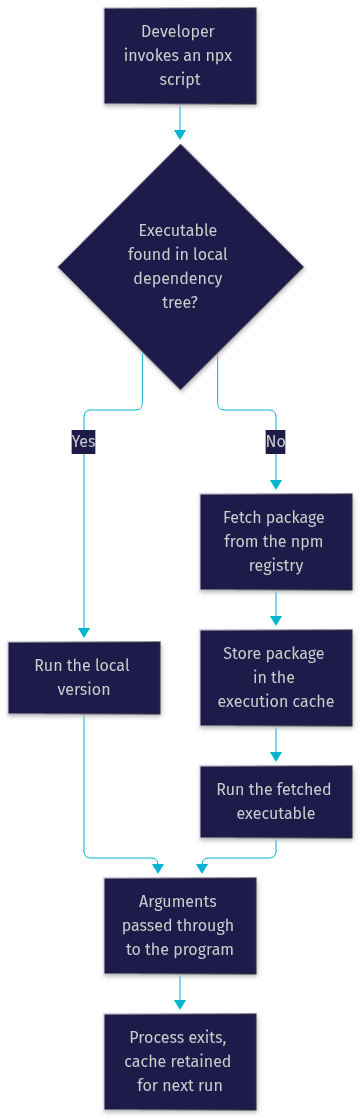
The package runner works by checking a specific resolution order. First, it looks inside your project's local dependency tree for a matching executable. If the tool is already installed locally, the local version runs, which keeps project behavior consistent. If no local match exists, the runner falls back to the public registry, downloads the package into a cache, and executes it from there. This two-stage lookup is what makes the npx script feel instant: tools you already have run from disk, and tools you do not have are fetched transparently.
According to npm's official documentation for the package execution interface, the runner also supports passing arguments through to the underlying program, running with elevated permissions when explicitly requested, and constraining execution to a specific package version. Those capabilities matter more than they first appear, because they turn a convenience feature into something you can reason about in a build pipeline.
The mental model that sticks: an npx script is a shortcut to an executable, not a definition of work. It answers the question "how do I run this tool right now," while your project manifest answers the question "what does this project officially do."
When Should You Use an npx Script?
The package runner shines in three situations, and all three share one trait: the tool is a means to an end, not a lasting part of your project.
One-Off Scaffolding
Scaffolding tools are the classic case. When you start a new project, you typically run a generator once, accept the files it produces, and never invoke it again. Committing a generator to your dependencies for a single use adds weight to every future installation for no benefit. An npx script lets you pull the generator on demand, produce your project skeleton, and leave your manifest untouched.
This pattern is why so many framework quick-start guides recommend the package runner for initialization. The tool's job ends the moment your first source file exists.
Local Tooling Without Permanent Dependencies
The second case is occasional developer tooling: a formatter you want to try, a migration helper you run twice a year, a diagnostic utility a teammate mentioned. These tools do not belong in the dependency tree of a shared project, because every collaborator and every CI runner would download them on every installation. Running them through the package runner keeps the project lean while still giving you access when needed.
The trade-off is worth stating plainly: convenience on your machine, at the cost of a network fetch the first time. For tools you use weekly, that cost stops making sense, and a development dependency becomes the better home.
Evaluating a Tool Before Committing to It
The third case is evaluation. Before you add any tool to a production project, you want to see how it behaves with your actual code. The package runner lets you trial a specific version, observe the output, and discard it if the fit is wrong. Because you can pin the runner to an exact version during evaluation, you can also compare two releases of the same tool side by side before deciding which one to adopt.
In practice, teams evaluating a linter or a bundler this way avoid the churn of adding, removing, and re-adding dependencies while a decision is still in flux.
Package Execution Versus Named Project Tasks
The choice between an npx script and a named project task is really a choice between ad-hoc execution and declared, reviewable work.
A named project task is a command defined in your package manifest under a human-readable name. According to npm's documentation on project task execution, these tasks run with your project's local executables on the path, so anything installed as a dependency is directly reachable. The definition lives in a file that goes through code review, appears in diffs, and is visible to every collaborator.
The package execution interface, by contrast, resolves at invocation time. Nothing in your repository records that the tool was used, which version ran, or what arguments were passed. That is a feature for throwaway work and a liability for anything your team relies on.
The practical dividing line:
- Use the package runner for exploration, one-time generation, personal tooling, and version comparison.
- Use named project tasks for builds, tests, linting, formatting, and any command a teammate or CI system might need to reproduce.
- Promote a tool from runner to named task the moment a second person needs it, or the moment it appears in documentation as "how we do this."
There is also a middle path worth knowing. Many teams use the package runner during evaluation, then formalize the winning tool as a dependency with a named project task that wraps it. The runner was the interview; the named task is the hire.
Reliability in Development and CI
Once an npx script leaves a single developer's laptop and enters a build pipeline, the assumptions that made it convenient start to matter. Four reliability factors determine whether it belongs there at all.
Reviewed Dependencies
A named project task is reviewed like any other code change. An ad-hoc invocation is not. If a build step depends on the package runner, the effective dependency exists only in the pipeline definition, and reviewers may not scrutinize it with the same care as a manifest change. Treat any runner-based step in CI as a dependency decision and review it accordingly.
Exact Versions
By default, an unpinned invocation resolves to the latest published version of the package. That means today's build and next month's build may run different code, even though nothing in your repository changed. For reproducible builds, pin the exact version in the invocation, or better, move the tool into a lockfile-managed dependency where the lockfile freezes it for you.
Trusted Registries and Supply Chain Risk
The package runner fetches from whatever registry your environment is configured to use. In CI, that usually means the public registry, which is convenient but inherits the supply-chain risks of any public package source. A compromised or typo-squatted package name becomes executable code in your pipeline the moment the runner fetches it. Organizations that take this seriously configure a private, curated registry as the resolution source and restrict direct public fetching.
Cache Availability and Network Dependence
The first run of any fetched tool requires network access to the registry. A CI runner with a cold cache and a restricted network will fail at that step. Warm caches, mirrored registries, or pre-baked runner images solve this, but only if you plan for it. A build that works on a developer's laptop and fails intermittently in CI is almost always a cache or network assumption that was never made explicit.
The reproducibility rule of thumb: if a build step must produce identical output over time, its inputs must be frozen. The package runner's default behavior is the opposite of frozen. Pin versions, or convert the step into a lockfile-backed dependency with a named task.
Common Misunderstandings
A few persistent myths about the package runner deserve correction, because they lead to real engineering mistakes.
Myth: it is a separate, independent tool. Modern runner behavior is built directly into npm's command-line infrastructure. It shares the registry client, the cache, and the configuration system. When you reason about how it authenticates, caches, or resolves packages, you are reasoning about npm itself.
Myth: it provides native wildcard task orchestration. It does not. The package runner executes one package's program with arguments. It has no built-in concept of running multiple named tasks by pattern, composing task graphs, or orchestrating parallel work. If you need pattern-based task execution, that capability belongs to your project task system or a dedicated task runner, not to the package execution interface.
Myth: it universally supports dry-run mode. Dry-run behavior depends entirely on the underlying program. Some tools implement a preview mode; many do not. The runner passes arguments through faithfully, which means it passes a preview flag to a tool that may ignore it entirely. Never assume a preview happened just because you asked for one.
Myth: it automatically cleans up after execution. Downloaded packages persist in the cache by design, because the cache is what makes subsequent invocations fast. There is no guaranteed post-run removal of fetched artifacts. If disk hygiene matters in your environment, cache management is your responsibility.
Myth: it is inherently safe. Convenience and safety are different axes. The runner reduces friction, and reduced friction cuts both ways: it makes good tools easier to run and questionable packages easier to execute too. Safety comes from pinning, trusted registries, and review, not from the runner itself.
Relevance to VideoSDK Projects
For developers building with VideoSDK, the package runner is purely a development-tooling convenience. It can help you pull a scaffolding generator, try a utility, or evaluate a helper library while you set up your project. It is not, and should never be confused with, the runtime that powers your application.
Your video calling, audio, and interactive live streaming functionality comes from the VideoSDK packages you install as real dependencies and initialize in your application code with a server-generated token. The package runner has no role in room creation, media transport, or participant management. Keeping that boundary clear prevents a common category of confusion: assuming that because a tool was fetched on demand, the SDK itself can be treated as ephemeral. It cannot. The SDK is a first-class dependency of your product.
A sensible VideoSDK project workflow looks like this: use the package runner for exploration and scaffolding, declare the SDK and its supporting tooling as reviewed dependencies, define your build and test steps as named project tasks, and generate your authentication tokens server-side as documented. The runner helps you start faster; the declared dependencies keep you shipping reliably.
Definitions Glossary
npx script: An on-demand invocation of a package's executable program through the package runner, which resolves the tool from the local dependency tree or the registry and executes it without requiring a permanent dependency declaration.
Package runner: The execution interface built into npm's command-line tooling that locates, fetches, caches, and runs package executables, sharing npm's registry client and cache infrastructure.
Named project task: A command defined in a project's package manifest under a human-readable name, executed with local dependencies on the path and subject to normal code review.
Execution cache: The storage area where packages fetched by the runner are kept between invocations, making repeat runs fast but requiring deliberate management for disk hygiene.
Pinned version: An explicit, exact package version specified in an invocation or lockfile, used to guarantee that the same code runs regardless of newer registry releases.
Key Takeaways
- An npx script executes a package's program on demand, resolving locally first and falling back to the registry, so your manifest stays clean during exploration.
- Use the package runner for one-off scaffolding, occasional tooling, and version evaluation; promote tools to named project tasks once a team or pipeline depends on them.
- Named project tasks are reviewable, reproducible, and visible to collaborators, which makes them the right home for builds, tests, and linting.
- In CI, pin exact versions, use trusted registries, and plan for cache and network availability, because the runner's defaults favor convenience over reproducibility.
- The package runner provides no wildcard task orchestration, no universal dry-run support, and no guaranteed cleanup; those behaviors depend on the selected tool and environment.
- In VideoSDK projects, the package runner is development tooling only; the SDK itself is a first-class dependency with server-side token authentication.
Conclusion
The npx script is a small idea with outsized daily value: run a tool now, decide later whether it deserves a permanent place in your project. Used for scaffolding, evaluation, and personal tooling, the package runner removes friction without polluting your dependency tree. Used carelessly in shared pipelines, it introduces unpinned versions, unreviewed dependencies, and hidden network assumptions.
The engineering discipline is simple. Let the runner handle the ephemeral, and let named project tasks and lockfile-managed dependencies handle everything your team or your CI needs to reproduce. If you are setting up a real-time communication project, start with the VideoSDK quickstart, grab your free tier at app.videosdk.live, and join the VideoSDK Discord community if you have questions along the way. What kind of tooling workflow are you building around your npx script usage? Drop a comment, I would love to hear how your team draws the line between ad-hoc execution and declared project tasks.
Free $20 Balance for AI Voice Agents & Video Calls
FAQ