


The future of conversational AI centers on agentic systems that complete tasks autonomously, multimodal interfaces that process voice, text, and visual inputs together, and orchestration layers that connect LLMs to business tools with deterministic guardrails. VideoSDK supports this shift with its open-source AI Voice Agent SDK and Conversational Graph engine for structured, compliant voice workflows. Developers building next-generation conversational experiences should start with a clear orchestration architecture and measurable ROI targets.
The Future of Conversational AI: Emerging Trends and Predictions
Conversational AI is undergoing its most significant transformation since the introduction of large language models. The shift from simple text-based chatbots to autonomous, multimodal, goal-oriented agents represents a fundamental change in how software interacts with humans. According to Gartner, by 2027, conversational AI will be the primary customer service channel for a majority of enterprise organizations.
For developers, product managers, and engineering leaders, this transition creates both opportunity and complexity. The technologies that powered first-generation chatbots, rule-based decision trees and keyword matching, are giving way to systems that reason, act, and persist context across sessions. VideoSDK's AI Voice Agent SDK is built specifically for this new era, connecting real-time voice pipelines to LLMs, speech-to-text, and text-to-speech providers within a single orchestration framework.
This article maps the trends defining the future of conversational AI in 2026, with practical guidance on architecture, governance, and implementation for teams building production systems.
Why the Landscape Is Shifting
The conversational AI market experienced a significant correction in 2024 and 2025. After years of hype-driven investment, organizations began demanding measurable returns on their AI initiatives. Budget tightening forced teams to justify every inference cost, every API call, and every hour spent fine-tuning models.
This market correction turned out to be healthy. It pushed the industry toward ROI-driven development and away from demo-ware. Companies stopped asking "what can AI do?" and started asking "what can AI do that saves us money or generates revenue?" The result is a more mature ecosystem where task-completion rates, cost-per-resolution, and customer satisfaction scores matter more than model parameter counts.
According to McKinsey's State of AI survey, organizations that tie AI initiatives to specific business outcomes are 2.5 times more likely to see positive ROI compared to those pursuing AI as a general capability.
From Chatbots to Agentic AI
Agentic AI represents the most important architectural shift in conversational systems. Unlike traditional chatbots that follow scripted dialogue flows, agentic AI systems pursue goals autonomously, making decisions about which tools to call, when to ask clarifying questions, and how to complete multi-step tasks without human intervention at every turn.
The distinction matters for developers. A rule-based chatbot answers "What are your business hours?" by matching keywords to a predefined response. An agentic system handles "I need to reschedule my appointment to next Tuesday" by understanding intent, checking calendar availability through a tool call, proposing alternative slots, confirming with the user, and updating the database. The agent owns the full task lifecycle.
VideoSDK's Conversational Graph addresses a critical challenge in agentic AI: controlling the conversation flow. Rather than letting the LLM decide every branching point non-deterministically, developers define a directed graph of conversation nodes with explicit transitions, state management, and data extraction. The LLM handles natural language generation while the graph enforces business rules.
Core Capabilities of Agentic Systems
Agentic conversational AI systems share three core capabilities that distinguish them from legacy chatbots.
First, task completion: agents execute multi-step workflows that involve external tools, databases, and APIs. They do not just retrieve information. They take action. Second, context persistence: agents maintain conversation state across turns, sessions, and even channels. A user who starts a conversation on a web chat can continue it on a phone call without repeating themselves. Third, action execution: agents make tool invocations to real systems, whether that means updating a CRM record, processing a payment, or scheduling a follow-up appointment.
These capabilities require a robust orchestration layer that connects the LLM's reasoning to executable tools while maintaining guardrails around what actions are permitted.
Real-World Examples
Consider a financial services company deploying an AI voice agent for loan applications. A customer calls in and says they want to apply for a personal loan. The agent greets them, asks for their income and employment details, runs a credit check through an internal API, calculates eligibility, presents loan options with specific interest rates, and initiates the application. The entire flow takes under five minutes with sub-second response latency.
Or consider a retail scenario where a voice-first AI agent handles order fulfillment. A customer calls to modify a delivery address. The agent authenticates the caller, retrieves their active orders from the e-commerce platform, confirms which order needs updating, submits the address change through the logistics API, and sends a confirmation SMS. No human agent is involved unless the customer requests escalation.
VideoSDK's telephony integration makes these scenarios deployable on real phone lines. The SIP and telephony gateway bridges traditional phone networks to WebRTC-based AI agent rooms, enabling inbound and outbound AI-powered calls through providers like Twilio, Telnyx, and Vonage.
AI Orchestration: Connecting LLMs, Tools, and Business Logic
AI orchestration is the architectural pattern that makes agentic conversational AI production-ready. It sits between the user interface and the LLM, managing intent routing, tool selection, context window optimization, response synthesis, and error handling.
Hybrid AI architectures combine deterministic natural language understanding with generative LLM capabilities. The deterministic layer handles structured intents like authentication, data collection, and compliance checks. The generative layer handles open-ended conversation, clarification, and natural language response generation. This combination reduces hallucinations, improves reliability, and makes compliance auditing feasible.
Tool invocation is the mechanism that connects language models to external systems. When the model determines that a user request requires external data or action, it produces a structured request that the orchestration layer executes against the appropriate service or database. The result is then fed back into the model's context for response generation.
Orchestration Architecture
The following diagram illustrates a typical conversational AI orchestration pipeline, showing how user input flows through intent detection, LLM reasoning, tool execution, and response synthesis.
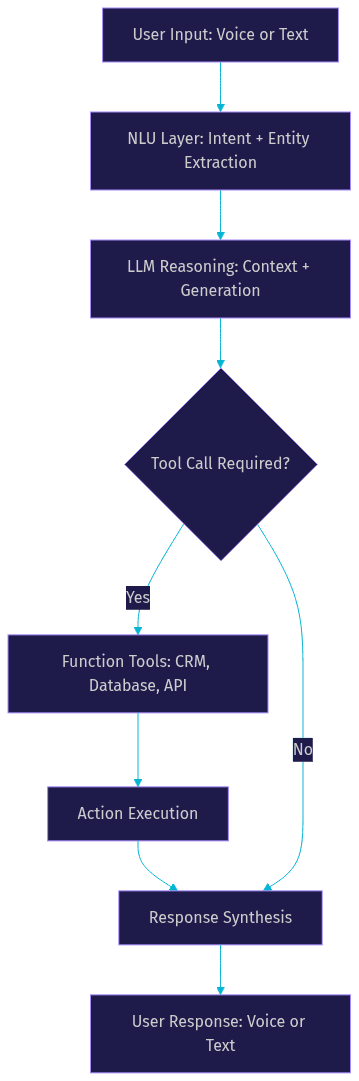
This architecture separates concerns cleanly. The NLU layer handles fast, deterministic intent classification. The LLM handles reasoning and natural language generation. The tool layer handles real-world actions. Each component can be tested, monitored, and replaced independently.
Benefits for Enterprises
Orchestration layers deliver three concrete benefits for enterprise teams building conversational AI systems.
Faster time-to-value comes from reusing orchestration components across multiple conversational interfaces. A loan application agent and a customer support agent can share the same authentication module, the same CRM integration, and the same compliance logging infrastructure.
Reduced hallucinations result from constraining the LLM's output space. When the orchestration layer provides structured tool results and deterministic guardrails, the LLM has less room to fabricate responses. The system grounds its answers in real data retrieved through tool invocations.
Easier compliance comes from the separation between conversation logic and language generation. Compliance teams can audit the deterministic flow, the guardrails, and the tool invocation logs without needing to understand the LLM's internal reasoning. This is particularly valuable in regulated industries like healthcare, finance, and insurance.
Multimodal Conversations: Voice, Text, Images, and Beyond
Multimodal conversational AI processes multiple input types simultaneously: voice, text, images, and video. This capability matters because human communication is inherently multimodal. We speak, gesture, show images, and reference visual context. Systems that only process text miss critical signals.
The rise of multimodal models like OpenAI's GPT-4o, Google's Gemini Live, and AWS Nova Sonic has made real-time multimodal conversation technically feasible. These models process audio, vision, and text within a single inference pipeline, reducing latency compared to chaining separate STT, vision, and LLM models.
For developers, multimodality opens new use cases. A telemedicine platform can let patients show a rash to an AI triage agent over video. A field service technician can point their camera at a broken machine while describing the problem verbally, and the AI agent can diagnose the issue using both inputs. VideoSDK's video calling SDK provides the real-time media transport layer that makes these scenarios possible, with sub-300ms latency over WebRTC.
Voice-First Interfaces
Voice-first AI agents are becoming the dominant conversational interface for several reasons. Speech is faster than typing for most users. Voice interfaces are accessible to users who cannot easily use keyboards or screens. And voice carries emotional and prosodic information that text cannot capture.
Latency improvements have been the critical enabler. According to Artificial Analysis's Speech Arena benchmark, the best real-time voice AI systems now achieve end-to-end response latencies under 500 milliseconds, approaching the natural cadence of human conversation. This is a dramatic improvement from the 2-3 second delays common in first-generation voice assistants.
Adaptive speech models are another advance. Modern STT systems like Deepgram Nova and ElevenLabs Scribe handle accents, background noise, and domain-specific vocabulary far better than their predecessors. TTS providers like ElevenLabs and Cartesia Sonic produce natural-sounding speech with controllable emotion and pacing.
VideoSDK's AI Voice Agent SDK integrates these providers through a unified pipeline, letting developers swap STT, LLM, and TTS components without rewriting their agent logic.
Visual Intelligence and Context
The following diagram shows how a multimodal conversational AI pipeline fuses audio, visual, and text inputs into a unified reasoning layer.
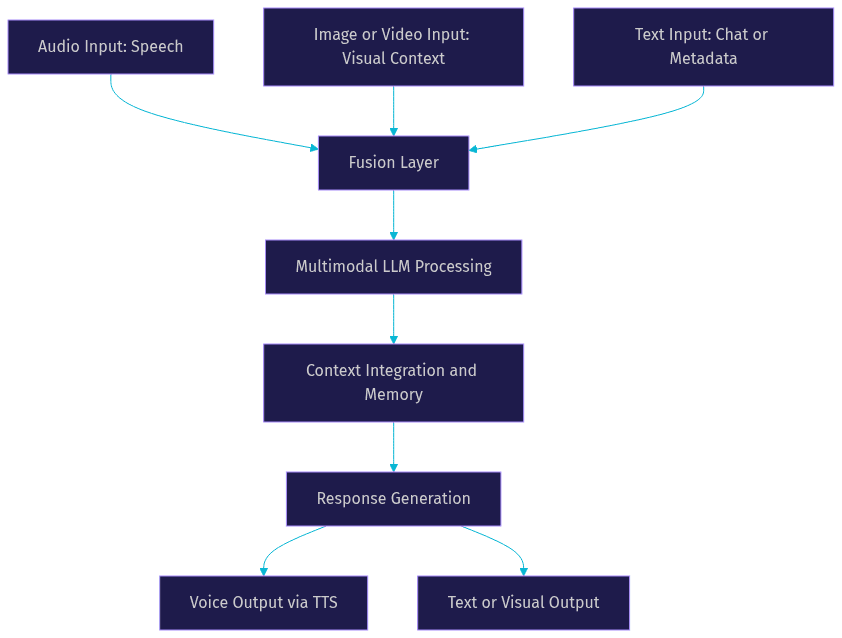
The fusion layer is the architectural innovation here. Rather than running separate models for each input type and stitching results together, the fusion layer tokenizes all inputs into a shared representation space that the multimodal LLM processes in a single pass. This reduces latency and improves cross-modal reasoning, since the model can reference what it sees while processing what it hears.
Governance, Safety, and Ethical Guardrails
As conversational AI systems gain autonomy and the ability to take real-world actions, governance becomes a primary engineering concern. Regulatory frameworks like the EU AI Act, sector-specific rules in healthcare and finance, and growing consumer expectations around transparency are pushing teams to build guardrails into their agent architectures from day one.
Governance for conversational AI covers several dimensions. Content safety ensures agents do not produce harmful, biased, or inappropriate responses. Action safety ensures agents do not execute unauthorized operations, like processing refunds above a threshold without human approval. Data privacy ensures agents handle sensitive user information according to applicable regulations. Transparency ensures users know when they are talking to an AI and how their data is being used.
VideoSDK's Conversational Graph addresses action safety directly. By defining conversation flows as deterministic graphs with explicit transitions and human-in-the-loop checkpoints, developers can guarantee that certain steps, like payment processing or data deletion, always require human confirmation regardless of what the LLM generates.
Policy-Driven Guardrails
Policy-driven guardrails use rule engines and content filters to enforce safety boundaries on LLM outputs. These guardrails operate at multiple levels.
Input filtering screens user messages for prompt injection attempts, toxic content, and out-of-scope requests before they reach the LLM. Output filtering screens generated responses for hallucinations, policy violations, and sensitive data leakage before they reach the user. Action filtering validates tool invocations against permission policies before execution.
Human-in-the-loop checkpoints add a final layer of safety for high-stakes actions. When an agent attempts to execute a sensitive operation, the orchestration layer pauses the conversation and routes the action to a human reviewer. The reviewer approves, modifies, or rejects the action, and the conversation resumes.
Auditing and Observability
Production conversational AI systems require comprehensive observability. Every user interaction, LLM inference, tool invocation, and agent decision should be logged with sufficient detail for debugging, compliance reporting, and performance optimization.
Key metrics to track include conversation completion rates, tool invocation success rates, guardrail intervention frequency, latency at each pipeline stage, and cost per conversation. These metrics feed into both operational dashboards and compliance audit trails.
VideoSDK's Agent SDK includes built-in pipeline observability, giving developers visibility into each stage of the STT to LLM to TTS pipeline. Session analytics are accessible through the REST API, enabling teams to pull post-call data for quality assurance and continuous improvement.
Measuring Success: KPIs and ROI
The shift from hype to measurable outcomes demands a rigorous approach to KPIs. Traditional chatbot metrics like message volume and session count are insufficient. The metrics that matter for agentic conversational AI focus on outcomes, not activity.
Cost-per-resolution measures the total inference and infrastructure cost divided by the number of successfully resolved user requests. This metric directly ties AI spending to business value. Task-completion rate measures the percentage of user requests that the agent fully resolves without human escalation. Customer satisfaction (CSAT) scores collected after agent interactions provide a quality signal. Automation lift measures the reduction in human agent workload attributable to the AI system.
A practical benchmark: enterprise conversational AI deployments that achieve a task-completion rate above 70% with a cost-per-resolution under $0.50 typically deliver positive ROI within six months. Systems that fall below 50% task completion often increase total cost of ownership because human agents must handle complex escalations while the AI infrastructure costs continue accruing.
Benchmarking Against Legacy Chatbots
Quantitative comparisons between agentic AI systems and legacy chatbots reveal dramatic differences. Legacy rule-based chatbots typically achieve task-completion rates of 20-30% for anything beyond simple FAQ lookups. Agentic systems with proper orchestration reach 60-80% task completion for complex multi-step workflows.
Latency comparisons also favor well-architected agentic systems. While legacy chatbots respond instantly (they simply look up a predefined response), they fail on novel queries. Agentic systems add 200-800 milliseconds of processing time but handle a vastly wider range of requests. The net effect is that agentic systems reduce total resolution time because users do not need to repeat themselves or escalate to human agents as often.
Implementation Roadmap for 2026
Building production conversational AI requires a structured approach. The following roadmap breaks the process into three phases, each with clear deliverables and success criteria. This is a prose walkthrough, not a code tutorial, so you can adapt it to your specific tech stack and business requirements.
Phase 1: Define Business Goals and Data Sources
Start by identifying a specific, measurable business problem. "Improve customer service" is too vague. "Reduce average handle time for billing inquiries by 40%" is a goal you can design against. Once the goal is defined, map the data sources your agent will need: CRM records, product catalogs, knowledge bases, scheduling systems, and payment APIs. Assess data quality and accessibility early, since data integration is the most common bottleneck in conversational AI projects.
Phase 2: Choose an Orchestration Platform
Select an orchestration platform that supports your required AI providers, tool integrations, and deployment model. VideoSDK's AI Voice Agent SDK supports OpenAI, Google Gemini, Anthropic Claude, Deepgram, ElevenLabs, and dozens of other providers through a unified pipeline interface. For teams that need deterministic conversation flows, the Conversational Graph add-on provides state machine-based flow control with checkpointing and human-in-the-loop support.
Consider deployment options carefully. VideoSDK Agent Cloud offers managed hosting with automatic scaling. Self-hosted deployment via Docker or Kubernetes gives you full control over data residency and infrastructure costs. Your choice depends on compliance requirements, expected call volume, and team expertise.
Phase 3: Deploy, Test, and Iterate
Deploy your agent in a limited pilot with real users but constrained scope. Monitor every conversation, not just successful ones. Failed conversations reveal where the agent's reasoning breaks down, where tool invocations fail, and where guardrails need tightening.
Iterate based on conversation logs. Common early-stage issues include STT errors on domain-specific vocabulary, LLM responses that are too verbose for voice interfaces, and tool invocation timeouts on slow backend APIs. Address each issue systematically before expanding the agent's scope.
Scale gradually. Once your pilot achieves target KPIs, expand to additional use cases, channels, or user segments. Each expansion should go through the same define, build, test cycle at a smaller scale.
What's Next? Long-Term Outlook
Looking beyond 2026, several trends will shape the next phase of conversational AI development.
Autonomous agents will handle increasingly complex workflows with minimal human oversight. A customer service agent will not just answer questions but proactively detect potential issues, reach out to customers, and coordinate with backend systems to resolve problems before the customer is aware of them.
Tighter AI-CRM coupling will make conversational agents the primary interface for business systems. Instead of humans navigating CRM dashboards, AI agents will query, update, and reason over CRM data through natural conversation. This has implications for CRM architecture, as systems will need agent-friendly APIs optimized for LLM consumption rather than human-friendly UIs.
Industry-standard governance frameworks will emerge. Just as SOC 2 and ISO 27001 became standard for information security, we expect analogous frameworks for AI safety, transparency, and accountability. Teams that build governance infrastructure now will be positioned to certify quickly when these standards arrive.
The convergence of real-time communication infrastructure with AI agent capabilities is where VideoSDK is uniquely positioned. By combining its video and audio calling SDKs with the AI Voice Agent SDK and Conversational Graph, VideoSDK provides the full stack for building conversational AI systems that interact with humans through natural voice and video.
Definitions Glossary
Agentic AI: AI systems that pursue goals autonomously by making decisions, calling external tools, and executing multi-step tasks without human intervention at every turn. VideoSDK's AI Voice Agent SDK provides the pipeline infrastructure for building agentic voice systems.
AI Orchestration: The architectural layer that connects LLMs to external tools, databases, and business logic while managing intent routing, context, and guardrails. Orchestration is what makes agentic AI production-ready.
Conversational Graph: VideoSDK's deterministic flow engine that defines conversation steps as nodes in a directed graph with explicit transitions, state management, and human-in-the-loop checkpoints. It ensures business rules, not LLM judgment, control critical branching decisions.
Multimodal Conversational AI: AI systems that process multiple input types (voice, text, images, video) simultaneously within a single inference pipeline, enabling richer and more natural interactions.
Tool Invocation: The mechanism by which an LLM produces structured requests for external tool execution, allowing the model to retrieve data or take actions through APIs rather than generating responses from training data alone.
Human-in-the-Loop: A guardrail pattern where the orchestration layer pauses agent execution and routes high-stakes actions to a human reviewer for approval before proceeding.
Key Takeaways
- The future of conversational AI is agentic: systems that complete tasks autonomously through tool invocations, context persistence, and multi-step reasoning, not just answer questions.
- AI orchestration layers are the architectural pattern that makes agentic systems production-ready by connecting LLMs to business tools with deterministic guardrails and compliance logging.
- Multimodal interfaces processing voice, text, and visual inputs together will become the default for customer-facing AI, enabled by real-time models like GPT-4o and Gemini Live.
- Governance and guardrails must be engineered from day one, using policy-driven rule engines, human-in-the-loop checkpoints, and comprehensive observability.
- VideoSDK's AI Voice Agent SDK and Conversational Graph provide the orchestration infrastructure for building compliant, deterministic, production-grade voice AI agents with built-in telephony support.
Conclusion
The future of conversational AI is not about bigger models or more natural small talk. It is about systems that understand intent, take action, and deliver measurable business outcomes through orchestrated, governed, multimodal interactions. For developers and engineering leaders, the priority in 2026 should be building orchestration infrastructure that connects LLMs to real business systems with deterministic guardrails and clear ROI measurement. VideoSDK's AI Voice Agent SDK, Conversational Graph, and telephony integration provide the building blocks for this next generation of conversational systems. You can start building today with a free VideoSDK account that includes credits for testing. What are you building with VideoSDK? Drop a comment below, I would love to hear what kind of conversational AI use case you are working on.
FAQ