


The best LLM for a voice bot depends on your priority: OpenAI GPT-4o Realtime leads in full-duplex conversational latency, Inworld Realtime TTS-2 tops naturalness benchmarks, and open-source options like NemotronLabs VoiceChat offer full-duplex speech-to-speech without licensing fees. VideoSDK's AI Agent SDK connects any of these models to real-time WebRTC rooms, letting you deploy a production voice bot with sub-second response times. Start with the VideoSDK AI Agents documentation to wire your chosen LLM into a live voice pipeline.
Choosing a large language model for a voice bot used to be straightforward: pick GPT-4, wire it between a speech-to-text and text-to-speech engine, and accept whatever latency you got. That approach broke down the moment users started expecting real conversations with interruptions, emotional nuance, and sub-second responses.
Between 2024 and 2026, the landscape shifted dramatically. Full-duplex models emerged that process audio in and out simultaneously, eliminating the STT-LLM-TTS round-trip that added 800 to 1500 milliseconds of dead air. Open-source speech language models appeared with tool-calling capabilities. Specialized TTS engines began accepting plain-English instructions for emotional steering. The result is a fragmented market where the right choice depends on latency budgets, naturalness requirements, licensing constraints, and deployment architecture.
This guide breaks down how to evaluate an LLM for voice bots and ranks six leading options across the criteria that matter in production.
How to Evaluate an LLM for Voice Bots
Evaluating an LLM for voice bot deployment requires looking beyond benchmark scores on text tasks. A model that writes excellent essays can still produce a terrible voice experience if it takes two seconds to start responding or cannot handle mid-sentence interruptions.
Latency and Real-Time Interaction
Latency is the single most critical metric for voice bots. Human conversation has natural pauses of 200 to 500 milliseconds. Anything longer feels broken. The traditional pipelined approach (STT then LLM then TTS) typically adds 800 to 1500 milliseconds of end-to-end latency, which is why full-duplex models that process audio directly have become so attractive.
Interruption handling matters just as much. A good voice bot LLM must detect when a user starts speaking mid-response, stop generating audio immediately, and resume listening. This requires barge-in support and voice activity detection that works at the audio frame level, not the text chunk level. Full-duplex streaming, where input and output audio flow simultaneously, is the gold standard for this.
Naturalness and Expressiveness
Naturalness encompasses prosody control, emotional steering, and multi-language support. A voice bot that sounds robotic or monotone will lose users within the first interaction, regardless of how intelligent its responses are.
Prosody control lets developers adjust pacing, pitch, and emphasis programmatically. Emotional steering goes further, allowing instructions like "respond with empathy" or "sound urgent" to shape the output. Multi-language support is essential for global deployments, and it means more than just translating text. The model must handle language-specific phonetics, code-switching, and regional accents convincingly.
Tool-Calling and Multi-Modal Capabilities
Voice bots rarely operate in isolation. They need to look up account information, book appointments, transfer calls, and query databases. Built-in function calling lets the LLM trigger external tools mid-conversation without breaking the voice flow.
Retrieval-augmented generation (RAG) is equally important for domain-specific bots that need to reference product catalogs, knowledge bases, or policy documents. Vision integration, while less common, enables scenarios where the bot can analyze images shared by the user or process visual context from a connected camera.
Cost and Licensing
Voice bot costs accumulate fast because every conversation involves continuous audio processing. Pricing models vary widely: some providers charge per million audio characters, others per minute of conversation, and some per token even for audio input.
Open-source models eliminate per-query licensing but shift costs to compute infrastructure. A self-hosted speech language model running on GPU instances can be cheaper at scale but requires significant engineering effort for deployment, monitoring, and scaling. Pay-as-you-go proprietary models are easier to start with but can become expensive at high concurrency.
Ecosystem and Integration Ease
The best LLM for a voice bot is worthless if it takes weeks to integrate. Look for SDKs in your target language, comprehensive API documentation, active community support, and pre-built UI components. The VideoSDK AI Agent SDK is designed to connect any LLM, STT, and TTS provider into a real-time WebRTC room with minimal wiring, which significantly reduces integration overhead.
Top LLMs for Voice Bots in 2026
Six models stand out for voice bot development in 2026, each excelling in different dimensions. The right choice depends on whether you prioritize raw latency, naturalness, open-source flexibility, or ease of deployment.
1. OpenAI GPT-4o Realtime: The Full-Duplex Leader
OpenAI's GPT-4o Realtime API processes audio input and generates audio output directly, bypassing the traditional STT-LLM-TTS pipeline entirely. This full-duplex architecture enables sub-500-millisecond response times and natural interruption handling, making it the benchmark other voice LLMs are measured against.
The model supports built-in tool calling, meaning your voice bot can trigger function calls to external APIs mid-conversation without dropping the audio stream. This is critical for customer support bots that need to look up order status or process refunds while keeping the user engaged.
Pricing follows OpenAI's per-session audio model, which charges based on audio input and output duration. While not the cheapest option, the developer experience is polished: comprehensive documentation, official SDKs, and broad community support make integration straightforward. According to OpenAI's Realtime API documentation, the model handles 16kHz PCM audio natively and supports both WebSocket and WebRTC transport.
The main drawback is cost at scale. High-concurrency deployments can rack up significant audio processing charges, and the model is proprietary with no self-hosting option.
2. Inworld Realtime TTS-2 with LLM Plug-in
Inworld's Realtime TTS-2 ranked first on the Artificial Analysis Speech Arena for naturalness, beating established providers on conversational voice quality. What sets it apart is steering via plain-English prompts: instead of configuring SSML tags or phonetic parameters, developers describe the desired voice characteristics in natural language.
The TTS-2 engine is model-agnostic, meaning you can pair it with any LLM. This flexibility lets you use a fast inference provider like Cerebras or Groq for the language model while routing synthesis through Inworld for high-quality output. Multi-language coverage spans over 30 languages with consistent quality across accents.
For voice bots where naturalness is the top priority, such as gaming NPCs or educational tutors, this combination is hard to beat. The trade-off is that you are running a pipelined architecture (STT then LLM then TTS), so latency will be higher than a native full-duplex model. Expect 600 to 900 milliseconds end-to-end with a fast LLM backend.
3. Lightning V3 by Smallest.ai: High-Fidelity TTS with Instruction-Following
Lightning V3 focuses on expressive speech synthesis with strong instruction-following capabilities. The model supports emotional register control, whisper mode, and dynamic pacing, all driven by text instructions rather than audio parameters.
The pay-as-you-go pricing model makes it accessible for projects that need high-quality voice without committing to enterprise contracts. Latency is competitive for a TTS-only component, with first-audio latency under 200 milliseconds on standard infrastructure.
Where Lightning V3 shines is in scenarios requiring emotional range. A mental health support bot, for example, needs to sound calm and empathetic, not just intelligible. The instruction-following approach lets developers specify emotional context per response, creating a more human interaction than fixed-voice TTS engines.
The limitation is that Lightning V3 is a TTS component, not a full voice bot LLM. You still need a separate STT and LLM, which means you are building a pipelined stack with the associated latency overhead.
4. NemotronLabs VoiceChat: Open-Source Full-Duplex Speech-to-Speech
NemotronLabs VoiceChat is an open-source full-duplex speech-to-speech model that processes audio input and generates audio output directly, similar to OpenAI's Realtime API but with open weights. This is significant for teams that need data sovereignty, on-premise deployment, or cost control at scale.
The model supports tool-calling, meaning it can trigger external functions during a conversation without falling back to a text-based LLM. Benchmark scores on conversational quality are competitive with mid-tier proprietary options, though they trail GPT-4o Realtime on complex reasoning tasks.
Community support is growing, with active development on GitHub and contributions from speech AI researchers. The open-source license allows commercial use, making it viable for production deployments without per-query licensing costs.
The main challenge is infrastructure. Running a full-duplex speech model requires significant GPU resources, and you are responsible for scaling, monitoring, and maintaining the inference pipeline. For teams with DevOps capacity, this is a strong choice. For small teams, the operational overhead may be prohibitive.
5. LLaMA-Omni 2: Academic-Grade SpeechLM on Qwen2.5
LLaMA-Omni 2 is a research-grade speech language model built on the Qwen2.5 foundation. It comes in multiple parameter sizes, allowing developers to trade off quality against inference cost based on their hardware constraints.
The model is trained on multilingual speech data, giving it reasonable coverage across major languages. As an academic project, it pushes the boundaries of what open-source speech models can achieve, particularly in end-to-end speech understanding without intermediate text representation.
For production voice bots, LLaMA-Omni 2 is best suited as a starting point for teams that want to fine-tune a speech model for a specific domain. The research-grade performance means it may not match commercial options out of the box, but the open weights allow customization that proprietary models cannot offer.
The trade-off is maturity. Documentation is academic rather than production-focused, and you will need to build significant infrastructure around the model to deploy it in a live voice bot.
6. Gradbot Framework in Rust: DIY Voice Bot Engine
Gradbot is not an LLM but a Rust-based framework for building voice bots that stitch together any LLM, STT, and TTS provider into a single pipeline. It handles turn-taking, interruption detection, and audio buffering, which are the hardest parts of building a voice bot from components.
The framework supports OpenAI, Anthropic Claude, and Groq as LLM backends, giving developers flexibility in choosing their reasoning engine. The Rust implementation provides low-latency audio processing, which is critical for keeping end-to-end response times under one second.
Gradbot is ideal for teams that want full control over their voice bot architecture and are comfortable with Rust. It is less suited for rapid prototyping or teams that need a managed solution. The framework handles the plumbing, but you still need to select and configure each component.
For a managed alternative that handles similar orchestration, the VideoSDK Conversational Graph provides deterministic conversation flow control with built-in turn detection and state management, without requiring you to build the audio pipeline from scratch.
Comparison Matrix
[LINKABLE ASSET: comparison table]
| Model | Latency | Naturalness | Languages | Tool-Calling | Cost Model | Open-Source | Best For |
|---|---|---|---|---|---|---|---|
| OpenAI GPT-4o Realtime | Sub-500ms | High | 50+ | Built-in | Per audio minute | No | Full-duplex production bots |
| Inworld TTS-2 + LLM | 600-900ms | Highest | 30+ | Via LLM | Per character | No | Gaming, entertainment |
| Lightning V3 (Smallest.ai) | Sub-200ms TTS | High | 20+ | Via LLM | Pay-as-you-go | No | Emotional voice apps |
| NemotronLabs VoiceChat | Sub-700ms | Medium | 10+ | Built-in | Self-hosted | Yes | On-premise, data sovereignty |
| LLaMA-Omni 2 | 800-1200ms | Medium | 5+ | Limited | Self-hosted | Yes | Research, fine-tuning |
| Gradbot Framework | Varies by LLM | Varies | Varies | Via LLM | Open framework | Yes | Custom Rust pipelines |
The table highlights a clear trade-off: the lowest latency and highest naturalness come from proprietary models, while open-source options offer control and cost predictability at the expense of polish. For most production deployments, OpenAI GPT-4o Realtime paired with VideoSDK's agent infrastructure delivers the best balance of speed, quality, and integration ease.
Choosing the Right LLM for Your Use-Case
Selecting the best LLM for a voice bot is not a one-size-fits-all decision. The right choice depends on your use case, scale, and operational constraints.
Customer Support vs Gaming vs Education
Customer support bots prioritize accuracy, tool-calling, and reliability over emotional expressiveness. OpenAI GPT-4o Realtime is the strongest choice here because its built-in function calling lets the bot query CRM systems and process transactions mid-conversation. The sub-500-millisecond latency keeps callers engaged, and the broad language support handles international support lines.
Gaming NPCs need personality, emotional range, and low latency to feel alive within a game loop. Inworld TTS-2 paired with a fast LLM backend excels here because the plain-English steering lets game designers craft distinct character voices without phonetic engineering. The naturalness scores on Speech Arena confirm its suitability for immersive experiences.
Educational tutors benefit from clear pronunciation, patient pacing, and the ability to adjust tone based on student performance. Lightning V3 is a strong fit because its instruction-following TTS can shift from encouraging to corrective based on the student's answer. Pair it with a reasoning-strong LLM like Claude or GPT-4o for the conversational logic.
Scaling Considerations
Moving from a prototype to a production voice bot introduces concurrency, geographic distribution, and reliability challenges. A model that handles one conversation perfectly may fail at 100 simultaneous sessions.
Concurrency limits vary by provider. OpenAI's Realtime API has session limits that require rate limiting and queue management for high-volume deployments. Self-hosted models like NemotronLabs VoiceChat scale with your GPU fleet but require load balancing and autoscaling configuration.
Geo-fencing and cloud proxy infrastructure help reduce latency for global users by routing audio through regional servers. VideoSDK's infrastructure includes global edge nodes that minimize round-trip time between the user and the agent worker, which is critical for maintaining sub-second response times across regions.
Production Checklist
Before deploying a voice bot to production, verify these items:
- HTTPS enforcement: WebRTC requires secure contexts. Your frontend must serve over HTTPS in production, even if localhost works without it.
- TURN server configuration: Corporate firewalls and restrictive networks block direct WebRTC connections. A TURN server fallback is mandatory for reliable connectivity.
- Token security: Never expose API keys or LLM credentials on the client. Generate authentication tokens server-side and pass them to the SDK at runtime.
- Monitoring and observability: Track end-to-end latency, interruption frequency, token usage, and error rates. Without telemetry, you cannot diagnose why a bot feels slow.
- Fallback handling: If the primary LLM times out or errors, have a fallback response ready. Silence is worse than a generic acknowledgment.
- DTMF support: For telephony integrations, ensure your bot can handle keypad input from traditional phone calls. The VideoSDK telephony documentation covers SIP and DTMF integration in detail.
Architecture Overview
A typical voice bot stack routes audio from the user's microphone through speech processing, language modeling, and synthesis before returning audio to the speaker. The architecture differs significantly between pipelined and full-duplex approaches.
In a pipelined stack, audio goes to STT, the transcript goes to the LLM, the LLM response goes to TTS, and the synthesized audio goes to the speaker. Each stage adds latency. In a full-duplex stack, a single speech language model handles audio input and output simultaneously, enabling interruptions and overlapping speech.
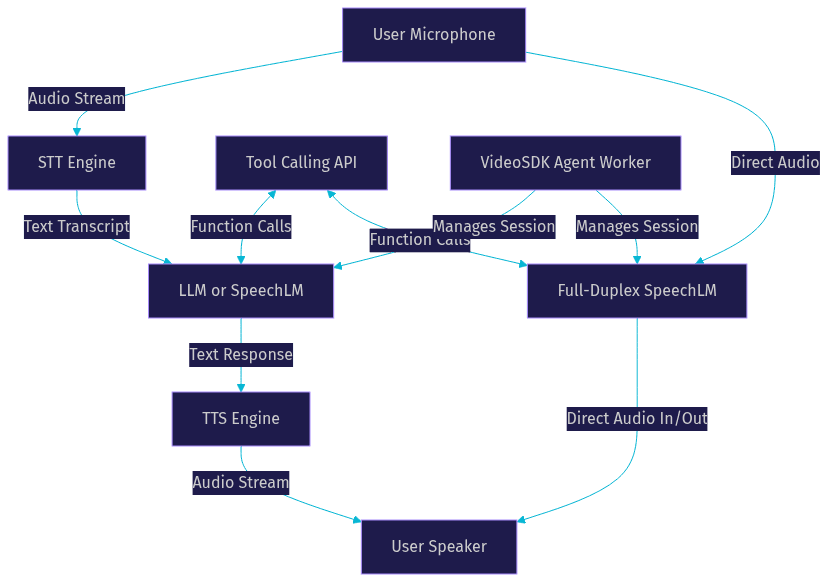
The diagram shows both paths: the traditional pipeline (STT to LLM to TTS) and the full-duplex shortcut where a SpeechLM processes audio directly. The VideoSDK Agent Worker orchestrates the session, managing turn detection, audio buffering, and tool execution regardless of which path you choose.
Future Trends
Voice bot architecture is evolving rapidly. Three trends will shape the next wave of development.
Multimodal voice agents are moving beyond audio-only interactions. Models that can process video, images, and text alongside speech will enable scenarios like visual customer support (analyzing a photo of a damaged product) and interactive education (responding to a student's whiteboard drawing). The VideoSDK AI Agent SDK already supports vision and multi-modal integration, positioning it for this shift.
On-device inference is becoming viable for smaller speech models. As mobile GPUs improve and model quantization techniques advance, running a voice bot entirely on-device will eliminate network latency and address privacy concerns. This is particularly relevant for healthcare and financial applications where data sovereignty is non-negotiable.
Standardized transport protocols are emerging. WebRTC-based voice bot delivery is becoming the default for browser and mobile clients, while SIP integration bridges traditional telephony. VideoSDK's architecture supports both, letting developers deploy a single voice bot that reaches web users, mobile app users, and phone callers through unified infrastructure.
Definitions Glossary
Full-Duplex Voice AI: A voice bot architecture where the model processes audio input and generates audio output simultaneously, enabling natural interruptions and overlapping speech without pausing.
Speech Language Model (SpeechLM): A model trained to understand and generate speech directly, without intermediate text conversion, reducing latency and preserving prosodic information.
Voice Activity Detection (VAD): The mechanism that detects when a user starts and stops speaking, enabling turn-taking and barge-in handling in voice bots.
Turn Detection: The process of determining when a speaker has finished their turn and the agent should respond, critical for natural conversational flow.
Agent Worker: The Python process in VideoSDK's AI Agent architecture that manages a voice agent session, orchestrating the STT, LLM, and TTS pipeline within a real-time WebRTC room.
Conversational Graph: VideoSDK's deterministic flow engine that controls conversation branching through defined nodes and transitions, ensuring business rules rather than LLM judgment drive critical conversation paths.
Key Takeaways
- The best LLM for voice bot development depends on your priority: OpenAI GPT-4o Realtime leads in full-duplex latency, Inworld TTS-2 leads in naturalness, and NemotronLabs VoiceChat offers the strongest open-source full-duplex option.
- Full-duplex speech models eliminate the STT-LLM-TTS round-trip, cutting end-to-end latency from over one second to under 500 milliseconds.
- Open-source voice LLMs provide cost control and data sovereignty but require significant infrastructure investment for production deployment.
- Tool-calling capability is essential for voice bots that need to interact with external systems, and not all speech models support it natively.
- VideoSDK's AI Agent SDK connects any LLM, STT, and TTS combination into a real-time WebRTC room, handling session management, turn detection, and global latency optimization.
Conclusion
Finding the best LLM for voice bot development means matching model capabilities to your specific requirements. Full-duplex proprietary models like OpenAI GPT-4o Realtime win on latency and integration ease. Open-source options like NemotronLabs VoiceChat win on cost and control. Specialized TTS engines like Inworld and Lightning V3 win on naturalness and emotional expressiveness. Whatever you choose, the real challenge is wiring it into a production-grade real-time pipeline. VideoSDK's AI Agent SDK handles that orchestration, from WebRTC transport to turn detection to telephony integration. Start building today with the VideoSDK free tier and connect your chosen LLM to a live voice room in minutes. What are you building with VideoSDK? Drop a comment below, I would love to hear what kind of voice bot use case you are working on.
Free $20 Balance for AI Voice Agents & Video Calls
FAQ