


The best LLM API for voice in 2026 depends on your latency budget and stack: OpenAI's Realtime API and Google Gemini Live lead for sub-second speech-to-speech quality, Azure OpenAI Realtime suits enterprise WebRTC deployments, and open-source stacks win on cost and control. VideoSDK's AI Agent SDK lets you swap any of these providers without rewriting your voice pipeline, so you can benchmark them inside a real call before committing.
Voice-first applications are moving from demo to production. Customer support lines, telehealth intake, in-game companions, and outbound calling agents all share one hard requirement: the model must respond in well under a second, or the conversation feels broken. A 2024 study of turn-taking in human dialogue found that people expect responses within roughly 200 to 300 milliseconds of a conversational pause, which means a slow LLM breaks the illusion no matter how clever its answers are.
That constraint changes how you evaluate providers. A chat model that scores well on a leaderboard can still be unusable for voice if its time-to-first-audio is measured in seconds. This article breaks down what actually makes an LLM API good for voice, compares the leading contenders in 2026 on latency, cost, and features, and gives you a decision framework for picking one for your project.
What Makes an LLM API Ideal for Voice?
A voice LLM API is defined as a service that accepts spoken audio (or its transcript) and returns generated speech or text fast enough to sustain a natural conversation. It works by chaining speech-to-text, a language model, and text-to-speech into a single low-latency pipeline, or by using a native speech-to-speech model that skips the text round-trip entirely.
Six criteria separate a voice-ready API from a chat API with a microphone bolted on:
- End-to-end latency, measured from the moment the user stops speaking to the first audible syllable of the response
- Naturalness, including prosody, emotional range, and multilingual voice quality
- Model flexibility, meaning you can swap the underlying LLM without rewriting your integration
- Pricing, usually expressed as cost per minute of conversation
- SDK and transport support, especially WebRTC, which matters far more than REST for real-time audio
- Security, covering token-based authentication, per-session scoping, and data handling policies
For voice use cases, latency and transport dominate. A REST-based pipeline that records audio, uploads it, waits for a response, and plays it back will never feel conversational. Persistent, bidirectional connections such as WebRTC or WebSocket are the baseline for anything interactive.
Latency and Real-Time Interaction
Sub-second end-to-end latency is the threshold where a voice agent stops feeling like a walkie-talkie and starts feeling like a person. The number that matters is time-to-first-audio: how long between the user finishing a sentence and hearing the agent begin to reply. Anything under about 800 milliseconds feels responsive; above 1.5 seconds, users start interrupting or disengaging.
Latency is measured across the whole chain, not just the LLM. Speech-to-text finalization, turn detection (deciding the user actually finished speaking), model inference, and text-to-speech first audio all add up. Native speech-to-speech models cut stages out of that chain, which is why they consistently post the lowest time-to-first-audio figures in independent benchmarks such as Artificial Analysis's Speech Arena.
Naturalness and Expressiveness
Voice quality is judged on more than intelligibility. Prosody (the rhythm and melody of speech), emotional expressiveness, and the ability to handle code-switching between languages all shape whether users tolerate long conversations with an agent.
Modern neural TTS has largely closed the intelligibility gap, so the differentiators are subtler: does the voice laugh, hesitate, or change pace naturally? Does it handle numbers, acronyms, and names without spelling them out? Multilingual support matters too. If your product serves users in Hindi, Spanish, and English in one session, you need a model that switches languages mid-conversation without a jarring voice change.
Model Flexibility and Vendor Lock-In
The voice AI market is re-pricing and re-modeling itself every quarter. An API that hard-couples you to one LLM vendor forces you to re-architect your pipeline every time a better or cheaper model ships. The more durable design is a provider-agnostic pipeline where the STT, LLM, and TTS stages are independently swappable.
This is exactly the architecture VideoSDK's AI Agent SDK uses: the agent worker connects your chosen speech-to-text, LLM, and text-to-speech providers to a VideoSDK room, so switching from GPT-4o to Claude or Gemini is a configuration change, not a rewrite. Open-source orchestration layers like Pipecat take the same philosophy if you're building the pipeline yourself.
Top Contenders for the Best LLM API for Voice
Four options dominate serious evaluations in 2026: two hyperscaler-backed realtime APIs, one speech-to-speech specialist, and the open-source route. Each wins in a different scenario, and pretending otherwise is how teams end up with the wrong stack.
Inworld Speech-to-Speech
Inworld's speech-to-speech API processes audio directly, skipping the text intermediate step, which produces sub-second response times and unusually expressive prosody. It is model-agnostic on the reasoning side and positions itself for gaming and interactive entertainment, where character voice matters more than raw factual accuracy. Pricing is usage-based per minute of conversation. It is the strongest pick when personality and latency matter more than deep reasoning.
Azure OpenAI Realtime API
Azure's hosting of the OpenAI Realtime API brings GPT-4o-class speech-to-speech into the enterprise Azure ecosystem, with WebRTC transport, regional deployments, and Azure's compliance certifications. That makes it the default choice for regulated industries that already run on Azure: telehealth, banking, and enterprise support. Pricing follows OpenAI's audio token model, with Azure's own rates and reserved-capacity options. The trade-off is deeper vendor coupling than a provider-agnostic pipeline.
xAI Grok Voice API
xAI has claimed its voice API delivers responses roughly five times faster than competitors, at a materially lower cost per minute. As of early 2026 it remains in earlier access stages than OpenAI or Google's offerings, with a narrower ecosystem of SDKs and production case studies. It is worth benchmarking if raw cost per minute is your primary constraint, but treat it as a fast-moving bet rather than a settled choice.
Open-Source Options
For full control, self-hosted stacks using Xinference or Speaches AI for inference, combined with open-weight models like Llama, let you run the entire voice pipeline on your own infrastructure. You eliminate per-minute API costs and keep all voice data in-house, at the price of operating GPU capacity and owning your own latency tuning. This route wins for privacy-critical deployments and for teams with existing ML infrastructure.
Deep Dive: Comparing Latency, Cost, and Feature Sets
The table below summarizes the leading options across the criteria that actually decide voice deployments. Treat vendor latency claims as marketing until you measure them in your own network conditions.
| Provider | Typical time-to-first-audio | Cost model | Transport | Best for |
|---|---|---|---|---|
| OpenAI Realtime API | ~300-800 ms (vendor + community reports) | Audio tokens, per session | WebRTC, WebSocket | General-purpose agents, fastest ecosystem |
| Google Gemini Live | ~500-900 ms | Token-based, generous free tier | WebSocket-based | Multimodal, Android-first products |
| Azure OpenAI Realtime | ~400-900 ms | Azure audio token rates | WebRTC | Enterprise, regulated industries |
| Inworld Speech-to-Speech | Sub-second (vendor-stated) | Per-minute usage | WebSocket | Gaming, character-driven experiences |
| xAI Grok Voice | Vendor claims ~5x faster | Per-minute, low cost | Varies | Cost-sensitive experiments |
| Open-source (Llama + Xinference) | Hardware-dependent | Infra cost only | You build it | Privacy, full control |
[LINKABLE ASSET - comparison table]
Whatever provider you pick, the data flow inside a voice agent session looks structurally the same:
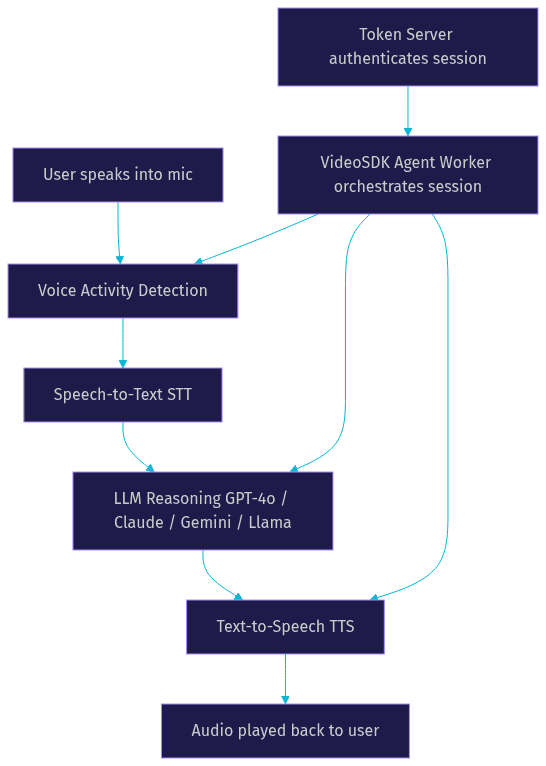
The difference between providers is largely where that pipeline runs and how the stages are bundled. OpenAI and Google collapse STT, LLM, and TTS into one realtime model. Composable pipelines (VideoSDK agents, Pipecat) keep the stages separate so each can be optimized or swapped independently.
How to Choose the Best LLM API for Voice for Your Project
Choosing comes down to four questions: your use case's latency tolerance, your budget at projected volume, your compliance surface, and how much lock-in you can accept.
- Customer support and outbound calling: latency under 800 ms is non-negotiable, and telephony integration matters. A realtime API paired with a SIP-capable platform like VideoSDK's telephony integration covers inbound and outbound phone flows.
- Gaming and interactive characters: expressiveness beats reasoning depth. Inworld-style speech-to-speech wins here.
- Telehealth and finance: compliance and data residency dominate. Azure OpenAI Realtime, or a self-hosted open-source stack, are the safe answers.
- High-volume, cost-sensitive products: benchmark xAI and open-source options against your real conversation lengths before committing.
If your use case involves structured, compliance-driven conversations (loan applications, appointment booking), also consider a deterministic flow layer like VideoSDK's Conversational Graph, which keeps business rules out of the LLM's judgment.
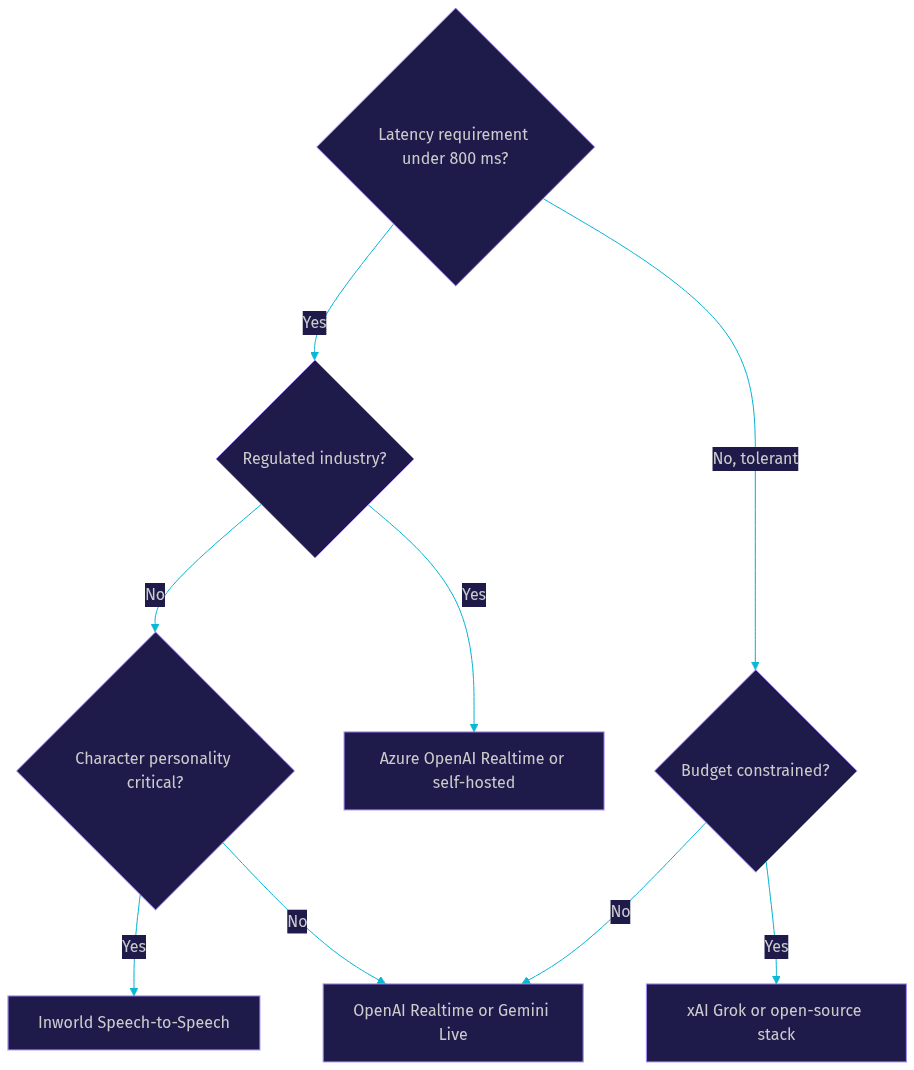
The decision tree below condenses the selection logic:
Integration Tips and Common Pitfalls
Most voice agent failures in production are integration failures, not model failures. These are the issues that bite teams most often.
Generate tokens server-side, always. Your API credentials must never live in a client app. Run a small token service that mints short-lived, session-scoped tokens and hands them to the client at call start. VideoSDK's authentication model works this way, and every serious voice API expects the same pattern.
Handle network jitter and packet loss. Mobile users on weak connections will lose audio packets. Use a transport with built-in congestion handling (WebRTC), enable adaptive bitrate where available, and design your turn detection to tolerate clipped speech rather than assuming clean audio boundaries.
Build a fallback path. If the realtime speech-to-speech connection degrades, fall back to a staged STT-then-LLM-then-TTS flow. It is slower but far more resilient, and users tolerate a brief slowdown better than a dropped call.
Watch turn detection settings. Over-eager turn detection cuts users off mid-sentence; sluggish detection adds seconds of dead air. Tune voice activity detection thresholds per language, because pause patterns differ significantly between, for example, Japanese and English.
Plan for interruption handling. Users will interrupt the agent. Your pipeline needs to support barge-in: canceling in-flight TTS audio the moment the user starts speaking again. APIs that lack clean preemption produce agents that talk over people, which is the fastest way to lose user trust.
Future Trends in Voice-First LLM APIs
Three shifts are worth tracking through 2026. First, fully multimodal models that accept and generate audio, text, and images in one context are replacing stitched-together pipelines, collapsing latency further. Second, edge inference is bringing small voice models onto devices, enabling offline voice agents and cutting cloud costs for simple interactions. Third, adaptive bitrate streaming for model output, mirroring what video calling has done for years, is letting providers degrade voice quality gracefully under congestion instead of dropping sessions.
The practical implication: architect for swappability. The best voice stack in 2027 will not be the best stack in 2026, and pipelines that treat the LLM, STT, and TTS as pluggable stages will absorb each shift cheaply.
Definitions Glossary
Time-to-first-audio: The elapsed time between a user finishing speaking and the agent's first audible response syllable. It is the single most important latency metric for voice agents.
Speech-to-speech model: A model that consumes raw audio and generates audio directly, skipping the text intermediate representation and reducing end-to-end latency.
Turn detection: The mechanism that decides when a user has finished speaking and the agent should respond, typically built on voice activity detection plus a pause threshold.
Barge-in: The ability to interrupt an agent mid-response, canceling in-flight generated speech the moment the user starts speaking again.
Agent Worker: In VideoSDK's AI Agent SDK, the Python process that runs the voice pipeline (STT, LLM, TTS) and manages the agent's session lifecycle inside a VideoSDK room.
Key Takeaways
- There is no single best LLM API for voice; the winner depends on your latency budget, compliance requirements, and cost per minute at projected volume.
- OpenAI Realtime and Google Gemini Live lead for general-purpose sub-second voice agents, Azure wins for regulated enterprise deployments, Inworld wins for expressive characters, and open-source wins for control and privacy.
- Time-to-first-audio, not model leaderboard scores, is the metric that decides whether a voice agent feels natural.
- Provider-agnostic pipelines like VideoSDK's AI Agent SDK let you swap LLM, STT, and TTS providers independently, protecting you from a market that re-prices itself every quarter.
- Production voice failures are usually integration failures: server-side token generation, jitter handling, fallback paths, and barge-in support matter as much as model choice.
Conclusion
The best LLM API for voice in 2026 is a conditional answer: match the provider to your latency tolerance, budget, and compliance surface, and keep the pipeline swappable so today's choice doesn't become tomorrow's rewrite. Benchmark at least two providers inside a real call before committing, because vendor latency claims and your users' network conditions rarely agree. VideoSDK's AI Agent SDK and code samples give you a fast path to run that comparison, with a free tier to get started at app.videosdk.live/login. What are you building with voice AI? Drop a comment, I'd love to hear what kind of voice agent use case you're working on.
Free $20 Balance for AI Voice Agents & Video Calls
FAQ