


Live voice chat is a real-time, audio-only communication method that enables users to converse instantly without video. It offers lower bandwidth consumption, reduced latency, and increased anonymity compared to video calls. Developers can integrate this capability using WebRTC-based voice chat SDKs like VideoSDK to build scalable social, educational, and support applications.
The way people connect online is shifting back toward audio. While video calling dominated the early part of the decade, developers are now seeing massive adoption for live voice chat in social apps, language learning platforms, and low-bandwidth environments. Voice-only communication removes the pressure of being on camera, making interactions feel more natural and accessible.
For developers, building a live voice chat experience presents unique technical challenges. You need ultra-low latency, reliable peer-to-peer connections, and robust moderation tools. This guide breaks down the architecture of real-time voice chat, the core benefits for end users, and how to integrate a voice chat SDK into your application without wrestling with raw WebRTC implementations.
What Is Live Voice Chat?
Live voice chat is defined as a real-time communication method where two or more users exchange audio data over the internet with minimal delay. Unlike pre-recorded audio messages or asynchronous voice notes, live voice chat requires a continuous, bidirectional stream of audio packets.
Live voice chat works by capturing audio from a user's microphone, compressing it, and transmitting it directly to another participant's device, where it is decompressed and played through their speaker. This process happens in milliseconds, creating the sensation of a natural, face-to-face conversation.
The primary differentiator between live voice chat and other communication formats is the absence of video. Compared to video calling, voice chat requires significantly less bandwidth and processing power. Compared to text chat, it conveys tone, emotion, and nuance that written words cannot capture. Under the hood, nearly all modern voice chat platforms rely on WebRTC, an open-source project that provides web browsers and mobile applications with real-time peer-to-peer communication capabilities.
Core Benefits of Live Voice Chat
Voice-only communication offers distinct advantages that make it ideal for specific user experiences. The most immediate benefit is anonymity. Users do not need to worry about their appearance, lighting, or background, which lowers the barrier to participation. This makes live voice chat particularly effective for anonymous voice chat platforms and mental health support groups.
Another major advantage is bandwidth efficiency. Audio streams require a fraction of the data needed for video streams. This makes voice chat accessible to users on 3G networks or in regions with expensive data plans. The reduced payload also translates to lower latency, meaning the delay between a user speaking and the other user hearing them is minimized.
Finally, voice chat enables a more natural conversation flow. Without the visual cues of video, users focus entirely on the spoken word. This creates an experience closer to a phone call or a radio broadcast, which is highly engaging for social audio rooms, gaming lobbies, and live shopping events.
How Live Voice Chat Works Under the Hood
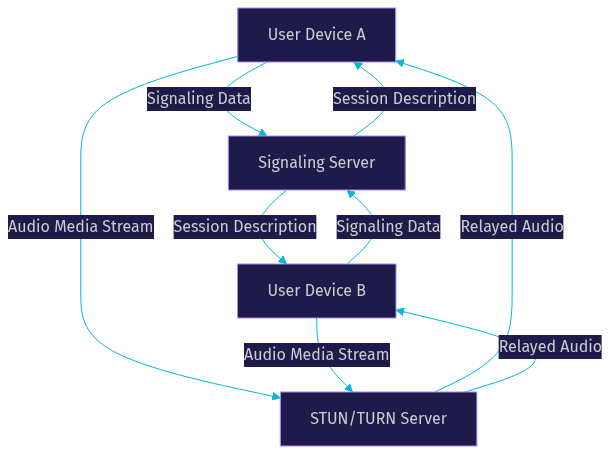
Understanding the architecture of a live voice chat application is critical for building a reliable product. At its core, the system relies on peer-to-peer audio streams, a signaling mechanism to establish connections, and relay servers for fallback scenarios.
When a user initiates a voice chat, their device needs to find the other participant. This is handled by a signaling server, which exchanges session descriptions and network routing information. Once the devices locate each other, they attempt to establish a direct peer-to-peer connection for the audio media stream. If a direct connection fails due to firewalls or network address translation (NAT) issues, the traffic is routed through a TURN server.
Here is a visual representation of how signaling and media flow work in a standard WebRTC voice chat architecture.
Signaling Process
The signaling process is the first step in establishing a live voice chat connection. When a user joins a voice chat room, the signaling server matches them with another participant based on the application's matching algorithm. The server then facilitates the exchange of Session Description Protocol (SDP) offers and answers.
The SDP contains information about the audio codecs supported by the device, the media formats, and the network ICE candidates. Once both devices have exchanged this information, they have the necessary data to attempt a direct media connection. The signaling server drops out of the process once the peer-to-peer connection is established.
Media Path and Encryption
Once the connection is established, audio packets travel directly between the two user devices. To ensure privacy and security, the media stream is encrypted using Secure Real-time Transport Protocol (SRTP). SRTP provides confidentiality, message authentication, and replay protection for the audio packets.
For applications requiring a higher level of security, developers can implement end-to-end encryption (E2EE). In an E2EE voice chat, the encryption keys are exchanged directly between the participants, meaning not even the server infrastructure can decrypt the audio. This is a critical feature for applications handling sensitive conversations, such as telehealth or legal consultations.
Key Features to Look for in a Live Voice Chat Platform
Choosing the right infrastructure for your voice chat application dictates the quality of the user experience. A robust voice chat platform or SDK should provide more than just basic audio transmission. It needs to offer tools for matchmaking, moderation, and network reliability.
Developers should evaluate platforms based on their matching algorithms, the availability of country and interest filters, built-in moderation capabilities, and the flexibility to switch between peer-to-peer and server-relay architectures. Additionally, the platform should offer simple UI components for mobile and web, allowing for rapid deployment.
Matching & Filters
A successful social voice chat app relies on a smart matching algorithm. The platform should allow developers to filter users by geographic location, language, or shared interests. For example, a language learning app needs to match a Spanish learner with a native English speaker. The SDK should expose parameters that let you define these rules without building a complex backend logic from scratch.
Real-Time Moderation
Voice chat safety is a paramount concern. A reliable voice chat platform must include real-time moderation tools. This includes AI-driven voice chat moderation that can detect harmful content, profanity, or harassment in the audio stream. The platform should also provide mute and ban functionalities, allowing room administrators to remove disruptive participants instantly.
Building a Live Voice Chat Experience for Your App
Integrating live voice chat into your application requires a systematic approach. By using a dedicated voice chat SDK, you can bypass the complexities of raw WebRTC and focus on your product features. VideoSDK provides a comprehensive platform for building real-time voice chat rooms with sub-second latency.
The development process involves selecting the right SDK for your platform, implementing secure authentication, and configuring the voice-only rooms. You can explore the VideoSDK Audio Calling Guide to understand the full scope of available features.
Choose the Right SDK
Your first step is selecting an SDK that supports your target platforms. VideoSDK offers SDKs for React, React Native, Flutter, iOS, and Android. When evaluating an SDK, ensure it provides network-adaptive streaming, which automatically adjusts audio quality based on the user's bandwidth. This prevents call drop-outs on unstable mobile networks. You should also verify that the SDK supports custom audio tracks if you plan to add voice filters or background noise suppression.
Set Up Secure Token Authentication
Security starts with authentication. VideoSDK uses token-based authentication to verify that users are authorized to join a voice chat room. You must generate a token on your backend server using your API key and secret. Never expose your API secret on the client side. Once the token is generated, pass it to the frontend SDK to initialize the connection. You can follow the VideoSDK Authentication and Token Guide for detailed instructions on this process.
Configure Voice-Only Rooms
With authentication in place, you can create voice chat rooms. VideoSDK uses a room-based architecture where participants join a shared space. To create a voice-only experience, you simply disable the video tracks when initializing the room. This ensures the SDK only captures and transmits audio, saving bandwidth and processing power. You can configure room metadata to store information like the topic of conversation or the language being practiced, helping your matching algorithm place users in the right rooms.
Production Considerations
Moving a live voice chat application from development to production requires careful planning. Scaling a voice chat platform means handling thousands of concurrent peer-to-peer connections. While peer-to-peer is efficient for one-on-one calls, large voice chat rooms or social audio events may require a Selective Forwarding Unit (SFU) media server to distribute the audio efficiently.
Network reliability is another major factor. Users will experience drop-outs. Your application must handle reconnection gracefully, automatically attempting to rejoin the room if the network drops. Implementing a TURN server fallback is mandatory for users behind strict corporate firewalls or symmetric NATs.
Privacy and compliance cannot be overlooked. If your app targets a global audience, ensure your voice chat infrastructure complies with GDPR and other regional data protection regulations. This involves choosing data center regions strategically and ensuring audio data is not stored unless explicitly required for recording. Finally, implement real-time monitoring to track latency and packet loss, allowing you to identify and resolve network issues before they affect the user experience.
Live Voice Chat Use Cases
The versatility of live voice chat opens up numerous product opportunities. Language learning platforms use voice chat to connect students with native speakers for real-time conversation practice. This is far more effective than text-based learning, as it builds listening comprehension and speaking confidence.
Mental health and wellness apps are adopting anonymous voice chat to combat loneliness. Users can join voice rooms to talk about their feelings without the pressure of video. Gaming lobbies rely on low-latency voice chat for team coordination. Remote teams use voice-only stand-ups for quick, focused updates without the overhead of a full video meeting. Community platforms are building Clubhouse-style social audio rooms for live discussions, AMAs, and virtual events.
Common Pitfalls and How to Avoid Them
Building a voice chat application is not without its traps. One common pitfall is poor matching logic. If users are matched randomly without considering language or interests, engagement will drop. Always implement contextual filters in your matching algorithm.
High latency is another frequent issue. If your latency exceeds 300 milliseconds, the conversation feels unnatural. Avoid this by choosing a voice chat SDK with global edge servers and network-adaptive streaming.
Ignoring moderation is a critical mistake. Unmoderated voice rooms can quickly become toxic, driving users away. Integrate AI-driven voice chat moderation from day one. Lastly, do not overlook privacy. Failing to implement SRTP encryption or secure token authentication exposes your users to eavesdropping and data breaches.
Future Trends in Live Voice Chat
The future of real-time voice chat is being shaped by artificial intelligence and network advancements. AI-driven moderation is becoming more sophisticated, capable of understanding context and tone, not just keywords. Real-time transcription is being integrated directly into voice chat SDKs, allowing users to read what is being said, which is a game-changer for accessibility and language learning.
We are also seeing the rise of avatar integration, where users have a virtual representation that moves its lips in sync with their speech, adding a visual element to voice-only chats. With the global rollout of 5G, ultra-low latency will become the standard, enabling high-fidelity audio conversations with zero perceptible delay. Developers who build on flexible, modern SDKs like VideoSDK React SDK will be positioned to adopt these trends rapidly.
Definitions Glossary
Room: A virtual space in VideoSDK where participants connect to share real-time audio streams, identified by a unique room ID.
Participant: A user or AI agent connected to a voice chat room, capable of sending and receiving audio tracks.
WebRTC: An open-source project that provides web browsers and mobile applications with real-time, peer-to-peer communication capabilities for audio and video.
STUN/TURN Server: Network protocols used to help devices discover their public IP addresses and traverse firewalls or NATs for establishing peer-to-peer connections.
SRTP: Secure Real-time Transport Protocol, a framework for encrypting and authenticating real-time media streams to ensure voice chat privacy.
Key Takeaways
- Live voice chat provides a low-bandwidth, high-anonymity alternative to video calling, making it ideal for social, educational, and support applications.
- A reliable voice chat experience relies on WebRTC architecture, including signaling servers for connection setup and STUN/TURN servers for network traversal.
- Security and moderation are non-negotiable, requiring token-based authentication, SRTP encryption, and AI-driven content moderation.
- VideoSDK simplifies the development process by offering a room-based architecture, multi-platform SDKs, and network-adaptive streaming for voice-only rooms.
- Future trends like real-time transcription and 5G connectivity will make voice chat even more accessible and engaging for global audiences.
Conclusion
Live voice chat has emerged as a powerful medium for real-time connection, offering a unique blend of intimacy, efficiency, and accessibility. Whether you are building a language learning platform, a social audio app, or a mental health support community, the underlying technology must deliver low latency, robust security, and scalable architecture. By leveraging a dedicated voice chat SDK, you can bypass the complexities of raw WebRTC and focus on creating engaging user experiences. Ready to bring real-time audio to your users? Sign up and start building with VideoSDK for free at app.videosdk.live/login. What are you building with VideoSDK? Drop a comment, I would love to hear what kind of live voice chat use case you are working on.
FAQ