


Maintaining context in conversation is the practice of preserving relevant information across multi-turn dialogue so an AI agent or LLM-powered system responds coherently over time. The core challenge is that every model has a fixed token window, so engineers must use strategies like rolling memory, context pruning, and hierarchical dialogue trees to keep conversations grounded. VideoSDK's Conversational Graph addresses this at the infrastructure level by treating conversation state as a deterministic graph with checkpointing and context management built in.
Introduction
A user asks your AI assistant to help design a REST API for a booking platform. Ten turns later, they reference "the endpoint we discussed earlier" and your agent responds as if the conversation just started. The design constraints, naming conventions, and architectural decisions from the first five turns are gone. The user has to repeat themselves, trust erodes, and the session effectively restarts from zero.
This is the context loss problem, and it is one of the most common reasons LLM-powered products feel broken in production. Maintaining context in conversation is defined as the systematic preservation of relevant information, constraints, and decisions across multi-turn dialogue so that an AI system remains coherent and consistent over time. It is not just about stuffing more tokens into a prompt. It is an engineering discipline that combines prompt architecture, memory management, retrieval strategies, and state machines to keep dialogue coherent across arbitrarily long sessions.
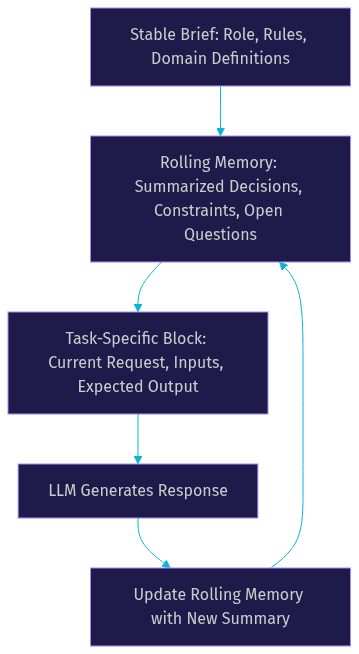
The most effective approach uses a three-layer pattern: a stable brief that never changes, a rolling memory that summarizes past decisions, and a task-specific block that isolates the current request. When you layer hierarchical context trees and dynamic pruning on top, you get a system that can handle topic switches, long-running sessions, and multi-partner conversations without losing the thread. VideoSDK's Conversational Graph implements a similar philosophy at the infrastructure level, giving developers a deterministic state machine for voice AI conversations where context persistence is built into the graph structure itself.
The Context Window Problem
Every modern LLM has a fixed token context window that limits how much text the model can process at once. GPT-4o supports 128,000 tokens, Claude 3.5 Sonnet supports 200,000, and Google Gemini 1.5 Pro reaches up to 2 million tokens. These figures sound enormous until you account for what actually fills them.
A single turn in a technical design conversation can consume thousands of tokens. A code review discussion with pasted snippets, architecture diagrams described in text, and detailed API specifications can easily burn through 10,000 to 20,000 tokens per exchange. A one-hour brainstorming session with 40 to 60 turns can exceed 100,000 tokens before you even reach the end of the conversation. The token budget is not just about the user's messages. It includes the system prompt, any retrieved documents, tool call results, and the model's own generated responses. Everything competes for the same fixed space.
There is also a computational reason infinite context windows are not practical. Transformer attention scales quadratically with sequence length, meaning doubling the context window roughly quadruples the compute required for each forward pass. This is why even models with massive theoretical windows degrade in quality as the context fills up. Researchers at Stanford and UC Berkeley documented this phenomenon in their 2023 paper on "lost in the middle" effects, showing that models pay disproportionate attention to the beginning and end of long contexts while effectively ignoring the middle. You can read the original research on arXiv for the full analysis.
This degradation is what practitioners call context rot. The model technically can see everything in the window, but its effective attention to early tokens diminishes as later tokens accumulate. Maintaining context in conversation is therefore not just a storage problem. It is an attention management problem where you must actively decide what deserves the model's limited focus.
Symptoms of Context Loss
Context loss manifests in predictable ways that directly degrade user experience and product quality. The most common symptom is inconsistent answers, where the agent contradicts a position it took five turns earlier because it no longer has the earlier context in its window. A user designing a payment system might establish in turn three that they are using Stripe, and by turn fifteen the agent recommends integrating PayPal as if no payment processor was ever discussed.
Forgotten constraints are another clear signal. If a user specifies in the opening message that their application must support offline mode, and the agent later recommends a real-time-only architecture, the constraint has been dropped from the active context. This happens frequently in technical design sessions where the initial requirements are stated once and never repeated.
Contradictory recommendations are particularly damaging in tutoring and educational scenarios. A student learning Python might be told in one turn to use list comprehensions for filtering, and then in a later turn receive a recommendation to use a for-loop for the same task without acknowledging the earlier guidance. The student cannot tell whether the agent is teaching them a different approach or has simply forgotten what it already taught.
In product brainstorming sessions, context loss shows up as circular conversations. The agent re-suggests ideas that were already discussed and rejected, forcing the user to re-explain why those ideas do not work. This wastes tokens, increases latency, and makes the product feel like it is not listening. For voice AI agents built on platforms like VideoSDK's AI Agent SDK, these symptoms are even more pronounced because spoken conversations move faster than typed ones, and users have less patience for repetition when they cannot scroll back to check what was said.
Core Strategies for Maintaining Context
The most effective approach to maintaining context in conversation combines five complementary strategies that work together across different conversation scales. Each addresses a specific failure mode, and together they form a system that handles everything from quick five-turn exchanges to multi-session design reviews.
1. Stable Brief
The stable brief is a persistent block of text that sits at the top of every prompt and never changes across turns. It defines the agent's role, quality standards, domain-specific definitions, and any global constraints that must hold for the entire conversation. Think of it as the agent's job description and rulebook combined.
A well-constructed stable brief includes the agent's persona and expertise level, the output format requirements, domain vocabulary that the model should use consistently, and any safety or compliance boundaries. Because this block is identical on every turn, the model treats it as ground truth rather than something that might be superseded by later conversation. The stable brief should be concise, typically 200 to 500 tokens, to leave maximum room for conversation history and the current task.
2. Rolling Memory
Rolling memory is the practice of summarizing key decisions, open questions, and active constraints after each turn or group of turns, then replacing the raw conversation history with this compressed summary. Instead of sending 50,000 tokens of verbatim dialogue, you send a 2,000-token summary that captures the essential state of the conversation.
The art of rolling memory is in what you choose to preserve. Good summaries retain decisions that were made, constraints that were established, options that were rejected and why, and any open questions that remain unresolved. They drop pleasantries, redundant explanations, and intermediate reasoning that the model already produced. The summary should be structured rather than free-form, using clear labels for each category of information so the model can parse it efficiently.
A practical approach is to trigger summarization when the conversation history reaches a threshold, such as 60 to 70 percent of the available token budget after accounting for the stable brief and task block. The summarization pass itself can be handled by a smaller, cheaper model to reduce latency and cost, with the summary then injected into the main model's context for subsequent turns. This approach to maintaining context in conversation keeps token usage predictable while preserving the conversational thread.
3. Task-Specific Block
The task-specific block isolates the immediate request from the broader conversation history. While the stable brief provides global rules and rolling memory provides past context, the task block focuses the model's attention on exactly what needs to happen right now.
This block should restate the current question or instruction clearly, include any specific inputs the model needs to process, and define the expected output format for this particular turn. By separating the current task from historical context, you reduce the chance that the model gets distracted by earlier conversation threads when it should be focused on the present request. The task block is typically the last thing in the prompt, positioned immediately before the model generates its response, because recency bias in transformer attention means the model pays the most attention to the end of the prompt.
4. Hierarchical Context Trees
Most conversations are not linear. A user might start discussing API design, branch into database schema decisions, return to the API discussion, then pivot to frontend architecture. Modeling this as a flat list of messages loses the structural relationship between topics and wastes tokens on irrelevant branches.
Hierarchical context trees model the conversation as a tree of topics rather than a flat sequence. Each node represents a topic or sub-topic, and the tree structure captures how conversations branch and merge. When the user returns to a previous topic, the system can retrieve just that branch's context rather than scanning the entire history. When a new topic starts, the system creates a new branch with a fresh context window while preserving a high-level summary of other branches.
This approach is particularly powerful for long-running sessions like technical design reviews or multi-session tutoring, where the same conversation might span days or weeks. VideoSDK's Conversational Graph implements a related concept for voice AI agents, using a directed graph where each node represents a conversation step and transitions are controlled by business rules rather than LLM judgment. The graph structure inherently maintains context by preserving state at each node and allowing checkpointing so conversations can be paused and resumed without losing their place in the flow.
5. Dynamic Context Pruning
Dynamic context pruning retrieves only the most relevant past turns based on the current utterance, rather than including the entire conversation history. The approach treats past conversation as a retrieval problem: each previous turn is stored with an embedding vector, and when a new message arrives, the system computes similarity scores to find the most relevant past turns and includes only those in the prompt.
This is essentially retrieval-augmented generation applied to conversation history rather than external documents. The benefit is dramatic token savings in long conversations, because you might include only 5 to 10 relevant turns out of 100 total. The risk is that you might miss context that is semantically distant but logically important, such as a constraint established early that affects all later decisions.
A robust approach combines pruning with the rolling memory summary: the summary provides the global state, while pruned retrieval provides specific past turns that are most relevant to the current question. This dual approach gives the model both the big picture and the specific details it needs without exceeding the token budget.
The following diagram illustrates the three-layer pattern that forms the foundation of context management in LLM-powered conversations:
This second diagram contrasts hierarchical context trees with linear conversation history, showing how tree-based modeling preserves topic structure while reducing token waste:

Practical Workflow: From Prototype to Production
Building a context management system for an LLM-powered chatbot or voice agent involves several engineering decisions that go beyond prompt design. The workflow starts with token accounting: you need to know exactly how many tokens each component of your prompt consumes so you can make informed decisions about when to trigger summarization and how much room you have for conversation history.
The first step is to establish your token budget allocation. A typical split might reserve 500 tokens for the stable brief, 2,000 to 3,000 tokens for rolling memory, 1,000 tokens for the task-specific block, and the remainder for the current conversation window. The exact numbers depend on your model's context window size and your application's complexity. You should document this allocation and treat it as a configuration parameter that can be tuned as your application evolves.
The second step is implementing the summarization trigger. Rather than summarizing after every turn, which adds latency and cost, you should trigger summarization when the raw conversation history exceeds a threshold. A common pattern is to monitor the token count of the conversation history after each turn and trigger a summarization pass when it reaches 60 to 70 percent of the allocated budget. The summarization pass compresses the history into a structured summary, which replaces the raw messages in subsequent prompts.
The third step is storing the rolled-up memory. For short-lived sessions, in-memory storage is sufficient. For long-running or multi-session conversations, you need persistent storage that can survive between sessions. This is where conversation state management becomes a database design problem: you need to store the conversation tree, the current branch, the rolling memory summary, and any retrieved context fragments.
Production concerns extend beyond correctness. Latency is critical, especially for voice AI agents where users expect sub-second response times. Summarization passes add round-trip latency, so you may need to run them asynchronously or use a smaller model for summarization. Cost is another factor: every token you send to the model costs money, so aggressive context management directly reduces your API bill. According to OpenAI's API documentation, input tokens are billed at the same rate as output tokens for most models, meaning context bloat is a direct and measurable cost driver. Monitoring is essential: you need to track token usage per turn, summarization frequency, and response quality metrics to catch context loss before users do.
For voice AI applications specifically, VideoSDK's AI Voice Agent SDK handles much of this infrastructure automatically. The agent worker manages session lifecycle, pipeline observability, and context management, while the Conversational Graph layer provides deterministic state transitions with built-in checkpointing. This means developers can define conversation flows as graphs where each node maintains its own context, and the system handles persistence, resumption, and state transitions without manual token accounting.
Evaluation Metrics and Monitoring
You cannot manage what you cannot measure, and context management is no exception. Three metrics form the core of a context monitoring system.
Context retention rate measures the percentage of established facts, constraints, and decisions from earlier in the conversation that the model correctly references or adheres to in later turns. You can measure this by logging every constraint and decision as it is established, then checking whether subsequent responses are consistent with them. A drop in retention rate below a threshold, such as 90 percent, indicates that your context management strategy is losing important information.
Token usage per turn tracks how many tokens your system sends to the model on each turn. This metric should stabilize in a well-designed system: after the initial ramp-up, token usage should plateau as summarization keeps the history bounded. If token usage grows linearly with conversation length, your summarization trigger is not firing early enough or is not compressing sufficiently.
Response latency measures the time from user input to model response. Context management adds overhead through summarization passes and retrieval operations, so you need to monitor whether your context strategy is introducing unacceptable delays. For voice agents, latency above 500 milliseconds starts to feel broken. For text chatbots, 2 to 3 seconds is the upper bound for a responsive experience.
Simple logging approaches can get you started without complex infrastructure. Log the token count of each prompt, the summarization trigger events, and a sample of constraints established versus constraints referenced. Set up alerts for sudden drops in retention rate or spikes in token usage, which typically indicate that the context management system is failing to keep up with the conversation.
Common Pitfalls and How to Avoid Them
Over-summarizing is the most frequent mistake teams make when implementing context management for the first time. When your rolling memory summary is too aggressive, it strips away nuances that matter. A constraint like "use PostgreSQL with row-level security for multi-tenant isolation" might get compressed to "use PostgreSQL," losing the critical security requirement. The fix is to use structured summaries with explicit fields for constraints, decisions, and open questions, and to never compress constraint statements below their full specificity.
Forgetting to update the stable brief is another common error. As conversations evolve, you may discover that the initial role definition or domain vocabulary needs adjustment. If you treat the stable brief as truly immutable, you miss the opportunity to refine the agent's behavior based on what you learn during the conversation. A better approach is to version the stable brief and allow controlled updates when the conversation reveals that the initial definition was incomplete.
Letting rolling memory grow unchecked defeats the purpose of having it. If your summary grows to 10,000 tokens over a long conversation, you have simply moved the bloat from raw history to summary. Implement a secondary compression pass that summarizes the summary when it exceeds its allocated budget, creating a hierarchical memory structure where older decisions are progressively compressed while recent ones retain full detail.
Definitions Glossary
Context Window: The maximum number of tokens an LLM can process in a single forward pass, including system prompts, conversation history, and generated responses.
Rolling Memory: A compressed summary of past conversation turns that replaces raw history in the prompt, preserving key decisions and constraints while reducing token usage.
Stable Brief: A persistent prompt block containing the agent's role, rules, and domain definitions that remains unchanged across all conversation turns.
Context Pruning: The practice of selectively retrieving only the most relevant past conversation turns based on semantic similarity to the current request.
Conversational Graph: VideoSDK's deterministic flow engine that models voice conversations as a directed graph of nodes and transitions, with built-in state management and checkpointing for context persistence.
Context Rot: The degradation of model attention to early tokens in a long context window, where the model technically can see all tokens but effectively ignores distant ones.
Token Budget: The allocation of available context window tokens across stable brief, rolling memory, task-specific blocks, and current conversation history.
Key Takeaways
- Maintaining context in conversation requires a layered approach: a stable brief for global rules, rolling memory for compressed history, and a task-specific block for the current request.
- Hierarchical context trees and dynamic pruning extend the three-layer pattern for long-running, multi-topic conversations where flat history becomes token-prohibitive.
- Token accounting and summarization triggers are production engineering concerns, not just prompt design decisions, and they directly affect latency, cost, and response quality.
- Monitoring context retention rate, token usage per turn, and response latency catches context loss before users notice it.
- VideoSDK's Conversational Graph provides infrastructure-level context management for voice AI agents, with deterministic state transitions and checkpointing that handle persistence without manual token accounting.
Conclusion
Maintaining context in conversation is a product feature, not a bug fix. The three-layer pattern of stable brief, rolling memory, and task-specific block gives you a foundation that works across text chatbots, voice agents, and multi-session applications. Layering hierarchical trees and dynamic pruning on top handles the edge cases that break simpler approaches. The engineering work is in the details: token budget allocation, summarization triggers, persistent storage, and production monitoring. For developers building voice AI applications, VideoSDK's Conversational Graph and AI Voice Agent SDK handle much of this infrastructure, letting you focus on conversation design rather than token accounting. You can start building for free at app.videosdk.live/login and join the VideoSDK Discord community to discuss context management patterns with other developers. What are you building with VideoSDK? Drop a comment below, I'd love to hear what kind of conversational AI use case you're working on.
Free $20 Balance for AI Voice Agents & Video Calls
FAQ