


For most telehealth founders and CTOs evaluating video infrastructure in 2026, VideoSDK offers the strongest balance of compliance readiness, developer velocity, and cost predictability. Zoom SDK is appropriate where enterprise procurement and brand familiarity matter more than flexibility. Raw WebRTC remains relevant only when teams have the engineering capacity to own the entire media stack.
Introduction: Why your video infrastructure decision matters more than ever in 2026
The telehealth market has moved past the pandemic-era improvisation phase. Patients now expect clinical-grade video quality, zero dropped sessions, and interfaces that feel purpose-built for healthcare. Regulators expect documented compliance postures. Investors expect cost models that scale without cliff edges.
The infrastructure decision behind your video layer, the choice between WebRTC vs Zoom SDK vs VideoSDK telehealth 2026, now directly affects patient outcomes, developer velocity, regulatory audit readiness, and unit economics. Getting it wrong means rebuilding at scale.
This article evaluates all three options across eight criteria that matter to telehealth platforms: integration complexity, infrastructure control, compliance readiness, latency and reliability, scalability, cost model, time to market, and vendor lock-in risk. Every option is evaluated against the same criteria, with no promotional framing.
Must read : HIPAA compliant video API for healthcare platforms
How to evaluate telehealth video infrastructure: the eight criteria
Before comparing options, it is worth defining what good looks like across each dimension.
Integration complexity measures how much engineering effort is required to embed video into a telehealth workflow, from initial proof of concept to production deployment.
Infrastructure control covers how much of the signaling, media routing, and session management your team owns, configures, and can audit.
Compliance readiness refers to built-in support for HIPAA (Health Insurance Portability and Accountability Act) in the US, GDPR (General Data Protection Regulation) in Europe, and similar frameworks. Compliance readiness is not just about BAA (Business Associate Agreement) availability, it includes data residency, access logging, and encryption posture.
Latency and reliability defines the sub-second responsiveness required for clinical conversations, diagnostic video, and real-time consultation.
Scalability addresses how cleanly the architecture handles growth from dozens to hundreds of thousands of concurrent sessions without re-architecture.
Cost model evaluates pricing structure, predictability, and the total cost of ownership at various stages of platform growth.
Time to market captures how quickly a team can ship a production-ready video feature using each option.
Vendor lock-in risk measures how difficult it is to migrate away if pricing, reliability, or product direction changes.
WebRTC for telehealth: full control, full responsibility
What WebRTC is
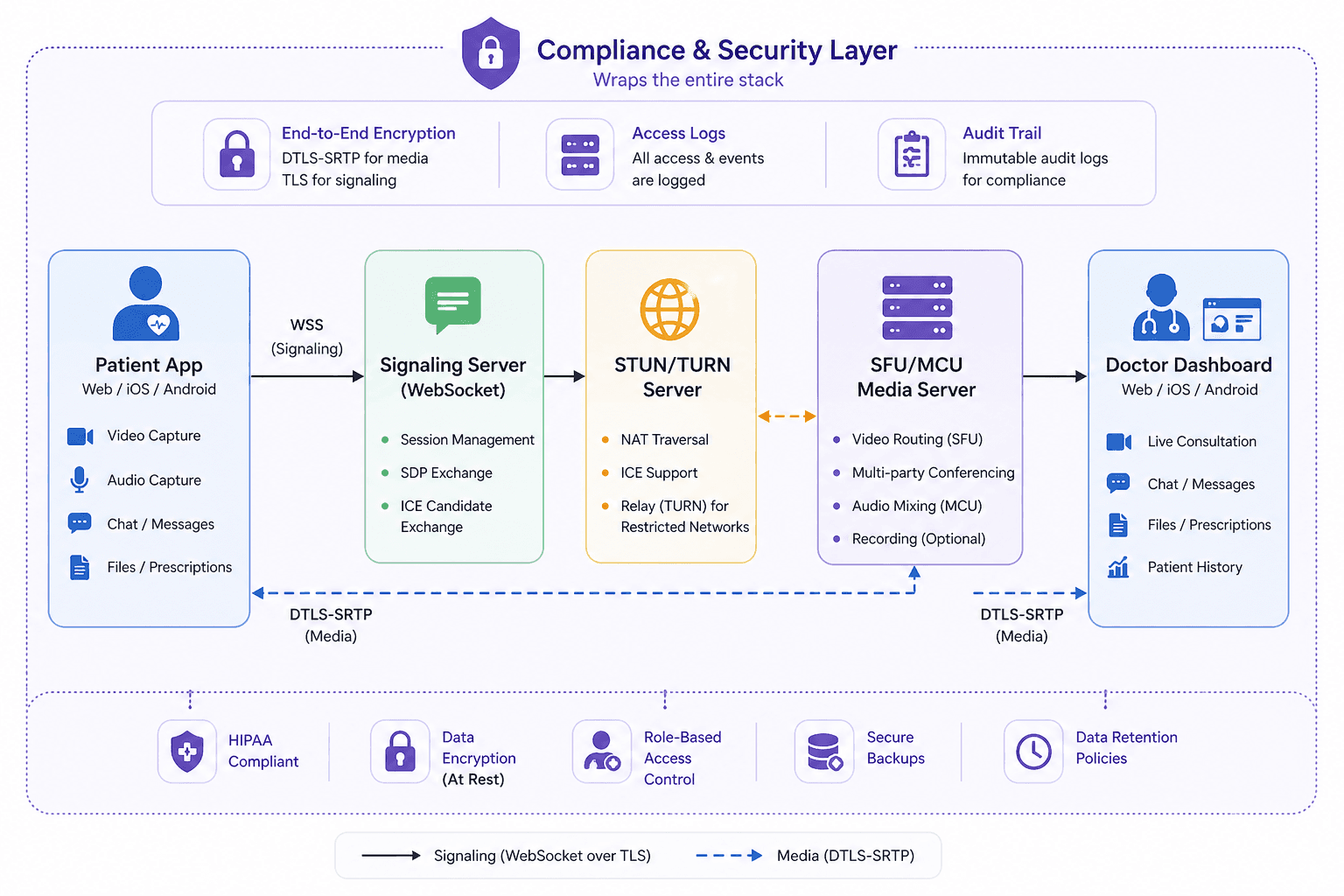
WebRTC (Web Real-Time Communication) is an open standard and browser API maintained by the W3C and IETF. It enables peer-to-peer audio, video, and data communication directly between browsers and native applications without plugins. WebRTC is not a product, it is a protocol suite that teams implement using a combination of signaling infrastructure, STUN/TURN servers, and optional media servers such as Janus, Mediasoup, or Kurento.
Strengths
- Complete architectural control over every layer of the stack
- No third-party data handling, all media traffic stays within your infrastructure
- No per-minute or per-participant pricing, cost scales with your own server capacity
- Best fit for platforms with strict data residency requirements in specific jurisdictions
- Open standard with no vendor dependency
Limitations
- Significant engineering effort: signaling, NAT traversal, codec negotiation, SFU selection, and recording pipelines must all be built and maintained
- HIPAA compliance is entirely the team's responsibility, no BAA from a vendor, no pre-built audit tooling
- Browser compatibility and codec differences require ongoing maintenance
- Operational complexity increases sharply at scale, managing TURN server capacity, SFU load balancing, and global PoP distribution is a full-time infrastructure problem
- Time to production is typically measured in months, not weeks
Ideal use cases for WebRTC in telehealth
- Large platforms with dedicated infrastructure engineering teams
- Platforms in regulated jurisdictions requiring on-premises or private cloud deployment
- Organisations with existing media server expertise (Janus, Mediasoup, LiveKit)
- Platforms where third-party vendor contact with patient data is contractually or legally prohibited
Read: How video integration streamlines Medical Examination Reports (MER)
Zoom SDK for telehealth: enterprise familiarity, constrained flexibility
What Zoom SDK is
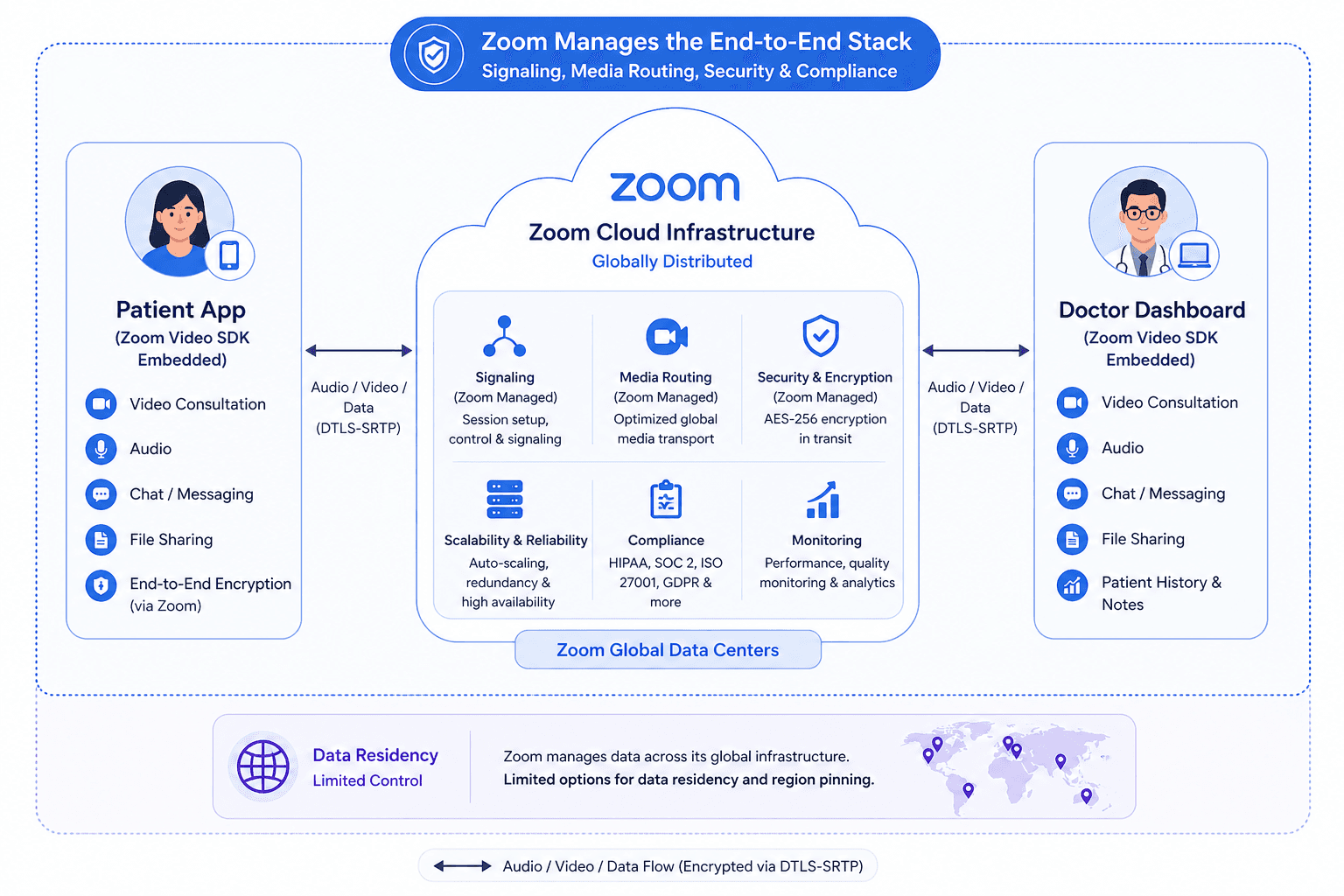
Zoom SDK (Zoom Video SDK and Meeting SDK) allows developers to embed Zoom's video infrastructure into custom applications. Unlike the consumer Zoom product, the SDK exposes APIs for video sessions, participant management, and UI customisation. Zoom Video SDK is designed for building custom video experiences, while Zoom Meeting SDK embeds the full Zoom client into third-party apps.
Strengths
- Mature, globally distributed infrastructure with proven reliability at enterprise scale
- HIPAA BAA available for qualifying healthcare organisations
- High patient familiarity with Zoom as a brand, reducing onboarding friction in some demographics
- Strong enterprise procurement pathways, fits existing vendor management processes
- Robust recording and transcription capabilities built in
Limitations
- Customisation is bounded by what Zoom's SDK exposes, you cannot modify the underlying media stack
- All media traffic routes through Zoom's cloud, data residency control is limited to Zoom's available regions
- Pricing is session-based and can become expensive at scale; cost modelling for high-volume telehealth platforms requires careful analysis
- The UI and UX remain recognisably Zoom, differentiation at the product layer is constrained
- Vendor lock-in is high: migrating away requires replacing all video infrastructure
- SDK updates and deprecation cycles are on Zoom's timeline, not yours
Ideal use cases for Zoom SDK in telehealth
- Enterprise health systems with existing Zoom Enterprise agreements
- Platforms where brand recognition and patient comfort with Zoom reduces adoption friction
- Organisations that need HIPAA compliance quickly without building compliance infrastructure
- Teams with limited video engineering capacity and access to Zoom's enterprise support
Read: Evaluating a Zoom Video SDK alternative for customized clinical UX
VideoSDK for telehealth: developer-first real-time infrastructure
What VideoSDK is
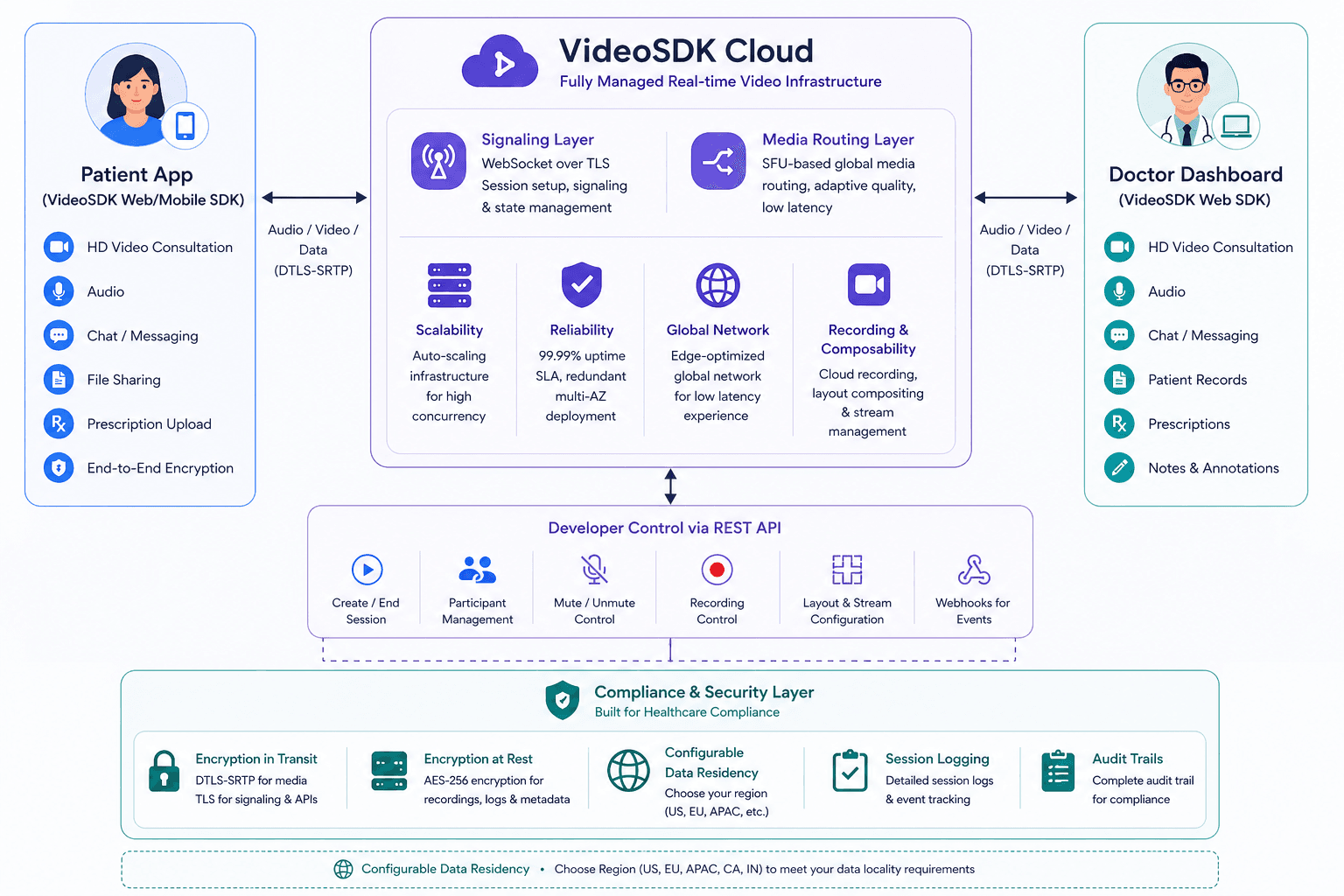
VideoSDK is a real-time communication infrastructure platform that provides video, audio, and data APIs for web and mobile applications. It offers SDKs for React, JavaScript, Android, iOS, React Native, and Flutter, alongside server-side APIs for session management, recording, and participant control. VideoSDK is available at videosdk.live and documented at docs.videosdk.live.
VideoSDK is built on WebRTC internally but abstracts the infrastructure complexity, signaling, media routing, STUN/TURN management, and codec handling, behind an API layer that developers can integrate without media server expertise.
Strengths
- Low integration complexity: production-ready video in hours to days rather than weeks to months, using SDKs across all major platforms
- Real-time audio and video APIs with low latency communication suitable for clinical consultation
- Scalable infrastructure for live interactions, supporting growth from early-stage platforms to large concurrent session volumes
- REST API and webhook support for session lifecycle management, start, stop, record, and monitor sessions programmatically
- Pricing is structured around usage, offering more predictability than some enterprise SDK models at mid-market scale
- Active documentation and SDK support reduces the engineering burden for teams without dedicated video infrastructure expertise
Limitations
- Media traffic routes through VideoSDK's cloud, teams requiring full on-premises deployment must evaluate data residency options directly with the vendor
- As a managed service, the underlying infrastructure is less customisable than a self-hosted WebRTC stack
- Teams with very specific codec, SFU topology, or recording pipeline requirements may encounter constraints at the edges of the API surface
Ideal use cases for VideoSDK in telehealth
- Telehealth startups and growth-stage platforms needing fast integration across web and mobile
- Platforms serving multiple geographies that need reliable low-latency performance without managing global PoP infrastructure
- Development teams without dedicated WebRTC or media server expertise
- Platforms prioritising developer velocity and time to market alongside scalability
Read : real-time video communication infrastructure
Feature and capability comparison matrix
| Criterion | WebRTC (self-hosted) | Zoom SDK | VideoSDK |
|---|---|---|---|
| Integration complexity | High — full stack build required | Medium — SDK integration with Zoom constraints | Low — SDK integration across web and mobile |
| Infrastructure control | Full — you own everything | Low — Zoom cloud only | Medium — managed cloud with API control |
| HIPAA BAA availability | Self-managed — your infrastructure | Yes, for qualifying orgs | Verify directly with vendor |
| GDPR posture | Self-managed | Available with configuration | Verify directly with vendor |
| Data residency control | Full — deploy anywhere | Limited to Zoom regions | Verify regional options with vendor |
| Latency performance | Excellent (peer-to-peer or optimised SFU) | Excellent (Zoom global infra) | Low latency via managed media routing |
| Global reliability | Depends on your PoP deployment | Excellent — Zoom's global network | Managed global infrastructure |
| Scalability ceiling | Unlimited (engineering-bound) | High — Zoom's capacity | High — scales with platform growth |
| Time to market | Months | Days to weeks | Hours to days |
| Cost model | CapEx / infrastructure costs | Session-based pricing | Usage-based pricing |
| Cost predictability | High (infrastructure-fixed) | Variable at scale | Predictable at mid-market scale |
| Vendor lock-in risk | None | High | Medium |
| SDK platform coverage | Build your own | iOS, Android, Web, Desktop | React, JS, Android, iOS, React Native, Flutter |
| Recording capability | Build your own pipeline | Built-in | API-managed recording |
| Active developer community | Large (open standard) | Moderate | Active |
Recommendation table: which option fits your platform
| Platform profile | Recommended option | Rationale |
|---|---|---|
| Early-stage telehealth startup, small engineering team | VideoSDK | Fastest path to production across web and mobile; avoids infrastructure overhead |
| Enterprise health system with existing Zoom agreement | Zoom SDK | Procurement alignment, HIPAA BAA, patient brand familiarity |
| Large platform, dedicated infrastructure team, strict data residency | WebRTC (self-hosted) | Full control, no third-party data handling, unlimited customisation |
| Mid-market platform scaling across multiple geographies | VideoSDK | Managed global infrastructure, predictable cost, multi-platform SDK coverage |
| Platform in a jurisdiction with specific on-prem requirements | WebRTC or hybrid | Evaluate VideoSDK data residency options; fallback to self-hosted |
| Platform needing custom recording pipelines and SFU topology | WebRTC | API surface of managed services may not cover edge requirements |
| Team evaluating vendor lock-in risk as a primary concern | WebRTC | Open standard, no proprietary dependency |
Architecture considerations for telehealth platforms
Compliance is architecture, not a checkbox
In telehealth, HIPAA compliance is not a feature you add at the end, it shapes every layer of the video stack. This means encryption in transit (TLS 1.2 minimum) and at rest, access logging for all session metadata, BAA coverage for any third-party vendor handling PHI (protected health information), and documented data retention and deletion policies.
Self-hosted WebRTC gives you maximum compliance flexibility but transfers the entire burden to your engineering and security teams. Managed services like Zoom SDK and VideoSDK reduce that burden but require you to verify their compliance posture, BAA availability, and data handling practices before signing contracts.
Read: Build vs buy video calling API evaluation framework
Latency requirements in clinical video
Clinical consultation requires video latency below 150ms round-trip for natural conversation. Diagnostic applications, remote dermatology, ophthalmology, wound care, may require higher frame rates and more aggressive codec configuration.
Pure peer-to-peer WebRTC achieves the lowest possible latency but degrades in multi-party sessions or across poor network paths. Managed infrastructure with globally distributed media routing, as provided by both Zoom and VideoSDK, trades some theoretical minimum latency for consistency and reliability across varied network conditions.
Scalability models differ significantly
A self-hosted WebRTC architecture scales by adding media server capacity, TURN server nodes, and signaling infrastructure. This is linear but engineering-intensive. Managed services abstract this, you pay for sessions and the vendor handles infrastructure elasticity.
For telehealth platforms with predictable session volumes (scheduled appointments), managed services offer cost efficiency. For platforms with highly variable or burst session demand, the pricing model of the managed service matters more than the underlying technology.
Multi-platform coverage is a telehealth-specific requirement
Telehealth patients access care from mobile phones, tablets, and desktop browsers, often on consumer-grade connections. Your video infrastructure must deliver a consistent experience across Android, iOS, and web simultaneously. VideoSDK's SDK coverage across React, JavaScript, Android, iOS, React Native, and Flutter is directly relevant here. Zoom SDK also covers major platforms. Self-hosted WebRTC requires building and maintaining native SDKs or relying on third-party wrappers.
Final verdict: scenario-based recommendations
Choose WebRTC if your platform operates in a jurisdiction where all patient data must remain on-premises or in a private cloud you fully control, your team includes dedicated media infrastructure engineers, and you are building for long-term differentiation at the infrastructure layer. Accept that time to market will be longer and ongoing operational cost will be significant.
Choose Zoom SDK if your organisation already has Zoom Enterprise licensing and procurement infrastructure, your patient base has demonstrated comfort with Zoom as an interface, and you need HIPAA BAA coverage quickly without building compliance tooling. Accept that customisation, pricing at scale, and vendor lock-in are real constraints.
Choose VideoSDK if you are building a telehealth product and need to move fast across web and mobile, you want managed low-latency infrastructure without the operational overhead of a self-hosted media stack, and you are building at a stage where engineering velocity and cost predictability matter more than full infrastructure ownership. Verify the compliance posture and data residency options directly with VideoSDK for your specific regulatory context.
For most telehealth founders and CTOs reading this in 2026, the primary decision is between VideoSDK and raw WebRTC, with Zoom SDK as a reasonable choice only in specific enterprise contexts. The WebRTC vs Zoom SDK vs VideoSDK telehealth 2026 comparison ultimately resolves to a trade-off between control and velocity.
Key takeaways
- WebRTC provides maximum infrastructure control but requires significant engineering capacity and transfers all compliance responsibility to your team.
- Zoom SDK offers enterprise-grade reliability and brand familiarity but constrains customisation and creates high vendor dependency.
- VideoSDK reduces integration complexity and time to market for telehealth platforms across web and mobile, with managed low-latency infrastructure.
- HIPAA compliance is an architectural requirement, not a feature, evaluate BAA availability, data residency, and encryption posture for any option you select.
- Time to market and infrastructure control trade off directly, the right choice depends on your team's engineering capacity and your platform's compliance context.
Frequently asked questions
Q.1 Is WebRTC HIPAA compliant for telehealth?
WebRTC itself is a protocol, not a product, it does not provide HIPAA compliance. HIPAA compliance depends entirely on how you implement the surrounding infrastructure: encryption, access controls, audit logging, and BAA coverage with any vendors who handle PHI. Teams building on raw WebRTC are responsible for the full compliance posture.
Q.2 Does Zoom SDK provide a HIPAA BAA for telehealth platforms?
Zoom offers HIPAA BAA coverage for qualifying healthcare organisations under its enterprise plans. This does not automatically make your application HIPAA compliant, you must also implement appropriate access controls, session logging, and data handling practices in your application layer. Verify the current BAA scope directly with Zoom's enterprise team.
Q.3 What is the difference between Zoom Meeting SDK and Zoom Video SDK for telehealth?
Zoom Meeting SDK embeds the full Zoom meeting experience inside your application, including Zoom's native UI. Zoom Video SDK allows developers to build fully custom video experiences using Zoom's infrastructure without the Zoom meeting interface. For telehealth platforms requiring custom clinical UX, the Video SDK is generally more appropriate.
Q.4 How does VideoSDK handle compliance for healthcare applications?
VideoSDK provides managed real-time communication infrastructure with encryption in transit and at rest. Teams building HIPAA-regulated telehealth applications should verify VideoSDK's current BAA availability, data residency configuration, and compliance documentation directly at videosdk.live before production deployment.
Q.5 What latency can telehealth platforms expect from each option?
Clinical conversation requires round-trip latency below approximately 150ms. Peer-to-peer WebRTC on good network paths can achieve sub-50ms. Managed services like Zoom and VideoSDK use globally distributed media routing to deliver consistent low-latency performance across varied network conditions, typically in the 50-150ms range for geographically proximate users.
Q.6 Which option is best for a telehealth startup with a small engineering team?
For teams without dedicated media infrastructure expertise, a managed SDK approach, VideoSDK or Zoom SDK, is strongly preferable to self-hosted WebRTC. VideoSDK's multi-platform SDK coverage and API-driven session management make it particularly well-suited to startup teams needing production-grade video across web and mobile without WebRTC infrastructure expertise.
Q.8 Can I migrate away from Zoom SDK or VideoSDK to self-hosted WebRTC later?
Migration is possible but non-trivial. Both Zoom SDK and VideoSDK abstract the media layer, migrating to self-hosted WebRTC requires rebuilding signaling, media server infrastructure, STUN/TURN configuration, and SDK integrations across all client platforms. Plan migration complexity into your architectural decisions early, particularly if infrastructure ownership is a long-term strategic requirement.
Q.9 How does global performance differ across these options for international telehealth?
Zoom operates one of the largest globally distributed video infrastructure networks, offering strong performance across most geographies. VideoSDK provides managed global media routing without requiring you to deploy regional infrastructure. Self-hosted WebRTC performance is entirely determined by your PoP deployment strategy, without regional TURN and media server capacity, international performance degrades significantly.