
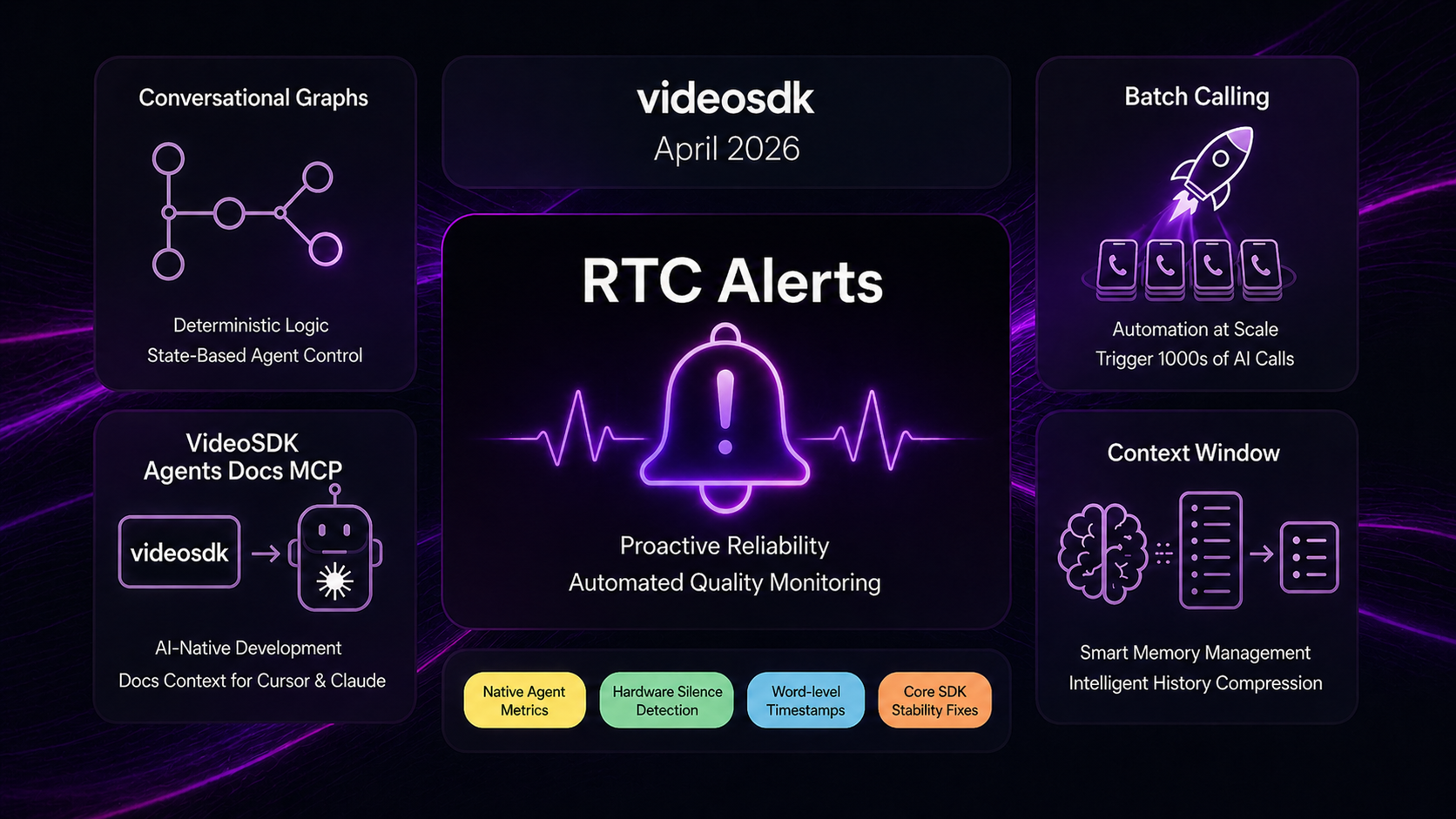


April 2026 Roundup: Proactive RTC Alerts, Deterministic Conversational Graphs, and Intelligent Context Management.
Welcome to the April edition of the VideoSDK Monthly Updates! This month, we have focused on moving from reactive monitoring to proactive reliability and giving AI agents a structured "brain" for complex business logic.
From the launch of RTC Alerts to the new Conversational Graph support and the ContextWindow for smarter memory, April marks a significant leap in our AI and infrastructure capabilities. Let's dive into what we shipped!
Proactive RTC Alerts
In any real-time application, quality is the product. Unlike traditional systems, RTC failures are often subtle degradations - choppy video, breaking audio, or lagging screenshare. To solve this, we are introducing VideoSDK Alerts.
RTC Alerts shift monitoring from passive observation to active detection. Instead of waiting for user complaints, you can now define metric-driven thresholds that trigger instant notifications.
Core Capabilities of RTC Alerts:
- Metric-Driven Monitoring: Build alerts based on Jitter, Latency, and Packet Loss across Camera or Screen Share streams.
- Dimensional Filtering: Scope alerts by Region (e.g., APAC, US-East), OS, Browser, or SDK to isolate specific environmental issues.
- Aggregation Logic: Use Max (worst-case), Average, or Percentiles to define what constitutes a failure.
- Noise Reduction: Configure Minimum Session Impact (to ignore single-user outliers) and Time-Based Validation (to ignore transient spikes).
- Historical Validation: Test your alert logic against past data before deployment to ensure accuracy.
- Multi-Channel Delivery: Direct integration with Slack, PagerDuty, and Webhooks.
AI Agents: Rigid Control & Large-Scale Automation
Conversational Graphs: Deterministic Workflows
Agents SDK v1.0.6 introduces directed graph support. This allows you to build multi-turn agents where you define the exact transitions between states (e.g., "Greeting" → "Booking" → "Payment"). The engine follows your routing exactly - the LLM handles the conversation, but never makes unauthorized routing decisions.
📄 Read the Conversational Graphs docs
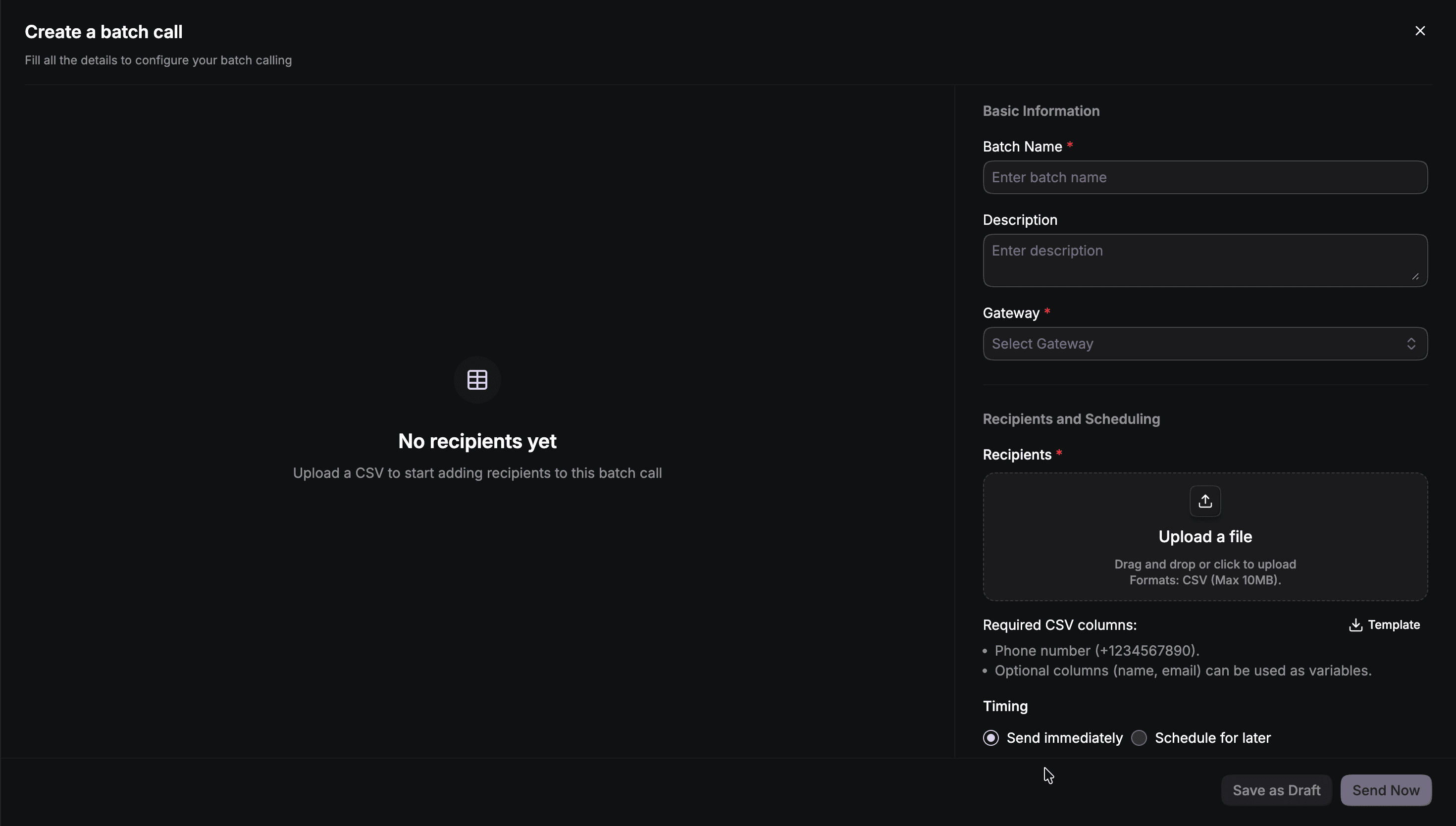
Batch Calling: Voice Outreach at Scale
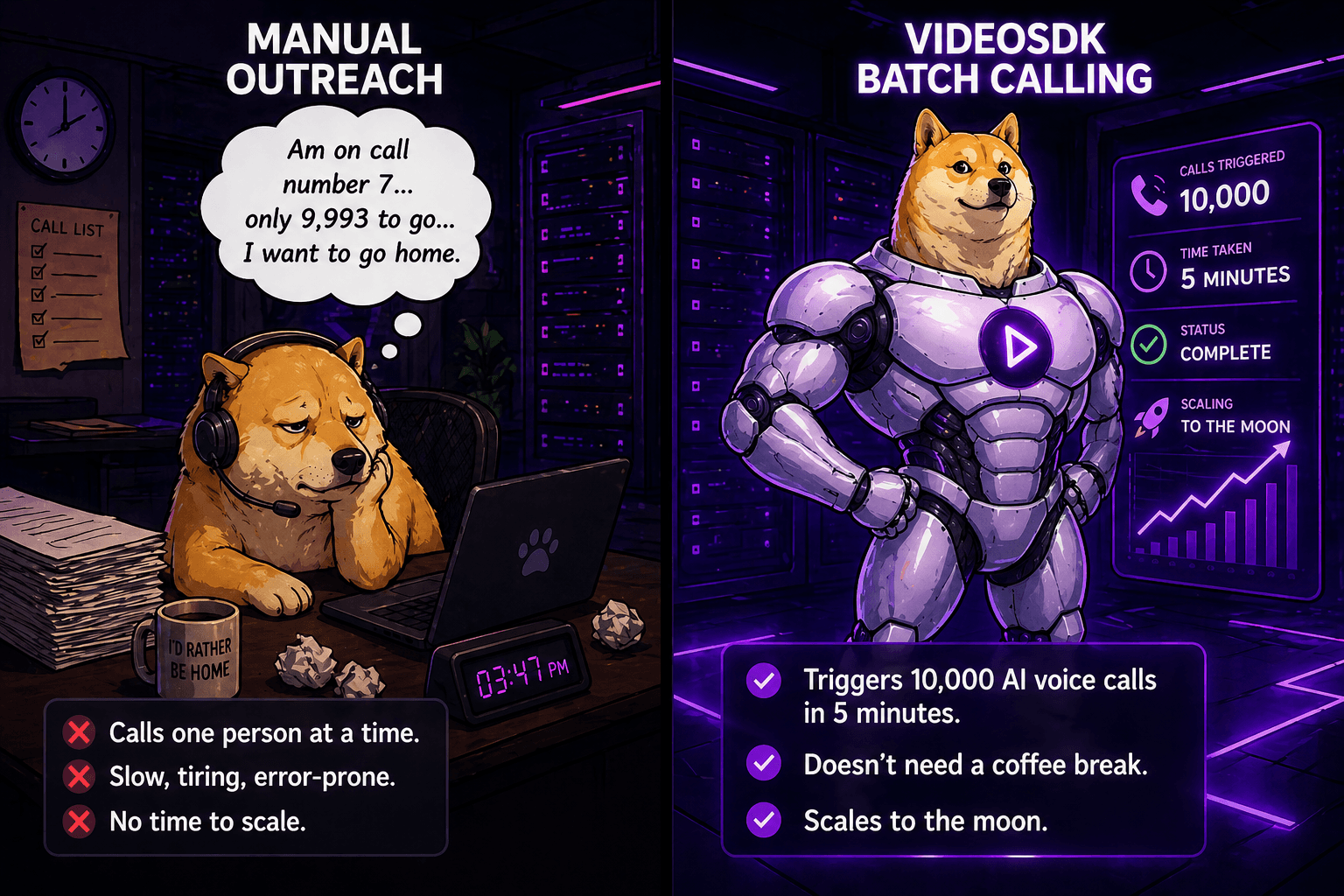
Our new Batch Calling infrastructure allows you to trigger hundreds of AI-powered voice calls simultaneously from the dashboard. This is designed for high-concurrency outbound use cases like automated reminders and large-scale customer surveys.
AI-Native Development: Agents MCP Server
We've launched the official Agents MCP Server. This allows you to provide the full, real-time context of our Agents documentation to AI coding assistants like Claude, Cursor, and VS Code. By connecting your AI to our docs, you can generate implementation code that follows our latest v1 standards and patterns automatically.
👉 View the Agents MCP Server Setup Guide
Agent Intelligence: Smarter Memory & Gated Speech
ContextWindow: Intelligent Memory
Agents SDK v1.0.3 introduces the ContextWindow. Instead of "blindly" truncating the oldest messages when token limits are reached, this feature uses history compression and summarization. It preserves the last N turns raw to maintain conversation quality while summarizing older history.
Startup Speech Gating
To prevent the user from interrupting an agent's initial greeting, we have implemented Early Speech Gating (v1.0.7). User audio is now gated until the agent has initiated its first say() or reply(), ensuring a professional and clear start to every interaction.
Read full release notes on GitHub
Observability & Metrics
Unified Observability Configuration
You can now pass all observability settings - recording, traces, metrics, and logs - directly at session startup (v1.0.9).
Pipeline & Metrics Hooks
Agents SDK v1.0.7 adds deep visibility hooks. Use @pipeline.metrics.on("stt") or @pipeline.metrics.on("realtime") to capture latency and token usage. You can also now use session.get_context_history to access session data for debugging or post-processing.
Native SDK Agent Metrics
Real-time agent performance data is now exposed directly in the client-side SDKs. Monitor latency, tokens, and component health via:
- JS SDK v0.7.2 - agent-metrics event on AgentParticipant
- React SDK v0.9.1 - onAgentMetrics() callback
- Flutter SDK v3.9.0 - Events.agentMetrics event
Hardware-Silence Detection
Available in JS SDK v0.7.2 and React SDK v0.9.1, the audio-input-silence event triggers when a microphone is publishing but no audio signal is detected. This allows you to alert users to hardware mutes or Bluetooth issues immediately.
Interactive Transcripts & Ecosystem
Word-level Timestamps & Interim Transcripts
Agents SDK v1.0.9 adds support for streaming agent transcripts with word-level timestamps (for Cartesia and ElevenLabs). Additionally, you can now enable interim user results to show text on the UI as the user is still speaking.
Core SDK Stability & Performance
- iOS SDK v2.7.1 - Resolved rare crashes in screenshare/PubSub and optimized stats collection for large meetings.
- Android SDK v1.2.0 - Rewritten audioManager logic to resolve complex Bluetooth handoff issues.
- React SDK v0.9.1 and React Native SDK v0.10.1 - Fixed unnecessary re-render issues and improved webcam toggle state handling.
Dashboard Power-ups
- Agent Logs: A dedicated tab in session details to view raw execution logs for debugging.
- Composite Recording: Download a unified view of agent-user interactions in a single MP4.
- Batch Calling & Alerts: Centralized UI to manage large-scale campaigns and configure proactive quality alerts.
📚 New Content & Resources
- Introducing VideoSDK AI Voice Agents v1: The official v1 breakdown.
- Video: Proactive monitoring with RTC Alerts
- Video: Deterministic Agent Workflows with Graphs
Featured Videos
✨ Community Spotlight
SDK Sketches
Build with April's Updates
Configure RTC Alerts and Batch Calling via the dashboard, or upgrade to Agents SDK v1.0.10 today.
Dashboard Join our Discord
Happy building!
Team VideoSDK