


Why Logistics Needs a Voice Revolution
Logistics is the backbone of global commerce, but the industry faces mounting challenges: surging shipment volumes, complex customer expectations, and the relentless demand for real-time delivery. Communication breakdowns, whether with shippers, carriers, or customers, often become a critical bottleneck, leading to missed updates, manual errors, and dissatisfied stakeholders. As organizations scale, traditional methods of managing logistics communications, manual calls, repetitive queries, and endless scheduling, can no longer keep up with operational demands.
An AI voice agent for logistics is redefining how logistics teams communicate, automate customer service, and orchestrate operations at scale. These advanced voicebots go far beyond legacy IVRs, enabling natural, human-like conversations, instant responses, and seamless integration with logistics platforms. With the VideoSDK Agents Framework, forward-thinking companies can rapidly deploy robust, enterprise-ready AI voice solutions that drive efficiency, elevate customer experience, and deliver measurable ROI.
AI voice agents for logistics automate routine interactions, provide real-time updates, and ensure every stakeholder receives timely, accurate information. This technology is transforming logistics by reducing manual workload, improving accuracy, and enabling round-the-clock support, making it an essential tool for modern supply chains.
The Modern Logistics Challenge: Where Traditional Methods Fall Short
Despite significant advances in technology, many logistics operations still depend on legacy systems and manual processes that are costly, slow, and prone to error. Call center teams are inundated with repetitive inquiries every day, order status checks, delivery confirmations, rescheduling, leading to fatigue, missed opportunities, and unnecessary operational costs. Fragmented communication channels further erode the customer experience and reduce overall productivity.
For example, integrating a phone call api empowers logistics teams to automate both outbound and inbound calls, reducing manual workload and ensuring consistent communication across all stakeholders.
Let’s compare traditional logistics communication with the next-generation AI-powered approach:
| Criteria | Traditional Logistics | AI Voice Agent-Powered Logistics |
|---|---|---|
| Average Response Time | 2-10 minutes | Instant (seconds) |
| Operational Cost | High (staff, overtime) | Lower (automation, 24/7 ops) |
| First Call Resolution (FCR) | 50-65% | 80-95% |
| Scalability | Limited by staffing | Effortless, elastic |
The difference is clear: AI voice agents for logistics deliver faster responses, higher accuracy, and scalable cost savings, freeing up human agents to focus on strategic, high-value work.
What is an AI Voice Agent for Logistics?
An AI voice agent for logistics is a specialized, intelligent voicebot designed to automate and optimize communication across the logistics value chain. Leveraging advanced speech recognition, natural language processing, and real-time decisioning, these agents can understand human requests, converse naturally, and execute tasks spanning the entire logistics lifecycle. AI voice agents for logistics serve as digital assistants that handle routine queries, provide real-time updates, and integrate with core logistics systems to streamline operations.
Key capabilities include:
- Handling order inquiries and shipment status updates
- Scheduling pickups, deliveries, and rescheduling appointments
- Providing proactive notifications and exception alerts
- Supporting multilingual conversations for global operations
- Operating 24/7 with consistent, human-like empathy
By utilizing a Voice SDK, these AI voice agents can deliver seamless, real-time conversations that integrate directly with logistics workflows. This ensures every customer, partner, and internal stakeholder receives timely, accurate information, reducing delays, manual errors, and operational friction.
High-Impact Use Cases Driving ROI
AI voice agents for logistics are not just about automating tasks, they drive measurable business impact across critical logistics functions:
- Automated Scheduling and Appointment Booking: Instantly confirm, reschedule, or cancel pickups and deliveries, reducing manual back-and-forth and minimizing costly no-shows.
- Real-Time Shipment Updates: Provide live status, ETAs, and location tracking to customers and carriers, proactively reducing the volume of inbound status calls.
- Proactive Notifications & Exception Management: Alert stakeholders to delays, disruptions, or required actions, preventing bottlenecks and improving supply chain visibility.
- Inventory and Warehouse Communication: Automate inventory checks, stock updates, and internal messaging for faster, data-driven decisions.
- Customer & Carrier Support: Streamline returns, handle feedback, and answer FAQs, boosting satisfaction and reducing support tickets.
For logistics teams aiming to enhance their communication infrastructure, integrating a Voice SDK or a phone call api enables automated, scalable, and reliable voice interactions across all these use cases.
| Use Case | Business Benefits | KPIs Impacted |
|---|---|---|
| Automated Scheduling | Reduces no-shows, saves time | 20-40% drop in missed appts |
| Real-Time Shipment Updates | Enhances transparency, trust | 30-50% fewer status calls |
| Proactive Exception Management | Minimizes delays, boosts CSAT | 15-25% higher customer NPS |
| Inventory & Warehouse Communication | Speeds operations, reduces errors | 10-20% faster order cycle time |
| Customer & Carrier Support | Lowers support costs, FCR gains | 15-30% cost savings |
These use cases deliver both operational efficiency and transformative ROI, making an AI voice agent for logistics a strategic imperative for modern logistics leaders.
Tangible Benefits: Transforming Operations and the Bottom Line
The adoption of an AI voice agent for logistics is more than a trend, it is a proven catalyst for operational and financial transformation. Companies deploying these solutions consistently report:
- Cost Reductions: Automation slashes call center expenses by 20-40%, eliminating overtime and reducing staff turnover.
- Improved First Call Resolution (FCR): AI agents resolve up to 80-95% of routine queries on the first interaction, elevating customer satisfaction and reducing repeat contacts.
- Scalability and Resilience: Unlike human teams, AI agents scale effortlessly during peak seasons, ensuring 24/7 coverage and eliminating service gaps.
- Strategic Resource Allocation: Freed from repetitive tasks, human agents can focus on complex logistics challenges and relationship management.
By leveraging a Voice SDK, logistics providers can enhance their communication channels, ensuring high-quality, real-time voice interactions that boost both efficiency and customer satisfaction.
Leading logistics providers have seen CSAT scores jump by over 25%, and some report ROI paybacks within weeks of deployment. According to Gartner, enhancing customer experience and operational efficiency through AI-driven automation is a top priority for supply chain leaders. As one global 3PL leader shared: "AI voice agents enabled us to scale customer support overnight, while cutting costs and raising service levels, especially during seasonal surges."
Overcoming Adoption Barriers: Security, Integration & Trust
While the benefits of an AI voice agent for logistics are compelling, successful adoption requires addressing several key concerns:
- Data Privacy & Compliance: Modern AI platforms, such as those built on the VideoSDK Agents Framework, provide end-to-end encryption and compliance with regulations like GDPR, CCPA, and other global privacy standards. This ensures sensitive data is protected at every stage.
- Seamless System Integration: Pre-built connectors and robust APIs enable effortless integration with TMS, CRM, warehouse management, and other core systems. This maintains data flow, process continuity, and minimizes disruption during deployment.
- Human-Like Transparency & Trust: Advances in conversational AI deliver natural, empathetic interactions. Clear escalation paths and transparent operations help build user acceptance and trust, critical for widespread adoption.
For logistics companies seeking to further enhance collaboration, integrating a Video Calling API can facilitate face-to-face interactions and streamline communication across distributed teams.
By choosing an enterprise-grade, developer-friendly platform, logistics businesses can accelerate adoption of AI voice agents while maintaining the highest standards of security, compliance, and trust. McKinsey highlights that automation and AI are key to building resilient, future-ready supply chains.
The Builder's Blueprint: How to Bring an AI Voice Agent to Life
Building a scalable AI voice agent for logistics requires a strategic approach that balances technical sophistication with real-world business needs. Here’s how to architect a solution that delivers measurable value:
The Core Components You'll Need
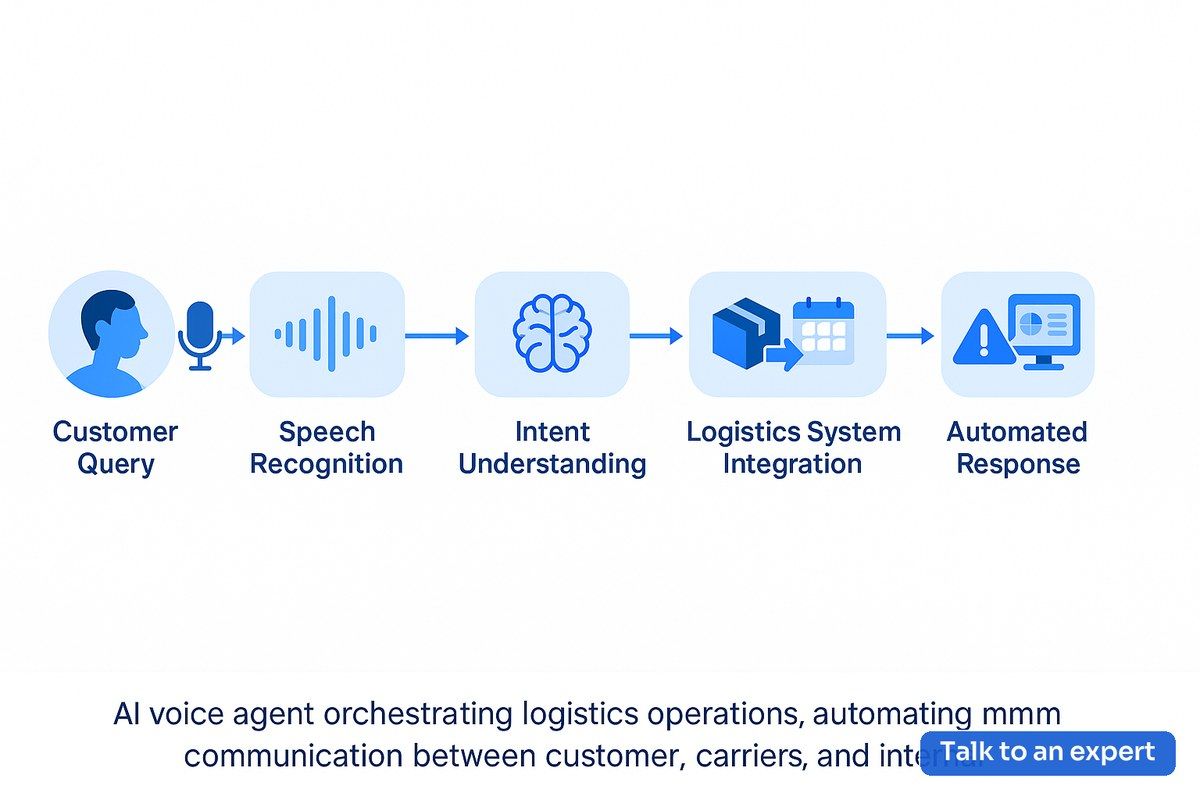
- Voice Recognition & Transcription: Accurately convert spoken requests into actionable data, supporting multiple accents and languages for global operations.
- Natural Language Processing (NLP): Understand context, intent, and sentiment, enabling adaptive, human-like conversations with customers and partners.
- Real-Time Decision Logic & Orchestration: Route requests, trigger workflows, and manage exceptions instantly. This ensures every conversation is context-aware and productive.
- Integration with Logistics Systems: Seamlessly connect with TMS, CRM, inventory management, and external APIs to access real-time data and update records on the fly.
For developers and product teams, leveraging an embed video calling sdk can accelerate the integration of both voice and video capabilities into logistics platforms. This reduces development time and ensures a seamless user experience across communication channels.
The Critical Challenge: Real-Time Orchestration
At the heart of an effective AI voice agent for logistics is real-time orchestration, coordinating high call volumes, concurrent conversations, and instant backend updates without missing a beat. Many legacy solutions struggle to deliver this level of performance and reliability.
Key orchestration challenges include:
- Managing multiple, simultaneous interactions without latency
- Instantly retrieving and updating shipment, customer, or inventory data
- Handling interruptions (e.g., customer changes delivery address mid-call)
- Seamless escalation to human agents when needed
Here’s how a modern real-time orchestration workflow operates:
The Solution: The VideoSDK Agents Framework
The VideoSDK Agents Framework is the essential enabler for building, deploying, and scaling AI voice agents purpose-built for logistics. VideoSDK provides:
- Pre-Built Modules: Voice recognition, NLP, and workflow orchestration are ready out-of-the-box, drastically reducing development time. For teams seeking to enable real-time voice interactions, integrating a Voice SDK ensures high-quality, scalable audio communication.
- Seamless Integration: Robust connectors for TMS, CRM, inventory, and custom APIs ensure data is always up-to-date and actionable.
- Real-Time Scalability: Designed for concurrent conversations and peak traffic, with enterprise-grade reliability and AI-driven context switching.
- Developer-Friendly Tools: Fast to implement, easy to customize, and supported by detailed documentation and expert support.
- Enterprise Security: End-to-end encryption, compliance, and data governance built in, so your stakeholders stay protected.
With VideoSDK, logistics innovators can move from concept to production in record time, delivering AI voice agents for logistics that drive ROI, boost customer satisfaction, and future-proof operations.
Future-Proofing Logistics with AI Voice Agents
AI voice agents for logistics are redefining what’s possible in supply chain management: accelerating response times, reducing costs, and transforming how teams and customers interact. In an industry where every minute and every margin count, the urgency to innovate has never been greater.
Do not let legacy processes hold your business back. Embrace the AI voice agent for logistics revolution and stay ahead of the competition. Ready to build the future of logistics? Explore the VideoSDK Agents Framework and Try it for free to unlock your next wave of growth and efficiency, today.
FAQ