


Transforming Utilities with AI Voice Agents
In 2026, utilities are under increasing pressure to deliver fast, reliable, and cost-effective customer service. The adoption of an AI voice agent for utilities is transforming how utility companies interact with customers, streamline operations, and stay competitive. By leveraging advanced natural language processing and machine learning, these AI-powered voice agents automate routine interactions, reduce operational costs, and elevate the customer experience across the sector.
AI voice agents for utilities automate high-volume customer service tasks, provide instant responses to common inquiries, and enable human agents to focus on complex cases. This results in faster service, improved accuracy, and significant cost savings, making them a strategic asset for any utility provider aiming to modernize operations and meet rising customer expectations.
How AI Voice Agents Solve Utilities' Challenges
AI voice agents for utilities address persistent industry challenges by automating customer interactions, reducing wait times, and lowering operational costs. These agents efficiently manage repetitive tasks, freeing up human staff for higher-value work and improving overall service quality and responsiveness.
Challenges in the Utilities Sector Today
Utility providers face a complex landscape marked by high customer service demands, regulatory compliance, aging infrastructure, and the need for 24/7 support. Traditional call center models often struggle to keep pace, resulting in long wait times, increased operational costs, and customer frustration. As digital transformation accelerates, utilities must respond with scalable, intelligent solutions. Teams that adopt ai voice agent for utilities typically measure success through faster response times and lower handle costs.
Increasing Customer Expectations
Modern utility customers expect rapid, personalized service on demand. AI voice agents for utilities deliver immediate answers to billing, outage, and account inquiries, dramatically reducing wait times. For example, when a customer calls about a billing question, the AI voice agent can instantly retrieve and communicate account details, ensuring a seamless and satisfying experience. According to McKinsey, digital engagement is now a key driver of customer satisfaction in the utility sector.
Cost Management Pressures
Rising operational costs and the pressure to do more with less are constant concerns for utilities. AI voice agents for utilities automate thousands of routine calls, such as billing inquiries or outage reports, simultaneously. This reduces the need for large call center teams and minimizes errors from manual data entry, driving down costs and increasing efficiency. As Gartner notes in their research, AI adoption is expected to significantly reduce operational overhead in service industries by 2026.
How AI Voice Agents Work in Utilities
AI voice agents for utilities use advanced speech recognition and natural language understanding to engage with customers in real time. These agents can handle a wide variety of interactions, from billing and payment reminders to outage notifications and service updates, all while integrating with existing utility systems.
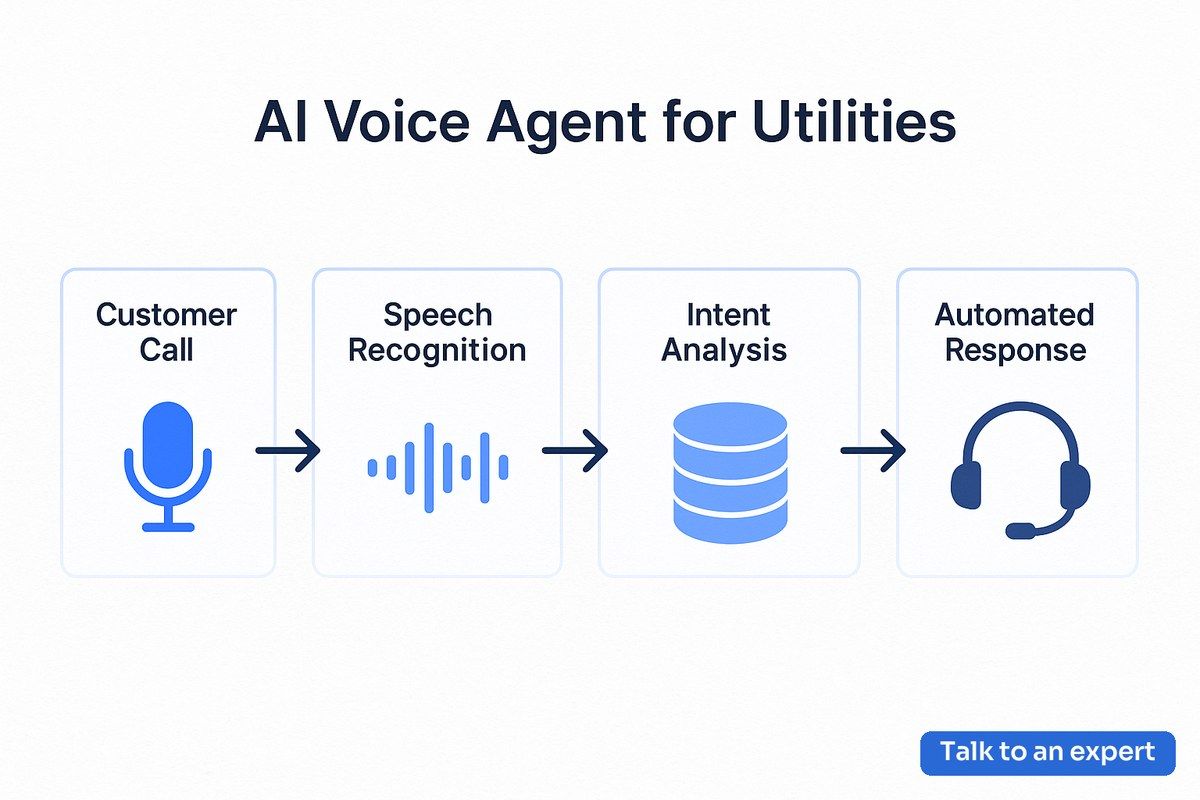
For organizations exploring ai voice agent for utilities, the priority is measurable ROI and practical deployment.
By connecting seamlessly to customer relationship management (CRM) platforms, billing databases, and outage management systems, AI voice agents can be deployed rapidly without major IT overhauls. This makes them an accessible and cost-effective innovation for utilities of any size.
Integration with Existing Systems
AI voice agents for utilities are designed to integrate with CRM, billing, and outage management systems. This ensures agents have real-time access to customer data and system status, enabling accurate and timely responses. For instance, if a customer calls to report a power outage, the AI voice agent can instantly check the latest outage information and provide updates or estimated restoration times. Integration streamlines workflows and enhances service reliability. For organizations exploring ai voice agent for utilities, the priority is measurable ROI and practical deployment.
Advanced Speech Recognition
Modern AI voice agents utilize robust speech recognition to accurately interpret customer queries, even in noisy or challenging environments. This is critical for utilities, as customers may call from busy streets or industrial sites. For example, a customer calling from a construction zone can still have their request understood and resolved quickly. According to Google Cloud Research, advanced speech-to-text models now match or exceed human accuracy in many real-world scenarios, boosting the effectiveness of AI voice agents in utilities.
Key Benefits and Outcomes
Enhancing Customer Service
AI voice agents for utilities automate routine inquiries, such as billing questions, outage notifications, and payment reminders, allowing human agents to focus on complex or sensitive cases. This improves first-call resolution rates and elevates the overall customer experience. For implementation guidance, refer to the Voice Agent Quick Start Guide. In practice, ai voice agent for utilities works best when integrated with existing CRM, telephony, and support tools.
Operational Efficiency
With AI voice agents, utilities can streamline appointment scheduling, automate identity verification, and manage large call volumes without increasing staff. Understanding the AI voice Agent core components overview is crucial for maximizing these efficiencies. For example, AI voice agents can automatically schedule maintenance appointments or confirm service requests, reducing manual workload and errors.
Real-Time Data Processing
AI voice agents for utilities process and analyze customer data in real time, enabling rapid responses during peak demand or emergencies. During a major outage, these agents can provide thousands of customers with real-time updates on restoration efforts, improving transparency and trust. Real-time analytics also help utilities identify trends and optimize resource allocation.
Improved Customer Engagement
By leveraging historical interaction data, AI voice agents for utilities deliver personalized experiences. They can remember past calls, offer tailored recommendations, and proactively notify customers about service changes or payment deadlines. This level of engagement fosters loyalty and strengthens customer relationships.
Scalability and Flexibility
AI voice agents for utilities are highly scalable, able to handle surges in call volume during storms or emergencies without degrading service quality. Their flexibility allows utilities to quickly adapt to new service offerings, regulatory changes, or customer needs, ensuring continuity and resilience even under pressure.
Implementation Path for Utility Teams
Deploying an AI voice agent for utilities requires careful planning, stakeholder engagement, and a focus on security and change management. Leveraging existing IT infrastructure and involving cross-functional teams early can accelerate adoption and maximize ROI. A Human-in-the-loop strategy ensures AI agents remain accurate and adaptable as customer needs evolve.
Addressing Data Privacy Concerns
Utilities must ensure that AI voice agents comply with strict data protection regulations. This includes implementing encryption, anonymization, and secure data storage, as well as obtaining explicit customer consent for data usage. For example, utilities can use advanced encryption protocols to safeguard sensitive customer information during voice interactions, meeting or exceeding industry standards as outlined by NVIDIA AI Resources.
Change Management Strategies
Successful implementation of AI voice agents for utilities depends on effective change management. Utilities should proactively communicate the benefits of AI, provide hands-on training, and address employee concerns early. Workshops, pilot programs, and ongoing feedback channels can help staff embrace new technology and drive a culture of innovation.
Training and Support
Comprehensive training is critical for both customer-facing staff and IT teams. Training should cover the technical operation of AI voice agents, best practices for escalation, and the role of AI in customer service transformation. Ongoing support resources, such as dedicated help desks or knowledge bases, ensure a smooth transition and sustained performance. A practical roadmap for ai voice agent for utilities begins with a pilot use case, defined KPIs, and a path to production.
ROI and Operational Impact
AI voice agents for utilities deliver measurable ROI by reducing call center volumes, lowering operational costs, and improving customer satisfaction. Utilities that adopt AI voice agents see faster response times, fewer manual errors, and enhanced service consistency. Monitoring AI voice Agent Session Analytics enables continuous optimization and performance improvement.
Measuring Success
To evaluate the impact of AI voice agents for utilities, organizations should track KPIs like average call resolution time, customer satisfaction scores, and cost savings. Regular analysis of these metrics helps utilities refine their AI strategies and maximize benefits. For example, a utility may see a significant drop in average call duration and an increase in positive customer feedback after deploying AI voice agents.
Long-Term Benefits
Beyond immediate operational gains, AI voice agents for utilities support long-term strategic goals. They enable continuous innovation, rapid adoption of new technologies, and ongoing improvement of customer service processes. As AI capabilities evolve, utilities can update their voice agents with new features, ensuring they remain at the forefront of digital transformation and customer engagement. Leaders evaluating ai voice agent for utilities often start with one high-volume workflow before scaling further.
Builder's Blueprint: VideoSDK Agents Framework for Utilities
The VideoSDK Agents Framework provides a powerful foundation for deploying AI voice agents for utilities. Its flexible architecture supports seamless integration with legacy systems, rapid customization, and real-time monitoring. With built-in observability and tracing, utilities can maintain high service standards and quickly adapt to changing demands. Monitoring AI voice Agent tracing and observability is essential for ongoing system health and improvement.
Customization and Scalability
The VideoSDK framework enables utilities to tailor AI voice agents to their unique requirements, from handling specialized inquiries to integrating with proprietary databases. Its scalable design supports growth, allowing utilities to expand AI capabilities as customer needs and call volumes increase. For example, a utility can deploy additional AI voice agents during seasonal peaks or emergencies, ensuring uninterrupted service.
Continuous Improvement
With regular software updates and enhancements, the VideoSDK framework ensures that AI voice agents for utilities remain at the cutting edge of technology. Utilities can leverage new features, such as advanced language support or improved analytics, to continuously improve customer service and operational efficiency. When planning ai voice agent for utilities, align stakeholders on data privacy, workflow design, and clear escalation paths.
Future Trends and Innovations
AI voice technology for utilities is advancing rapidly, with trends pointing toward more conversational interfaces, predictive analytics, and deeper integration with smart grid systems. These innovations will further enhance the value of AI voice agents for utilities, driving better outcomes for both providers and customers. The OpenAI Real-Time API Integration exemplifies how real-time AI can transform customer interactions.
Predictive Analytics
By integrating predictive analytics, AI voice agents for utilities can anticipate customer needs, forecast demand surges, and proactively manage resources. This enables utilities to optimize scheduling, prevent outages, and improve overall service reliability. Predictive insights also help utilities identify emerging trends and respond to customer concerns before they escalate.
Enhanced Conversational Interfaces
Future AI voice agents for utilities will feature more natural, intuitive conversational abilities, making interactions smoother and more satisfying. Advanced natural language processing will enable agents to understand complex queries, detect sentiment, and provide nuanced responses, reducing the need for human intervention in routine calls.
AI-Driven Insights
AI voice agents for utilities will increasingly generate actionable insights from customer interactions and operational data. By analyzing call patterns, sentiment, and service outcomes, utilities can identify opportunities for process improvement, resource optimization, and strategic growth. These insights empower utility leaders to make data-driven decisions and stay ahead in a competitive landscape.
In conclusion, adopting an AI voice agent for utilities is a strategic move for providers seeking to deliver exceptional customer service, reduce costs, and future-proof their operations. By leveraging the latest AI innovations and robust frameworks like VideoSDK, utilities can confidently navigate the evolving demands of 2026 and beyond. Understanding AI voice Agent Sessions is key to unlocking the full potential of these transformative tools.
Comparison of AI Voice Agent Capabilities in Utilities
| Feature | Benefit | Example Use Case | |
|---|---|---|---|
| Speech Recognition | Accurate understanding of customer queries | Managing billing inquiries | |
| Natural Language Processing | Improved interaction quality | Outage notifications | |
| Machine Learning | Continuous improvement over time | Predictive maintenance scheduling | Across industries, ai voice agent for utilities is most effective when paired with human oversight for complex edge cases. |
FAQ