


AI Voice Agent for Gaming: Enhance Engagement
AI voice agent for gaming technology is rapidly transforming the gaming industry, setting new standards for player interaction and engagement. Traditionally, non-playable characters (NPCs) relied on repetitive and scripted dialogue, often breaking immersion and limiting narrative depth. The introduction of AI voice agent for gaming solutions enables dynamic, emotionally rich interactions that respond to player actions in real time. This innovation not only elevates player experiences but also streamlines production processes and introduces scalable business models, making AI-driven voice technology essential for studios aiming to stay ahead.
AI voice agent for gaming platforms provide a strategic advantage for developers and business leaders. As the global demand for interactive, personalized gaming experiences accelerates, leveraging these solutions is crucial for maximizing ROI and maintaining a competitive edge in a crowded marketplace.
How Do AI Voice Agents Solve Gaming Industry Problems?
AI voice agents revolutionize gaming by enabling real-time, emotionally nuanced dialogue, transforming static NPCs into interactive companions. This technology enhances player immersion, boosts engagement, and offers scalable, cost-effective solutions for game development.
Gaming Challenges Today
The gaming industry faces several persistent challenges that AI voice agent for gaming solutions can directly address:
- Static NPC Dialogue: Traditional NPCs often break immersion with repetitive, canned lines that limit storytelling potential.
- High Production Costs: Voice production is expensive and time-consuming, involving actors, studios, and localization services.
- Limited Scalability: Scaling voice production globally is challenging and resource-intensive, hindering rapid market expansion.
AI voice agent for gaming platforms offer robust solutions by providing dynamic dialogue, reducing costs, and enabling global scalability.
Addressing Static NPC Dialogue
AI voice agents transform NPCs from static entities into dynamic, interactive characters. By leveraging advanced natural language processing (NLP) and machine learning, these agents can understand context and adapt their responses to player actions. This capability allows for a more personalized gaming experience, where NPCs can react differently based on previous interactions with the player. For example, AI voice Agent tracing and observability can be utilized to monitor and enhance these interactions, ensuring a seamless and engaging narrative. Leading research from OpenAI and Microsoft Research highlights the growing effectiveness of conversational AI in delivering lifelike, context-aware dialogue in interactive environments.
Reducing High Production Costs
The traditional process of voice production in gaming involves hiring voice actors, recording sessions, and extensive post-production work. AI voice agent for gaming solutions streamline this process by generating high-quality voice outputs without the need for human actors. This not only reduces costs but also accelerates the production timeline. Additionally, AI voice agents can be easily updated or modified, allowing developers to make changes without the need for re-recording sessions, thus offering a more agile development process. For a detailed understanding of this process, refer to the Voice Agent Quick Start Guide.
Enhancing Scalability
With AI voice agents, games can be easily localized for different markets without the need for separate voice recordings for each language. AI-driven multilingual support allows for the automatic translation and adaptation of dialogue, ensuring that players worldwide can enjoy the same level of interaction and immersion. This scalability is crucial for developers aiming to reach a global audience and maximize their game's market potential. Reports from Gartner emphasize the importance of scalable AI solutions for global gaming success.
How AI Voice Agents Work in Gaming
AI voice agent for gaming platforms operate through a sophisticated workflow that integrates seamlessly into gaming environments:
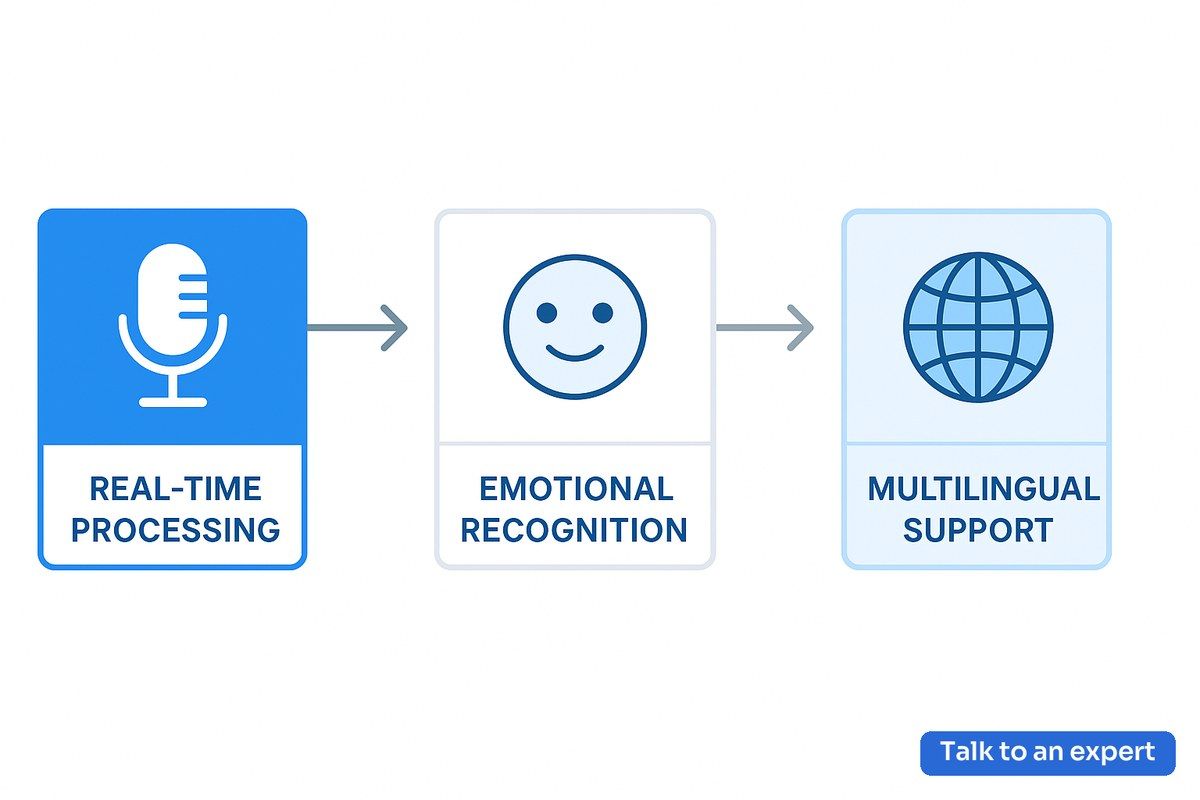
- Real-Time Processing: AI processes player inputs instantly, ensuring natural conversation flow.
- Emotional Recognition: Agents detect and respond to player emotions, enhancing authenticity.
- Multilingual Support: AI agents provide localized experiences, broadening audience reach.
Real-Time Processing and Emotional Recognition
The integration of AI voice agent for gaming technology into interactive environments requires advanced real-time processing capabilities. These agents must analyze player inputs and generate appropriate responses instantaneously, using sophisticated algorithms to process natural language and understand the context of player interactions. Emotional recognition adds another layer of complexity, as AI agents must detect subtle emotional cues in a player's voice or actions and respond in a way that feels authentic and engaging. For more insights, explore the AI voice Agent core components overview. Research from NVIDIA AI Resources shows that real-time emotional AI can significantly elevate player immersion and satisfaction.
Multilingual Support and Global Reach
One of the standout features of AI voice agent for gaming platforms is their ability to support multiple languages, allowing games to be easily adapted for different regions. This capability is particularly important for developers looking to expand their reach into international markets. By providing localized experiences, AI voice agents ensure that players from different cultural backgrounds can enjoy the game in their native language, enhancing accessibility and engagement. As highlighted in Google Cloud Research, scalable multilingual AI is key for global audience growth in interactive entertainment.
Key Benefits and Outcomes
Implementing AI voice agent for gaming solutions delivers numerous business and player benefits:
- Enhanced Player Engagement: Interactive dialogue keeps players immersed and invested.
- Cost Efficiency: Reduces reliance on traditional voice production, cutting costs and time.
- Scalability: Supports global releases with automated, multilingual voice solutions.
Enhanced Player Engagement
AI voice agent for gaming platforms significantly enhance player engagement by providing more interactive and immersive experiences. Players are more likely to remain engaged with a game when they feel that their actions have a direct impact on the narrative. By offering dynamic dialogue that adapts to player choices, AI voice agents create a sense of agency and involvement that traditional scripted dialogue cannot match.
Cost Efficiency and Scalability
The cost savings associated with AI voice agent for gaming solutions are substantial. By eliminating the need for traditional voice production, developers can allocate resources more efficiently and focus on other aspects of game development. The scalability of AI voice agents also means that games can be launched simultaneously in multiple markets, maximizing their potential reach and revenue.
Implementation Path for Gaming Teams
To successfully integrate AI voice agent for gaming solutions, gaming teams should:
- Select the Right Tools: Choose AI voice solutions that offer real-time interaction and emotional nuance.
- Integrate with Game Engines: Ensure seamless compatibility with platforms like Unity or Unreal.
- Focus on Scalability: Plan for global deployment with robust infrastructure.
Selecting the Right Tools
Choosing the right AI voice agent for gaming is critical for successful implementation. Developers should look for tools that offer advanced features such as real-time processing, emotional recognition, and multilingual support. These capabilities are essential for creating a seamless and engaging player experience. For a comprehensive guide, refer to the AI voice Agent Sessions.
Integration with Game Engines
Seamless integration with popular game engines like Unity and Unreal is crucial for the successful deployment of AI voice agent for gaming solutions. Developers must ensure that the chosen AI voice solution is compatible with their existing development environment and can be easily integrated into their workflow. This involves working closely with both the AI provider and the game engine to ensure that all components function together smoothly.
Focusing on Scalability
Scalability should be a key consideration for developers looking to integrate AI voice agent for gaming technology into their projects. This involves planning for global deployment and ensuring that the necessary infrastructure is in place to support a large number of players across different regions. By focusing on scalability from the outset, developers can ensure that their games are ready to meet the demands of a global audience. For deployment strategies, see the AI voice Agent deployment.
ROI and Operational Impact
The qualitative benefits of AI voice agent for gaming solutions are significant:
- Increased Retention: Engaging, interactive experiences lead to higher player retention.
- Market Differentiation: Unique, AI-driven gameplay sets games apart in a competitive market.
- Agile Development: Rapid iteration and updates are possible without traditional bottlenecks.
Increased Retention and Market Differentiation
AI voice agent for gaming technology contributes to increased player retention by offering more engaging and personalized experiences. Players are more likely to return to a game that offers unique interactions and a sense of agency. Additionally, games that incorporate AI-driven voice agents stand out in a crowded market, offering a competitive edge and attracting players looking for innovative gameplay experiences.
Agile Development and Operational Efficiency
The integration of AI voice agent for gaming into development processes allows for more agile production cycles. Developers can quickly iterate on dialogue and gameplay elements without the need for lengthy recording sessions or post-production work. This flexibility enables teams to respond to player feedback and make adjustments in real time, improving the overall quality and appeal of the game. To further enhance development efficiency, utilizing AI voice Agent Session Analytics can provide valuable insights into player interactions and agent performance.
Builder's Blueprint: VideoSDK Agents Framework for Gaming
The VideoSDK Agents Framework provides a comprehensive solution for integrating AI voice agent for gaming technology:
- Low-Latency Performance: Ensures real-time, seamless dialogue interactions.
- Orchestration of Voice and Game Events: Synchronizes voice with animation and game logic for cinematic experiences.
- Scalability and Security: Supports global launches with enterprise-grade security.
Core Components
- Game Engine Integration: Works with leading engines like Unity and Unreal.
- AI Voice API: Offers real-time streaming with emotional nuance.
- Dialogue Management: Tracks context for lifelike interactions.
By leveraging the VideoSDK Agents Framework, gaming teams can focus on creating engaging narratives while the framework handles the complexities of real-time AI voice integration.
Low-Latency Performance and Orchestration
The VideoSDK Agents Framework is designed to deliver low-latency performance, ensuring that voice interactions occur in real time without any noticeable delay. This is crucial for maintaining immersion and ensuring that players remain engaged with the game. The framework also orchestrates voice interactions with game events, synchronizing dialogue with animations and game logic to create a cohesive and cinematic experience.
Scalability and Security
Scalability and security are key considerations for any game looking to reach a global audience. The VideoSDK Agents Framework provides the infrastructure needed to support large-scale deployments, ensuring that games can be launched simultaneously in multiple regions. Additionally, the framework offers enterprise-grade security features, protecting both the game and its players from potential threats.
Future Outlook for AI Voice in Gaming
The future of AI voice agent for gaming is bright, with advancements in hyper-personalized voices, generative NPCs, and cross-platform integration. As technology evolves, AI voice agents will continue to redefine gaming experiences, offering new levels of immersion and interaction.
Hyper-Personalized Voices and Generative NPCs
Future developments in AI voice agent for gaming technology are expected to focus on hyper-personalized voices, allowing players to customize the voices of NPCs to suit their preferences. This level of personalization will enhance player engagement and create a more tailored gaming experience. Additionally, generative NPCs, which can create their own dialogue and interactions based on player behavior, will offer even more dynamic and unpredictable gameplay.
Cross-Platform Integration
As gaming becomes increasingly cross-platform, AI voice agent for gaming solutions will play a crucial role in ensuring consistent experiences across different devices. Whether players are on a console, PC, or mobile device, AI voice agents will enable seamless interactions and maintain the quality of gameplay.
Conclusion
AI voice agent for gaming solutions are revolutionizing the industry by enhancing immersion, scalability, and narrative depth. For game developers and leaders, embracing this technology is essential for staying competitive and delivering unparalleled player experiences. Explore the VideoSDK Agents Framework to transform your gaming projects and lead the next wave of interactive entertainment.
FAQ