


Understanding Murf Voice Agents and Their Alternatives
For business leaders, product managers, and entrepreneurs evaluating AI voice solutions, this murf voice agent review and alternatives guide offers a comprehensive comparison to help you make an informed decision in 2026. As organizations seek to automate and personalize communication, Murf stands out for its accessible AI voice technology, but several strong alternatives and custom-build options exist. In short, Murf offers robust text-to-speech and voice cloning, but alternatives like LOVO AI, Google Cloud Text-to-Speech, and Amazon Polly provide unique capabilities and pricing models. For those needing deep customization, building with VideoSDK is a compelling route. This article will give you a clear understanding of the murf voice agent review and alternatives landscape, helping you select the best fit for your business needs.
The Rise of AI Voice Agents in Business Communication
AI voice agents are revolutionizing the way businesses interact with customers and manage internal communications. The shift toward AI-powered voice technology is driven by the need for scalable, cost-effective, and always-available communication channels. In 2026, companies are leveraging AI voice agents to automate customer support, deliver multilingual content, and provide personalized experiences that build loyalty and trust. According to Google Cloud Research, AI voice agents are now integral to digital transformation strategies, with adoption accelerating across sectors such as finance, healthcare, and retail. These advancements enable businesses to streamline workflows, reduce operational costs, and ensure consistent brand messaging.
AI voice assistants are also making it easier for organizations to reach global audiences. With multilingual support and natural-sounding speech synthesis, companies can create voice-driven experiences that resonate with users across different regions. Automated voice assistants are being used for everything from appointment scheduling to interactive voice response (IVR) systems, and their applications continue to expand as technology matures. The murf voice agent review and alternatives comparison is especially relevant as businesses seek to future-proof their communication strategies and stay ahead of competitors.
Detailed Review of Murf Voice Agent
Features and Capabilities
Murf voice agent is designed to address a wide range of business needs with a feature-rich platform. Its core capabilities include advanced text-to-speech conversion, high-fidelity voice cloning, and extensive multilingual support. Murf's AI voice engine allows users to generate natural-sounding, expressive voices for applications like customer service, e-learning, marketing, and more. The platform's intuitive user interface supports seamless integration with existing business systems, minimizing friction during deployment. Murf also provides a Voice Agent Quick Start Guide to help teams implement their first AI voice agent efficiently. For businesses operating globally, Murf's support for multiple languages and dialects makes it a practical solution for diverse audiences.
Murf's voice cloning feature is particularly useful for brands that want to maintain a consistent audio identity across all touchpoints. The platform enables users to create custom voices that reflect their brand personality, increasing engagement and trust. Additionally, Murf offers a library of pre-built voices, each with unique accents, tones, and inflections, allowing businesses to select the most appropriate voice for their target audience. The platform's cloud-based architecture ensures that updates and new features are rolled out seamlessly, keeping users at the forefront of AI voice technology. Leaders evaluating murf voice agent review and alternatives often start with one high-volume workflow before scaling further.
Murf also supports advanced editing tools, such as pitch and speed control, background noise removal, and emphasis adjustments. These features empower users to fine-tune voice output for maximum impact. The API integration capabilities make it easy to embed Murf's voice technology into websites, mobile apps, and enterprise software, streamlining workflows and enhancing user experiences. For teams with limited technical expertise, Murf's drag-and-drop interface and comprehensive documentation lower the barrier to entry, enabling rapid deployment of AI voice solutions.
Pros and Cons
Murf's strengths include high-quality, customizable voice output and a broad selection of voices, which allows brands to maintain a consistent tone across channels. The platform's ease of use and integration capabilities are especially valuable for organizations without deep technical resources. Murf's customer support is frequently praised for its responsiveness and helpfulness, making onboarding and troubleshooting straightforward.
However, some users report that voice cloning accuracy can vary, particularly for nuanced speech patterns. This means that while Murf is effective for general voice applications, it may require additional tuning for highly specialized use cases. Additionally, Murf's reliance on a stable internet connection may limit usability in environments with inconsistent connectivity. The subscription pricing model may also be less flexible for businesses with fluctuating usage needs, compared to pay-as-you-go alternatives. Some organizations have noted that while Murf excels at basic integrations, more complex workflows may require additional development effort or third-party tools.
Another consideration is data privacy and compliance. For industries with strict regulatory requirements, such as healthcare or finance, it is important to assess how Murf handles sensitive information and whether it meets necessary standards. While Murf offers robust security features, businesses should conduct due diligence to ensure alignment with their internal policies. Overall, Murf remains a strong choice for many organizations, but the murf voice agent review and alternatives analysis shows that other platforms may be better suited for specific needs or environments.
Alternatives to Murf Voice Agent
Overview of Competitors
The landscape for AI voice agents is rapidly evolving, with several notable competitors offering compelling alternatives to Murf. LOVO AI is recognized for its hyper-realistic voices and flexible pricing. Google Cloud Text-to-Speech integrates seamlessly with the broader Google ecosystem, making it a preferred choice for enterprises already leveraging Google Cloud infrastructure. Amazon Polly offers deep integration with AWS services and supports a wide range of languages and voices. The Google TTS Plugin for voice agent is particularly appealing for developers seeking powerful APIs and scalable deployment options. Each solution brings unique strengths, so the right choice depends on your organization's priorities, such as voice realism, integration needs, or budget flexibility.
Beyond these, other review alternatives like Microsoft Azure Speech and IBM Watson Text to Speech are gaining traction for their enterprise-grade security and advanced customization options. Azure Speech excels at real-time transcription and translation, making it valuable for global organizations. IBM Watson stands out for its deep learning capabilities and ability to handle complex conversational scenarios. These platforms are often chosen by businesses with specific compliance or scalability requirements.
When evaluating murf review alternatives, consider factors such as ease of integration, voice quality, language coverage, and customer support. Some platforms offer advanced analytics and reporting tools, enabling businesses to monitor usage patterns and optimize performance. Others provide extensive developer resources, making it easier to build custom workflows or embed voice technology into proprietary applications. The growing ecosystem of plugins and add-ons also means that organizations can extend the functionality of their chosen voice agent platform as their needs evolve. For organizations exploring murf voice agent review and alternatives, the priority is measurable ROI and practical deployment.
Comparative Analysis
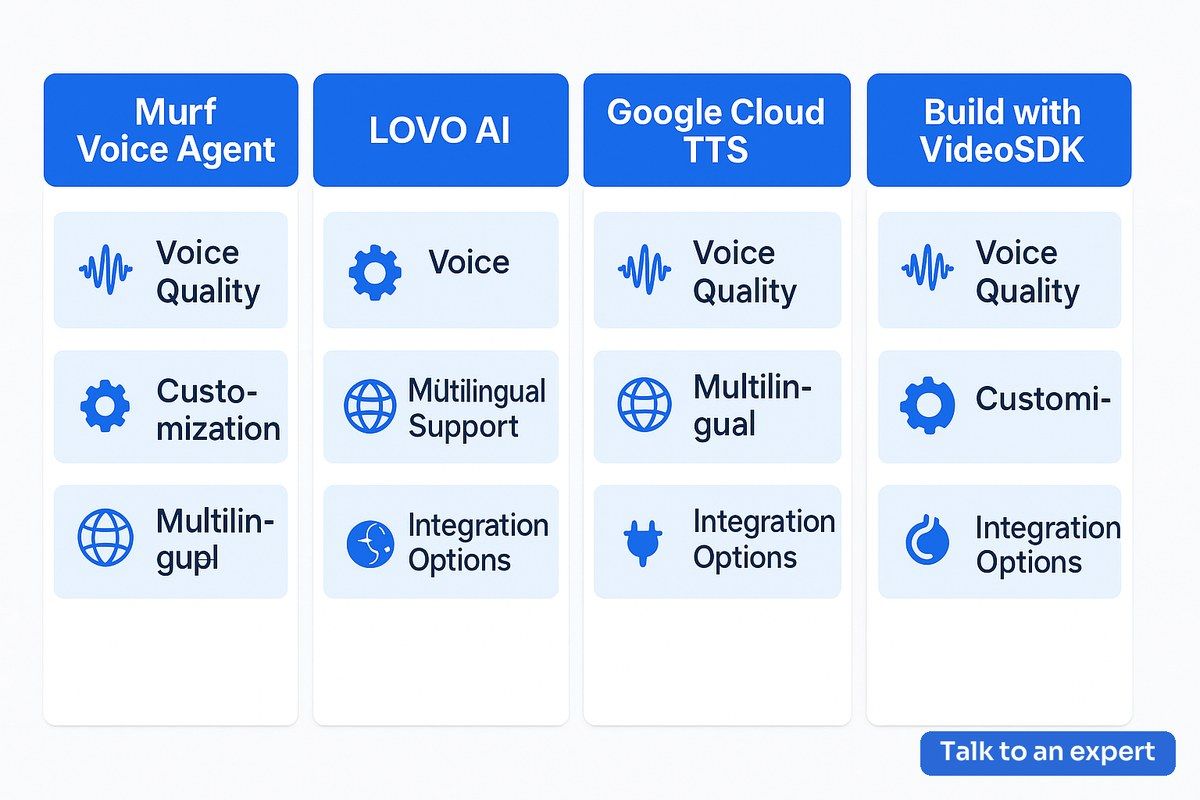
| Feature | Murf | LOVO AI | Google Cloud Text-to-Speech | Amazon Polly |
|---|---|---|---|---|
| Text-to-Speech | Yes | Yes | Yes | Yes |
| Voice Cloning | Yes (limited) | Yes | No | No |
| Multilingual Support | Yes | Yes | Yes | Yes |
| Pricing Model | Subscription | Pay-as-you-go | Pay-as-you-go | Pay-as-you-go |
| Unique Selling Point | Diverse Voice Options | Realistic Voices | Integration with Google | AWS Integration |
This table highlights the primary features and differentiators of each platform. Murf and LOVO AI both offer voice cloning, but LOVO AI is often noted for its more lifelike voices. Google Cloud Text-to-Speech and Amazon Polly excel in integration and scalability, making them suitable for enterprises with existing cloud infrastructure. Pricing models vary, with Murf using a subscription approach and others offering pay-as-you-go flexibility, which can impact total cost of ownership depending on usage patterns.
LOVO AI's hyper-realistic voices are powered by advanced neural network models, which capture subtle nuances in speech and emotion. This makes it a popular choice for creative industries, such as media production and advertising. Google Cloud Text-to-Speech, on the other hand, is favored by developers for its robust API and seamless integration with other Google services. Amazon Polly's strength lies in its scalability and support for a wide range of languages, making it ideal for global enterprises.
When comparing murf voice agent review and alternatives, it is important to consider not just technical features but also the overall ecosystem and community support. Platforms with active user communities often provide faster access to troubleshooting resources, best practices, and third-party integrations. Additionally, some providers offer dedicated account management and onboarding services, which can accelerate time-to-value for new deployments.
Practical Use Cases and Success Stories
AI voice agents are delivering measurable value across industries. In e-learning, Murf and its alternatives enable the creation of interactive, accessible voice content that improves learner engagement and retention. Marketing teams use AI voice agents to craft personalized audio campaigns that connect with audiences on a deeper level. In customer service, businesses deploy voice agents to automate routine inquiries, freeing human agents for complex tasks and ensuring 24/7 support. For example, a global retail brand leveraged Google Cloud Text-to-Speech to localize customer support in over 20 languages, resulting in higher customer satisfaction scores. Understanding AI voice Agent Sessions is essential for tracking and optimizing these interactions, ensuring both operational efficiency and a superior customer experience.
Healthcare organizations are also adopting AI voice assistants to improve patient engagement and streamline administrative workflows. Automated voice reminders for appointments, medication adherence, and post-discharge instructions help reduce no-shows and improve health outcomes. In the financial sector, voice AI assistants are being used to authenticate users, provide account information, and deliver personalized financial advice. These applications demonstrate the versatility of voice agent review alternatives across different verticals.
Another compelling use case is in the travel and hospitality industry. AI voice agents can handle booking inquiries, provide real-time updates on flight status, and answer frequently asked questions. This not only enhances the customer experience but also reduces the workload on human agents during peak periods. Retailers are leveraging voice AI to power interactive kiosks and virtual shopping assistants, creating engaging in-store experiences and driving sales.
Success stories from organizations that have implemented murf voice agent review and alternatives consistently highlight improvements in efficiency, customer satisfaction, and scalability. By automating repetitive tasks and enabling personalized interactions, businesses can focus resources on higher-value activities and drive innovation across their operations.
Why Consider Building Your Own Solution with VideoSDK
While off-the-shelf solutions like Murf, LOVO AI, and Amazon Polly are powerful, some organizations require deeper customization or unique integrations. Building a custom voice agent with VideoSDK allows businesses to tailor every aspect of the solution, from voice characteristics to backend workflows. This approach maximizes flexibility and can deliver a strong return on investment, especially for companies with specialized requirements or proprietary data. VideoSDK's AI voice Agent deployment tools streamline the development process, reducing time-to-market and minimizing technical risk. By building your own solution, you gain full control over data privacy, compliance, and feature roadmap, which is increasingly important in regulated industries. Custom solutions also allow for innovative features that may not be available in commercial products, positioning your business at the forefront of AI-driven communication. In practice, murf voice agent review and alternatives works best when integrated with existing CRM, telephony, and support tools.
Developers using VideoSDK can leverage a wide range of APIs and SDKs to create highly customized voice experiences. This includes integrating with existing CRM systems, analytics platforms, and security tools to ensure seamless operation across the business. VideoSDK supports real-time monitoring and observability, enabling teams to track performance, identify issues, and optimize workflows on the fly. For organizations with unique branding or compliance needs, building a custom solution ensures that every aspect of the voice agent aligns with corporate standards and regulatory requirements.
Another advantage of building with VideoSDK is the ability to future-proof your investment. As AI voice technology continues to evolve, having a custom-built platform allows you to quickly adopt new features, integrate with emerging tools, and stay ahead of industry trends. This agility is particularly valuable for businesses operating in dynamic markets or facing rapidly changing customer expectations. By investing in a custom solution, you position your organization to capitalize on the full potential of AI voice agents, driving long-term growth and competitive advantage.
Conclusion
Choosing the right AI voice agent is a strategic decision that impacts customer experience, operational efficiency, and long-term innovation. This murf voice agent review and alternatives guide demonstrates that while Murf offers a robust and user-friendly platform, alternatives like LOVO AI, Google Cloud Text-to-Speech, and Amazon Polly each present unique advantages. For organizations seeking maximum flexibility and differentiation, building a custom solution with VideoSDK is a forward-thinking option. To ensure your AI voice agent delivers consistent quality and reliability, leverage AI voice Agent tracing and observability for ongoing optimization. In 2026, the right choice will depend on your business goals, technical requirements, and appetite for innovation.
By carefully evaluating the murf voice agent review and alternatives, you can select a solution that aligns with your organization's vision and delivers measurable value. Whether you choose an out-of-the-box platform or invest in a custom build, the future of business communication will be shaped by AI voice agents that are intelligent, adaptable, and deeply integrated into your operations.
FAQ