


Introduction
Selecting the right technology stack is a pivotal decision for any business aiming to stay competitive in 2026. For organizations evaluating Decagon, understanding Decagon alternatives and review insights is essential to ensure your investment delivers the best ROI, scalability, and flexibility. This article is designed for CTOs, product managers, and decision-makers seeking a comprehensive look at how Decagon compares to other leading platforms, including VideoSDK, and when it makes sense to consider switching or building with alternatives.
Decagon is recognized for its robust development tools and support, but many businesses are now exploring Decagon alternatives and review findings to find platforms that offer greater customization, cost-efficiency, and integration flexibility. VideoSDK, in particular, is emerging as a top contender for forward-thinking teams.
In summary, Decagon provides reliable, scalable solutions, but alternatives like VideoSDK offer enhanced customization, cost savings, and seamless integration, making them attractive for businesses aiming for innovation and agility in 2026.
What is Decagon?
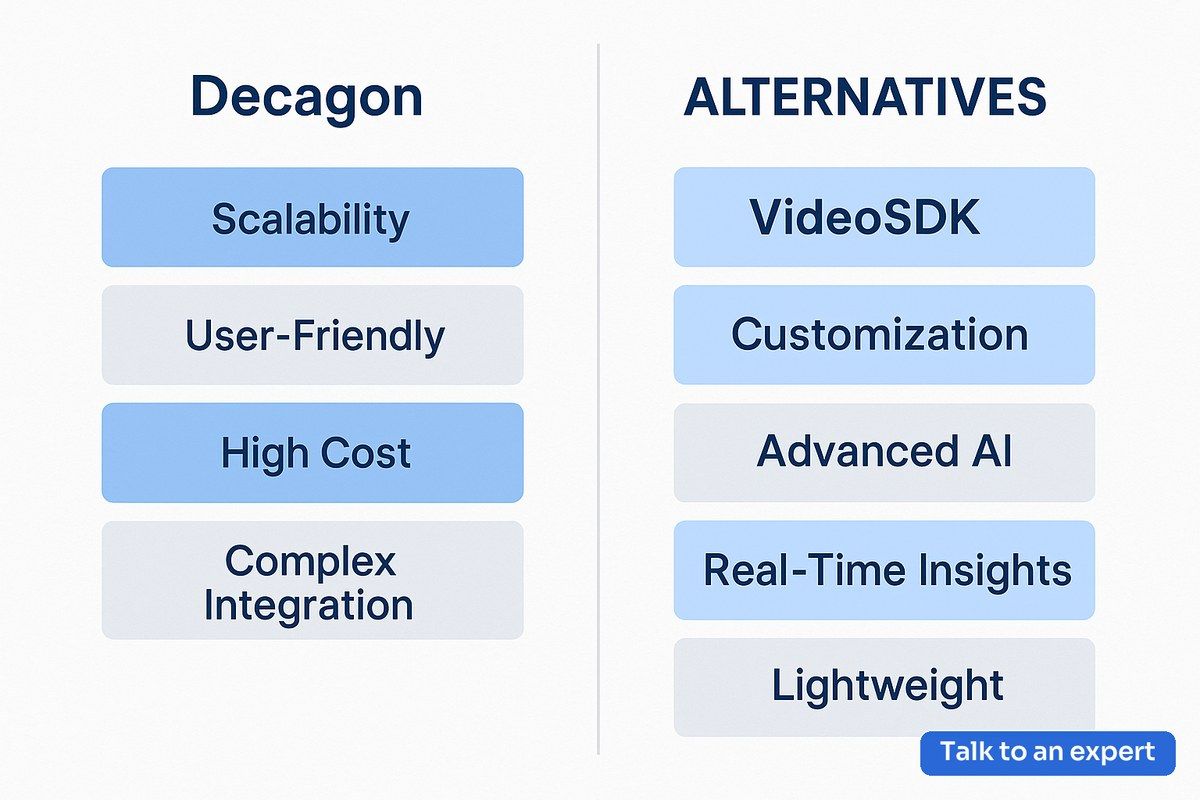
Decagon is a leading technology platform that delivers a suite of developer tools aimed at streamlining software development and digital transformation. Its core offerings span multiple industries, including software development, digital media, and education technology. Decagon is praised for its scalability, comprehensive technical support, and intuitive user interface, making it a dependable choice for many organizations. However, as digital demands evolve, some users report challenges with high costs, limited customization, and integration complexity, prompting them to research Decagon alternatives and review competitor offerings.
Industry Applications
Decagon's suite is implemented across various sectors. In software development, its frameworks accelerate coding and deployment cycles, while in digital media, Decagon helps manage large-scale data and content delivery. Education technology companies leverage Decagon to power interactive, scalable e-learning platforms that support thousands of concurrent users.
Real-World Examples
A prominent e-learning provider used Decagon to scale their virtual classroom infrastructure, successfully supporting thousands of simultaneous users during peak exam sessions. However, the integration required significant technical resources and time, leading the company to evaluate Decagon alternatives and review options like VideoSDK for future projects, where rapid deployment and customization were critical.
Key Features and Capabilities
Decagon stands out for its ability to handle large-scale projects and simplify complex development workflows. Its user-friendly interface and extensive support resources are designed to empower development teams and reduce onboarding friction.
- Scalability: Built for enterprise-grade projects, Decagon ensures reliability under heavy workloads.
- User-Friendly Interface: Developers benefit from intuitive tools and clear documentation.
- Comprehensive Support: Users have access to technical assistance, knowledge bases, and community forums.
Despite these strengths, some organizations find Decagon's cost structure and customization options limiting, motivating them to explore Decagon alternatives and review competitive platforms.
Integration Challenges
Integrating Decagon with existing systems can be complex and resource-intensive. The process often requires specialized expertise and may extend project timelines, particularly in environments with legacy infrastructure or unique business requirements. This complexity can drive up costs and delay time-to-market, factors that weigh heavily for businesses considering Decagon alternatives and review reports from industry peers.
Implementation Insights
To mitigate integration challenges, teams should allocate budget and time for training, technical onboarding, and potential third-party integration tools. Collaborating with experienced partners or leveraging external consulting can streamline the process, though this may add to the overall investment. For some, these hurdles are a catalyst to seek more agile solutions like VideoSDK, which are designed for rapid integration and customization.
Pros and Cons
Pros:
- Robust scalability for enterprise workloads
- Comprehensive technical support and resources
- Intuitive, user-friendly interface
Cons:
- High total cost of ownership
- Limited flexibility for deep customization
- Integration can be complex and time-consuming
Cost Analysis
Decagon's pricing model is often cited as a barrier for startups and small to mid-sized businesses. While it delivers enterprise-grade features, the lack of modular pricing or pay-as-you-go options can make it less accessible for organizations with constrained budgets. This is a key reason why many businesses look for Decagon alternatives and review the cost benefits of competitors like VideoSDK, which offer more transparent and flexible pricing structures.
Cost-Saving Strategies
To optimize costs with Decagon, businesses can negotiate volume licensing or long-term contracts, which may yield discounts. Another approach is to audit feature usage regularly and select a package that aligns closely with core business needs, avoiding unnecessary add-ons. However, for many, switching to a more cost-effective alternative is the preferred strategy, as highlighted in multiple Decagon alternatives and review case studies.
Top Alternatives
For organizations seeking more flexibility, lower costs, or advanced AI capabilities, several Decagon alternatives and review options stand out in 2026:
- Cari AI: Renowned for advanced AI and machine learning integration, with seamless deployment.
- Satisfaction.AI: Excels in customer support analytics and real-time insights.
- LIA: Focuses on lightweight, user-centric applications with high customization.
- VideoSDK: Offers unparalleled flexibility, rapid integration, and a modular approach for building custom voice and video AI solutions.
Detailed Comparison
- Cari AI: Delivers a robust AI development framework, ideal for data-driven enterprises seeking to embed machine learning into workflows. Its integration is straightforward, reducing deployment time and costs. Google Cloud Research highlights the growing importance of AI frameworks in modern tech stacks.
- Satisfaction.AI: Provides an intuitive dashboard and actionable analytics, empowering businesses to elevate customer satisfaction. Real-time data and reporting tools are especially valuable for customer-centric industries.
- LIA: Prioritizes user experience with a lightweight, responsive design, making it perfect for mobile-first applications and environments where performance is critical.
- VideoSDK: Stands out for its developer-first approach, enabling teams to build highly customized voice and video applications. Its modular plugins and open architecture allow for seamless integration with existing systems, making it a top choice for teams prioritizing agility and innovation. NVIDIA AI Resources and Gartner both emphasize the value of customizable, scalable platforms in the evolving tech landscape.
In-Depth Analysis
- Cari AI: Integrates advanced machine learning models and natural language processing, enabling predictive analytics and automation. Its rapid deployment capabilities reduce project lead times, making it attractive for fast-paced industries.
- Satisfaction.AI: Features robust customer support tools, including sentiment analysis and automated ticket routing, that help businesses deliver superior client experiences.
- LIA: With a focus on UX, LIA supports rapid prototyping and iteration, allowing teams to quickly adapt to user feedback and market changes.
- VideoSDK: Empowers developers to create bespoke solutions with plug-and-play modules for video, voice, and AI. Its extensive documentation and active community accelerate implementation and troubleshooting.
Comparison Table
| Feature | Decagon | Cari AI | Satisfaction AI | LIA |
|---|---|---|---|---|
| AI Integration | Yes | Yes | No | Yes |
| Customization | Limited | High | Moderate | High |
| Cost Efficiency | Moderate | High | Moderate | Low |
| User Experience | Good | Excellent | Good | Excellent |
When to Choose Decagon vs Building with VideoSDK
Deciding between Decagon and building with VideoSDK depends on your organization's priorities. Decagon is suitable for teams seeking a proven, all-in-one platform with robust support and established workflows. However, if your business values customization, rapid integration, and cost efficiency, Decagon alternatives and review findings suggest that VideoSDK is a superior choice. VideoSDK's modular architecture and developer-centric approach make it ideal for projects where flexibility and innovation are paramount.
Use Cases for VideoSDK
VideoSDK is particularly well-suited for projects that demand tailored solutions and seamless integration with existing systems. For example, in healthcare, VideoSDK enables the creation of secure, regulatory-compliant telemedicine platforms. In education, it powers interactive virtual classrooms with real-time collaboration tools, supporting dynamic, engaging learning experiences. VideoSDK's versatility extends to industries such as finance and events, where secure, high-quality video and voice communication are essential.
Industry-Specific Applications
- Healthcare: Enables HIPAA-compliant telehealth solutions with secure video and voice.
- Education: Facilitates real-time, interactive online learning environments.
- Finance: Supports secure video KYC (Know Your Customer) and remote advisory services.
- Events: Powers large-scale virtual events with high engagement and reliability.
Implementation Considerations for Teams Building Voice AI
For teams building voice AI solutions, VideoSDK offers a comprehensive toolkit that accelerates development and enhances user engagement. The Voice Agent Quick Start Guide provides step-by-step instructions for rapid onboarding. VideoSDK's plugin ecosystem supports advanced features such as:
- ElevenLabs TTS Plugin for natural-sounding text-to-speech.
- Google TTS Plugin for scalable speech synthesis.
- Sarvam AI TTS Plugin and Amazon Polly TTS Plugin for diverse voice options.
- Speechify TTS Plugin and Deepgram STT Plugin for advanced speech processing.
Organizations adopting VideoSDK have reported improved efficiency, reduced development costs, and faster time-to-market. As highlighted by Microsoft Research, leveraging modular, API-driven platforms is key to accelerating AI-driven innovation.
Workflow Integration
Integrating VideoSDK into existing workflows is straightforward, thanks to its open architecture and extensive documentation. Teams can quickly embed video and voice features into current systems, minimizing disruption and maximizing productivity. This ease of integration is a recurring theme in Decagon alternatives and review discussions among industry leaders.
Best Practices
To ensure a successful implementation, teams should invest in comprehensive training and leverage VideoSDK's active community forums for support. Regularly updating your deployment and maintaining open feedback channels with the VideoSDK team can help align your solution with the latest advancements in voice and video AI.
Conclusion
As businesses navigate the evolving technology landscape, evaluating Decagon alternatives and review insights is essential for making informed decisions. In 2026, VideoSDK stands out as a leading alternative, offering unmatched flexibility, cost efficiency, and rapid integration for teams building next-generation digital solutions. Organizations seeking innovation, scalability, and a future-ready tech stack should prioritize VideoSDK when considering their options.
For deeper technical insights and practical guides, explore VideoSDK's documentation and AI agents to discover how these solutions can transform your projects.
FAQ