


Introduction
WebRTC has revolutionized real-time communication by enabling peer-to-peer audio, video, and data sharing directly within web browsers and mobile applications. However, opening direct channels between peers across untrusted networks introduces significant attack surfaces. WebRTC Security is not an optional add-on; it is a foundational requirement mandated by the IETF and W3C standards. In 2026, as real-time communication becomes increasingly embedded in critical infrastructure from telehealth to financial services understanding and implementing robust WebRTC security best practices is essential for every developer. This guide explores the WebRTC security architecture, threat models, and practical implementation strategies to ensure your real-time communication applications remain secure and private.
The WebRTC Threat Model
The browser threat model for WebRTC is unique because it bridges the gap between local device access and public internet exposure. Browsers enforce the same-origin policy, but WebRTC requires cross-origin communication to establish peer connections. When a web application requests access to local resources like cameras and microphones via
getUserMedia, the browser acts as the trust broker, prompting the user for explicit consent. However, once media streams are flowing, they traverse complex network paths involving signaling servers, STUN/TURN servers, and the remote peer. Attackers can exploit vulnerabilities at any of these junctions. Common WebRTC security threats include signaling server compromise, man-in-the-middle (MITM) attacks during the ICE process, and IP location leakage through candidate gathering.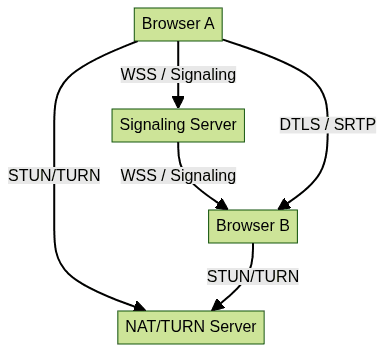
Core Security Mechanisms
DTLS Handshake and Media Encryption
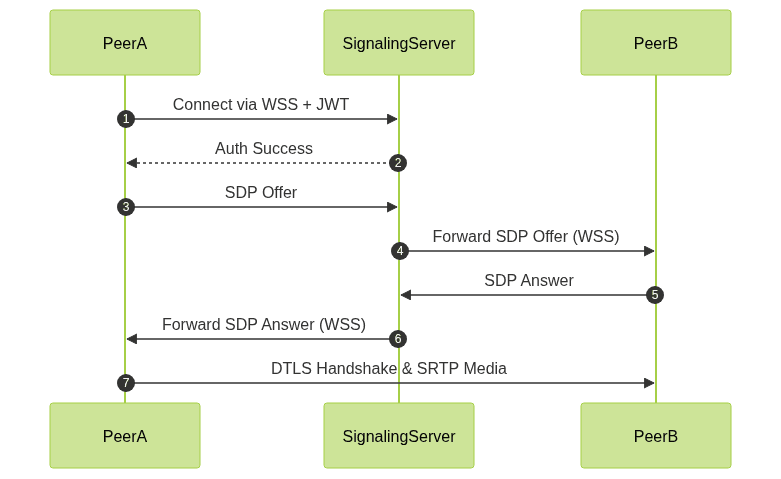
WebRTC mandates encryption for all media and data streams. The Datagram Transport Layer Security (DTLS) handshake is the cornerstone of WebRTC encryption. During the connection setup, peers exchange certificates within the SDP offer and answer. DTLS is then used to negotiate session keys, which are subsequently used to encrypt media packets via Secure Real-time Transport Protocol (SRTP). This ensures that even if packets are intercepted, they cannot be decrypted without the DTLS-derived keys.
1const configuration = {
2  iceServers: [
3    { urls: 'stun:stun.l.google.com:19302' }
4  ],
5  // Enforce DTLS key agreement for SRTP
6  bundlePolicy: 'max-bundle',
7  // Modern browsers enable this by default, but it's good to be explicit
8  // rtcpMuxPolicy: 'require'
9};
10const peerConnection = new RTCPeerConnection(configuration);
For a more streamlined approach, developers can leverage a dedicated javascript video and audio calling sdk that abstracts away much of the complexity.
ICE Candidate Verification
Interactive Connectivity Establishment (ICE) is responsible for finding the best network path between peers. It gathers candidates from local interfaces, STUN servers, and TURN relays. While ICE itself doesn't encrypt data, securing the candidate gathering process is a critical WebRTC security consideration. TURN servers should always require authentication using long-term credentials to prevent open relays. Furthermore, developers should validate ICE candidates to prevent IP spoofing or routing attacks.
1const iceServers = [
2  {
3    urls: 'turn:turn.example.com:3478',
4    username: 'user-2026',
5    credential: 'secure-credential-hash',
6    credentialType: 'password'
7  }
8];
9
10const pc = new RTCPeerConnection({ iceServers: iceServers });
11
12pc.onicecandidate = event => {
13  if (event.candidate) {
14    // Verify candidate type and IP before sending over signaling
15    console.log('ICE Candidate:', event.candidate.candidate);
16  }
17};
For mobile developers, integrating flutter webrtc can simplify the implementation of these security mechanisms. Similarly, Android developers can use webrtc android libraries to ensure secure peer connections.
Signaling Security
WebRTC does not standardize the signaling protocol, leaving developers to implement it via WebSockets, HTTP, or other mechanisms. This flexibility makes signaling security paramount. All signaling traffic must be encrypted using WSS (WebSocket Secure) or HTTPS to prevent eavesdropping and tampering. Furthermore, signaling messages containing SDP offers and ICE candidates must be authenticated. Implementing short-lived, signed authentication tokens (e.g., JWT) ensures that only authorized users can initiate or join sessions. Always validate tokens on the server side before relaying SDP payloads. React developers can leverage a react video and audio calling sdk that handles signaling securely out of the box. Python developers can use a python video and audio calling sdk for server-side signaling and security logic.
SDP Identity and Consent Verification
To mitigate MITM attacks, WebRTC includes mechanisms for identity verification and consent. The SDP identity attribute allows peers to assert their identity via a third-party Identity Provider (IdP). While not widely adopted in custom implementations, it is a crucial part of the WebRTC security RFC. For simpler implementations, Short Authentication Strings (SAS) can be compared out-of-band by users to verify key continuity. Consent freshness is another critical aspect; browsers ensure that the user is actively aware of ongoing media sharing. Developers must handle permission revocation gracefully. For React Native apps, a react native video and audio calling sdk can manage identity verification seamlessly.
1async function startMedia() {
2  try {
3    const stream = await navigator.mediaDevices.getUserMedia({
4      video: true,
5      audio: true
6    });
7    // Handle successful permission grant
8    const videoElement = document.querySelector('video');
9    videoElement.srcObject = stream;
10  } catch (error) {
11    if (error.name === 'NotAllowedError') {
12      console.error('User denied media access. Consent verification failed.');
13    } else if (error.name === 'NotFoundError') {
14      console.error('Media devices not found.');
15    }
16  }
17}
End-to-End Encryption (E2EE) in WebRTC
While DTLS and SRTP provide point-to-point encryption, they do not protect media if it traverses a media server (e.g., an SFU) that decrypts and re-encrypts streams. For applications requiring strict confidentiality, such as telehealth or legal consultations, End-to-End Encryption (E2EE) is necessary. In 2026, the standard approach for WebRTC E2EE utilizes Insertable Streams, allowing developers to encrypt media frames before they hit the RTP packetizer. Libraries like libsodium can be used to manage E2EE keys independently of the WebRTC engine. Use E2EE when media servers are untrusted or when regulatory compliance demands it; otherwise, DTLS-only might suffice for peer-to-peer calls. Flutter developers can use the flutter video and audio calling api to implement E2EE with ease.
Privacy Considerations
WebRTC security is inextricably linked to privacy. One of the most notorious WebRTC privacy issues is IP location leakage. By default, ICE gathers host candidates, exposing local IP addresses to the remote peer and potentially to malicious scripts. To mitigate this, modern browsers use mDNS (Multicast DNS) candidates to obfuscate local IPs. Additionally, routing all traffic through a TURN relay can hide the user's public IP from the peer, though this increases server costs. Developers must also be wary of browser fingerprinting via media device enumeration and should only request media tracks when absolutely necessary. Flutter developers can use the flutter video and audio calling api to implement privacy-preserving features like mDNS.
Security Testing and Auditing
A comprehensive WebRTC security checklist must include rigorous testing and auditing. Developers should utilize tools like OWASP ZAP to test signaling endpoints for vulnerabilities like Cross-Site WebSocket Hijacking (CSWSH). Browser built-in tools like
chrome://webrtc-internals are invaluable for inspecting DTLS handshakes, ICE candidate gathering, and SRTP encryption status. Automated fuzzing of the signaling server and SDP parsing logic can uncover edge-case vulnerabilities. Regularly audit your TURN server configurations to ensure they are not being abused as open proxies. Android developers should test their implementations using an android video and audio calling sdk that includes built-in security audits.Conclusion
Securing real-time communication applications requires a multi-layered approach. From the initial DTLS handshake and ICE candidate verification to robust signaling security and strict consent protocols, every component must be fortified. As we move through 2026, implementing WebRTC security best practices is not just about preventing data breaches; it is about building trust with your users. By adhering to the WebRTC security architecture and standards outlined in this guide, developers can build resilient, secure video calling and real-time communication platforms that protect both data and privacy. For quick integration, consider using an embed video calling sdk that provides pre-built secure components.
Free $20 Balance for AI Voice Agents & Video Calls
FAQ