


A voice over IP service provider delivers phone service over the internet instead of legacy copper lines, cutting call costs by 40 to 60 percent while adding features like AI transcription, CRM integration, and virtual numbers in dozens of countries. The right provider depends on your budget, call volume, security needs, and global footprint. This guide compares the top five providers for 2026 and gives you a decision framework to choose one. If you also need embedded real-time voice or video in your own app, VideoSDK's audio calling SDK covers that side of the stack.
Businesses are dropping legacy PSTN lines faster than ever. Rising international calling costs, remote work, and the demand for AI-powered call intelligence have pushed voice over IP service providers from a cost-saving niche to the default choice for business telephony. Regulators in several countries are also winding down copper networks, which means the migration question is no longer if, but when.
By the end of this article you will know how voice over IP service providers actually work, which criteria matter when comparing them, how the top five vendors stack up, and how to plan a rollout that avoids the mistakes that sink most migrations.
What Is a Voice Over IP Service Provider?
A voice over IP service provider is a company that delivers telephone service by converting voice into digital packets and routing them over the internet or a private IP network, rather than through traditional circuit-switched phone lines. The provider handles the signaling, media transport, and phone number management so your business does not have to operate its own telephony infrastructure.
Voice over IP works by sampling your voice, compressing it into packets, and sending those packets to the recipient using the Session Initiation Protocol (SIP) for signaling and the Real-time Transport Protocol (RTP) for the media stream. SIP sets up, modifies, and tears down the call, while RTP carries the actual audio. RTCP runs alongside RTP and reports on quality metrics like packet loss and jitter.
For businesses, this architecture matters because it decouples your phone service from physical lines. A cloud PBX or hosted phone system can be managed from a dashboard, extended with APIs, and scaled up or down in minutes. Providers like VideoSDK also expose this real-time voice layer to developers, so teams building custom products can embed the same low-latency audio into their own applications.
Key Evaluation Criteria for Selecting a Voice Over IP Service Provider
Choosing among voice over IP service providers comes down to six criteria. Weight them against your actual call patterns, not vendor marketing.
Pricing and Billing Models
Providers charge per user per month, per minute, or via unlimited-use plans. Per-user suits offices with steady usage, per-minute suits low-volume or international-heavy callers, and unlimited plans hide their value in the fine print. Always ask about setup fees, number rental, and early termination charges before signing.
Call Quality and Reliability
Quality is measured in latency, jitter, and packet loss. Aim for latency under 150 milliseconds one-way, jitter under 30 milliseconds, and packet loss below one percent. Check the provider's uptime SLA, and prefer providers that publish a public status page with historical uptime data.
Core Features
Baseline features include call routing, IVR menus, voicemail-to-email, and call recording. In 2026, real-time and post-call AI transcription has become table stakes. Providers that bundle call analytics and conversation summaries save you from buying a separate speech analytics tool.
Security and Compliance
Look for TLS for signaling and SRTP for media encryption, plus end-to-end encryption options for sensitive industries. Confirm GDPR compliance if you handle EU callers, and FCC compliance including E911 support and STIR/SHAKEN caller ID authentication for US traffic.
Integration Capabilities
Your phone system should live inside your workflow, not beside it. Native integrations with Salesforce, HubSpot, Zendesk, Microsoft Teams, and Slack cut context switching. For engineering teams, API access and webhooks matter more than prebuilt connectors, because they let you build custom call flows.
Global Coverage and Number Portability
If you sell internationally, check which countries the provider offers virtual numbers in, what international calling rates look like, and how the number porting process works. A botched port can leave you unreachable for days, so ask for their port-in timeline in writing.
Market Overview of Voice Over IP Service Providers
The business VoIP market has grown into a mature, crowded category. Analysts consistently project double-digit annual growth through the decade, driven by the PSTN sunset, remote work, and the convergence of voice with unified communications (UCaaS) platforms. The lines between a phone provider, a contact center platform, and a collaboration suite have blurred, and most major vendors now sell bundles that mix all three.
The competitive landscape splits into a few tiers. Enterprise players like RingCentral, 8x8, and Vonage sell broad UCaaS suites with global reach. AI-first challengers like Dialpad differentiate on built-in intelligence. Carrier-grade SIP trunking specialists serve companies that keep their own PBX hardware. And developer-focused platforms like Twilio and VideoSDK serve teams that want to build voice directly into their products rather than buy a boxed phone system.
Consolidation is also reshaping the market. Vonage was acquired by Ericsson, and several smaller providers have merged to chase enterprise contracts. For buyers, this means checking a vendor's financial stability and product roadmap matters as much as comparing feature lists.
Top 5 Voice Over IP Service Providers for 2026
Here are five providers worth shortlisting in 2026, chosen for different buyer profiles rather than a single ranking.
FreJun
FreJun is a business VoIP and cloud telephony platform focused on click-to-call, call tracking, and CRM-driven outbound calling. Its standout feature is deep integration with CRMs like HubSpot and Zoho, automatically logging every call and recording against the right contact. Pricing sits in the mid tier, typically per-user plans with usage-based add-ons. It is ideal for sales and support teams that live inside their CRM all day.
Strengths:
- Strong CRM integration and automatic call logging
- Simple setup for small and mid-sized teams
- Good value for outbound-heavy sales workflows
Weaknesses:
- Smaller global number footprint than enterprise rivals
- Fewer advanced contact center features
Who should choose this provider? Sales-led SMBs that want calls, recordings, and CRM records connected without custom engineering.
RingCentral
RingCentral is the market leader in unified communications, combining voice, video, messaging, and contact center capabilities in one platform. Its standout feature is the breadth and polish of the all-in-one suite, backed by a strong uptime SLA and a large app marketplace. Pricing spans from affordable small-business tiers to enterprise contracts. It is ideal for companies that want one vendor for all communications.
Strengths:
- Most complete UCaaS feature set in the market
- Strong reliability record and global data centers
- Extensive third-party integrations
Weaknesses:
- Higher cost at enterprise tiers
- Complexity can overwhelm very small teams
Who should choose this provider? Mid-sized to enterprise businesses consolidating voice, video, and messaging under one vendor.
8x8
8x8 combines cloud phone service with a contact center platform and strong global coverage, offering virtual numbers in a large number of countries. Its standout feature is international reach combined with built-in compliance and analytics for regulated industries. Pricing is per-user with separate contact center tiers. It is ideal for distributed teams and global support operations.
Strengths:
- Broad international number availability
- Integrated contact center and analytics
- Solid security and compliance posture
Weaknesses:
- Interface can feel dated in places
- Contact center features add meaningful cost
Who should choose this provider? Multi-site and international businesses that need one platform across many countries.
Vonage
Vonage, now part of Ericsson, offers business VoIP alongside a well-known communications API platform. Its standout feature is flexibility: you can start with a hosted phone system and graduate to fully API-driven voice services on the same vendor. Pricing is per-user for the UCaaS product, with usage-based pricing on the API side. It is ideal for companies that expect to build custom voice workflows.
Strengths:
- Strong API platform for custom voice applications
- Flexible migration path from hosted to programmable voice
- Enterprise backing from Ericsson
Weaknesses:
- Two product families can be confusing to navigate
- Support quality varies by tier
Who should choose this provider? Product and engineering teams that want a phone system today and programmable voice tomorrow.
Dialpad
Dialpad is the AI-first entrant, with its own speech recognition engine powering real-time transcription, live call summaries, and sentiment analysis across every conversation. Its standout feature is AI that is genuinely built in rather than bolted on, including post-call highlights and coaching insights. Pricing is competitive per-user, with AI features included in most tiers. It is ideal for teams that treat calls as a data source.
Strengths:
- Best-in-class built-in AI transcription and analytics
- Clean, modern interface
- Good value for AI-heavy use cases
Weaknesses:
- Smaller global number coverage than 8x8 or RingCentral
- Contact center depth trails dedicated CCaaS vendors
Who should choose this provider? Sales and support teams that want every call transcribed, scored, and searchable.
Side-by-Side Comparison of Voice Over IP Service Providers
The table below summarizes the five providers across the criteria that matter most. Use it as a shortlist filter, then run a pilot before committing.
| Provider | Pricing Model | AI Features | CRM Integrations | Global Coverage | Best For |
|---|---|---|---|---|---|
| FreJun | Per user + usage | Call tracking, logging | HubSpot, Zoho, deep CRM sync | Moderate | CRM-driven sales teams |
| RingCentral | Per user, tiered | Transcription, summaries | Very broad marketplace | Strong | All-in-one UCaaS buyers |
| 8x8 | Per user, CC tiers | Analytics, sentiment | Broad, enterprise-grade | Strongest | Multi-site global operations |
| Vonage | Per user + API usage | Via add-ons | Broad, plus APIs | Strong | API-driven custom voice |
| Dialpad | Per user, AI included | Native, best-in-class | Good, growing | Moderate | AI-first call intelligence |
The most important row is the last one. Match the provider to your primary need, whether that is global coverage, AI depth, or API flexibility, rather than chasing the longest feature list.
Decision Flow: Choosing the Right Voice Over IP Service Providers
If you are torn between options, walk through this decision flow. It maps your budget, AI needs, and global requirements to a concrete recommendation.
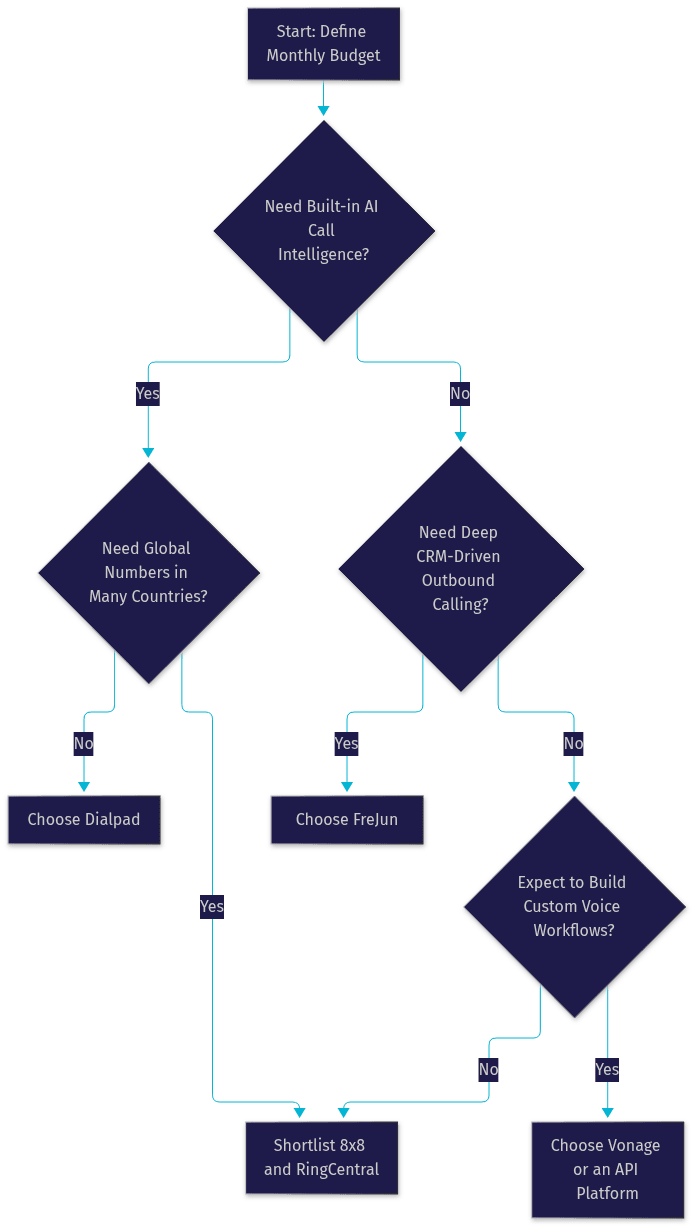
The flow is deliberately simple. Most failed VoIP purchases happen because teams optimize for features they never use while underweighting the one criterion that actually drives their daily workflow.
Implementation Considerations for Your VoIP Rollout
A successful migration from legacy PSTN to VoIP is a network project as much as a procurement project. Plan it in stages.
First, audit your network bandwidth. Each concurrent VoIP call consumes roughly 100 kilobits per second with a modern codec, so size your uplink for peak concurrent calls plus existing traffic, and enable quality of service rules that prioritize voice packets over bulk traffic.
Second, handle credentials and trunk setup deliberately. Your provider will issue SIP credentials or a SIP trunk endpoint after you provision the service. Configure your firewall to allow the signaling and media ports the provider documents, and set up DNS so your trunk endpoint resolves reliably. Never expose your PBX directly to the open internet without TLS signaling and SRTP media encryption enabled.
Third, pilot before you cut over. Run a small group of users for two to four weeks, measure latency, jitter, and packet loss from inside your network, and fix QoS issues while the stakes are low. Then port your numbers, train staff on the new features, and set up ongoing monitoring with alerts on call quality degradation. Teams building custom voice experiences can pilot the same way using VideoSDK's real-time audio SDK, which includes built-in noise suppression and network-adaptive streaming.
Common Pitfalls and How to Avoid Them
Four mistakes account for most painful VoIP migrations.
Overlooking hidden fees. Number rental, setup charges, per-minute international rates, and early termination fees can double a quoted price. Ask for a fully itemized first invoice estimate in writing.
Ignoring network latency. VoIP quality dies on congested or misconfigured networks. Measure latency and jitter before rollout, and prioritize voice traffic with QoS rules on your router or switch.
Inadequate security settings. Running SIP trunks without TLS and SRTP invites toll fraud, which can cost thousands in a weekend. Enable encryption, use strong credentials, and restrict trunk access by IP where possible.
Failing to port numbers correctly. Porting requires accurate account details from your current carrier, and mismatches cause rejections that delay the port by weeks. Gather your current bills, confirm the porting authority details, and never cancel service before the port completes.
Future Trends in Voice Over IP
Voice over IP service providers are converging with AI at speed. Real-time call analytics are moving from post-call reports to live coaching, where an agent sees suggested answers and sentiment warnings mid-conversation. Generative voice agents are the bigger shift: providers are wiring LLM-powered agents with speech-to-text, text-to-speech, and turn detection directly into call flows, so routine calls get handled without a human. Platforms like VideoSDK's AI voice agents already let developers build these pipelines with sub-second response times.
5G is pushing voice processing to the edge, cutting latency for mobile workers and enabling reliable voice on connections that used to drop calls. And UCaaS convergence continues: voice, video, messaging, and contact center are collapsing into single platforms, with APIs as the connective tissue. The practical takeaway is that your provider choice in 2026 should anticipate AI features you may not need yet, because in two years you probably will.
Definitions Glossary
SIP (Session Initiation Protocol): The signaling protocol that sets up, modifies, and ends voice calls over an IP network. Every modern VoIP provider uses SIP to establish calls between endpoints.
SIP Trunking: A service that connects a company's own PBX hardware to a provider's voice network over the internet, replacing physical phone lines while keeping existing equipment.
Cloud PBX: A hosted phone system where the call management software runs in the provider's cloud instead of on-premises hardware, managed through a web dashboard.
SRTP (Secure Real-time Transport Protocol): An encrypted version of RTP that protects the actual voice media of a call from interception.
UCaaS (Unified Communications as a Service): A bundled cloud offering that combines voice calling, video meetings, messaging, and sometimes contact center tools under one subscription.
Virtual Number: A phone number that is not tied to a physical line, letting a business appear local in a country or city where it has no office.
Key Takeaways
- Voice over IP service providers cut telephony costs by 40 to 60 percent while adding AI transcription, CRM integration, and global virtual numbers that legacy PSTN cannot match.
- Evaluate providers on six criteria: pricing model, call quality and SLA, core features, security and compliance, integrations, and global coverage with number portability.
- Match the provider to your primary need: RingCentral for all-in-one UCaaS, 8x8 for global multi-site operations, Dialpad for AI-first intelligence, FreJun for CRM-driven sales, and Vonage for API-driven custom voice.
- A successful rollout requires a network bandwidth audit, a small pilot group, TLS and SRTP encryption, and a carefully managed number port.
- If you are building voice into your own product rather than buying a phone system, developer platforms like VideoSDK's audio calling SDK offer real-time voice with built-in noise suppression and network-adaptive streaming.
Conclusion
Choosing among voice over IP service providers in 2026 is less about finding the best vendor and more about finding the right fit for your call patterns, budget, and roadmap. Use the six evaluation criteria, run the decision flow, pilot with a small group, and port your numbers carefully. And if your roadmap includes building voice directly into your own application, explore VideoSDK's real-time communication SDKs and the AI voice agent platform, or grab the free tier at app.videosdk.live to test it yourself. What are you building with voice? Drop a comment, I'd love to hear which VoIP use case you are working on.
Conclusion: Making the Right Choice for Your Needs
Choosing the right voice over IP service provider is a critical decision that can significantly impact your communication infrastructure and business operations. By carefully considering your specific needs, evaluating different providers, and understanding the key features and security considerations, you can make an informed choice that sets you up for success.
Free $20 Balance for AI Voice Agents & Video Calls
FAQ