



Ooma pricing follows a two-part model: a one-time hardware purchase plus recurring monthly service fees. Home service starts with a free Basic plan (you only pay monthly taxes and regulatory fees, typically a few dollars), while the Premier home plan costs $9.99 per month plus taxes. Business plans under Ooma Office run from roughly $19.95 to $29.95 per user per month across three tiers. Understanding how taxes, add-ons, and hardware stack up is the key to predicting your real monthly bill before you commit.
Cutting the cord on a traditional landline usually means one of two things: a mobile-only household or a VoIP service. For the millions of homes and small businesses that still want a reliable phone number, Ooma has become one of the most searched names in the space, and for good reason. Its entry-level home service is advertised as free, which immediately raises a practical question: what does it actually cost each month?
The honest answer is that Ooma pricing is layered. There is the upfront device cost, the base subscription, the taxes and regulatory fees that vary by ZIP code, and the optional add-ons that quietly change your total. Budget-conscious households and small businesses comparing VoIP options need the full picture, not just the headline number on the pricing page.
This guide breaks down every layer of Ooma pricing in 2026: home plans, business tiers, hardware, taxes, add-ons, and how it all compares to competitors like RingCentral, Vonage, and Google Voice. By the end, you will be able to estimate your own monthly cost with reasonable confidence.
Understanding Ooma Pricing Structure
Ooma pricing is built on a two-part model that separates one-time hardware costs from recurring service fees. This structure is what makes Ooma different from most subscription-only VoIP providers: you buy the device outright, and in return the ongoing service cost stays low, sometimes zero.
The upfront purchase is the barrier to entry. The recurring fees are what you live with for years. Getting both right matters, because a cheap plan paired with expensive hardware can cost more in year one than a pricier plan with free equipment, and vice versa.
Here is how the overall cost flow fits together for a typical Ooma setup:
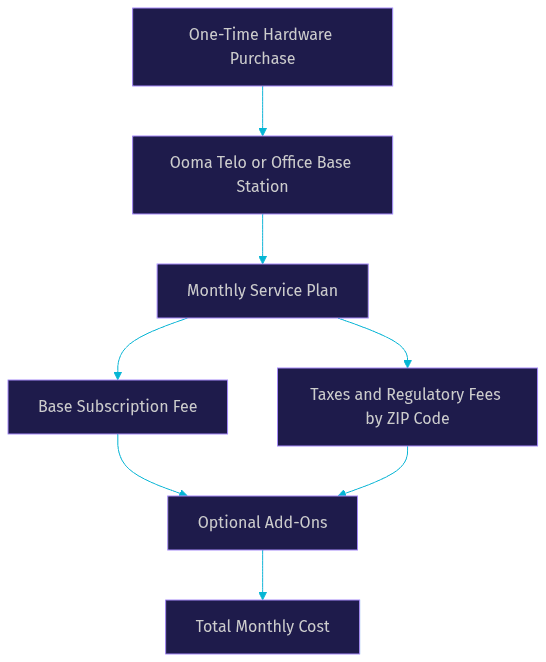
The diagram above shows the two cost streams every Ooma customer manages. The one-time stream ends after purchase; the recurring stream continues for the life of the service.
Device Costs and One-Time Fees
Ooma's home service revolves around the Ooma Telo, a small base station that connects your internet router to your existing phones. The Telo typically retails in the range of $99 to $129, though Ooma frequently runs promotional discounts that bring it closer to $70 to $100, especially during holiday sales or when bundled with a Premier subscription.
Optional home hardware adds to the upfront total. The Ooma HD3 wireless handset generally sells for around $60 to $70 each. The Ooma Linx, a small device that lets you place a phone jack in any room without running new wiring, usually costs around $30 to $40. An LTE adapter for cellular backup during internet outages adds roughly $30 to $50 plus a small monthly connectivity fee. None of these accessories are required; the Telo alone is enough for basic service.
For business customers, Ooma Office requires its own base station, typically priced around $60 to $100 depending on the current promotion, plus optional IP desk phones that range from about $60 to $200 per unit depending on model.
Monthly Service Fees Overview
Ooma's recurring fees fall into three buckets: home service, business service, and the taxes and fees layered on top of both.
On the home side, the Basic plan carries no subscription charge at all. You pay only monthly taxes and regulatory fees, which Ooma estimates at roughly $3 to $6 per month depending on your location. The Premier home plan costs $9.99 per month plus those same taxes and fees, bringing the realistic total to roughly $13 to $16 per month.
On the business side, Ooma Office offers three tiers, Essentials, Pro, and Pro Plus, priced per user per month. Taxes and fees apply to business plans as well and vary by state and locality, which is why two businesses in different states can pay noticeably different totals for identical plans.
Ooma Home Plans: Basic vs Premier
Ooma's home service splits into two plans, and the pricing gap between them is the single biggest decision most households face. The Basic plan is genuinely free of subscription charges, while Premier costs $9.99 per month plus taxes. Whether that $9.99 is worth it depends entirely on which features your household actually uses.
The Basic plan covers the fundamentals: unlimited U.S. calling, a real phone number, voicemail, and 911 service. Premier adds convenience and screening features that many landline-replacement buyers want, especially those dealing with robocalls or managing calls across multiple devices.
What's Included in the Free Basic Plan
The Basic plan includes unlimited nationwide calling within the U.S., caller ID, call waiting, voicemail with online access, a free phone number (or number porting for a one-time fee, typically around $40), and Enhanced 911 service that transmits your registered address to emergency dispatchers. You also get access to the Ooma mobile app, which lets you make and receive calls on your smartphone using your Ooma number.
For a household that just wants a cheap, reliable replacement for a landline, Basic covers nearly everything. The realistic monthly cost is only the taxes and regulatory fees, usually $3 to $6. Compared with a traditional landline at $30 to $50 per month, the savings over a year are substantial.
The catch is that Basic omits the features that make a VoIP line feel modern: robocall blocking, voicemail-to-email, a second line, and the call screening tools. Those all live behind the Premier paywall.
Premier Plan Features and Costs
Premier costs $9.99 per month plus taxes and fees, bringing the realistic total to roughly $13 to $16 per month. For that, you get a significantly deeper feature set.
The headline Premier features include advanced call blocking with a continuously updated robocall database, voicemail-to-email delivery, a virtual second phone line, call forwarding to multiple numbers, a personal blacklist and contact blocking, three-way conferencing, and the ability to screen calls before answering. Premier also includes a monthly credit toward international calling, which softens the cost for households that regularly call abroad.
International calling rates themselves are pay-as-you-go and vary by country, with calls to Canada and many European destinations among the cheaper routes. Premier subscribers get discounted per-minute rates compared with Basic users, which matters if overseas calls are a regular part of your routine.
For seniors and caregivers, Ooma has marketed bundle pricing that pairs the Telo with Premier service at a discounted combined rate, worth checking on Ooma's site before buying hardware at full price.
Ooma Office Business Pricing
Ooma Office is the business product line, and its pricing is structured per user per month across three tiers. Unlike the home product, there is no free tier; every business plan carries a subscription fee, though the entry price undercuts most full-featured business VoIP competitors.
The three tiers are Essentials, Pro, and Pro Plus. Each adds capabilities on top of the previous one, and the per-user pricing scales accordingly. Businesses should also budget for the base station and any desk phones, plus the add-on services described below.
Essentials, Pro, and Pro Plus Tiers
Ooma Office Essentials is the entry tier, typically priced around $19.95 per user per month. It includes a virtual receptionist (auto-attendant), extension dialing, a company directory, call forwarding, voicemail, conferencing, and a mobile app. For a small business that needs a professional phone presence without advanced features, Essentials is usually sufficient.
Ooma Office Pro generally runs around $24.95 per user per month. It adds video conferencing, call recording, and more advanced call management features. Businesses that need to record calls for training or compliance, or that want built-in video meetings without paying for a separate service, tend to land on Pro.
Ooma Office Pro Plus typically costs around $29.95 per user per month and layers on CRM integrations, including Salesforce and Zoho connectivity, plus enhanced analytics and desktop application support. Pro Plus is aimed at sales-driven teams that want their phone system tied into their customer records.
A quick comparison of the tiers:
| Tier | Approx. Price (per user/mo) | Key Capabilities | Best For |
|---|---|---|---|
| Essentials | $19.95 | Auto-attendant, extensions, voicemail, mobile app | Very small businesses, basic needs |
| Pro | $24.95 | Everything in Essentials plus video conferencing and call recording | Teams needing recordings and meetings |
| Pro Plus | $29.95 | Everything in Pro plus CRM integrations and analytics | Sales teams using Salesforce or Zoho |
The most important row for most buyers is Essentials: it is the tier that competes directly with entry plans from RingCentral and Vonage, and it usually comes in several dollars cheaper per user while covering the same core ground.
Add-On Services and Usage Charges
Beyond the base tiers, Ooma Office charges separately for several services. Text messaging is billed per message, with per-message rates that drop when you buy bulk messaging packages, so businesses running SMS campaigns should prepay for volume. Additional phone numbers beyond your included ones carry a small monthly fee each. Directory assistance calls are billed per use.
Other usage-based charges include international calling at published per-minute rates by country, and number porting fees when you transfer existing business numbers. None of these add-ons are mandatory, but a business that texts heavily or calls internationally often should model them into the monthly estimate rather than being surprised by the first invoice.
Calculating Your Total Monthly Cost
The most common mistake people make with Ooma pricing is comparing the advertised plan price to their actual bill and assuming something went wrong. Nothing went wrong; taxes, fees, and add-ons simply were not part of the headline number. Here is a step-by-step way to calculate your realistic total before you buy.
First, pick your plan tier and note its base price. Second, estimate your taxes and regulatory fees using Ooma's ZIP-code estimator, which is available on Ooma's website during signup. Third, list every add-on you expect to use: extra numbers, text messaging volume, international calling, or an LTE backup line. Fourth, add the base price, taxes, and add-ons together. That sum is your expected monthly cost.
Taxes, Fees, and Regional Variations
Taxes and regulatory fees are the least predictable part of Ooma pricing because they depend entirely on where you live. The same free Basic plan can cost $3.50 per month in one state and nearly $7 in another, because state telecom taxes, 911 surcharges, and local fees all stack differently by jurisdiction.
Ooma provides a ZIP-code-based fee estimator during the signup flow, and it is accurate enough for budgeting. Use it before committing, especially if you are comparing Ooma against a competitor whose advertised price already includes taxes. Two providers with identical sticker prices can produce different invoices purely because of how fees are applied.
Example Cost Scenarios
Three realistic scenarios illustrate how the numbers come together.
A retired household on the Basic plan with a Telo pays roughly $4 per month in taxes and fees, about $48 per year of recurring cost after the hardware purchase. A family on Premier with one HD3 handset pays roughly $14 per month all-in, about $168 per year. A five-person small business on Office Essentials with one base station and five desk phones pays roughly $100 per month in subscriptions plus taxes, with the hardware being a one-time outlay of a few hundred dollars.
Comparing Ooma Pricing to Competitors
Ooma's pricing model stands out against the major VoIP competitors because of its hardware-first, low-subscription structure. RingCentral's entry business plans typically start higher per user than Ooma Office Essentials, and its home-oriented offerings are limited. Vonage's business plans are similarly priced above Ooma's entry tier, though Vonage bundles more unified communications features at higher tiers.
Google Voice is the closest competitor on price for very small setups, with free personal use and low-cost business plans, but it lacks dedicated hardware, a physical base station, and native 911 handling in the same way Ooma provides. For households, Ooma's free Basic plan is hard to beat against any paid competitor. For businesses, Ooma wins on entry price while RingCentral and Vonage win on depth of integrations at higher tiers.
The honest verdict: choose Ooma when upfront hardware cost is acceptable and you want the lowest ongoing fees. Choose RingCentral or Vonage when you need deep CRM, contact center, or enterprise collaboration tooling and are willing to pay more per user for it.
Tips to Reduce Your Ooma Bill
Several practical moves can lower your Ooma costs. Start on the free Basic home plan and upgrade to Premier only if you find yourself missing specific features, rather than paying upfront for capabilities you never use. Watch for promotional hardware bundles, since Ooma regularly discounts the Telo or pairs it with Premier service at a reduced combined rate.
For businesses, buy text messaging in bulk packages rather than paying per message, and skip desk phones where the mobile and desktop apps suffice. If you call internationally, check Premier's included calling credit and discounted rates before paying pay-as-you-go prices. Finally, review your invoice quarterly: unused extra numbers and add-ons are the most common sources of silent bill creep.
Definitions Glossary
Ooma Telo: The base station device that connects your home phones to Ooma's VoIP service through your internet router. It is the one-time hardware purchase required for Ooma home service.
VoIP: Voice over Internet Protocol, the technology that delivers phone calls over an internet connection instead of a traditional copper phone line, enabling lower recurring costs.
Regulatory fees: The taxes, 911 surcharges, and local charges added on top of any VoIP plan's base price, varying by state and ZIP code.
Ooma Premier: Ooma's paid home plan tier at $9.99 per month plus taxes, adding call blocking, voicemail-to-email, a second line, and international calling credits.
Ooma Office: Ooma's business product line with Essentials, Pro, and Pro Plus tiers priced per user per month, including auto-attendant and extension features.
Key Takeaways
- Ooma pricing combines a one-time hardware purchase with low recurring fees, and the free Basic home plan costs only monthly taxes and regulatory fees, typically $3 to $6.
- The Premier home plan at $9.99 per month plus taxes adds robocall blocking, voicemail-to-email, a second line, and international calling credits.
- Ooma Office business tiers run roughly $19.95 to $29.95 per user per month, with Essentials undercutting comparable RingCentral and Vonage entry plans.
- Taxes and fees vary significantly by ZIP code, so use Ooma's fee estimator before comparing it against competitors whose advertised prices may already include taxes.
- Add-ons like per-message texting, extra numbers, and international rates are the most common sources of bill creep, so model them into your estimate and review your invoice quarterly.
Conclusion
Ooma pricing rewards buyers who look past the headline numbers. The free Basic home plan, the $9.99 Premier tier, and the per-user Office plans are all straightforward on their own; the real cost lives in the taxes, add-ons, and hardware choices layered around them. Run your numbers through Ooma's online ZIP-code cost estimator before signing up, and revisit your invoice after the first month to catch any add-ons you do not need. For households replacing a landline or small businesses building a professional phone presence on a budget, Ooma remains one of the most cost-effective VoIP options in 2026. What does your current phone service cost per month, and how does it compare? Drop a comment, I would love to hear what you find.
Free $20 Balance for AI Voice Agents & Video Calls
FAQ