


A Developer's Guide to VoIP Protocols: Signaling, Media Transport, and Security in 2026
Voice over IP has become the backbone of modern communication, powering everything from enterprise phone systems to real-time video calling applications. At the heart of every VoIP deployment lies a layered stack of protocols that handle signaling, media transport, security, and quality of service. Understanding these VoIP Protocols is essential for developers building telephony applications, integrating real-time communication SDKs, or troubleshooting call quality issues in production environments.
This guide breaks down the core protocol families—signaling, media transport, codec negotiation, NAT traversal, and security—so you can make informed architectural decisions whether you're building a custom SIP infrastructure or leveraging a cloud-based communication SDK.
Core Signaling Protocols
Signaling protocols handle the "control plane" of VoIP: they set up, manage, and tear down calls. They negotiate capabilities, route requests, and manage session state—but they do not carry the actual voice or video media. That role belongs to media transport protocols, which we'll cover next.
SIP (Session Initiation Protocol)
SIP is the dominant signaling protocol in modern VoIP. Defined in RFC 3261, it is a text-based protocol modeled after HTTP, making it relatively approachable for web developers. SIP handles user registration, session establishment, presence, and call control through a set of request methods and response codes.
The most common SIP methods include:
- REGISTER — A client registers its current IP address with a SIP registrar server.
- INVITE — Initiates a session, carrying SDP to negotiate media parameters.
- BYE — Terminates an established session.
- OPTIONS — Queries a server or user agent for supported capabilities.
- ACK — Confirms that an INVITE request has been received.
- CANCEL — Aborts a pending INVITE before it is answered.
Here is a simplified SIP INVITE request showing the key headers and an SDP body:
1INVITE sip:bob@example.com SIP/2.0
2Via: SIP/2.0/UDP 192.168.1.100:5060;branch=z9hG4bK776asdhds
3Max-Forwards: 70
4To: <sip:bob@example.com>
5From: <sip:alice@example.com>;tag=1928301774
6Call-ID: a84b4c76e66710@pc33.example.com
7CSeq: 314159 INVITE
8Contact: <sip:alice@192.168.1.100:5060>
9Content-Type: application/sdp
10Content-Length: 142
11
12v=0
13o=alice 2890844526 2890844526 IN IP4 192.168.1.100
14s=-
15c=IN IP4 192.168.1.100
16t=0 0
17m=audio 5004 RTP/AVP 0 96
18a=rtpmap:0 PCMU/8000
19a=rtpmap:96 opus/48000/2
SIP supports both UDP and TCP as transport protocols, with TLS (SIP-TLS) providing encryption for signaling. SIP proxies, redirect servers, and registrars work together to route calls across networks, handle authentication, and manage user mobility.
H.323
Before SIP became the de facto standard, H.323 was the ITU-T's answer to packet-based multimedia communication. Introduced in 1996, H.323 is a suite of binary protocols that includes H.225 for call signaling and RAS (Registration, Admission, and Status), H.245 for media control, and H.235 for security.
H.323 introduced the concept of a gatekeeper—a network element that manages address resolution, bandwidth control, and admission to the H.323 zone. Gateways bridge H.323 networks to the PSTN, while multipoint control units (MCUs) handle conferencing.
While H.323 is largely legacy, it remains in use in some enterprise video conferencing systems and legacy telecom infrastructure. Its binary encoding and complex state machines made it harder to implement than SIP, which contributed to SIP's widespread adoption.
MGCP & SCCP
MGCP (Media Gateway Control Protocol) is a master-slave protocol where a call agent controls media gateways, primarily used in PSTN-to-IP interconnection. SCCP (Skinny Client Control Protocol) is Cisco's proprietary protocol for communicating between IP phones and Cisco Unified Communications Manager. Both are simpler than SIP but lack SIP's flexibility and extensibility.
Media Transport Protocols
Once signaling establishes a session, media transport protocols carry the actual audio and video packets between endpoints. These protocols are optimized for real-time delivery, prioritizing timeliness over reliability.
RTP (Real-time Transport Protocol)
RTP, defined in RFC 3550, is the standard protocol for delivering real-time audio and video over IP networks. Unlike TCP, RTP runs over UDP, accepting packet loss in exchange for lower latency—a critical tradeoff for real-time communication.
Every RTP packet contains a header with several key fields:
- Payload Type (PT) — Identifies the codec format (e.g., 0 for G.711 PCMU, 96 for Opus).
- Sequence Number — Increments by one for each packet sent, enabling receivers to detect packet loss and reorder out-of-sequence packets.
- Timestamp — Reflects the sampling instant of the first byte in the payload, used for jitter buffer management and media synchronization.
- SSRC (Synchronization Source Identifier) — Uniquely identifies the source of a stream within an RTP session.
- CSRC (Contributing Source Identifiers) — Lists sources that have contributed to a mixed stream (e.g., in an audio mixer scenario).

The jitter buffer at the receiver side is critical: it temporarily stores incoming RTP packets to smooth out network-induced timing variations, ensuring continuous playback even when packets arrive at irregular intervals.
RTCP (RTP Control Protocol)
RTCP runs alongside RTP on a separate port (typically RTP port + 1) and provides out-of-band statistics about the RTP session. RTCP sender reports (SR) and receiver reports (RR) carry information such as packet counts, cumulative packet loss, inter-arrival jitter, and round-trip time estimates. This data enables QoS monitoring and adaptive bitrate adjustments.
SCTP (Stream Control Transmission Protocol)
SCTP is a message-oriented transport protocol that combines features of TCP and UDP. In the WebRTC ecosystem, SCTP runs over DTLS to power data channels, enabling reliable, ordered, or unordered message delivery for non-media data such as chat messages, file transfers, and application state. Some SIP implementations also use SCTP as an alternative to UDP or TCP for signaling transport, benefiting from its multi-homing and multi-streaming capabilities.
Codec Negotiation & SDP
The Session Description Protocol (SDP), defined in RFC 4566, is the mechanism VoIP protocols use to negotiate media parameters during call setup. SDP itself is not a transport protocol—it's a format for describing media sessions. In SIP, SDP is carried inside the message body of INVITE and 200 OK messages.
The negotiation follows the offer/answer model (RFC 3264): one party sends an SDP offer listing supported codecs, payload types, transport addresses, and media types. The other party responds with an SDP answer, selecting from the offered options.
Here is an example SDP body offering both G.711 (PCMU) and Opus codecs:
1v=0
2o=- 2890844526 2890844526 IN IP4 203.0.113.50
3s=-
4c=IN IP4 203.0.113.50
5t=0 0
6m=audio 5004 RTP/AVP 0 8 96 97
7a=rtpmap:0 PCMU/8000
8a=rtpmap:8 PCMA/8000
9a=rtpmap:96 opus/48000/2
10a=fmtp:96 useinbandfec=1; usedtx=1
11a=rtpmap:97 telephone-event/8000
12a=sendrecv
13a=ptime:20
In this example:
- Payload type 0 maps to G.711 PCMU (North America).
- Payload type 8 maps to G.711 PCMA (Europe).
- Payload type 96 maps to Opus at 48 kHz with 2 channels, with in-band FEC and discontinuous transmission enabled.
- Payload type 97 handles DTMF telephone events.
- ptime=20 indicates 20ms packetization intervals.
Codec negotiation is critical because endpoints from different vendors or generations may support different codecs. Opus has become the preferred codec for modern VoIP and WebRTC due to its wide bitrate range (6 kbps to 510 kbps) and excellent quality at low bitrates. G.711 remains ubiquitous for PSTN interoperability, while G.729, though once popular for bandwidth-constrained links, is largely deprecated in favor of Opus.
NAT Traversal & Security
STUN/TURN/ICE
Network Address Translation (NAT) is one of the biggest challenges in VoIP. NAT modifies IP addresses and ports in packet headers, breaking the end-to-end model that VoIP protocols rely on. SDP bodies contain IP addresses that may be private and unreachable from the public internet, leading to one-way audio or complete call failure.
Three protocols work together to solve this:
- STUN (Session Traversal Utilities for NAT) — Allows a client to discover its public IP address and port as seen by a STUN server on the public internet. This works for "full cone" and "restricted cone" NAT types.
- TURN (Traversal Using Relays around NAT) — When direct peer-to-peer connectivity fails (common with symmetric NAT), TURN relays media through a server. This adds latency and bandwidth costs but guarantees connectivity.
- ICE (Interactive Connectivity Establishment) — A framework that systematically tries all possible connection paths: host candidates (local IP), server-reflexive candidates (STUN results), and relay candidates (TURN allocations). ICE picks the best path based on priority and connectivity checks.

SIP-TLS & SRTP
VoIP traffic is vulnerable to eavesdropping, replay attacks, and man-in-the-middle attacks if left unencrypted. Two layers of security are typically applied:
SIP-TLS encrypts the signaling channel. Instead of sending SIP messages over plaintext UDP or TCP, TLS wraps the entire SIP transport in an encrypted tunnel. This protects registration credentials, call metadata, and SDP content from interception. The SIP URI scheme changes from
sip: to sips: to indicate TLS is required.SRTP (Secure RTP) encrypts the media payload. Defined in RFC 3711, SRTP uses AES (typically AES-128 in Counter mode) to encrypt RTP payloads while leaving RTP headers unencrypted—necessary for intermediate routers and firewalls to process packets. SRTP also provides authentication and integrity protection via HMAC-SHA1, preventing packet tampering and replay attacks.
Key exchange for SRTP is typically handled through SDES (Session Description Protocol Security Descriptions), where the SRTP master key is exchanged in the SDP body (protected by SIP-TLS), or through DTLS-SRTP, which performs a DTLS handshake to derive keys.
ZRTP & DTLS-SRTP
ZRTP is an alternative key agreement protocol for SRTP that performs a Diffie-Hellman key exchange directly in the RTP media stream, without relying on SIP signaling for key transport. ZRTP includes a Short Authentication String (SAS) that users can verbally compare to detect man-in-the-middle attacks. DTLS-SRTP is the approach used in WebRTC, where a DTLS handshake occurs on the media path before SRTP transmission begins, providing end-to-end encryption without requiring trust in the signaling server.
Quality of Service (QoS) & Bandwidth Management
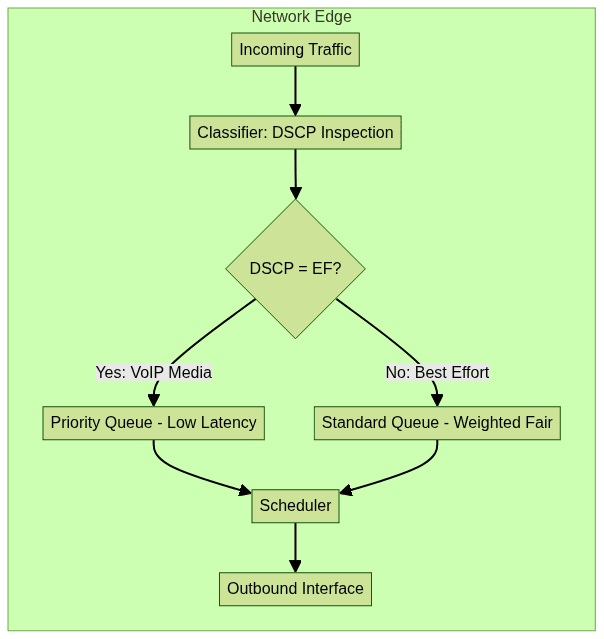
VoIP is highly sensitive to network conditions. Unlike file transfers or web browsing, where TCP retransmission handles lost packets transparently, VoIP cannot afford the latency of retransmission. QoS mechanisms ensure that voice and video packets receive priority treatment on congested networks.
DiffServ (Differentiated Services) uses the 6-bit DSCP (Differentiated Services Code Point) field in the IP header to classify packets. VoIP signaling (SIP) is typically marked with CS3 (DSCP 24), while RTP media is marked with EF (Expedited Forwarding, DSCP 46), ensuring routers prioritize media packets over best-effort traffic.
RSVP (Resource Reservation Protocol) allows endpoints to request bandwidth reservations along the path, but it is rarely deployed on the public internet due to scalability concerns. It sees some use in managed enterprise networks.
Traffic shaping and policing at network edges smooth out bursty traffic and enforce bandwidth limits. Adaptive codecs like Opus can dynamically adjust their bitrate based on network feedback, reducing quality gracefully rather than dropping calls.
Additional QoS techniques include jitter buffer tuning (dynamic buffer sizing based on observed network conditions), packet loss concealment (PLC algorithms that interpolate lost audio frames), and echo cancellation (critical when VoIP connects to the PSTN where hybrid echo occurs). Modern VoIP SDKs and platforms implement these techniques automatically, but understanding them is valuable when diagnosing quality issues.
Deployment Models & Use Cases
Enterprise PBX & SIP-Trunking
Traditional enterprise telephony relied on on-premises PBX systems connected to the PSTN via ISDN or analog lines. Modern deployments use IP-PBX systems (such as Asterisk, FreeSWITCH, or 3CX) that connect to ITSPs (Internet Telephony Service Providers) via SIP trunks. A SIP trunk replaces physical phone lines with a virtual connection over the internet, carrying multiple concurrent calls.
SIP trunking offers significant cost savings over traditional PRI lines, supports flexible scaling, and enables features like direct inward dialing (DID), caller ID, and E911 emergency calling. Enterprises must consider SIP-connect interoperability, security (SIP-TLS and SRTP), and redundancy when deploying SIP trunks.
Cloud-Based Video SDKs (e.g., VideoSDK)
For developers building real-time communication into applications, cloud-based SDKs abstract away the complexity of underlying VoIP protocols. VideoSDK provides Video Calling APIs and SDKs that handle WebRTC signaling, media transport, NAT traversal, and codec negotiation behind a clean developer interface. Instead of implementing SIP stacks or managing ICE candidates, developers use a rooms-based architecture where participants join a room, share media streams, and communicate with sub-300ms latency.
VideoSDK supports a broad range of SDKs including React, JavaScript, React Native, Android, iOS, Flutter, Unity, and Python. For iOS developers, a comprehensive callkit tutorial is available to integrate VoIP calling with CallKit. Android developers can refer to a dedicated webrtc android guide for native integration. Flutter developers can use the flutter webrtc guide to build cross-platform apps. For building a react video call application, VideoSDK provides a React SDK with hooks and components. The javascript video and audio calling sdk offers a quick-start guide for web applications. Features like participant recording, real-time transcription, E2E encryption, and role-based access control are available out of the box. For voice-only use cases, the same SDK surface can be used with video tracks disabled, providing audio calling and voice room capabilities optimized for low-bandwidth scenarios. Developers can leverage the Voice SDK for building live audio rooms and voice-only applications. For quick integration, you can embed video calling sdk using prebuilt UI components.
For interactive live streaming, VideoSDK's ILS mode enables low-latency streaming where viewers can be promoted to active participants in real time—suitable for live sho
You can Try it for free to start building real-time communication features today.
Free $20 Balance for AI Voice Agents & Video Calls
FAQ