


Open source text to speech (TTS) is speech synthesis software whose source code and, increasingly, whose model weights are freely available for anyone to run, modify, and self-host. Leading projects like Piper, eSpeak NG, OpenTTS, and Kokoro Web let developers generate natural-sounding speech offline, without per-character API fees or vendor lock-in. This guide compares the major engines, explains licensing and deployment, and helps you pick the right one for your project.
Speech synthesis has quietly become one of the most active corners of the open source audio world. A few years ago, running high-quality text to speech locally meant either paying for a commercial SDK or accepting robotic formant output. That has changed. Open source text to speech engines now deliver neural-quality voices that run on a Raspberry Pi, in a Docker container, or entirely inside a browser tab.
The driving forces are easy to see. Privacy regulations push teams to keep voice data on-premise. Per-character pricing from commercial TTS APIs gets expensive at scale. And the release of open weight neural models has given the community raw material to build genuinely competitive engines. Developers building voice assistants, accessibility tools, audiobook pipelines, and AI voice agents now have real choices beyond the big cloud vendors.
This guide walks through why open source TTS deserves a place in your stack, how the leading projects compare, and how to deploy them in practice. Whether you need a lightweight offline engine for embedded hardware or a self-hosted API server for a production application, there is an engine here that fits.
Why Choose Open Source Text to Speech?
Open source text to speech gives you control over cost, data, and voice behavior in ways that hosted APIs cannot match. For many teams, that control is the deciding factor rather than raw voice quality alone.
Benefits of Open Source TTS
Cost is the most immediate benefit. Commercial TTS APIs typically charge per character or per million characters of synthesized speech. An application generating thousands of audio clips daily, such as a news reader or an e-learning platform, can burn through budgets quickly. A self-hosted engine has zero marginal cost after the initial setup.
Privacy matters just as much. Medical, legal, and enterprise applications often cannot send user text to a third-party cloud. With an open source engine running on your own infrastructure, the text never leaves your network. That simplifies compliance with GDPR, HIPAA-adjacent policies, and internal data governance.
Customizability is the third pillar. Open engines let you swap voices, adjust phonemization, tune speaking rate and pitch, and even retrain models on domain-specific vocabulary. Community support rounds it out: active GitHub repositories mean bugs get patched, new languages get added, and you are never dependent on a single vendor's roadmap.
Licensing Considerations
Not all open source licenses behave the same way in commercial products, and TTS projects span the full spectrum. MIT and Apache 2.0 licenses are permissive: you can use, modify, and ship the engine inside proprietary software with minimal obligations, typically just retaining attribution notices.
GPL-family licenses are copyleft. If you distribute software that links a GPL-licensed engine, you may be required to open source your own application code as well. For server-side deployment where you never distribute the binary, this obligation usually does not trigger, but you should confirm with counsel for your specific case. Also check the model weights separately: some projects use permissive code licenses but release voices under non-commercial or Creative Commons terms. Always verify both the engine license and the voice model license before shipping to production.
Landscape of Open Source TTS Engines
The open source TTS ecosystem splits into two broad technical generations, and understanding that split explains most of the trade-offs you will encounter.
Neural vs. Traditional Approaches
Traditional engines, often called formant or concatenative synthesizers, generate speech from acoustic rules and small recorded fragments. eSpeak NG is the classic example. These engines are extremely lightweight, run on almost any hardware, and support an enormous number of languages, but the output sounds distinctly synthetic. For accessibility screen readers and embedded devices, that trade-off is often acceptable.
Neural engines use deep learning models trained on recorded human speech. They produce far more natural prosody, intonation, and rhythm, at the cost of larger memory footprints and slower synthesis on weak hardware. Modern neural engines like Piper are optimized to the point where they run comfortably on single-board computers, closing the practicality gap. The general rule in 2026: choose neural when naturalness matters, choose formant when footprint and language breadth matter most.
Popular Projects Overview
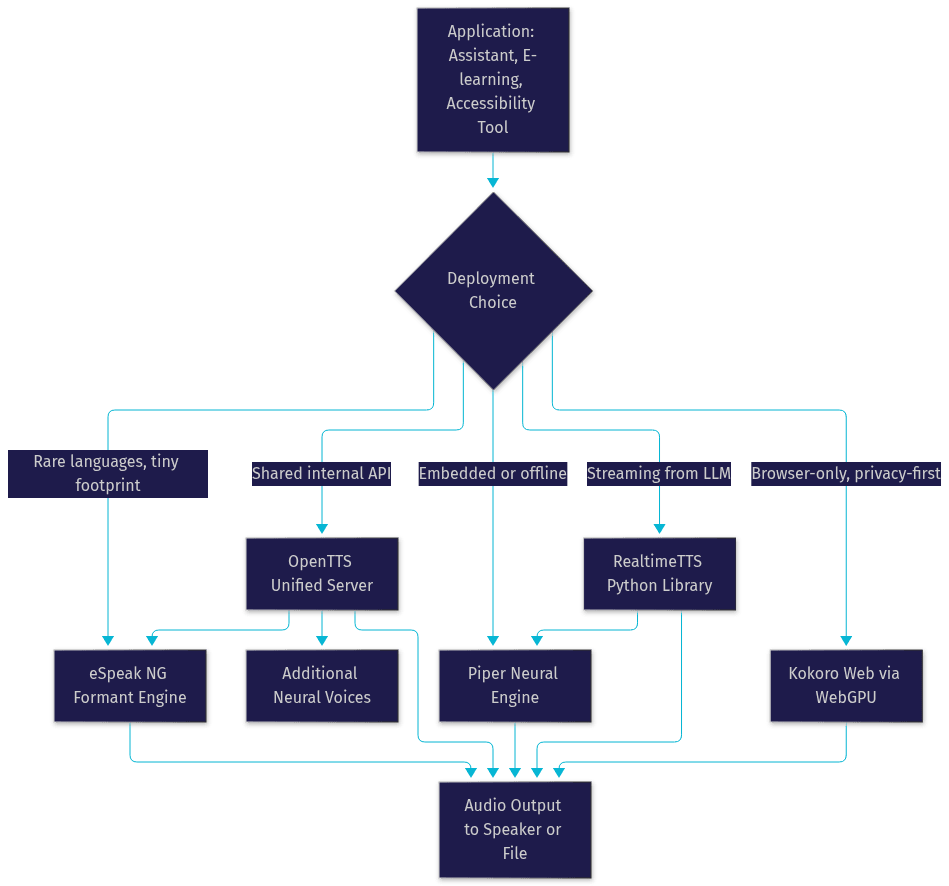
Several projects dominate the conversation. Piper is a fast, local neural engine designed for offline use on low-power hardware. eSpeak NG is the veteran formant synthesizer with unmatched language coverage. OpenTTS is a unified server that aggregates multiple engines behind a single HTTP interface. RealtimeTTS is a Python library focused on low-latency streaming synthesis, popular for piping LLM output directly into speech. Kokoro Web brings neural TTS into the browser using WebGPU acceleration. Each occupies a distinct niche, and the deep dive below maps them out.
Deep Dive into Top Projects
Four projects cover the majority of real-world open source TTS needs, from embedded devices to browser-based applications.
Piper – Fast Local Neural Engine
Piper is defined as a fast, local neural text to speech engine that converts text into natural-sounding speech entirely offline. It works by running compact neural voice models that convert phonemized text directly into audio waveforms, using eSpeak NG under the hood for the phonemization step, which is what gives it broad multilingual support despite its small model sizes.
Piper's design goal is speed on modest hardware. It runs well on Raspberry Pi-class devices, which has made it a favorite for home automation voice output, offline assistive devices, and embedded kiosks. Voice models are distributed as small downloadable files, each representing a specific language and speaker, so you only ship the voices you need.
Docker support makes server deployment straightforward: you can run Piper as a containerized service and expose it to your application over a local HTTP endpoint. Real-world use cases include offline screen readers, voice announcements in industrial settings, and generating audio for language-learning apps where cloud dependency is undesirable. For developers who want neural quality with zero recurring cost, Piper is usually the first engine to evaluate.
eSpeak NG – Classic Formant Synthesizer
eSpeak NG is a compact open source speech synthesizer that generates speech using formant synthesis rather than recorded audio. Its standout strength is language coverage: it supports dozens of languages and variants, including many minority languages that neural engines have not yet been trained on.
The footprint is tiny, often just a few megabytes, and synthesis is nearly instantaneous even on the weakest hardware. The trade-off is the characteristic robotic timbre. For screen readers, pronunciation tooling, and testing pipelines where intelligibility beats naturalness, that is a feature, not a bug. eSpeak NG is also extensible: it can use MBROLA voice databases to improve output quality, and its phonemization layer is reused by other projects, including Piper. If you need to synthesize an obscure language offline tomorrow, eSpeak NG is likely your only option.
OpenTTS – Unified Server for Multiple Engines
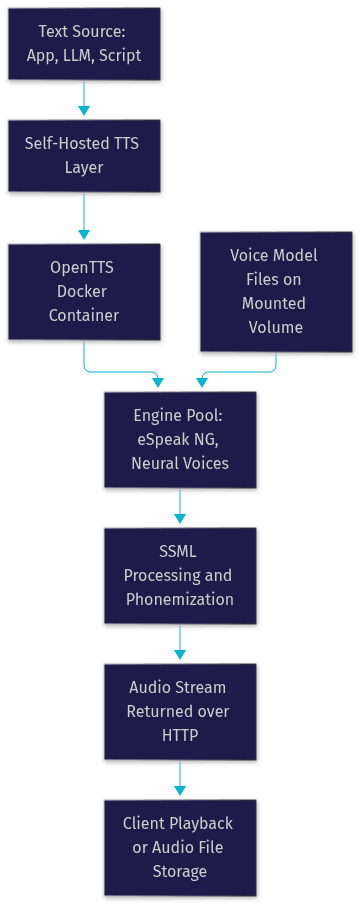
OpenTTS is a self-hosted text to speech server that aggregates multiple synthesis engines and voices behind a single, consistent HTTP API. Instead of committing to one engine, you deploy OpenTTS as a Docker container and it exposes all configured voices through one endpoint, including eSpeak NG voices and additional neural voices you configure.
The unified interface matters for teams. Your application code targets one API shape, and you can swap or add engines behind the server without touching clients. It handles SSML input, so you can control pauses, emphasis, and pronunciation through standard markup. Deployment follows the standard Docker pattern: run the container, map the port, and point your application at the local endpoint. OpenTTS is a good fit when multiple applications or teams need TTS from a shared internal service, or when you want a transition layer while evaluating different engines.
Kokoro Web – Browser-Based AI TTS
Kokoro Web deserves a mention for a different reason: it runs neural TTS entirely in the browser, using WebGPU acceleration to synthesize speech client-side without any server. It exposes an OpenAI-compatible API surface, which makes it easy to slot into applications already written against commercial endpoints. For privacy-sensitive web apps and offline-capable browser tools, it is one of the most interesting projects to watch.
Selecting the Right Engine for Your Needs
Choosing among open source TTS engines comes down to five practical criteria, and weighing them honestly prevents most project regrets.
Decision Criteria
Hardware is the first filter. If you are targeting a Raspberry Pi or embedded board, Piper or eSpeak NG are realistic; heavyweight neural models are not. Language support is the second: check that your target languages have mature voices in the engine's model catalog, since neural engines vary widely by language.
Latency comes third. Real-time conversational applications, such as AI voice agents, need sub-second synthesis, which favors streaming-focused libraries like RealtimeTTS or compact models like Piper. Batch workloads like audiobook generation care more about throughput than first-audio latency. API style is fourth: a Python library suits application code directly, while an HTTP server like OpenTTS suits polyglot teams. Licensing is the final gate: confirm both engine and voice model licenses fit your commercial plans before committing.
Comparison Table
The table below summarizes the key trade-offs across the major engines.
| Engine | Approach | Hardware Needs | Best For | License Considerations |
|---|---|---|---|---|
| Piper | Neural, offline | Very low (Pi-class) | Embedded, offline apps, home automation | Permissive engine; check voice model terms |
| eSpeak NG | Formant | Minimal | Accessibility, rare languages, testing | GPLv3, verify distribution obligations |
| OpenTTS | Server aggregator | Moderate | Shared internal TTS API, multi-engine teams | Depends on bundled engines |
| RealtimeTTS | Streaming library | Moderate to high | Live LLM voice agents, low-latency apps | Check per-engine licenses |
| Kokoro Web | Browser neural | Client GPU (WebGPU) | Privacy-first web apps, zero backend | Verify model weight license |
[LINKABLE ASSET — comparison table]
Piper's row is the one most teams start with: it hits the best balance of naturalness, footprint, and deployment simplicity. The following diagram shows how these engines typically fit into an application architecture.
Practical Implementation Guide
Getting an open source TTS engine running is genuinely a weekend-scale project. This section walks through the three most common paths in plain terms.
Installing a Local Engine (Piper Example)
Installing Piper follows the standard Python package route: you install the engine package from the Python package repository, download the voice model for your language, and then invoke synthesis by pointing the engine at your text and the chosen voice file. The expected result is an audio file generated entirely on your machine, with no network traffic at any point.
For server-style deployment, the Docker route is cleaner. You pull the official container image, run it with a mapped port and a volume holding your voice models, and the engine becomes a local HTTP service your application can call. This is the pattern most production teams settle on because it isolates dependencies and makes upgrades a container swap rather than a system change.
Integrating via Python API (RealtimeTTS)
RealtimeTTS is designed for the streaming case: text arrives incrementally, and speech should start before the full text is known. The typical integration works by feeding text chunks from a generator, an LLM token stream, or any other incremental source into the engine, which begins synthesizing and playing audio as sentences complete.
The expected behavior is noticeably lower perceived latency: users hear the first words of a response while the rest is still being generated. This is the pattern behind most local AI voice assistants built in Python. You select a backend engine under the hood, configure the voice, and pipe your model's output through it. The result is a responsive conversational experience without any cloud TTS dependency.
Deploying a Self-Hosted API (OpenTTS/Kokoro)
For team-wide access, the recommended approach is to run OpenTTS as a multi-service container stack. In practical terms, you describe the OpenTTS service in your orchestration configuration, specify which internal port it should expose to your network, and indicate where the voice model files live so the container can reach them. Once the stack is started, the server comes up with all configured voices available, and your applications can consume speech through simple HTTP requests to the local endpoint, requesting specific voices by name and receiving audio back in response.
Kokoro Web inverts this: there is no server at all. You load the engine in a modern browser, and synthesis happens on the client's GPU through WebGPU. Because it exposes an OpenAI-compatible interface, applications written against commercial TTS APIs can often switch to it with minimal changes. The deployment decision is therefore about where compute lives: server-side for OpenTTS, client-side for Kokoro Web.
Tips for SSML and Voice Customization
When an engine supports SSML, use it deliberately: insert explicit pauses at sentence boundaries, spell out acronyms and numbers, and mark foreign words for correct pronunciation. Test voices against your actual domain text, since a voice that sounds great on generic prose can stumble on technical jargon. Keep a small pronunciation exception list for product names and proper nouns, and prefer shorter sentences in source text, because most engines produce better prosody when clauses are clean.
Future Trends in Open Source TTS
The open source TTS space is accelerating along three fronts. First, GPU-accelerated and browser-accelerated models are shrinking the quality gap with commercial APIs; WebGPU-based engines like Kokoro Web point toward fully client-side synthesis becoming normal. Second, open weight voice models are proliferating, with larger multilingual datasets and voice cloning capabilities arriving under permissive licenses, which will make custom brand voices achievable without vendor contracts. Third, community contributions are compounding: projects like Piper reuse each other's phonemization layers, and the AI voice agent ecosystem is pulling TTS deeper into real-time pipelines. For developers, the practical implication is that self-hosted speech synthesis is shifting from a compromise choice to a first-class default.
Definitions Glossary
Open source text to speech (TTS): Speech synthesis software whose source code is freely available to run, modify, and redistribute, often with downloadable voice models for offline use.
Formant synthesis: A traditional synthesis method that generates speech from acoustic rules and resonant frequencies, producing lightweight but robotic-sounding output, as used by eSpeak NG.
Neural TTS: Speech synthesis using deep learning models trained on recorded human speech, producing natural prosody at the cost of larger memory and compute requirements.
Phonemization: The process of converting written text into phonetic symbols before synthesis, the step that determines pronunciation quality and multilingual support.
SSML (Speech Synthesis Markup Language): An XML-based markup standard for controlling pauses, emphasis, pronunciation, and pacing in synthesized speech.
Self-hosted TTS: A speech synthesis service deployed on your own infrastructure, typically via Docker, so text and audio never leave your network.
Key Takeaways
- Open source text to speech engines eliminate per-character API costs and keep sensitive text entirely on your own infrastructure.
- Piper delivers neural-quality offline synthesis on hardware as small as a Raspberry Pi, making it the default starting point for local TTS.
- eSpeak NG remains unmatched for language breadth and minimal footprint, while OpenTTS aggregates multiple engines behind one self-hosted HTTP API.
- RealtimeTTS and Kokoro Web cover the low-latency and browser-native ends of the spectrum, from streaming LLM output to fully client-side WebGPU synthesis.
- Always verify both the engine license and the voice model license before shipping an open source TTS integration into a commercial product.
Conclusion
Open source text to speech has matured into a genuine alternative to commercial APIs, with engines covering every deployment shape from embedded boards to browser tabs. Start with Piper for offline neural quality, reach for eSpeak NG when language coverage or footprint dominates, and standardize on OpenTTS when multiple teams need one shared service. If you are building real-time voice experiences, pair a streaming library like RealtimeTTS with your LLM pipeline, and explore what fully client-side synthesis means for your architecture. Ready to go further with real-time voice? Check out the VideoSDK AI voice agents documentation to see how synthesized speech fits into production voice pipelines, and join the VideoSDK developer community to get started for free. What are you building with open source TTS? Drop a comment, I'd love to hear about your use case.
Free $20 Balance for AI Voice Agents & Video Calls
FAQ