


A WebSocket is a bidirectional, persistent communication channel that starts as an HTTP handshake and then upgrades to a full-duplex connection, making it ideal for real-time Go services. Golang is a strong fit because goroutines map naturally to connections, and libraries like Gorilla/websocket, Gobwas/ws, and GWS offer mature, high-performance implementations. This guide compares the leading Go WebSocket libraries, explains hub patterns, TLS, reconnection, and scaling, so you can ship a production-grade WebSocket server with confidence.
Real-time features have moved from nice-to-have to table stakes. Chat apps, live dashboards, multiplayer games, collaborative editors, and telemetry pipelines all depend on pushing data the instant it changes. For teams building these systems in Go, the WebSocket protocol is usually the transport of choice, and the ecosystem around it has matured considerably.
Go's concurrency model is the reason so many real-time backends are written in it. Each WebSocket connection maps cleanly to a goroutine, and Go's scheduler handles tens of thousands of them without the thread-per-connection overhead that plagues other runtimes. Combined with a strong standard library and a competitive set of third-party WebSocket libraries, Go lets small teams build services that would otherwise require significant infrastructure engineering.
This guide walks through the protocol fundamentals, compares the most popular Go WebSocket libraries with published benchmark data, and covers the implementation practices that separate a working demo from a production system. Whether you are picking a library for a new chat server or tuning an existing telemetry pipeline, you will find concrete guidance here. For teams that eventually need full video and audio calling rather than just messaging, solutions like VideoSDK's real-time communication SDKs build on the same real-time principles.
What Is a WebSocket?
A WebSocket is defined as a communication protocol that provides a single, long-lived, bidirectional connection between a client and a server over TCP. It begins as an ordinary HTTP request containing an upgrade header. If the server accepts, the connection switches from the request-response semantics of HTTP to a persistent message channel where either side can send frames at any time.
This is the key difference from alternatives. With HTTP polling, the client repeatedly asks the server for updates, wasting requests and adding latency. Long polling reduces waste but still carries per-message overhead. Server-Sent Events (SSE) allow the server to push to the client, but the channel is one-directional and text-only. WebSockets support both directions, binary payloads, and low per-message framing cost, which is why they dominate real-time application design.
Why Build WebSocket Services with Golang?
Go works by giving each WebSocket connection its own lightweight goroutine, and the runtime multiplexes those goroutines across a small number of OS threads. The result is a server that can hold very large numbers of concurrent connections with modest memory use, which is exactly the workload profile of real-time systems.
The standard library's HTTP server handles the initial upgrade request, so a WebSocket server in Go is often just a standard HTTP handler with a special path. That means middleware, routing, and TLS termination all work the way Go developers already expect.
The community library ecosystem is another strength. Gorilla/websocket has been the de facto standard for years, Gobwas/ws pushes performance further with zero-allocation design, and newer entrants like GWS add event-driven APIs and built-in hub patterns. Whatever your priority, simplicity, raw throughput, or built-in reconnection, there is a well-maintained option.
Key Design Considerations for Golang WebSocket Projects
Before choosing a library, map out the design problems every WebSocket service must solve. Getting these right early prevents painful rewrites later.
Connection lifecycle management. Every connection needs explicit handling for open, message, error, and close events. Unhandled closes leak goroutines and file descriptors. A production server tracks connection state centrally so that disconnects propagate cleanly to the rest of the system.
Concurrency and goroutine safety. Most libraries require that only one goroutine reads from a connection while another writes. Violating this contract causes subtle data corruption. Design your read and write paths up front so ownership is unambiguous.
Memory allocation and buffer reuse. Naive message handling allocates a fresh byte slice per frame, which drives garbage collection pressure at high throughput. Buffer pooling and zero-allocation write paths matter enormously for WebSocket performance in Go.
TLS and secure origins. Production traffic should run over TLS, and servers must validate the Origin header on upgrade requests to prevent cross-site WebSocket hijacking.
Reconnection strategies. Networks drop connections. Clients need exponential backoff with jitter, and servers need idempotent session resumption so a reconnecting client does not lose state.
Compatibility with browsers and test suites. The Autobahn test suite verifies protocol compliance, and passing it matters if you serve arbitrary browsers rather than a controlled client.
Overview of Popular Golang WebSocket Libraries
The Go WebSocket library landscape has several strong options, each with a distinct philosophy. Here is how the main contenders compare.
GWS (lxzan/gws)
GWS is an event-driven WebSocket library with a zero-allocation design and a built-in hub pattern for broadcasting. Instead of manually managing read loops, you register event callbacks for connection open, message receipt, and close. The integrated hub saves you from writing your own connection registry, which makes GWS attractive for chat and notification workloads where broadcast is the core operation.
Gobwas/ws
Gobwas/ws takes a low-level approach. It exposes the upgrade and frame-parsing machinery directly, with a zero-copy upgrade path that avoids allocating during the handshake. The companion wsutil helpers provide convenient read and write operations for those who want control without writing frame parsing from scratch. It is the library of choice when WebSocket performance in Go is the primary constraint, at the cost of a steeper learning curve.
Gorilla/websocket
Gorilla/websocket is the most widely adopted Go WebSocket library, with extensive documentation, a long maintenance history, and a familiar connection-based API. Its examples cover the hub pattern, TLS, origin checks, and compression. For teams that value predictability and community knowledge over raw benchmark numbers, Gorilla remains the safe default, and most Stack Overflow answers about Go WebSockets assume it.
wszero
wszero focuses on performance with a custom buffer pool, while keeping an API deliberately similar to Gorilla's. That similarity lowers migration friction for teams that started on Gorilla and hit allocation or throughput ceilings. It is a pragmatic middle ground between Gorilla's ergonomics and Gobwas-level efficiency.
recws
recws is a client-side library that adds automatic reconnection on top of a standard WebSocket client. If your Go service consumes streams from a third-party server, recws handles the retry loop, backoff, and re-subscription plumbing that you would otherwise write yourself. It is not a server library, but for WebSocket client Go use cases it removes a whole category of boilerplate.
coregx/stream
coregx/stream combines SSE and WebSocket support in one package, with a hub implementation included. That dual support is useful for applications that serve both lightweight, one-way event streams and interactive bidirectional channels from the same backend, letting you pick the transport per endpoint rather than per service.
Performance and Benchmark Comparison
Published benchmarks for Go WebSocket libraries generally measure nanoseconds per message, bytes allocated per operation, and allocations per operation. The numbers shift with Go versions and hardware, but the relative ordering has been stable across recent benchmark runs on typical x86-64 hardware using recent Go releases.
| Library | Relative latency | Allocations per message | Hub pattern built in | Compression | Best for |
|---|---|---|---|---|---|
| Gobwas/ws | Lowest | Near zero | No | No | Maximum throughput |
| GWS | Very low | Near zero | Yes | Yes | Broadcast-heavy servers |
| Gorilla/websocket | Moderate | Low | Via example | Yes | General-purpose reliability |
| wszero | Low | Very low | No | No | Gorilla-style API, less GC |
| recws | Client-side | Client-side | No | No | Auto-reconnecting clients |
| coregx/stream | Moderate | Low | Yes | No | Mixed SSE and WebSocket |
The pattern to notice: the lowest-latency libraries achieve it by minimizing allocations, not by clever frame parsing. Garbage collection pauses, not protocol handling, are usually the bottleneck in a busy Go WebSocket server. Gobwas and GWS both report allocation counts near zero on their hot paths, which is why they lead WebSocket benchmark Go discussions. Gorilla trades some allocation for API clarity, and for most applications the difference is invisible until you exceed tens of thousands of messages per second.
Choosing the Right Library for Your Use Case
Library choice should follow from your requirements, not from benchmark bragging rights. Use this decision framework.
- Need built-in broadcasting and an event-driven API? Choose GWS. The hub pattern is included, so a chat or notification server needs far less scaffolding.
- Need maximum throughput and are comfortable with lower-level code? Choose Gobwas/ws. Its zero-allocation upgrade and frame handling reward teams that can invest in the plumbing.
- Need the safest, best-documented default? Choose Gorilla/websocket. Its maturity means most problems you hit have documented solutions.
- Need automatic client reconnection? Choose recws for consumer-side streams.
- Need both SSE and WebSocket from one service? Choose coregx/stream.
Three typical scenarios make this concrete. For a chat server with thousands of concurrent rooms, GWS fits best because the hub pattern and compression support match the workload directly. For a high-throughput telemetry pipeline pushing binary frames at high frequency, Gobwas/ws minimizes per-message cost where it matters most. For a lightweight client that subscribes to an external feed, recws removes reconnection complexity entirely.
Implementation Best Practices
Handshake and Upgrade Flow
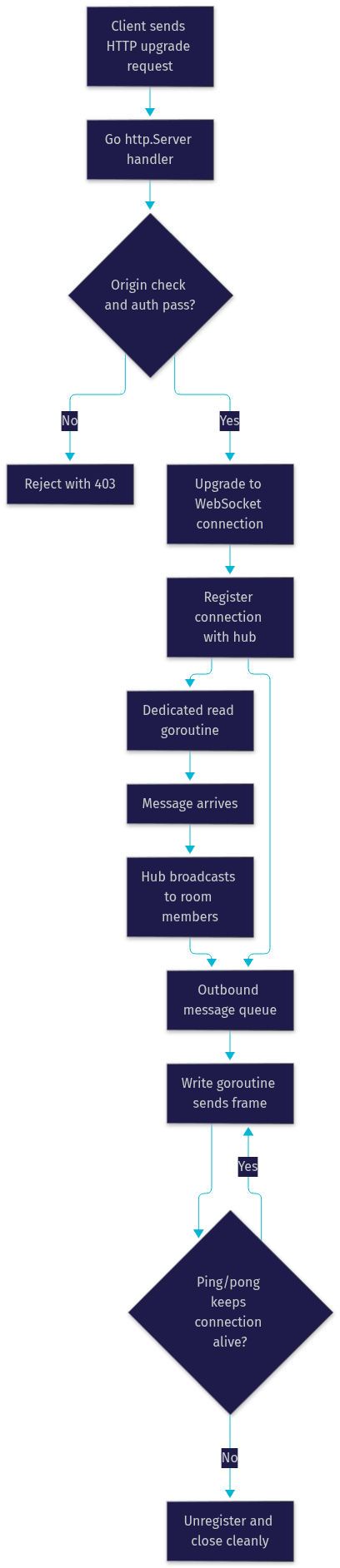
The WebSocket handshake works by receiving a normal HTTP request that asks to upgrade to the WebSocket protocol, computing a security key response from the client's provided key, and returning the appropriate acceptance headers. In Go, this happens inside a standard HTTP handler, so you can apply authentication middleware, rate limiting, and routing before the upgrade is accepted. Once the upgrade completes, the connection is no longer an HTTP request and must be managed by your WebSocket library's read and write methods.
Hub / Broadcast Pattern
The hub pattern solves the problem of managing many connections and delivering messages to subsets of them. A central registry tracks every active connection, usually grouped by channel or room. When a message arrives, the hub fans it out to the relevant connections' write paths. Each connection keeps a dedicated outbound queue so a slow client cannot block the broadcast loop. This is the pattern most production Go WebSocket servers converge on, and libraries like GWS and coregx/stream ship it built in.
Buffer Pooling and Zero-Allocation Writes
To avoid garbage collection pressure, reuse byte slices across messages rather than allocating fresh buffers per frame. A sync pool of pre-sized buffers lets read paths recycle memory, and write paths that accept caller-owned slices avoid hidden copies. At high message rates this is the single biggest lever on WebSocket performance in Go. Monitor allocation metrics during load testing; if allocations per message are not flat or near zero, your hot path is paying a GC tax on every frame.
Secure Connections and Origin Checks
Serve WebSocket traffic over TLS, either by terminating TLS at a reverse proxy or directly in your Go server. Always validate the Origin header on upgrade requests against an allowlist of trusted origins. Without this check, a malicious page can open a WebSocket to your server from a victim's browser and hijack an authenticated session, a class of attack known as cross-site WebSocket hijacking.
Testing for Protocol Compliance
The Autobahn test suite is the reference conformance suite for WebSocket implementations, running hundreds of protocol edge cases covering fragmentation, close semantics, UTF-8 validation, and reserved bits. Running your Go server against Autobahn before launch catches protocol bugs that ordinary happy-path testing misses. Not every failure matters equally; failures in basic echo, text framing, and close handling are production blockers, while edge cases around unusual extension negotiation may never occur with your actual clients.
At the unit level, Go's built-in testing framework covers message serialization, hub routing logic, and reconnection state machines. Test the hub with simulated connections that assert delivery and cleanup, and test reconnection logic with a fake server that drops connections on schedule. Protocol conformance plus unit coverage of your own logic is the combination that holds up in production.
Scaling and Production Tips
A single Go process can hold a very large number of WebSocket connections, but production systems eventually need horizontal scale. The standard architecture places a load balancer such as NGINX or HAProxy in front of multiple stateless Go workers, with the balancer configured for long-lived connections and appropriate idle timeouts. Because WebSocket connections are stateful once established, use IP-hash or cookie-based session affinity so reconnecting clients return to the worker holding their session, or externalize session state to Redis so any worker can resume.
Monitor the metrics that reveal problems early: active connection count, message rates per connection, end-to-end latency percentiles, and garbage collection pause durations. Rising GC pauses usually point at allocation-heavy hot paths. Connection churn that spikes during deployments points at missing graceful shutdown, so drain connections before process exit. For teams building beyond messaging into live audio and video, VideoSDK's interactive live streaming handles the media layer so your Go backend can focus on application logic.
Common Pitfalls and Troubleshooting
The same problems recur across Go WebSocket deployments. Missed ping/pong handling is the most common: without periodic pings, half-open connections linger forever after a client vanishes. Send pings on a timer and treat missed pongs as disconnects. Deadlocks from blocking reads happen when a write blocks while holding a lock the read path needs. Keep reads and writes on separate goroutines and never hold hub locks while writing to a connection.
TLS handshake errors usually trace to certificate mismatch or clients not trusting the chain; validate certificates locally and test with the same client stack you ship. Memory leaks from unclosed connections show up as slowly climbing goroutine counts; ensure every code path, including error paths, unregisters the connection from the hub. Finally, silent origin misconfiguration lets browsers connect from untrusted pages; test origin rejection explicitly, not just acceptance.
Future Directions: WebTransport and HTTP/3
WebSocket is not the end of the road. WebTransport, built on HTTP/3 and QUIC, promises unreliable datagrams, multiple independent streams, and better behavior over lossy mobile networks, addressing limitations WebSockets cannot fix within the TCP framing model. Browser support is expanding, and Go's ecosystem is preparing through QUIC implementations and early WebTransport libraries.
For now, WebSockets remain the pragmatic choice: universally supported, well tooled, and battle-tested at scale. Watch WebTransport for latency-sensitive use cases, but do not delay shipping on WebSockets waiting for it.
Definitions Glossary
WebSocket: A persistent, bidirectional communication protocol that upgrades from an HTTP handshake to a full-duplex TCP channel, allowing server and client to exchange framed messages at any time.
Hub pattern: A central registry that tracks all active WebSocket connections and fans out messages to targeted subsets, typically organized by room or channel, with per-connection outbound queues.
Goroutine: Go's lightweight concurrency unit, scheduled by the runtime onto a small pool of OS threads, allowing one goroutine per WebSocket connection at scale.
Zero-allocation write: A write path that reuses caller-owned byte slices and pooled buffers instead of allocating new memory per message, minimizing garbage collection pressure.
Origin check: Server-side validation of the Origin header during the WebSocket upgrade handshake, preventing cross-site WebSocket hijacking from untrusted web pages.
Autobahn test suite: The reference conformance test suite for WebSocket implementations, covering fragmentation, close semantics, and protocol edge cases.
Key Takeaways
- Go's goroutine-per-connection model and strong standard library make it one of the best languages for building high-concurrency WebSocket servers.
- Gobwas/ws and GWS lead on allocation-free performance, while Gorilla/websocket remains the most documented and safest general-purpose default.
- The hub pattern with per-connection outbound queues is the core architecture for any broadcast-heavy Go WebSocket service.
- Buffer pooling and zero-allocation writes matter more than protocol handling for real-world WebSocket performance in Go.
- Always validate origins, run TLS, implement ping/pong keepalives, and test protocol compliance with the Autobahn suite before production launch.
- When your real-time needs grow beyond messaging into live video, audio, or interactive streaming, platforms like VideoSDK provide the media infrastructure layer.
Conclusion
Building a golang websocket service is less about picking the fastest library and more about matching the library to your workload, then investing in the unglamorous parts: lifecycle management, buffer reuse, origin checks, reconnection, and monitoring. GWS suits broadcast-heavy servers, Gobwas/ws wins on raw throughput, Gorilla stays the reliable default, and recws handles client-side reconnection. Test with real traffic, run the Autobahn suite, and watch your GC metrics before and after optimization. For deeper real-time patterns, explore the VideoSDK blog and code samples. What are you building with Go WebSockets? Drop a comment, I'd love to hear what kind of real-time use case you're working on.
Advanced WebSocket Features
For more advanced WebSocket implementations, consider adding features such as authentication and real-time updates.
Authentication
Go
1func handleConnections(w http.ResponseWriter, r *http.Request) {
2    // Perform authentication here
3    // If successful, upgrade the connection
4    ws, err := upgrader.Upgrade(w, r, nil)
5    // Handle connection as before
6}
Real-time Updates
- Implement real-time chat or live notifications.
- Use WebSockets for real-time data streaming, such as live sports scores or financial tickers.
Example Code Snippets
Go
1func broadcastUpdates(data string) {
2    for client := range clients {
3        err := client.WriteJSON(data)
4        if err != nil {
5            client.Close()
6            delete(clients, client)
7        }
8    }
9}
By incorporating these advanced features, you can create more dynamic and interactive web applications.
Conclusion
WebSockets in Golang offer a powerful tool for real-time, bidirectional communication in web applications. By following this guide, you have learned how to set up your environment, create a WebSocket server and client, manage connections, handle errors, and implement advanced features. Now, it's time to experiment and build dynamic applications.
Free $20 Balance for AI Voice Agents & Video Calls
FAQ