


Pip Chat is a geo-social platform that pins public posts to physical locations, enabling neighborhood discovery, community groups, local commerce, and peer-to-peer payments within a 25 to 100 kilometer radius. It combines map-based feeds, ephemeral status updates, and business tools into one location-anchored mobile experience. Developers building similar apps can leverage real-time communication SDKs like VideoSDK to power the live interaction layer underneath geo-social features.
The rise of location-based social apps has reshaped how communities interact online. Instead of scrolling through global feeds disconnected from physical surroundings, users increasingly want digital experiences tied to where they actually live, work, and socialize. Pip Chat enters this space as a location-anchored platform designed for public posts, community groups, and local services.
What sets Pip Chat apart from conventional social networks is its core principle of pinning conversations to places. Every post, thread, and status update carries geographic context, making discovery feel hyper-local rather than algorithmically abstract. For developers and product thinkers interested in geo-social architecture, Pip Chat represents an interesting case study in how location services, real-time updates, and community moderation can converge in a single mobile application.
By the end of this article, you will understand what Pip Chat is, how its features work, what use cases it serves, and how its architecture supports location-anchored communication at scale.
What Is Pip Chat?
Pip Chat is defined as a mobile-first geo-social platform that anchors user-generated content to approximate physical locations. Instead of connecting people through friend graphs or follower lists, Pip Chat connects people through proximity. Posts are pinned to places, and users discover content based on their current location and configurable distance filters.
Pip Chat works by combining device geolocation services with a backend matching engine that surfaces relevant posts, groups, and business listings within a user's selected radius. The platform targets neighborhood residents, local business owners, community organizers, and anyone who wants to engage with hyper-local discourse without the noise of global social media feeds.
VideoSDK provides the kind of real-time communication infrastructure that geo-social platforms like Pip Chat rely on for live interactions, instant notifications, and community engagement features.
Core Features
Posts Pinned to Places
Posts pinned to places form the foundational content model of Pip Chat. When a user creates a post, the app attaches an approximate geographic coordinate to that content rather than displaying an exact address. This approach preserves user privacy while keeping the post contextually relevant to anyone nearby.
Posts remain visible to users within the configured distance radius and decay in visibility over time if they receive no engagement. This means a post about a lost dog pinned to a neighborhood park stays relevant to local users without cluttering feeds across an entire city. The location anchor also enables contextual discovery, where users browsing the map can tap any pinned post to read its full content and join the conversation.
Groups and Threads
Pip Chat supports neighborhood groups that organize discussions around shared interests, streets, apartment complexes, or local issues. Groups function as persistent spaces where members can create threaded discussions, share updates, and coordinate activities.
Threads within groups can be configured with expiration timers, meaning discussions automatically archive after a set period. This ephemerality keeps group spaces focused on current topics rather than accumulating months of stale commentary. For example, a group organizing a weekend clean-up event can set threads to expire after the event concludes, keeping the group feed clean for the next initiative.
Map and Discovery
The map view is the primary discovery surface in Pip Chat. Instead of a chronological or algorithmic feed, users see a map populated with pinned posts, active groups, and business listings within their selected distance filter. The distance filter ranges from 25 to 100 kilometers, letting users control how local or broad their discovery experience feels.
Real-time alerts notify users when new posts appear within their radius, when group activity spikes, or when local businesses post updates. This map-first approach makes discovery feel spatial and intuitive, mirroring how people naturally think about their surroundings. Developers building similar experiences can leverage VideoSDK's REST APIs to manage real-time session updates and participant notifications at scale.
Ephemeral Status Updates
Pip Chat includes ephemeral status updates that disappear after 24 hours, similar to stories on other social platforms. Users can post text, photos, or short videos as status updates visible to their selected audience within their geographic radius.
Audience controls let users restrict status visibility to specific groups, confirmed neighbors, or the broader local community. The 24-hour expiration creates a sense of immediacy that encourages regular check-ins without contributing to long-term content bloat. This feature works particularly well for time-sensitive updates like weather warnings, flash sales at local shops, or spontaneous neighborhood gatherings.
Business Tools
Pip Chat offers a suite of business tools designed for local merchants, service providers, and freelancers. The Business Inbox functions as a lightweight CRM where business owners can manage customer inquiries, track conversations, and organize client interactions from a single interface.
Professional profiles allow businesses to showcase services, operating hours, and contact information in a structured format. The booking system enables customers to schedule appointments directly through the app, reducing friction for local service providers like tutors, plumbers, and fitness coaches. Businesses can also create catalogs listing their products or services with pricing, and use forms to collect customer information for quotes, feedback, or event registration.
These tools position Pip Chat as more than a social platform. They make it a local commerce enabler where small businesses can operate without needing a standalone website or separate booking software. For developers building similar commerce features, VideoSDK's code samples demonstrate how to integrate real-time communication into business workflows.
P2P Payments and Trust Reputation
Pip Chat integrates peer-to-peer payments through a hand-off payment flow that facilitates transactions between users without the platform holding funds in escrow. When a buyer and seller agree on a transaction, the payment flow guides them through a secure transfer process using connected payment providers.
The trust reputation system complements payments by assigning reputation scores based on transaction history, community engagement, and verification status. Users with higher reputation scores gain visibility and trust within the local community, creating an incentive for honest behavior and active participation. This system is particularly valuable for local commerce scenarios where buyers and sellers may not know each other personally.
Moderation and Safety
Pip Chat implements community-driven moderation through post flagging, role-based moderator permissions, and verification badges for confirmed residents and businesses. Group administrators can assign moderation roles to trusted members, and flagged content enters a review queue for evaluation. Verification badges help users distinguish authentic local accounts from potential spam or impersonation attempts.
Multi-Platform Availability
Pip Chat launched on Android and has an iOS release on its product roadmap. A web client is also planned for future development, which would extend access to desktop users and enable cross-platform synchronization. The Android app is available for download through the Google Play Store, with installation requiring Android 8.0 or higher.
How Pip Chat Works: Architecture Overview
Understanding Pip Chat's architecture helps developers appreciate how location-anchored social platforms operate under the hood. The system follows a flow that begins with the user device, passes through geolocation services, reaches a backend matching engine, and returns curated content to the user's map and feed interface.
When a user opens the app, the device shares its approximate location with the geolocation service, which translates raw coordinates into a standardized geographic context. The backend matching engine queries the posts database for content within the user's configured distance radius, applying relevance scoring based on recency, engagement, and group membership. The map and feed service then delivers the curated results back to the user device for display.
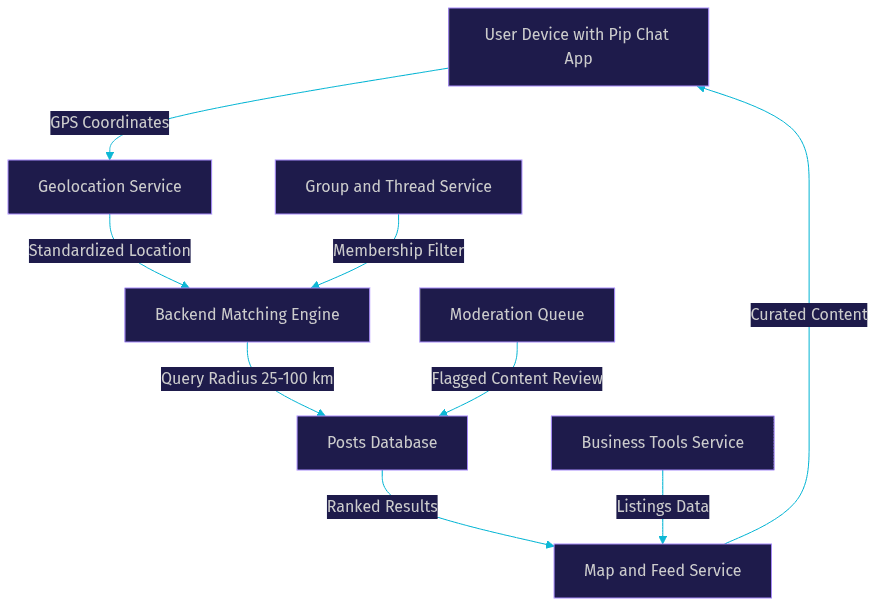
This architecture separates concerns effectively. The geolocation service handles location normalization, the matching engine manages relevance scoring, and the feed service handles presentation logic. Developers building similar systems can reference the W3C WebRTC specification for real-time media considerations and explore how real-time communication SDKs like VideoSDK handle participant management and session orchestration in location-aware applications.
Getting Started with Pip Chat
Getting started with Pip Chat requires an Android device and a few minutes of setup. The process is straightforward and designed to get users posting within their first session.
First, download the Pip Chat app from the Google Play Store. Search for the app by name, verify the developer name matches the official listing, and install the application. The app requires approximately 45 megabytes of storage space and runs on Android 8.0 or later.
Second, create an account. Pip Chat asks for a display name, an approximate home location, and an optional profile photo. The home location setting determines your default discovery radius and helps the platform surface relevant local content from your first session. You can adjust this location later if you move or want to explore a different area.
Third, grant location permissions. When prompted, allow Pip Chat to access your device's location services. The app uses approximate location rather than precise GPS coordinates, which means your exact address is never shared with other users. This permission is essential for the map view and distance-based discovery to function correctly.
Fourth, post your first pinned message. Tap the compose button, write a short message, and select a location anchor. You can pin the post to your current approximate location or search for a specific place like a park, shopping center, or street name. Once posted, your message becomes visible to other users within your configured distance radius.
Finally, explore the map view and join neighborhood groups that match your interests. The discovery experience improves as you engage with content, join groups, and interact with local businesses.
Real-World Use Cases
Community Alerts
Pip Chat excels at distributing hyper-local alerts that matter to immediate neighborhoods. Residents can pin posts about road work, water main breaks, power outages, or suspicious activity to specific locations. Because these posts are geographically anchored, neighbors within the affected radius see them without needing to follow a specific account or join a particular group.
During emergencies, the ephemeral status feature becomes valuable for rapid updates. A resident can post a 24-hour status about a downed tree branch blocking a sidewalk, and neighbors receive a real-time alert. Once the issue resolves, the status naturally expires without requiring manual cleanup.
Local Commerce
Local businesses use Pip Chat's business tools to reach nearby customers organically. A neighborhood bakery can create a professional profile, post its daily specials as pinned posts near its physical location, and accept bookings for custom cake orders through the integrated booking system.
The catalog feature lets service providers list offerings with transparent pricing, while the forms feature collects customer details for quotes or consultations. P2P payments complete the loop, allowing customers to pay for goods and services without leaving the app or exchanging cash.
Volunteer Coordination
Community organizers use Pip Chat groups to coordinate volunteer events efficiently. A clean-up drive at a local park can be organized through a dedicated group where members share updates, assign tasks, and track participation. Thread expiration keeps the group focused on the current event, and pinned posts at the event location provide logistical details to anyone nearby who has not joined the group but might be interested.
Blood donor requests represent another powerful use case. A pinned post at a hospital or blood bank location can alert nearby eligible donors about urgent needs, with contact information and donation hours included in the post body.
Social Interaction
Beyond utility, Pip Chat supports casual social interaction among neighbors. Hobby groups for gardening, running, or book clubs can form around geographic clusters. Users discover these groups through the map view and join based on proximity rather than existing social connections.
The ephemeral status feature encourages low-pressure sharing, where users post casual updates about their day without the permanence of traditional social media posts. This creates a more relaxed social environment that feels closer to chatting with a neighbor over a fence than broadcasting to a global audience.
Pip Chat vs. Competitors
Several platforms compete for local community attention, but Pip Chat differentiates itself through its location-anchored content model, integrated payments, and ephemerality features. The table below compares Pip Chat with three common alternatives across key dimensions.
| Feature | Pip Chat | Nextdoor | Facebook Marketplace | Local Reddit Communities |
|---|---|---|---|---|
| Primary Focus | Location-anchored posts and groups | Private neighborhood network | Buy and sell listings | Topic-based discussion |
| Content Model | Posts pinned to places | Feed-based posts | Listing-based | Thread-based |
| Distance Control | 25 to 100 km configurable | Fixed neighborhood boundaries | City or region level | Global with local subreddits |
| Ephemeral Content | 24-hour status updates | No | No | No |
| P2P Payments | Integrated hand-off flow | No | No | No |
| Business Tools | CRM, bookings, catalogs, forms | Business pages | Listing tools | None |
| Moderation | Community flagging and role-based | Platform and user moderation | Platform moderation | Volunteer moderators |
| Map Discovery | Native map-first interface | Address-based | Location filters | No map view |
Pip Chat's combination of map-first discovery, ephemeral content, integrated payments, and business tools makes it uniquely suited for hyper-local engagement. Nextdoor focuses on verified private neighborhoods but lacks ephemerality and integrated commerce. Facebook Marketplace excels at listings but operates at a broader geographic scale without community anchoring. Local Reddit communities offer discussion but lack location services and payment features entirely.
Future Roadmap and Upcoming Features
Pip Chat's development team has outlined several planned features for 2026 and beyond. The iOS release is the most anticipated milestone, bringing the platform to iPhone users and expanding the potential user base significantly. A web client is also in development, which will enable desktop access and cross-device synchronization.
On the feature side, enhanced AI-driven content curation is planned to improve relevance scoring in the matching engine. This upgrade will help surface the most useful local content while reducing noise from low-engagement posts. Expanded payment integrations are also on the roadmap, potentially adding support for additional payment providers and international transaction capabilities.
Definitions Glossary
Posts Pinned to Places: A content model where each post carries an approximate geographic coordinate, making it discoverable to users within a configurable distance radius. This is Pip Chat's foundational content structure.
Ephemeral Status Updates: Short-form posts that automatically expire after 24 hours, designed for time-sensitive updates and low-pressure sharing within a user's local radius.
Business Inbox: A lightweight CRM tool within Pip Chat that lets business owners manage customer inquiries, track conversations, and organize client interactions from a single interface.
Trust Reputation System: A scoring mechanism that assigns reputation values to users based on transaction history, community engagement, and verification status, incentivizing honest behavior in local commerce.
Distance Filter: A configurable radius setting ranging from 25 to 100 kilometers that controls how far from a user's location the platform surfaces posts, groups, and business listings.
Geo-Social Platform: A social application that anchors user interactions to physical locations rather than social graphs, enabling discovery and communication based on geographic proximity.
Key Takeaways
- Pip Chat anchors public posts to approximate physical locations, creating a hyper-local discovery experience that global social networks cannot replicate.
- The platform combines community groups, ephemeral status updates, business tools, and P2P payments into a single location-aware mobile application.
- Map-first discovery with configurable distance filters gives users control over how local or broad their content feed feels.
- Business tools including CRM, bookings, catalogs, and forms make Pip Chat viable for local commerce without requiring separate software.
- Developers building similar geo-social platforms can leverage real-time communication SDKs like VideoSDK to power live interactions and community engagement features.
Conclusion
Pip Chat represents a thoughtful evolution in geo-social design, where location context drives every interaction rather than serving as an afterthought. By pinning posts to places, supporting ephemeral updates, integrating business tools, and enabling P2P payments, the platform creates a complete local engagement ecosystem that existing social networks only partially address.
For developers interested in building location-anchored communication apps, Pip Chat's architecture offers valuable lessons in combining geolocation services, real-time matching engines, and community moderation. If you are building a similar platform, explore VideoSDK's documentation for real-time communication SDKs that can power the live interaction layer, or browse the code samples for integration inspiration. You can also join the VideoSDK Discord community to discuss real-time communication architecture with fellow developers.
What are you building with location-based features? Drop a comment below, I would love to hear what kind of geo-social use case you are working on.
Free $20 Balance for AI Voice Agents & Video Calls
FAQ