



Introduction to Communication Protocols
Communication protocols are the backbone of modern digital and analog systems, ensuring reliable data exchange between devices, systems, and applications. At their core, communication protocols are standardized sets of rules that govern the formatting, transmission, and receipt of data. In 2025, communication protocols remain essential for computers, microcontrollers, IoT devices, and large-scale networks. Their role is pivotal in guaranteeing interoperability, data integrity, and security across increasingly complex and heterogeneous technological environments. Without robust communication protocols, devices would be unable to understand each other, leading to failed connections and unreliable systems. As technology evolves, so do the communication protocols that enable seamless information flow in every layer of computing.
Types of Communication Protocols
Communication protocols can be categorized based on the systems they connect and the layers of the OSI model they operate within. Understanding the types of communication protocols is crucial for selecting the right solution for any application.
Inter System Communication Protocols
Inter system communication protocols facilitate data exchange between discrete systems or devices. Examples include UART (Universal Asynchronous Receiver/Transmitter), USART (Universal Synchronous/Asynchronous Receiver/Transmitter), and USB (Universal Serial Bus). These communication protocols ensure that computers, embedded devices, and peripherals can exchange data effectively even if they have different internal architectures. For developers building real-time communication features, integrating a Video Calling API can streamline the process of enabling high-quality video and audio interactions between systems.
Intra System Communication Protocols
Intra system communication protocols operate within a single system, connecting various components like microcontrollers, sensors, and memory modules. Common examples are I2C (Inter-Integrated Circuit), SPI (Serial Peripheral Interface), and CAN (Controller Area Network). These communication protocols provide reliable, efficient, and standardized data transfer within complex embedded systems. For mobile and cross-platform applications, technologies such as flutter webrtc are increasingly popular for enabling seamless real-time communication within apps.
Network and Application Layer Protocols
Network and application layer communication protocols function at higher levels, enabling data transmission across local and global networks. Notable examples include TCP (Transmission Control Protocol), UDP (User Datagram Protocol), HTTP (HyperText Transfer Protocol), MQTT (Message Queuing Telemetry Transport), FTP (File Transfer Protocol), and ICMP (Internet Control Message Protocol). These protocols are foundational for internet and IoT communication in 2025. For Android developers, leveraging webrtc android can help implement secure and scalable real-time communication features in their applications.

Serial Communication Protocols
Serial communication protocols are vital for point-to-point and multi-device data exchange in embedded systems and industrial automation. These communication protocols define how information flows bit by bit over physical channels, ensuring timing, voltage compatibility, and message integrity. For applications focused on audio communication, integrating a Voice SDK can provide robust and scalable voice interaction capabilities.
UART Protocol
The UART protocol is a widely used asynchronous serial communication protocol. It transmits data one bit at a time over two wires (TX and RX) with configurable voltage levels (typically 3.3V or 5V) and selectable baud rates (e.g., 9600, 115200 bps). UART communication protocols rely on start and stop bits for synchronization. For developers looking to quickly embed video calling sdk into their projects, prebuilt solutions can significantly reduce development time and complexity.
1// UART initialization in C (STM32 example)
2void UART_Init(void) {
3    USART1->BRR = 0x0683; // Baud rate
4    USART1->CR1 |= USART_CR1_TE | USART_CR1_RE | USART_CR1_UE; // Enable TX, RX, UART
5}
SPI Protocol
SPI (Serial Peripheral Interface) is a full-duplex, synchronous serial communication protocol often used in master-slave configurations. It employs four lines: MISO, MOSI, SCLK, and SS. SPI communication protocols provide high-speed data transfer and are ideal for short-distance, high-throughput applications. For those building live broadcast or interactive experiences, utilizing a Live Streaming API SDK can help deliver real-time video and audio content to a wide audience.
1# SPI data transfer in Python (spidev - Raspberry Pi)
2import spidev
3spi = spidev.SpiDev()
4spi.open(0, 0)
5spi.max_speed_hz = 50000
6data = [0x01, 0x02, 0x03]
7resp = spi.xfer2(data)
I2C Protocol
I2C is a two-wire serial communication protocol designed for multiple devices. It uses SDA (data) and SCL (clock) lines, supports addressing (7 or 10 bits), and handles both read and write operations in half-duplex mode, making it popular for sensor and EEPROM interfaces. When building web-based communication tools, a javascript video and audio calling sdk can simplify the implementation of real-time features in browsers.
1# I2C read/write in Python (smbus - Raspberry Pi)
2import smbus
3bus = smbus.SMBus(1)
4address = 0x48
5data = bus.read_byte(address)
6bus.write_byte(address, 0x20)
CAN Protocol
The CAN (Controller Area Network) protocol is prominent in automotive and industrial sectors. It enables robust, multi-device communication over twisted-pair wiring, with built-in error checking and support for real-time data exchange in harsh environments using priority-based message arbitration. For Python developers, a python video and audio calling sdk offers an efficient way to add communication features to their applications.
Network Protocols for Data Communication
Communication protocols for data networking are essential for transmitting information across local, wide-area, and cloud networks. These protocols define addressing, packet structure, transmission reliability, and application-level interaction. Businesses seeking to integrate telephony features can benefit from a phone call api to enable seamless voice communication within their platforms.
TCP and UDP
TCP (Transmission Control Protocol) and UDP (User Datagram Protocol) are foundational network communication protocols. TCP is connection-oriented, ensuring reliable, ordered delivery, ideal for applications like web and file transfer. UDP, in contrast, is connectionless, allowing faster, lightweight transmission suitable for real-time streaming and gaming.
1# TCP socket example in Python
2import socket
3s = socket.socket(socket.AF_INET, socket.SOCK_STREAM)
4s.connect(("example.com", 80))
5s.sendall(b"GET / HTTP/1.1\r\nHost: example.com\r\n\r\n")
6data = s.recv(1024)
7s.close()
8
9# UDP socket example in Python
10udp = socket.socket(socket.AF_INET, socket.SOCK_DGRAM)
11udp.sendto(b"Hello", ("example.com", 8080))
HTTP, MQTT, FTP
Application layer communication protocols like HTTP, MQTT, and FTP enable high-level data exchange. HTTP is vital for web applications, MQTT is a lightweight protocol tailored for IoT and sensor networks, while FTP is used for file transfer. Their design emphasizes interoperability, security, and scalability in 2025.

RS-232 and RS-485
RS-232 and RS-485 are classic serial communication protocols used extensively in industrial settings. RS-232 supports point-to-point connections over short distances (up to 15 meters) at moderate baud rates. RS-485 allows multi-drop networks over longer distances (up to 1200 meters) and higher noise immunity due to differential signaling.
Practical Implementation of Communication Protocols
Selecting the right communication protocols for an application in 2025 involves evaluating speed, range, reliability, error handling, and environmental factors. For example, high-speed requirements may favor SPI or Ethernet, while long-distance industrial networks often use RS-485 or CAN. Noise-prone environments require robust protocols with error detection and correction. Security is another critical factor—network protocols like HTTPS or MQTT over TLS ensure encrypted communication. The best practice is to match communication protocols to application needs, balancing performance, complexity, and resilience.
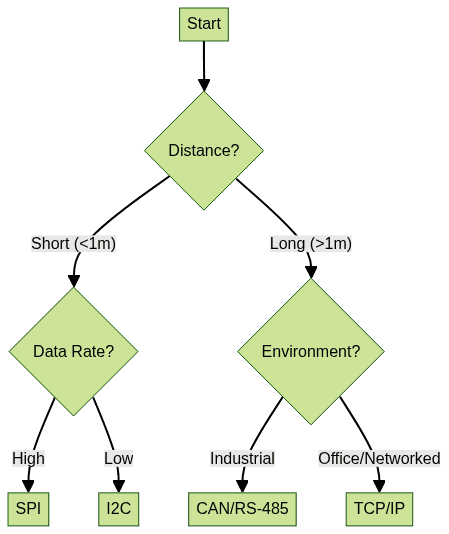
Common Use Cases and Examples
Communication protocols play a pivotal role in various domains:
- Industrial Automation: CAN and RS-485 are used for robust, real-time machine control.
- IoT Device Communication: MQTT and HTTP enable remote sensor and actuator integration.
- Microcontroller Interfacing: UART, SPI, and I2C protocols connect sensors, displays, and memory.
- Networked Applications: TCP/IP underpins everything from web browsing to cloud computing.
Here's a sample IoT sensor setup using MQTT in Python:
1# IoT sensor MQTT publish example
2import paho.mqtt.client as mqtt
3client = mqtt.Client()
4client.connect("broker.hivemq.com", 1883, 60)
5client.publish("iot/sensor/temp", "25.4")
6client.disconnect()
Advantages and Disadvantages of Key Communication Protocols
A comparative overview of communication protocols helps in selecting the right one for your needs:

Conclusion
Communication protocols are fundamental to all digital and analog systems, enabling seamless, secure, and reliable data exchange. In 2025, the choice of communication protocols determines system interoperability, efficiency, and resilience. Whether for embedded development, industrial automation, or large-scale networking, understanding and implementing the right communication protocols is key to building robust technological solutions. Ready to enhance your applications with advanced communication features? Try it for free and experience seamless integration today.
Free $20 Balance for AI Voice Agents & Video Calls
FAQ