


A multilingual LLM for voice agents is a large language model that understands, reasons over, and generates text across many languages within a real-time speech pipeline. Combined with multilingual speech-to-text and text-to-speech, it lets a single voice agent serve callers in dozens of languages without separate bots per locale. VideoSDK's AI Agent SDK connects these LLM, STT, and TTS providers into low-latency voice sessions, so you can deploy one multilingual agent across web, mobile, and phone channels. Read the AI Agents docs to get started.
A support call center in Dubai might receive Arabic, Hindi, English, and Tagalog in the same hour. Building a separate voice bot for each language means separate codebases, separate tuning, and separate failure modes. A multilingual LLM collapses all of that into one pipeline that detects the caller's language, reasons in it, and responds in a natural voice within a second.
That is the promise, but the engineering is non-trivial. Cross-lingual speech recognition, multilingual speech synthesis, and low-latency LLM inference each carry their own failure modes, and they compound when chained together. This guide walks through the full architecture: the challenges, the core components, how to select models, how to build the end-to-end pipeline, and how to optimize latency and quality in production.
Multilingual LLM for Voice Agents: Challenges and Opportunities
Building a multilingual voice agent is harder than a monolingual one because every layer of the pipeline must handle multiple scripts, accents, and prosody patterns simultaneously. The core challenges are data scarcity for low-resource languages, tokenization inefficiency across non-Latin scripts, end-to-end latency budgets, and pronunciation fidelity when synthesized speech meets mixed-language input.
Data scarcity bites hardest at the STT layer. A model trained mostly on English and Mandarin will degrade sharply on Swahili or Bengali, and word error rate (WER) climbs fast once you leave high-resource languages. Tokenization matters at the LLM layer: some scripts fragment into many more tokens per sentence, which inflates inference time and cost. Latency compounds across the chain, and pronunciation fidelity becomes critical when a caller code-switches mid-sentence, a common pattern in bilingual regions.
The opportunities are just as large. One unified codebase serves every market, cutting maintenance cost dramatically. Global reach opens overnight: the same agent handles a Tokyo caller and a São Paulo caller. And user satisfaction measurably improves when people can speak their preferred language instead of navigating an English-only menu.
Here is what the overall architecture looks like:
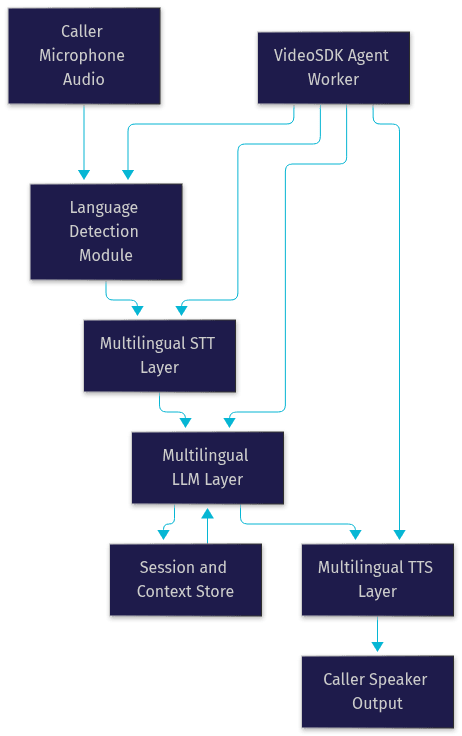
The language detection module can sit before STT or run in parallel with it, feeding a language hint downstream so the LLM and TTS layers respond in the right language from the first utterance.
Core Components of a Multilingual Voice Agent
A multilingual voice agent is a chain of four cooperating components: speech recognition, language reasoning, speech synthesis, and language routing. Each has distinct selection criteria and failure modes.
Speech-to-Text (STT) Layer
The STT layer converts caller audio into text, and its multilingual accuracy sets the ceiling for everything downstream. If transcription mishears a Hindi word, the LLM reasons over garbage no matter how good it is.
Two metrics dominate evaluation: word error rate per language and transcription latency. A model that scores 8% WER on English but 25% on Tamil is not truly multilingual for your use case. Look for providers that publish per-language WER on conversational audio rather than clean read speech. Deepgram, Google Cloud STT, OpenAI Whisper, and AssemblyAI all offer multilingual models with automatic language identification, and each publishes benchmark data worth comparing against your target languages.
Streaming transcription is essential for voice. Batch models that transcribe a finished recording add seconds of latency; streaming models emit partial hypotheses as the caller speaks, letting the LLM start reasoning before the sentence ends.
Large Language Model (LLM) Layer
The LLM layer is where multilingual understanding actually happens. Modern frontier models from OpenAI, Google, and Anthropic handle dozens of languages natively, but quality varies by language tier. High-resource languages like Spanish and French perform near English levels; low-resource languages can show weaker instruction following and more hallucination.
Context handling matters for conversations. The model needs the running dialogue history plus a system instruction that defines supported languages and fallback behavior. A practical prompting strategy is language-agnostic: instruct the model to respond in the language of the user's most recent utterance, rather than pinning it to a session locale. This handles code-switching gracefully, where a caller alternates between two languages mid-conversation.
For latency, smaller multilingual models often beat frontier models in voice settings. A response that arrives in 300 milliseconds with 95% quality beats one that arrives in 2 seconds with 98% quality, because callers perceive anything beyond roughly a second as broken conversation.
Text-to-Speech (TTS) Layer
The TTS layer turns the LLM's text back into speech, and multilingual TTS is the least mature link in the chain. Two approaches dominate. Fine-tuned multilingual TTS models are trained per language family and deliver the most natural prosody but require per-language assets. Zero-shot multilingual models, including voice cloning systems from providers like ElevenLabs and Cartesia, generate speech in many languages from a single voice sample, trading some naturalness for massive coverage.
Voice cloning raises a practical consideration: a cloned voice may sound native in English but accented in Korean. Test cloned voices per language with native speakers before shipping. Also watch for script handling, since some TTS models mishandle mixed-script output, such as an English brand name inside an Arabic sentence.
Language Detection and Switching
The language detection module identifies which language the caller is speaking, either as a standalone classifier or as a feature of the STT model. Real-time language identification typically needs only a second of audio to reach high confidence.
The harder problem is mid-conversation switching. If a caller starts in Spanish and switches to English, the agent should follow without asking them to repeat. The cleanest pattern is to let the STT layer emit a language tag with each transcript segment, pass that tag to the LLM as context, and let the TTS layer read the response language from the LLM's output rather than from a session-level setting. This keeps switching seamless at the segment level instead of requiring a session reset.
Selecting the Right Multilingual Models
Model selection comes down to four criteria: language coverage, model size versus latency, licensing, and open-source versus commercial trade-offs.
Language coverage is the first filter. List every language your users actually speak, including dialects, and check per-language benchmarks, not headline counts. A model claiming 100 languages may cover your top five poorly. Model size versus latency is the second filter: for real-time voice, favor models that can complete inference in a few hundred milliseconds on your available hardware. Licensing is the third: open-weight models like Qwen3-Omni or community multilingual TTS projects let you self-host and avoid per-token costs, but you own the GPU bill and the ops burden. Commercial APIs cost more per minute but remove infrastructure work.
The decision flow looks like this:
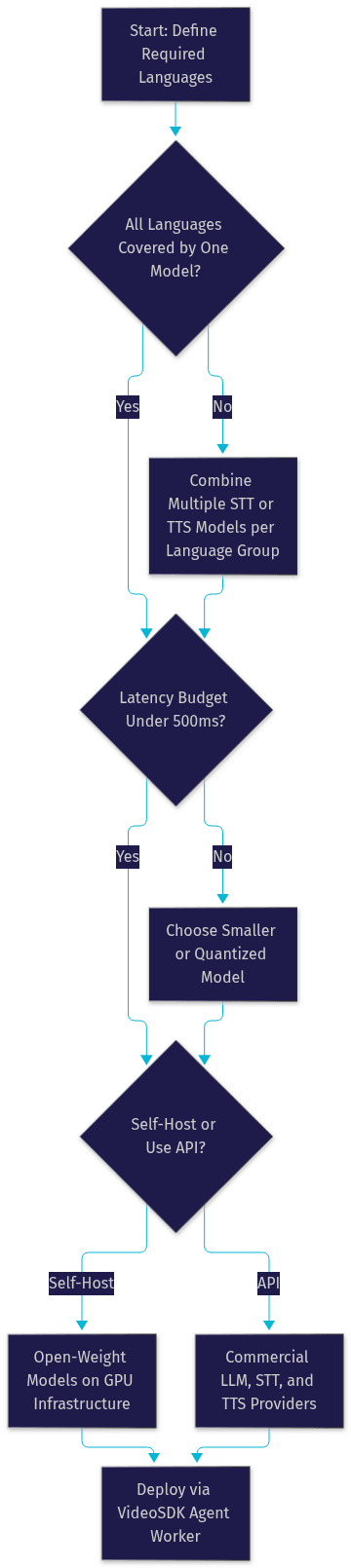
A pragmatic pattern many teams land on: commercial APIs for the LLM (where frontier quality matters most), and a mix of commercial and open-weight models for STT and TTS depending on language coverage gaps.
Building the End-to-End Pipeline
The pipeline flows from caller audio to agent speech in a continuous loop. Here is the full path in narrative form.
Step 1: Session setup. When a caller connects, your backend creates a session, authenticates it with a token, and initializes the agent worker. With VideoSDK's AI Agent SDK, the worker is a Python process that joins a VideoSDK room and manages the pipeline lifecycle, whether the caller connects via web, mobile, or a SIP phone line through the telephony integration.
Step 2: Audio ingestion and language detection. The caller's audio stream arrives at the agent worker, which routes it to the STT layer. If your STT model supports automatic language identification, it emits a language tag alongside the transcript. Otherwise, a lightweight classifier runs on the first second of audio and passes a language hint downstream.
Step 3: Streaming transcription. The STT layer emits partial transcripts as the caller speaks. Turn detection, the mechanism that decides when the caller has finished speaking, watches these partials for natural pause boundaries and triggers the LLM only at utterance end. Good turn detection is what makes the agent feel conversational rather than walkie-talkie.
Step 4: LLM reasoning. The transcript, the language tag, the conversation history, and the system instruction go to the LLM. The model generates a response in the caller's language. If your agent needs structured behavior, such as collecting a loan application step by step, VideoSDK's Conversational Graph lets you define the flow deterministically while the LLM handles only the natural language generation in whatever language the caller uses.
Step 5: Speech synthesis and playback. The LLM's text output streams to the TTS layer, which synthesizes audio in the response language and plays it back into the room. Streaming TTS, which synthesizes sentence-by-sentence rather than waiting for the full response, cuts perceived latency dramatically.
Step 6: Handling language switches. If the next transcript segment carries a different language tag, the LLM follows the new language and the TTS layer synthesizes accordingly. Because language is decided per segment rather than per session, switching is invisible to the caller.
Production considerations are where tutorials usually stop short. Scaling means running multiple agent worker processes, one per active session, which is why a managed option like VideoSDK Agent Cloud or a containerized self-hosted deployment matters. GPU versus CPU depends on your model choices: commercial APIs offload all inference, while self-hosted STT and TTS typically need GPU instances. Real-time constraints mean every layer must stream, not batch. And fallback mechanisms are essential: if the STT model fails on an unsupported language, the agent should gracefully ask the caller to switch to a supported language rather than hallucinate.
Optimizing Latency and Quality
Latency is the metric that decides whether users stay. The target for natural conversation is a round-trip time under one second from end of caller speech to start of agent speech, with under 500 milliseconds being the gold standard.
Four techniques deliver most of the win. Streaming inference at every layer means the LLM starts generating as soon as the utterance boundary is detected, and TTS starts synthesizing as soon as the first sentence of the LLM response is available. Chunked audio processing keeps STT memory and compute bounded on long utterances. Model quantization reduces self-hosted inference time at a small quality cost, and is often worth it for voice where speed dominates. Caching helps in two places: TTS caching stores synthesized audio for repeated phrases like greetings and disclaimers, and LLM prompt caching reduces cost on repeated system contexts. VideoSDK's agent pipeline includes built-in TTS caching for exactly this reason.
For monitoring, track round-trip time per session, audio quality via mean opinion score (MOS) sampling, and per-language WER on a held-out test set. Alert on language-specific degradation, since a model update can silently break one language while improving others.
Debugging multilingual edge cases deserves its own checklist. Test code-switching explicitly, since mixed-language sentences break both STT and TTS boundaries. Test numbers, dates, and currency formats per locale, because LLMs frequently format these in the wrong locale's convention. Test proper nouns across scripts, since a TTS model may mispronounce an English name inside a Japanese sentence. And test accented speech of the same language, since a Spanish model trained on Castilian audio may struggle with Mexican Spanish callers.
Real-World Use Cases and Success Stories
Customer support centers are the clearest fit. A single multilingual agent handles inbound calls in a dozen languages, deflecting routine queries before human escalation. With SIP telephony integration, the same agent answers both web callers and traditional phone callers, and the AI voice agent pipeline keeps latency low enough for natural phone conversation.
Multilingual virtual assistants in e-commerce are another proven pattern. A live shopping platform can let a host present in one language while the agent answers buyer questions in each buyer's own language, powered by the same interactive live streaming infrastructure that handles the video and chat layers.
Educational platforms round out the picture. Language-agnostic tutoring means one agent tutors math in Portuguese for a São Paulo student and in Hindi for a Mumbai student on the same deployment, with the LLM adapting explanations to each language's academic conventions.
Future Trends in Multilingual Voice Agents
Three research directions will reshape this stack over the next two years. Diffusion-based TTS models are improving multilingual naturalness fast, narrowing the gap between zero-shot and fine-tuned voices. Instruction-tuned speech-native LLMs, which process audio directly without a separate STT step, promise to collapse the pipeline and remove one latency stage entirely. And multimodal grounding will let agents reference what they see, not just what they hear, which matters for support agents that read shared screens or documents.
Zero-shot language coverage will keep expanding. The practical effect for developers is that the maintenance burden of per-language models shrinks each year, and the winning architecture is the one designed to swap models per layer without rewriting the pipeline. That is exactly why a layered agent architecture with pluggable providers ages well.
Definitions Glossary
Multilingual LLM: A large language model trained on text across many languages, able to understand and generate responses in the caller's language without per-language fine-tuning.
Cross-lingual speech recognition: Speech-to-text that transcribes audio in multiple languages, often with automatic language identification that tags each transcript segment with its detected language.
Zero-shot voice cloning: Multilingual text-to-speech that generates speech in many languages from a single voice sample, without per-language training data for that voice.
Turn detection: The pipeline mechanism that decides when a caller has finished speaking and the agent should begin responding, critical for natural conversational pacing.
Agent Worker: The Python process in VideoSDK's AI Agent SDK that manages a voice agent session, orchestrating the STT, LLM, and TTS layers inside a VideoSDK room.
Key Takeaways
- A multilingual LLM lets one voice agent serve every market from a single codebase, replacing per-language bots with a unified pipeline.
- Evaluate STT and TTS models on per-language benchmarks, not headline language counts, and test with real accented conversational audio.
- Handle language as a per-segment property flowing from STT through the LLM to TTS, so mid-conversation code-switching works without session resets.
- Target sub-one-second round-trip latency using streaming inference at every layer, plus TTS caching for repeated phrases.
- VideoSDK's AI Agent SDK connects your chosen LLM, STT, and TTS providers into low-latency sessions across web, mobile, and phone channels, with Conversational Graph available for deterministic multilingual flows.
Conclusion
Building a multilingual voice agent in 2026 is a solvable engineering problem: pick models with verified per-language performance, design language handling at the segment level, and optimize every layer for streaming. The teams that win treat the pipeline as pluggable layers rather than a monolith, so better models swap in as they ship. VideoSDK gives you the session infrastructure to make that real, from the open-source AI Agent SDK to managed deployment on Agent Cloud. Start with the AI Agents documentation, grab your free tier at app.videosdk.live/login, and join the Discord community when you hit a wall. What are you building with multilingual voice agents? Drop a comment, I'd love to hear which languages you're targeting and where the pipeline bites hardest.
Free $20 Balance for AI Voice Agents & Video Calls
FAQ