


An LLM for conversational AI is a large language model optimized to power chatbots, voice agents, and virtual assistants through natural, multi-turn dialogue. The right choice balances real-time inference latency, token pricing, context window size, and safety guardrails. VideoSDK's AI Agent SDK connects these models to live voice and video rooms, letting you deploy production conversational agents across web, mobile, and telephony channels.
Conversational AI has moved from novelty to infrastructure. In 2026, customers expect chatbots and voice assistants to respond in under a second, remember what they said three turns ago, and handle text, audio, and images in the same conversation. Behind every one of those experiences sits an LLM, and the model you pick quietly determines your latency budget, your monthly bill, and how often your assistant says something embarrassing.
The market has never been more crowded. OpenAI, Google, and Anthropic ship fast, cheap flagship-tier models. Open-source options like Llama 4 Maverick and Mixtral 8x7b let you self-host and control costs at scale. Meanwhile, real-time multimodal models are collapsing the traditional speech-to-text, LLM, text-to-speech pipeline into a single inference step.
This guide breaks down how to evaluate an LLM for conversational AI, compares the leading proprietary and open-source options, walks through a realistic cost analysis, and covers deployment architecture so your assistant performs in production, not just in a demo.
What Is an LLM for Conversational AI?
An LLM for conversational AI is defined as a large language model tuned or configured for multi-turn dialogue, where the model must interpret user intent, maintain conversation state, and generate contextually appropriate responses in real time. Unlike one-shot text generation, conversational use demands low latency, consistent persona behavior, and reliable handling of ambiguous or incomplete input.
An LLM powers chatbots and virtual assistants by processing the full conversation history (the context window) plus a system prompt that defines its role, then generating the next response token by token. Function-calling capabilities let the model trigger external actions, such as checking an order status or booking an appointment, while safety filters keep outputs within policy. VideoSDK's AI Agent SDK wraps this entire loop so developers can connect any LLM provider to live voice and video sessions.
Core Evaluation Criteria for Conversational AI Models
Evaluating conversational AI models requires looking past benchmark leaderboards at the metrics that shape real user experience. A model that scores brilliantly on reasoning tests but takes four seconds to start speaking will feel broken in a voice assistant. These five criteria form the practical evaluation framework.
Performance and Latency
Latency is the single most user-visible property of a conversational LLM. Two numbers matter: time-to-first-token (TTFT), which is how long until the model starts responding, and tokens-per-second, which determines how quickly the full response streams out. For chat interfaces, a TTFT under 500 milliseconds keeps the experience feeling responsive. For voice agents, the budget is tighter, because speech-to-text and text-to-synthesis add their own delays, so the LLM layer should target roughly 200 to 300 milliseconds to keep total round-trip response under one second. Streaming output is essential, since showing or speaking the first words immediately masks the remaining generation time.
Cost Efficiency
LLM pricing is token-based, with separate rates for input tokens (what you send, including conversation history) and output tokens (what the model generates). Input is almost always cheaper, but conversational workloads are input-heavy, because every turn resends the accumulated dialogue. A 20-turn conversation can easily consume ten times more input than output tokens. Total cost of ownership also includes embedding costs, fine-tuning expenses, moderation API calls, and, if you self-host, GPU infrastructure. Always model your worst-case month, not your average one, because traffic spikes and verbose users drive the bill.
Context Length and Memory
The context window defines how much conversation the model can "see" at once. Windows now range from 8,000 tokens to over a million, but bigger is not automatically better: longer windows cost more per request and can dilute instruction-following. For long-form dialogue, such as support sessions or tutoring, a 128,000-token window comfortably handles hours of conversation. For state-tracking across sessions, you need external memory, either summarization into the prompt or a retrieval layer, since the window resets each request.
Multimodality and Tool Use
Modern conversational AI models increasingly accept images, audio, and video alongside text, enabling assistants that can look at a photo of a broken part or hear frustration in a customer's voice. Function calling (tool use) is equally important: it lets the LLM request real actions, like querying a database or initiating a call transfer, with structured outputs your application can execute. Real-time multimodal variants, such as OpenAI's Realtime API and Google Gemini Live, process speech directly and cut pipeline latency dramatically.
Safety and Guardrails
Production assistants need built-in moderation for harmful content, hallucination mitigation through grounding and retrieval, and compliance alignment for regulated industries like healthcare and finance. Evaluate whether safety filtering happens at the provider level, in your orchestration layer, or both, and test edge cases deliberately, because a single policy-violating response can do more brand damage than a thousand slow ones.
Landscape of Available LLMs for Conversational AI
The 2026 LLM landscape splits into three tiers: proprietary APIs optimized for price-performance, open-source weights you can self-host, and niche models built for specific conversational behaviors. Here is how the leading options stack up.
Proprietary Offerings
Commercial models dominate production conversational AI deployments for good reason: they combine low latency, strong instruction-following, and managed infrastructure.
OpenAI GPT-4o Mini remains the workhorse for high-volume chat. It streams quickly, handles function calling reliably, and its token pricing sits at the low end of the proprietary spectrum, making it the default choice for cost-sensitive chatbot workloads. Its larger sibling, GPT-4o, adds stronger reasoning and native multimodal input for escalation paths.
Google Gemini Flash is engineered for speed. It offers a very large context window, aggressive token pricing, and native integration of text, image, and audio understanding, which suits assistants that need to process documents or screenshots mid-conversation.
Anthropic Claude Haiku prioritizes response quality and safety. It follows system prompts with unusual consistency, produces notably concise outputs (which reduces output token spend), and benefits from Anthropic's constitutional-AI training approach, making it a strong fit for customer-facing and compliance-sensitive deployments.
All three are accessible through VideoSDK's AI Agents documentation as pluggable LLM providers.
Open-Source Alternatives
Self-hosting an open-source conversational LLM trades operational effort for cost control, data residency, and customization freedom.
Llama 4 Maverick is Meta's flagship open-weight model, offering strong general dialogue quality, a large context window, and a mature ecosystem of serving frameworks. At sufficient volume, self-hosted inference on GPU clusters undercuts per-token API pricing.
Mixtral 8x7b uses a mixture-of-experts architecture, activating only a fraction of its parameters per token. The result is small-model speed with large-model quality, ideal for latency-sensitive chat at scale.
CoALM-405B targets teams that need frontier-level conversational reasoning without proprietary dependencies, though its hardware requirements are substantial.
HelpingAI-9B-200k demonstrates how compact open models now compete: a 9-billion-parameter model with a 200,000-token context window, fine-tuned specifically for empathetic dialogue, capable of running on a single consumer-grade GPU.
Emerging Niche Models
A growing tier of specialized conversational models focuses on emotional intelligence (HelpingAI's empathy-focused variants), real-time speech-native interaction, and domain-specific agents for healthcare and legal workflows. These trade general capability for precision in a narrow conversational register, and they are worth evaluating when your assistant's persona is the product.
Comparative Table: Top LLMs for Conversational AI
[LINKABLE ASSET — comparison table]
| Model | Latency Class | Cost per 1M Tokens (Input/Output) | Context Window | Multimodal | Safety Features |
|---|---|---|---|---|---|
| OpenAI GPT-4o Mini | Very fast | Low / Low | 128k | Text, image, audio input | Built-in moderation |
| Google Gemini Flash | Fastest tier | Low / Low | Up to 1M | Text, image, audio, video | Provider-level safety filters |
| Anthropic Claude Haiku | Fast | Low-mid / Mid | 200k | Text, image | Constitutional AI training, refusals |
| Llama 4 Maverick (self-hosted) | Depends on hardware | Infra cost only | Large | Text, image | Self-managed guardrails |
| Mixtral 8x7b (self-hosted) | Fast (MoE efficiency) | Infra cost only | 32k | Text | Self-managed guardrails |
| HelpingAI-9B-200k | Fast on single GPU | Infra cost only | 200k | Text | Empathy-tuned, self-managed |
The most important row depends on your constraint: Gemini Flash wins on raw speed and context, GPT-4o Mini wins on managed-cost simplicity, and the self-hosted options win once monthly token volume makes GPU infrastructure cheaper than per-token API spend. Verify current pricing before committing, since provider rates change frequently.
Cost-Benefit Analysis: A Realistic Chatbot Workload
Consider a customer-support chatbot serving 200 million tokens per month, split roughly 85 percent input and 15 percent output, which is typical for multi-turn support dialogue where history accumulates.
With a low-cost proprietary model like GPT-4o Mini, input tokens dominate the bill. At published rates in the range of a fraction of a dollar per million input tokens and a slightly higher output rate, the monthly spend lands in the low hundreds of dollars, roughly 170 dollars for input plus about 45 dollars for output, totaling around 215 dollars per month. That includes zero infrastructure management, automatic scaling, and provider-side safety filtering.
Self-hosting Llama 4 Maverick changes the math entirely. A production-grade GPU serving setup capable of sustaining this throughput requires one or more high-memory accelerators, which at cloud rental rates cost several hundred to over a thousand dollars per month, plus engineering time for deployment, monitoring, and scaling. At 200 million tokens, self-hosting likely loses on pure cost. But at two billion tokens per month, the API bill scales linearly while GPU costs scale in steps, and self-hosting becomes dramatically cheaper, while also delivering data residency and unlimited fine-tuning freedom.
The crossover point typically sits somewhere between 500 million and one billion monthly tokens, depending on your latency requirements and hardware strategy. Below that, managed APIs win on total cost of ownership. Above it, open weights win.
Deployment Considerations for Conversational LLMs
Getting an LLM into production involves three layers: inference infrastructure, integration architecture, and observability. Skipping any of them is how demo-quality assistants fail in the wild.
Inference Hardware and Scaling
GPU inference is mandatory for large models, but the choice between owning GPUs and using inference-as-a-service matters more than the hardware itself. Managed inference platforms (from the model providers themselves or neutral hosts like Together and Fireworks) handle auto-scaling, batching, and failover, and they let you start without capacity planning. If you self-host, plan for auto-scaling based on concurrent request count rather than CPU metrics, keep a warm pool to avoid cold-start latency spikes, and use batching carefully, since aggressive batching improves throughput but inflates time-to-first-token. For voice workloads, prioritize TTFT over raw throughput.
Integration Architecture
A conversational LLM never runs alone; it sits inside a request pipeline. The diagram below shows the typical flow for a production assistant, from user request through gateway-level checks, LLM inference, and optional post-processing before the response reaches the user.
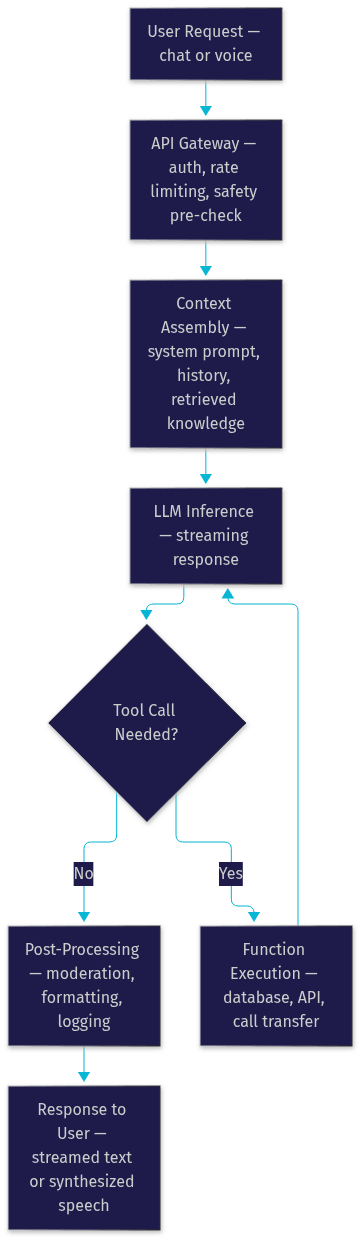
VideoSDK's Agent SDK implements this exact pattern for real-time voice and video, with the agent worker managing the session, pipeline, and tool execution inside a live room. For deterministic flows where every step must happen in order, such as loan applications or appointment booking, VideoSDK's Conversational Graph adds a graph-based orchestration layer on top of the LLM.
Monitoring and Observability
Track four metric families from day one: latency percentiles (especially p95 and p99 time-to-first-token, since averages hide the bad experiences), error and refusal rates, cost per conversation, and quality signals like user thumbs-down rates or escalation-to-human frequency. Alert on latency regressions, not just outages, because a slow assistant is a silently failing one.
Prompt Engineering and Conversation Management
The system prompt is your assistant's constitution: it defines persona, scope, refusal behavior, and output format, and it should be versioned and tested like code. Keep it specific rather than aspirational, and state what the assistant should do rather than only what it must avoid.
For conversation management, trim history intelligently. Rather than sending the entire transcript every turn, summarize older exchanges and inject the summary at the top of the context, keeping recent turns verbatim. This cuts input token cost substantially on long sessions with minimal quality loss. For turn-taking in voice contexts, rely on turn detection and voice activity detection to decide when the user has finished speaking, and design the system prompt to favor short, spoken-friendly responses, since a paragraph-length reply feels wrong in a voice conversation. Finally, ground the model in retrieved knowledge for factual claims; hallucination rates drop sharply when the prompt supplies the source material rather than asking the model to recall it.
Future Trends in Conversational LLMs
Three shifts are reshaping the category in 2026. First, real-time multimodal models are eliminating the stitched speech-to-text, LLM, text-to-speech pipeline, processing audio natively and cutting end-to-end voice latency toward half a second. Second, adaptive context windows are emerging, where models dynamically allocate attention across very long histories without linear cost growth, making all-day assistant sessions practical. Third, pricing models are diversifying: providers are experimenting with per-conversation, capacity-based, and cached-prompt pricing, which particularly rewards conversational workloads whose long system prompts repeat across thousands of requests. Providers change offerings quickly, so re-evaluate your model choice quarterly.
Definitions Glossary
LLM for Conversational AI: A large language model configured or fine-tuned for multi-turn dialogue, where it must maintain context, track conversation state, and respond within real-time latency budgets.
Time-to-First-Token (TTFT): The delay between sending a request and receiving the model's first generated token. It is the dominant factor in perceived responsiveness for chat and voice assistants.
Context Window: The maximum number of tokens a model can process in a single request, including system prompt, conversation history, and current user input.
Function Calling: An LLM capability that produces structured requests for external actions, such as database queries or call transfers, which the host application then executes.
Agent Worker: In VideoSDK's architecture, the Python process that runs an AI agent's session, managing the speech-to-text, LLM, and text-to-speech pipeline inside a live room.
Conversational Graph: VideoSDK's deterministic orchestration layer that defines conversation flow as a directed graph of nodes and transitions, with the LLM handling only natural language generation.
Key Takeaways
- Choose an LLM for conversational AI by balancing latency, token cost, context window, multimodality, and safety, not by reasoning benchmarks alone.
- For voice agents, target roughly 200 to 300 milliseconds of LLM latency so the total round trip stays under one second.
- Managed APIs like GPT-4o Mini, Gemini Flash, and Claude Haiku win on total cost of ownership below roughly 500 million monthly tokens; self-hosted open models like Llama 4 Maverick and Mixtral 8x7b win above it.
- Input tokens dominate conversational bills because history resends every turn, so summarize older dialogue to control spend.
- VideoSDK's AI Agent SDK and Conversational Graph connect any of these LLMs to production-grade real-time voice, video, and telephony channels.
Conclusion
Selecting the right LLM for conversational AI in 2026 is a systems decision, not a model decision. The winner is the model whose latency fits your response budget, whose token pricing fits your volume, and whose safety posture fits your industry, deployed inside an architecture that monitors all three. Start with a managed API if you are below the cost crossover, pilot an open-weight model as you scale, and let real usage data, not benchmarks, make the final call. To see how these models perform in live conversations, explore the VideoSDK AI Agents quickstart or grab free credits at app.videosdk.live. What are you building with conversational AI? Drop a comment, I'd love to hear what kind of assistant use case you're working on.
Free $20 Balance for AI Voice Agents & Video Calls
FAQ