


A Google LLM for voice combines Gemini text-to-speech, Voice Design API, and audio transcription models to generate natural, expressive speech from text prompts. Developers can create custom vocal personas, produce multi-speaker audio, and build real-time voice agents using Google's multimodal Gemini models. Start by exploring the Gemini TTS capabilities in Google AI Studio, then integrate via the Gemini API for production workloads.
Developers building voice-first applications in 2026 face a problem that did not exist two years ago: too many good options. The gap between robotic text-to-speech and genuinely human-sounding voice generation has nearly closed, thanks to large language models trained on audio data. Google's Gemini family now includes models specifically designed for speech synthesis, transcription, and real-time voice interaction.
A Google LLM for voice is the combination of Gemini text-to-speech models, the Voice Design API for creating custom vocal personas, and Gemini Audio models for transcription and live translation. Together, these components let developers build pipelines that go from a text prompt to studio-quality audio in seconds, with control over pacing, emotion, accent, and speaker identity.
By the end of this guide, you will understand the core Google voice model families, how to structure an end-to-end voice generation pipeline, practical integration patterns for production applications, and how Google's offering compares to alternatives like Azure Speech, Amazon Polly, and ElevenLabs.
What Is a Google LLM for Voice?
A Google LLM for voice is a suite of Gemini-based models and APIs that generate, transform, and transcribe speech using large language model architecture rather than traditional concatenative or parametric TTS engines. Google's voice LLM stack treats speech generation as a token prediction problem, where the model has been trained on vast corpora of audio data and can produce novel speech patterns, emotional inflections, and speaking styles that were never explicitly recorded.
The key distinction from traditional TTS is architecture. Conventional systems assemble audio from pre-recorded phoneme fragments or use statistical models to map text features to acoustic parameters. A Google LLM for voice, by contrast, generates speech the same way a text LLM generates words: by predicting the next audio token given the preceding context. This means the model can infer emotional tone from the text itself without explicit markup, support multi-speaker generation natively, and integrate with the broader Gemini LLM family for chained text generation, reasoning, and speech synthesis in a single pipeline.
Google's current voice LLM stack includes several model families. Gemini 3.8 Flash TTS and Gemini 3.1 Flash TTS handle text-to-speech generation with different speed and quality tradeoffs. Gemini Audio encompasses Transcribe for speech-to-text, Live Translate for real-time translation, and Flash Live for streaming voice interactions. The Voice Design API allows developers to create persistent custom voice personas from text descriptions or audio samples.
Core Model Families
Google's voice LLM lineup splits into three functional tiers based on latency, quality, and use case requirements.
Gemini 3.8 Flash TTS is the flagship creative model, optimized for expressive, high-quality speech generation suitable for audiobooks, game dialogue, and narrative content. Gemini 3.1 Flash TTS, also called Flash-Lite, targets high-volume, cost-sensitive workloads like bulk dubbing and notification systems where per-character cost matters more than maximum expressiveness.
The Voice Design API operates separately from the TTS models. You describe a voice using natural language, such as a warm middle-aged female voice with a slight Scottish accent and a conversational pace, or provide a short audio sample. The API returns a persistent voice ID you can reference in subsequent TTS calls. This separation means you design a voice once and reuse it indefinitely across any text you generate.
Underlying all of these is audio codec research from Google's AudioLM and SoundStream projects. AudioLM demonstrated that language model architectures could generate coherent audio by treating codec tokens as a vocabulary. SoundStream provides the neural audio codec that compresses raw audio into discrete tokens and reconstructs high-fidelity audio from them. These technologies are the foundation that makes LLM-based voice generation possible.
End-to-End Voice Pipeline with Google LLMs
Building a production voice pipeline with Google LLMs involves four sequential stages, each with distinct configuration options and tradeoffs. Understanding how these stages connect is essential for producing high-quality audio at scale.
The pipeline begins with prompt creation. You write or generate the text you want spoken, optionally including style instructions like emotional tone, pacing hints, or speaker direction. Unlike traditional SSML-based systems, Gemini TTS models can interpret natural language style cues directly from the text prompt itself.
Next, if you want a custom voice, you invoke the Voice Design API. You provide either a text description of the desired voice characteristics or a short reference audio clip. The API returns a voice ID that persists across sessions. You can reuse this ID for any future TTS call, which means you design a voice once and reference it indefinitely.
The TTS generation step is where the actual audio synthesis happens. You send your text prompt, the voice ID if using a custom voice, and any model parameters to the Gemini TTS endpoint. The model processes the request and returns audio data, typically as PCM or WAV format.
Post-processing is optional but recommended for production. This stage can include noise suppression, volume normalization, format conversion, or integration with a real-time communication platform. For example, if you are building a voice agent, you would route the generated audio into a WebRTC session for live playback to the end user.
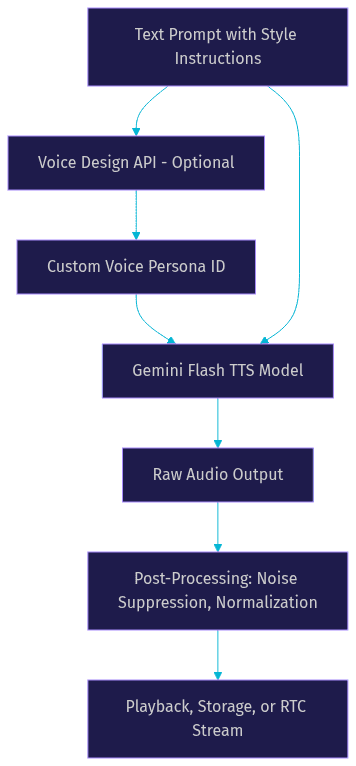
Where you insert custom controls matters. Style tags and pacing instructions belong in the initial text prompt. Accent and voice character settings belong in the Voice Design step. Audio quality adjustments belong in post-processing. Mixing these layers incorrectly, such as trying to control accent through post-processing, produces poor results.
Choosing the Right Model for Your Use-Case
Model selection depends on three factors: quality requirements, volume expectations, and latency constraints.
For creative content like audiobooks, game narratives, and podcast production, Gemini 3.8 Flash TTS delivers the highest expressiveness and emotional range. The tradeoff is higher per-character cost and slightly longer generation latency.
For high-throughput dubbing, notification systems, and bulk content processing, Gemini 3.1 Flash TTS (Flash-Lite) offers lower cost at acceptable quality. This model handles thousands of characters per second efficiently, making it suitable for processing entire video libraries or large document collections.
For real-time voice agents and interactive applications, Flash Live combined with Gemini Transcribe creates a streaming pipeline. Speech comes in as audio, gets transcribed, processed by the LLM, and converted back to speech with minimal latency. This is the architecture that powers live voice agents, and it pairs naturally with platforms like VideoSDK's AI Voice Agent SDK for real-time delivery over WebRTC.
Practical Integration Patterns
Production voice applications require more than a single API call. The integration pattern you choose determines your application's latency, cost, and user experience.
For single-speaker TTS, the Gemini Interactions API provides a straightforward request-response pattern. You send text, receive audio, and play it back. This pattern works well for reading assistants, notification systems, and any scenario where one voice speaks sequentially.
Multi-speaker generation is where Google's LLM approach shines. Instead of making separate TTS calls for each character, you can submit a single prompt with audio tags that indicate speaker switches. The model generates a continuous audio stream with natural transitions between speakers, including appropriate pauses, tone shifts, and conversational overlap. This is particularly valuable for dialogue-heavy content like radio dramas, training simulations, and interactive fiction.
The Voice Design workflow offers two paths. In Google AI Studio, you can experiment with voice creation visually, adjusting parameters and listening to samples before committing. For production, the programmatic API lets you automate voice creation as part of your build pipeline. A common pattern is to maintain a registry of voice IDs mapped to character names or brand personas, so your application references voices by logical name rather than raw ID.
Authentication uses standard Google Cloud credentials. For server-side applications, a service account with appropriate IAM roles is the recommended approach. For client-side prototypes, an API key works but should never be exposed in production code. Quota management is critical: the Gemini TTS endpoints have per-project rate limits that scale with your billing tier. Monitor usage closely during development to avoid unexpected throttling.
Production deployment introduces several considerations that quickstart guides often skip. HTTPS is mandatory for any client-facing audio delivery. Latency expectations should be set explicitly: Flash TTS models typically generate audio in 200 to 500 milliseconds for short prompts, but longer texts scale roughly linearly. Caching voice IDs and frequently used audio outputs dramatically reduces both latency and cost. For real-time agent scenarios, consider using VideoSDK's Conversational Graph to orchestrate deterministic conversation flows while the Gemini models handle natural language generation and speech synthesis.
If you are connecting voice agents to traditional phone systems, VideoSDK's telephony and SIP integration bridges the gap between WebRTC-based voice agents and standard phone networks, letting your Gemini-powered agent receive and make actual phone calls.
Error-Handling and Quality Assurance
Voice generation pipelines fail in predictable ways, and handling these failures gracefully separates production systems from demos.
The most common error is an invalid or expired voice ID. Voice IDs can be deactivated or deleted, so your application should validate voice IDs at startup and fall back to a default voice if the custom one is unavailable. Language mismatch errors occur when the text language does not match the voice's trained language; always validate language compatibility before generation.
Rate limit errors return HTTP 429 responses. Implement exponential backoff with jitter, and consider queueing requests during peak usage. For audio quality monitoring, Google Cloud Monitoring provides metrics on API latency, error rates, and quota usage. Set up alerts for latency spikes, which often indicate model congestion or network issues.
Real-World Use Cases
Google LLM for voice technology enables applications that were impractical with traditional TTS systems. Here are four production scenarios where developers are using these models today.
Audiobook creation with custom narrator personas is a natural fit. A publisher can design a unique voice for each series or character using the Voice Design API, then generate entire chapters through Gemini Flash TTS. The model's contextual understanding means it adjusts pacing and emotional tone based on the narrative content without requiring explicit markup for every sentence. One developer reported reducing audiobook production time from weeks to hours by combining Gemini TTS with a review-and-regenerate workflow.
Interactive voice agents for customer support represent the highest-growth use case. By chaining Gemini Transcribe, the Gemini LLM for reasoning, and Gemini Flash TTS for response generation, developers build agents that hold natural conversations. The key architectural decision is the delivery layer: WebRTC-based platforms like VideoSDK provide sub-second latency for real-time interaction, while HTTP-based streaming works for less time-sensitive applications.
Multilingual live dubbing for video platforms leverages Gemini's Live Translate and Flash-Lite TTS models. The pipeline transcribes original audio, translates the text, and generates dubbed audio in the target language. Flash-Lite's throughput makes it possible to process video content at scale, and the Voice Design API ensures the dubbed voice matches the original speaker's character.
Gaming NPC dialogue with dynamic emotion tags showcases the creative potential. Game developers feed dialogue text with emotional context, such as angry, whispering, or terrified, directly into the prompt. The Gemini TTS model interprets these cues and generates appropriately inflected speech, eliminating the need for pre-recorded voice acting for every possible dialogue branch.
Comparing Google LLM Voice to Competitors
Google's voice LLM stack competes with several established platforms, each with distinct strengths and tradeoffs. The right choice depends on your specific requirements for quality, customization, ecosystem integration, and cost.
Google's unique advantages include native integration with the Gemini LLM family for end-to-end text generation and speech synthesis, the Voice Design API for creating custom personas from text descriptions, and multi-speaker generation from a single API call. The multimodal architecture means you can chain reasoning, translation, and speech generation without switching providers.
However, competitors hold advantages in specific areas. Azure Speech Services offers the most mature SSML support, with granular control over phoneme timing, pitch contours, and prosodic features that Google's natural-language prompt approach does not yet match. Amazon Polly provides broad language coverage and deep AWS ecosystem integration. ElevenLabs leads in voice cloning quality from minimal audio samples and offers a larger library of pre-built voices.
For developers building real-time voice agents, the delivery platform matters as much as the TTS engine. VideoSDK's AI Voice Agent SDK supports multiple TTS providers including Google TTS, letting you swap engines without rebuilding your agent pipeline.
Comparison Table
| Provider | Key Voice LLM Feature | Multi-Speaker Support | Custom Voice Design | Best For |
|---|---|---|---|---|
| Google Gemini TTS | Native LLM integration, contextual speech | Yes, via audio tags | Voice Design API from text or sample | End-to-end AI voice agents, creative content |
| Azure Speech Services | Mature SSML, neural voices | Limited, requires multiple calls | Custom Neural Voice (requires approval) | Enterprise apps with SSML requirements |
| Amazon Polly | Broad language coverage | No native support | Brand Voice (limited availability) | AWS-ecosystem high-volume workloads |
| ElevenLabs | Voice cloning from short samples | Yes, conversation mode | Voice cloning and design | Rapid voice cloning, large voice library |
Google Gemini TTS leads for applications that need integrated LLM reasoning and speech generation in a single pipeline. Azure Speech remains the best choice when precise SSML control is non-negotiable. ElevenLabs wins for voice cloning from minimal samples. Amazon Polly suits high-volume AWS-native workloads where ecosystem integration outweighs raw voice quality.
Best Practices and Future Outlook
Getting the most from Google LLM for voice requires attention to prompt engineering, asset management, and responsible use practices. These three areas determine whether your voice application sounds professional or artificial.
Prompt engineering for expressive speech is an emerging discipline. Unlike SSML, which uses explicit tags for pitch and rate, Gemini TTS responds to natural language style instructions. Phrases like speaking softly with a hint of sadness or in an excited rapid pace produce measurable changes in the output audio. Experiment with different phrasings and compare results, as the model's interpretation of style cues can vary based on surrounding context.
Voice asset management becomes critical at scale. Maintain a catalog of voice IDs with metadata about their characteristics, intended use cases, and creation date. Google applies SynthID watermarking to AI-generated audio, which helps with provenance tracking but does not replace your own asset management practices. Rotate voice IDs periodically if your application uses them for authentication-adjacent purposes.
Looking ahead, Google's roadmap suggests continued investment in voice LLMs. The Gemini model family is expected to expand with improved real-time streaming capabilities and broader language coverage. Developers building on the current API should design their pipelines to be model-agnostic where possible, abstracting the TTS layer so future model upgrades require minimal code changes.
Ethical considerations are not optional. Voice cloning and generation technology raises concerns about impersonation, consent, and misinformation. Google's responsible AI practices require disclosure when AI-generated voices are used in public-facing content. Always obtain consent before cloning a real person's voice, and implement safeguards against generating misleading audio.
Definitions Glossary
Gemini Flash TTS: Google's large language model-based text-to-speech system that generates expressive speech from text prompts using token prediction architecture rather than traditional concatenative synthesis.
Voice Design API: A Google API that creates persistent custom voice personas from text descriptions or audio samples, returning a reusable voice ID for subsequent TTS calls.
AudioLM: A Google research project demonstrating that language model architectures can generate coherent audio by treating neural codec tokens as a vocabulary, forming the theoretical foundation for LLM-based voice generation.
SoundStream: Google's neural audio codec that compresses raw audio into discrete tokens and reconstructs high-fidelity audio from them, serving as the underlying codec technology for Gemini voice models.
SynthID Watermarking: Google's system for embedding imperceptible watermarks in AI-generated audio to enable provenance tracking and identification of synthetic speech.
Multi-speaker Generation: A capability of Gemini TTS models that produces audio containing multiple distinct speakers from a single API call, using audio tags to indicate speaker transitions.
Key Takeaways
- A Google LLM for voice combines Gemini TTS models, Voice Design API, and Gemini Audio models to provide end-to-end speech generation, transcription, and translation capabilities.
- Gemini 3.8 Flash TTS targets creative content with maximum expressiveness, while Gemini 3.1 Flash TTS (Flash-Lite) handles high-volume workloads at lower cost.
- The Voice Design API lets developers create custom voice personas from text descriptions or audio samples, with persistent voice IDs reusable across sessions.
- Multi-speaker generation from a single API call is a key differentiator from traditional TTS engines and most competitors.
- For real-time voice agent deployments, pairing Google Gemini TTS with a WebRTC delivery platform like VideoSDK provides sub-second latency for live interaction.
Conclusion
Google LLM for voice represents a fundamental shift in how developers build speech-enabled applications. By treating voice generation as a language modeling problem rather than a signal processing task, Google's Gemini models produce speech that understands context, conveys emotion, and handles multi-speaker scenarios natively. The combination of Flash TTS for generation, Voice Design for custom personas, and Gemini Audio for transcription creates a complete toolkit for voice-first development.
Start by experimenting with Gemini TTS in Google AI Studio, where you can test voice design and generation without writing server-side code. When you are ready for production, integrate via the Gemini API and consider pairing with VideoSDK's AI Voice Agent SDK for real-time delivery. If you are building deterministic conversation flows, explore the Conversational Graph for structured voice interactions.
What are you building with Google LLM for voice? Drop a comment below. I would love to hear what kind of voice application you are working on, whether it is an audiobook platform, a customer support agent, or something nobody has thought of yet. You can also join the VideoSDK Discord community to connect with other developers building real-time voice experiences. Sign up free at app.videosdk.live/login to start building today.
Free $20 Balance for AI Voice Agents & Video Calls
FAQ