


Live stream chat rooms combine a low-latency video stream with real-time text chat, participant roles, and moderation inside a single room-based experience. VideoSDK's Interactive Live Streaming (ILS) delivers sub-second latency with built-in chat, polls, and Q&A across React, Flutter, Android, iOS, and Unity SDKs. Start with the VideoSDK quick-start guide to get a working room running in minutes.
Live streaming has quietly become the default interaction model for everything from product launches to online tutoring. But a stream without chat is television, and developers building modern platforms know it. The chat room is where the audience actually lives: they react, ask questions, vote in polls, and occasionally need to be moderated before things go sideways.
The engineering challenge is that chat and video have very different requirements. Text chat needs message ordering, delivery guarantees, and moderation hooks. Video needs sub-second latency, adaptive bitrate, and a media routing layer that can scale to thousands of concurrent viewers. Most teams try to glue a chat service onto a video provider and spend months fixing the seams.
This guide covers how live stream chat rooms work, the architecture behind them, and how to build one with VideoSDK's Interactive Live Streaming, which handles both the video and the chat layer in a single room-based SDK.
What Are Live Stream Chat Rooms?
Live stream chat rooms are defined as real-time communication spaces where a live video or audio stream is paired with synchronized text chat, structured participant roles, and moderation controls. They work by connecting every audience member to a shared room: the host publishes media, viewers receive it at low latency, and all participants exchange chat messages over the same room session.
Three core components make up a live stream chat room. First, the media stream itself, the host's video and audio delivered to viewers. Second, the real-time chat layer, which carries text messages, reactions, polls, and Q&A alongside the video. Third, the participant role system, which distinguishes hosts, co-hosts, and viewers, and controls who can speak, stream, or moderate.
VideoSDK is defined as a real-time communication platform that provides Interactive Live Streaming (ILS) with built-in chat rooms. Unlike traditional HLS streaming, which buffers 10 to 30 seconds of delay, ILS keeps latency low enough that viewers can respond to the host in real time, which is exactly what a chat room needs to feel alive.
Core Benefits of Using VideoSDK for Live Stream Chat Rooms
VideoSDK's ILS mode is purpose-built for interactive streaming, and the practical benefits show up in four areas.
Sub-second latency. ILS is built on WebRTC media routing rather than buffered HLS delivery. Viewers see and react to the host in near real time, which makes chat, polls, and audience promotions feel conversational instead of delayed. When a host asks a question, viewers can answer while it is still relevant.
Built-in engagement features. Chat, polls, Q&A, and screen sharing ship inside the SDK rather than as add-ons. You do not need to integrate a separate chat provider, reconcile two session systems, or build moderation tooling from scratch. The interactive live streaming docs cover each feature directly.
Multi-platform SDKs. VideoSDK offers SDKs for React, JavaScript, React Native, Android, iOS, Flutter, and Unity. One product surface, one room model, and consistent behavior across web and mobile. For teams shipping both a web app and mobile apps, this removes an entire class of platform-parity bugs.
Scalable rooms with token-based security. Rooms run on an SFU (Selective Forwarding Unit) architecture in VideoSDK Cloud, and access is controlled through server-generated tokens. The Prebuilt UI Kit goes one step further, giving you a working stream-and-chat interface with zero custom UI code.
Architecture Overview: How a VideoSDK Live Stream Chat Room Works
The architecture follows a clean, vertical flow. A host or viewer device captures media and connects to VideoSDK Cloud through the platform SDK. VideoSDK Cloud, running the SFU, routes each participant's media and chat messages to everyone else in the room. A separate token server on your backend generates signed access tokens and hands them to clients before they join.
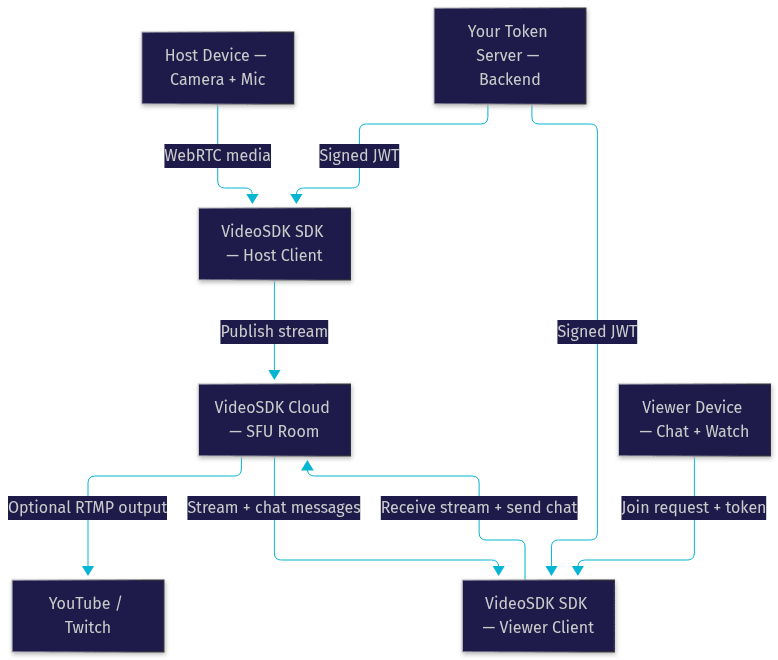
Two details matter here. First, the token server sits on your infrastructure, meaning you control who joins which room and with what role. Second, the SFU never mixes media into a single composite by default; it forwards tracks, which is what lets the same room scale from a two-person call to a large audience without re-architecting anything. Optional RTMP output lets you simultaneously broadcast the same stream to YouTube or Twitch while keeping the interactive chat room alive on your own platform.
Step-by-Step Implementation Guide
Here is the full implementation path in natural language. Each step describes what you do, why you do it, and what you should see when it works.
1. Set Up Your VideoSDK Account and Obtain API Keys
Create an account on the VideoSDK dashboard and copy your API key and secret. The key identifies your organization; the secret signs your tokens. Keep the secret on your server only. At this stage you can also explore the code samples to see complete reference apps for your platform.
2. Create a Secure Token Service
VideoSDK uses token-based authentication. Your backend generates a signed token using your API key and secret, embeds the participant's permissions and role into it, and returns it to the client. The client then presents that token when initializing the SDK. Never generate tokens in the browser, because that would expose your secret to every visitor. The authentication and token guide explains the claims you can embed, such as allowed roles and room scoping.
3. Initialize the SDK in Your Chosen Platform
Install the VideoSDK SDK for your platform, whether that is React on the web, Flutter for cross-platform mobile, or native Android and iOS. Initialize the SDK with the token from your token service. On success, the SDK establishes a connection to VideoSDK Cloud and exposes the room object you will use for everything else.
4. Join or Create a Live Stream Chat Room
A room is identified by a unique room ID. If the room does not exist, joining with that ID creates it; if it exists, the participant joins the live session. You can attach room metadata, such as a stream title or category, which your UI can read to render stream context. Participants join with a role: hosts can publish media and moderate, viewers watch and chat. You can create rooms ahead of time through the REST API if you prefer server-side orchestration.
5. Enable Real-Time Chat and Moderation Features
The SDK exposes chat events that fire when messages arrive, so your UI can render the chat panel and update it live. On the moderation side, you can mute a participant's chat, remove a participant from the room, and build reporting flows on top of participant events. Role-based access control lets you decide programmatically who can send chat, who can speak, and who can promote viewers to co-hosts.
6. Switch Between Host and Viewer Modes
VideoSDK ILS uses a single SDK surface for both modes, and you switch a participant's mode with the SDK's mode-change capability. A viewer promoted mid-stream becomes an active speaker without rejoining the room, which is the mechanic behind "raise hand" and "bring audience member on stage" features. This is the core differentiator between ILS and one-way HLS streaming.
7. Go Live and Monitor Room Health
Once live, VideoSDK handles network-adaptive streaming, automatically adjusting bitrate and resolution per viewer based on real-time bandwidth. Active speaker detection tells your UI who is talking so you can switch layouts. Use the REST API to pull session analytics and manage recording programmatically, so your team can review streams and chat logs after the event.
Managing Scale and Performance
Scaling live stream chat rooms is a routing problem, not a bandwidth problem you solve with a bigger server. VideoSDK's SFU architecture forwards each participant's media tracks to only the participants who need them, so adding viewers adds forwarding load rather than encoding load. This is why the same room model works for a tutoring session with three people and a virtual event with thousands.
Bandwidth adaptation is handled per participant. When a viewer's connection degrades, VideoSDK automatically steps down the resolution and bitrate delivered to that viewer instead of freezing or dropping them. The host's stream stays stable for everyone with good connections. In practice, teams running large virtual events report that this per-viewer adaptation is what keeps audience retention high on mobile networks.
For operations, the REST API gives you programmatic control over the full room lifecycle: create rooms before events, list active participants mid-stream, start and stop recording, and deactivate rooms after they end. Session analytics let your team answer questions like peak concurrent viewers, chat message volume, and average connection quality, which are exactly the metrics you need when tuning a recurring live series.
Moderation, Safety, and Community Tools
A chat room is only as good as its safety tooling. VideoSDK ships the building blocks: role-based access control so only trusted participants can speak or moderate, waiting rooms so you can screen participants before they join, and participant events that let you build mute, kick, and report flows.
For community safety, a few practices work consistently. Assign at least one dedicated moderator role for any stream above a few hundred viewers, because host-moderated chats degrade quickly. Use waiting rooms for invite-only events. Log chat through the recording and transcription features so you have an auditable record, which matters for compliance-sensitive verticals like finance and education. And design your report flow so moderators see flagged messages in context, with the participant's history, rather than as isolated alerts.
On data handling, VideoSDK supports end-to-end encryption for media and gives you control over where recordings live. If you operate under GDPR, review your data retention settings for recordings and transcripts and document them in your privacy policy.
Real-World Use Cases
Live shopping platforms use chat rooms to let viewers ask product questions mid-stream and hosts to answer instantly, with polls for audience preference. Sub-second latency is what makes the buy moment work.
Virtual events and webinars use host, co-host, and viewer roles with Q&A moderation, promoting audience questions to the stage one at a time.
Online tutoring uses small rooms with chat, screen sharing, and whiteboard-style collaboration, where ILS keeps the interaction genuinely two-way.
Gaming tournaments stream matches to large audiences while chat carries live commentary, predictions, and community reactions, with RTMP output simulcasting to Twitch.
Common Pitfalls and How to Avoid Them
Token expiry mid-stream. Tokens have a validity window. If a long stream outlives its token, participants can be disconnected on reconnect attempts. Generate tokens with a lifetime that comfortably exceeds your longest planned stream, and refresh them for participants you expect to promote.
HTTPS requirement in production. Browsers only grant camera and microphone access on secure origins. Everything works on localhost during development, then breaks in production if you deploy over plain HTTP. Serve your app over HTTPS from day one.
TURN fallback gaps. Some corporate and mobile networks block direct WebRTC paths. VideoSDK's cloud infrastructure includes relay fallback, but test your app on restrictive networks before launch, not after your first support tickets arrive.
Ignoring permission denial. Users deny camera or mic permissions constantly. Handle the denial state in your UI with a clear recovery path instead of a silent black tile.
Definitions Glossary
Room: A VideoSDK session container identified by a unique room ID, where participants share media streams and chat messages over WebRTC.
Interactive Live Streaming (ILS): VideoSDK's low-latency streaming mode where viewers can chat, respond, and be promoted to active speakers, switched via the SDK's mode-change capability.
Participant: A user connected to a VideoSDK room with an assigned role, such as host, co-host, or viewer, each with different permissions.
Meeting Token: A signed JWT generated server-side from your API key and secret that authenticates and authorizes a participant's access to a room.
SFU (Selective Forwarding Unit): The media routing architecture in VideoSDK Cloud that forwards individual media tracks to participants, enabling rooms to scale to large audiences.
Network-Adaptive Streaming: VideoSDK's automatic per-viewer adjustment of bitrate and resolution based on real-time bandwidth conditions.
Key Takeaways
- Live stream chat rooms pair low-latency video with real-time chat, roles, and moderation in a single room-based experience, and gluing separate chat and video providers together is the hard way to build one.
- VideoSDK's Interactive Live Streaming delivers sub-second latency with built-in chat, polls, and Q&A, so the engagement layer ships with the media layer.
- The same SDK surface covers React, JavaScript, React Native, Android, iOS, Flutter, and Unity, eliminating platform-parity work across web and mobile.
- Token-based authentication generated server-side is the security backbone; never expose your API secret to clients.
- Viewer-to-speaker promotion through mode switching is what separates interactive streaming from one-way HLS broadcast.
Conclusion
Building live stream chat rooms in 2026 is less about raw WebRTC engineering and more about choosing infrastructure that treats chat, roles, moderation, and scaling as first-class citizens. VideoSDK's ILS does exactly that, with sub-second latency, built-in engagement tools, and SDKs for every major platform. Start free on VideoSDK, follow the quick-start guide for your platform, and join the VideoSDK Discord community to compare notes with other developers. What are you building with live stream chat rooms? Drop a comment, I'd love to hear what kind of interactive streaming use case you're working on.
Free $20 Balance for AI Voice Agents & Video Calls
FAQ