


Conversational AI in sales refers to real-time, AI-driven voice and text systems that assist sales representatives during live calls by generating context-aware responses, detecting buyer intent, and automating CRM updates. Unlike post-call analytics, these systems operate with sub-500ms latency using speech-to-text, large language models, and text-to-speech pipelines. VideoSDK provides an open-source AI Agent SDK and Conversational Graph engine that lets developers build deterministic, production-grade sales voice agents with built-in telephony and CRM integration points.
Sales teams using AI-driven conversation tools have reported revenue lifts of 10 to 15 percent according to McKinsey's 2025 sales AI study, and that number is climbing as real-time inference gets faster. The gap between teams that deploy conversational AI and those that rely on manual call notes is widening every quarter.
Conversational AI in sales is not a chatbot bolted onto a website. It is a real-time system that listens to live sales calls, processes speech through a language model, and delivers actionable guidance to the rep or directly to the prospect within seconds. This article breaks down the architecture, walks through an implementation blueprint without code, covers best practices, and identifies the KPIs that matter when you ship this to a pilot team. By the end, you will understand how to build a conversational AI sales assistant using modern SDKs and real-time infrastructure.
What Is Conversational AI in Sales?
Conversational AI in sales is defined as a real-time artificial intelligence system that participates in or assists with sales conversations by processing live audio, generating contextually relevant responses, and automating downstream workflows like CRM updates and follow-up emails. It works by capturing speech through a streaming audio pipeline, converting it to text with speech-to-text, reasoning over that text with a large language model, and producing spoken or written output through text-to-speech.
This differs fundamentally from post-call analytics tools. Post-call tools record a meeting, transcribe it after the fact, and surface insights hours later. Conversational AI in sales operates during the call itself, enabling live objection handling, real-time coaching prompts, and instant lead qualification scoring.
The technology stack typically includes a real-time LLM for reasoning, a streaming STT engine for transcription, a TTS engine for spoken output, and a retrieval-augmented generation layer that connects the model to product catalogs, pricing sheets, and CRM records. VideoSDK's AI Voice Agent SDK provides the real-time room infrastructure that ties these components together, managing the audio streams, turn detection, and session lifecycle.
Core Components of a Conversational AI Sales System
A production-grade conversational AI sales system requires four tightly integrated components working in real time. Each component has specific latency and accuracy requirements that determine whether the system feels like a helpful copilot or a distracting delay.
Real-Time Language Model (LLM)
The LLM is the reasoning engine. It takes the transcribed conversation, applies sales context (deal stage, prospect industry, historical interactions), and generates the next best response or coaching prompt. For live sales calls, the LLM must produce responses in under 200ms of inference time to keep the interaction natural. Models like OpenAI's GPT-4o, Anthropic's Claude, and Google's Gemini are commonly used, with providers like Cerebras offering accelerated inference for lower-latency scenarios. The LLM must also handle sales-specific tasks: objection handling, competitive positioning, and pricing logic.
Speech-to-Text and Text-to-Speech
Low-latency STT and TTS are the bridge between human speech and machine reasoning. For live sales assistance, the STT engine must stream partial transcripts so the LLM can begin reasoning before the prospect finishes speaking. Providers like Deepgram, AssemblyAI, and OpenAI Whisper offer streaming endpoints designed for this. TTS must produce natural-sounding speech with minimal latency. According to Artificial Analysis's Speech Arena benchmark, leading TTS providers like ElevenLabs and Cartesia achieve sub-200ms time-to-first-audio, which is critical for maintaining conversational flow. VideoSDK's agent pipeline integrates with these providers through a plugin architecture, letting you swap STT and TTS engines without rewriting your agent logic.
Knowledge Base and Retrieval-Augmented Generation
A sales AI without access to your product catalog, pricing sheets, and playbooks is just a generic chatbot. Retrieval-augmented generation (RAG) solves this by connecting the LLM to your structured and unstructured sales data. When a prospect asks about pricing for a specific SKU, the RAG layer retrieves the relevant product document, injects it into the LLM context window, and the model generates an accurate, specific answer. This requires vectorizing your sales collateral, maintaining a retrieval index, and managing context window limits so the model does not hallucinate. VideoSDK's agent SDK supports RAG integration through its Python pipeline, allowing you to connect custom retrieval systems to the real-time conversation flow.
Intent and Signal Detection
Intent detection is what separates a conversational AI sales assistant from a general-purpose voice bot. The system must recognize buying signals in real time: budget mentions, timeline cues, decision-maker identification, competitor comparisons, and objection patterns. This is typically handled by a lightweight classifier running alongside the LLM, or by structured prompts that extract intent signals from each conversation turn. VideoSDK's Conversational Graph is particularly useful here because it lets you define deterministic extraction rules that pull structured data from unstructured conversation, ensuring no buying signal is missed.
How Conversational AI Enhances the Sales Funnel
Conversational AI in sales touches every stage of the funnel, from first contact to post-call follow-up. The value at each stage comes from reducing manual work for reps while increasing the quality and consistency of each interaction.
Lead Qualification
During initial calls, the AI agent asks qualifying questions based on your sales framework (BANT, MEDDIC, or custom criteria). As the prospect responds, the system extracts key data points like company size, budget range, and decision timeline, then writes them directly to CRM fields. This eliminates the rep needing to type notes mid-call and ensures every lead is scored consistently. With a deterministic conversation graph, you can enforce that every qualification question gets asked before the call advances, preventing reps from skipping critical discovery steps.
Discovery Calls
Discovery calls are where conversational AI delivers the most immediate ROI. The system listens to the prospect's responses and surfaces real-time coaching prompts to the rep through a separate audio channel or on-screen display. If the prospect raises a pricing objection, the AI can suggest a relevant case study or a discount tier based on historical deal data. If the prospect mentions a competitor, the AI pulls up a battle card within seconds. This real-time sales AI assistance means even junior reps perform closer to senior reps on discovery calls.
Proposal and Closing
At the proposal stage, conversational AI automates the generation of quotes, payment links, and follow-up emails based on the conversation's outcome. If the prospect agrees to a specific package, the AI can draft a proposal document using your templates, populate it with the discussed terms, and send it before the call ends. For closing, the system can generate payment links through your billing provider and schedule follow-up tasks. This reduces the time between verbal agreement and signed contract from days to minutes.
Post-Call Follow-Up
After the call, the AI generates a structured summary including key discussion points, objections raised, next steps, and extracted CRM fields. It creates tasks for the rep, schedules follow-up emails, and syncs everything to your CRM through API integration. VideoSDK's Python SDK supports post-call transcription and summary generation, so the follow-up workflow starts the moment the call ends. This eliminates the rep needing to spend 15 minutes after each call on administrative work.
Implementation Blueprint for Conversational AI in Sales
Building a conversational AI sales system requires careful platform selection, data integration, and conversation design. Here is a five-step blueprint that covers the full implementation path without code.
Step 1: Choose the Right Platform
Your platform choice determines latency, scalability, and integration flexibility. Evaluate SDKs based on their real-time audio handling, supported STT and TTS providers, and deployment options (cloud vs self-hosted). VideoSDK's AI Agent SDK is open-source and supports both managed cloud deployment and self-hosted Docker or Kubernetes setups. Consider whether you need telephony integration for outbound calls, web-based agents for video sales calls, or both. VideoSDK's telephony integration supports SIP trunk providers like Twilio, Telnyx, and Plivo, so you can build AI sales agents that make outbound phone calls directly.
Step 2: Connect Your Data Sources
Your AI sales agent is only as good as the data it can access. Connect your product catalog, pricing engine, CRM, and sales playbooks through APIs. The RAG layer needs structured access to this data so the LLM can retrieve accurate information during live calls. Map out which data sources are needed at each conversation stage: lead qualification needs CRM contact data, discovery calls need battle cards and case studies, and proposal generation needs pricing and contract templates. Use VideoSDK's function tools and MCP integration to let the agent call external APIs during the conversation.
Step 3: Set Up Real-Time STT and TTS
Select STT and TTS providers that support streaming, not batch processing. Streaming STT sends partial transcripts as the user speaks, so the LLM can start reasoning immediately. Streaming TTS begins audio output before the full response is generated, reducing perceived latency. Configure your providers through the agent pipeline, setting parameters for language, voice selection, and noise suppression. VideoSDK's agent SDK includes built-in VAD (voice activity detection) and de-noise processing, which are essential for sales calls where background noise is common. Target sub-500ms total round-trip latency from end of user speech to start of AI response.
Step 4: Define Conversation Stages
Map your sales stages to specific AI behaviors. For lead qualification, define the mandatory questions the AI must ask and the extraction rules for capturing responses. For discovery, define objection handling flows and coaching prompt templates. For closing, define the proposal generation workflow and CRM update actions. VideoSDK's Conversational Graph lets you define these stages as nodes in a directed graph, with deterministic transitions that enforce your sales process. This prevents the LLM from freewheeling and ensures every call follows your methodology. Define fallback actions for each stage: what happens if the prospect asks an off-topic question, or if the AI cannot find relevant information in the knowledge base.
Step 5: Deploy and Monitor
Roll out to a small pilot team before full deployment. Track three categories of metrics: latency (time-to-first-audio, total round-trip latency), accuracy (intent recognition F1 score, hallucination rate, CRM field extraction accuracy), and business outcomes (win rate, deal cycle time, rep adoption rate). VideoSDK's pipeline observability features let you monitor agent sessions in real time, including turn detection events, STT confidence scores, and LLM response times. Set up alerts for latency spikes and accuracy degradation. Plan for a human-in-the-loop fallback where high-stakes objections or pricing negotiations transfer to a human rep.
Here is the architecture for a typical conversational AI sales system:
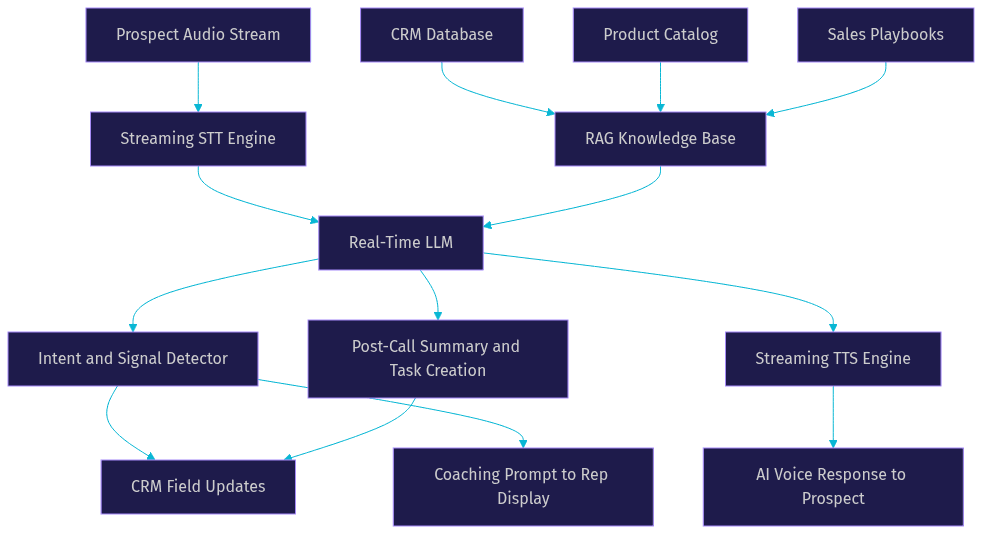
This diagram shows how data sources feed the RAG layer, how the real-time pipeline processes audio, and how intent detection drives both CRM updates and rep-facing coaching prompts simultaneously.
Best Practices and Common Pitfalls
Building conversational AI for sales is straightforward in architecture but unforgiving in execution. Here are the practices that separate production systems from prototypes.
Keep prompts concise and scoped. Long, complex prompts increase hallucination risk and inference latency. Break your sales logic into stage-specific prompts rather than one massive system prompt. The Conversational Graph approach handles this naturally by assigning each node its own focused context.
Guard against data leakage. Sales conversations often involve sensitive information: pricing, customer data, competitive intelligence. Implement role-based access control so the AI agent only retrieves data the current rep is authorized to see. If multiple reps use the same agent instance, ensure session isolation prevents cross-contamination of deal data.
Monitor latency obsessively. Sub-500ms round-trip latency is the threshold for natural conversation. Above that, prospects notice the delay and the interaction feels robotic. Track time-to-first-audio separately from total response time, because the first syllable is what the prospect perceives. If latency drifts above 500ms, investigate STT streaming configuration, LLM inference provider load, and TTS buffering settings.
Prepare human-in-the-loop fallbacks. AI sales agents handle 80 to 90 percent of conversation scenarios well, but the remaining 10 to 20 percent include high-stakes moments: complex pricing negotiations, legal questions, emotional objections. Define clear transfer triggers that hand the call to a human rep. VideoSDK's call transfer and warm transfer features support this, letting the AI agent seamlessly bridge the prospect to a human sales rep without dropping the call.
Avoid over-reliance on LLM judgment for structured data extraction. LLMs are good at generating natural language but unreliable at consistently extracting structured fields like budget numbers or timelines. Use deterministic extractors for structured data and reserve the LLM for natural language generation. This is a core design principle of VideoSDK's Conversational Graph.
Measuring Success: KPIs for Conversational AI in Sales
Measuring the impact of conversational AI in sales requires tracking both technical performance and business outcomes. Technical metrics tell you whether the system is working correctly. Business metrics tell you whether it is actually helping your sales team close more deals.
Revenue per rep is the ultimate bottom-line metric. Compare pilot team revenue against a control group over the same period. According to McKinsey's sales AI research, teams using AI-assisted selling tools see 10 to 15 percent revenue lifts, but your results depend on implementation quality and rep adoption.
Win-rate lift measures whether the AI is actually improving close rates. Track win rates before and after deployment, segmented by deal stage and rep experience level. Junior reps typically see larger lifts because the AI compensates for experience gaps.
Average deal cycle reduction tracks whether the AI is accelerating the funnel. If the AI handles lead qualification and follow-up automation, deals should move faster through early stages. Measure cycle time from first contact to closed-won.
Intent recognition accuracy is the core technical KPI. Measure this as an F1 score across a labeled test set of sales conversations. An F1 score above 0.85 is a reasonable production target for intent classification. Below that, the system misses too many buying signals or generates too many false positives.
Latency benchmarks determine whether the system is usable in live calls. Track median and 95th percentile round-trip latency. The median should be under 400ms and the 95th percentile under 700ms. Use Artificial Analysis's Speech Arena benchmark to evaluate whether your STT and TTS providers are performing at expected levels.
Rep adoption rate is the human factor that determines whether the system delivers value. If reps disable the AI or ignore its prompts, the technical metrics do not matter. Track how often reps actively use the AI coaching prompts and how often they override AI suggestions.
Future Trends in Conversational AI for Sales
The conversational AI sales landscape is evolving rapidly. Three trends will shape the next 12 to 18 months.
Multimodal agents will combine voice with visual elements. Instead of just speaking, the AI agent will share slides, product demos, and visual proposals during video sales calls. VideoSDK's vision and multi-modality support, along with avatar provider integrations, positions it well for this shift. A sales agent that can both talk and present visually will handle complex product demonstrations that today require a human rep.
Generative contract drafting will move from post-call automation to in-call generation. As LLM context windows grow and inference speeds improve, the AI will draft contract terms during the negotiation, adjusting language in real time based on the prospect's counteroffers. This requires tight integration with legal approval workflows and version control.
CRM-native integrations will deepen. Rather than building custom API connectors, expect CRM platforms to expose native AI agent hooks. Salesforce, HubSpot, and others are moving toward embedded AI agent frameworks. VideoSDK's REST APIs and server-side orchestration capabilities position it as the real-time layer that connects these CRM-native AI features to live voice and video channels.
Definitions Glossary
Conversational AI in Sales: A real-time AI system that assists with or automates sales conversations using speech-to-text, large language models, and text-to-speech, operating during live calls rather than post-call.
Conversational Graph: VideoSDK's deterministic flow engine that defines sales conversation stages as nodes in a directed graph, with structured transitions and extractors that enforce business rules over LLM judgment.
Retrieval-Augmented Generation (RAG): A technique that connects a language model to external knowledge bases (product catalogs, playbooks, CRM data) so it generates responses grounded in your specific sales data rather than generic training data.
Intent Detection: The process of identifying buying signals, budget cues, and decision-maker indicators from prospect speech in real time, typically through a classifier running alongside the LLM.
Agent Worker: The Python process that runs a VideoSDK AI agent session, managing the STT to LLM to TTS pipeline, turn detection, and session lifecycle within a VideoSDK room.
Key Takeaways
- Conversational AI in sales operates during live calls with sub-500ms latency, fundamentally different from post-call analytics tools that surface insights hours later.
- The core architecture requires four integrated components: a real-time LLM, streaming STT and TTS, a RAG-connected knowledge base, and intent detection, all managed through a real-time audio pipeline.
- VideoSDK's AI Agent SDK and Conversational Graph provide the infrastructure to build deterministic sales voice agents with built-in telephony, CRM integration, and human-in-the-loop fallbacks.
- Success requires tracking both technical KPIs (latency, intent recognition F1, hallucination rate) and business KPIs (revenue per rep, win-rate lift, deal cycle reduction, rep adoption).
- Start with a pilot team, monitor latency obsessively, and prepare human transfer fallbacks for high-stakes negotiation scenarios before scaling to the full sales organization.
Conclusion
Conversational AI in sales is moving from experimental to essential. Teams that deploy real-time AI voice agents for lead qualification, discovery coaching, and post-call automation are seeing measurable revenue lifts and cycle time reductions. The technology stack is mature enough for production, but success depends on architecture choices, data integration quality, and disciplined conversation design. VideoSDK's open-source AI Agent SDK, Conversational Graph engine, and built-in telephony integration give developers the tools to build these systems without stitching together half a dozen vendors. Start with a pilot team, track the KPIs that matter, and iterate. You can explore the AI Agents documentation or grab a free account at app.videosdk.live/login to begin building. What are you building with VideoSDK? Drop a comment below, I would love to hear what kind of conversational AI sales use case you are working on.
Free $20 Balance for AI Voice Agents & Video Calls
FAQ