Introduction to AI Voice Agents in the Travel Industry
AI Voice Agents are intelligent systems designed to interact with users through voice commands. These agents can understand spoken language, process the information, and respond in a human-like manner. In the travel industry, AI Voice Agents can significantly enhance customer service by providing instant information on destinations, flight schedules, hotel bookings, and travel tips.
What is an AI Voice Agent
?
An AI
Voice Agent
is a software application that uses artificial intelligence to process and respond to voice commands. It typically involves components like Speech-to-Text (STT), Language Model (LLM), and Text-to-Speech (TTS) to convert spoken language into text, process the information, and generate a spoken response.Why are they important for the travel industry?
In the travel industry, AI Voice Agents can streamline customer interactions by providing quick answers to queries, suggesting itineraries, and assisting with travel planning. This reduces the need for human intervention, allowing travel companies to handle more queries efficiently.
Core Components of a Voice Agent
- Speech-to-Text (STT): Converts spoken language into text.
- Language Model (LLM): Processes the text and generates a response.
- Text-to-Speech (TTS): Converts the response text back into spoken language.
For a comprehensive understanding, refer to the
AI voice Agent core components overview
.What You'll Build in This Tutorial
In this tutorial, you will build a simple AI
Voice Agent
for the travel industry using the VideoSDK framework. This agent will assist users with travel-related queries and provide information on destinations, flights, and hotels.Architecture and Core Concepts
High-Level Architecture Overview
The architecture of an AI
Voice Agent
involves several components working together to process user input and generate a response. The process begins with the user speaking into the system, which is then captured and converted into text by the STT component. The text is processed by the LLM to understand the user's intent and generate a suitable response. Finally, the TTS component converts the response text into speech, which is played back to the user.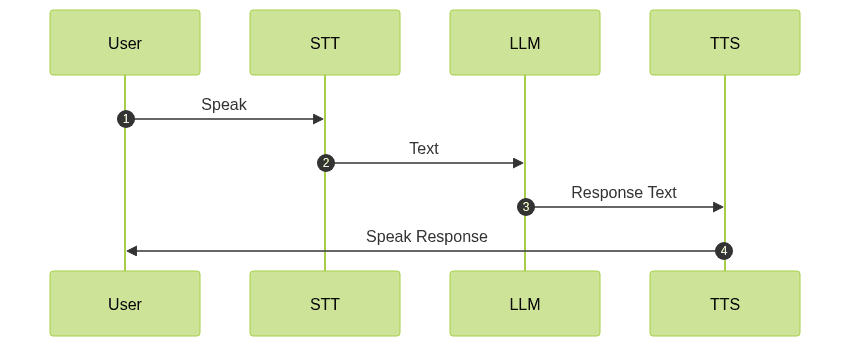
Understanding Key Concepts in the VideoSDK Framework
- Agent: The core class representing your bot. It handles the interaction logic and manages the conversation state.
- CascadingPipeline: This defines the flow of audio processing, moving from STT to LLM and finally to TTS. Explore more about the
Cascading pipeline in AI voice Agents
. - VAD & TurnDetector: These components help the agent determine when to listen and when to speak, ensuring smooth interaction. Learn about the
Turn detector for AI voice Agents
.
Setting Up the Development Environment
Prerequisites
Before you start, ensure you have Python 3.11+ installed and a VideoSDK account. You can sign up at app.videosdk.live.
Step 1: Create a Virtual Environment
To keep your dependencies organized, create a virtual environment:
1python -m venv myenv
2source myenv/bin/activate  # On Windows use `myenv\\Scripts\\activate`
3
Step 2: Install Required Packages
Install the necessary packages using pip:
1pip install videosdk-agents videosdk-plugins
2
Step 3: Configure API Keys in a .env file
Create a
.env file in your project directory and add your VideoSDK API key:1VIDEOSDK_API_KEY=your_api_key_here
2Building the AI Voice Agent: A Step-by-Step Guide
Below is the complete code for the AI Voice Agent. We will break it down and explain each part in detail.
1import asyncio, os
2from videosdk.agents import Agent, AgentSession, CascadingPipeline, JobContext, RoomOptions, WorkerJob, ConversationFlow
3from videosdk.plugins.silero import SileroVAD
4from videosdk.plugins.turn_detector import TurnDetector, pre_download_model
5from videosdk.plugins.deepgram import DeepgramSTT
6from videosdk.plugins.openai import OpenAILLM
7from videosdk.plugins.elevenlabs import ElevenLabsTTS
8from typing import AsyncIterator
9
10# Pre-downloading the Turn Detector model
11pre_download_model()
12
13agent_instructions = "You are a friendly and knowledgeable AI Voice Agent specialized in the travel industry. Your primary role is to assist users with travel-related inquiries and tasks. You can provide information about destinations, suggest travel itineraries, check flight and hotel availability, and offer travel tips and advice. However, you must always remind users to verify details with official sources or travel agents, as you do not have real-time access to booking systems or databases. You are not a travel agent and cannot make bookings or reservations on behalf of users. Always ensure that users understand the need to double-check critical travel information before making any decisions."
14
15class MyVoiceAgent(Agent):
16    def __init__(self):
17        super().__init__(instructions=agent_instructions)
18    async def on_enter(self): await self.session.say("Hello! How can I help?")
19    async def on_exit(self): await self.session.say("Goodbye!")
20
21async def start_session(context: JobContext):
22    # Create agent and conversation flow
23    agent = MyVoiceAgent()
24    conversation_flow = ConversationFlow(agent)
25
26    # Create pipeline
27    pipeline = CascadingPipeline(
28        stt=DeepgramSTT(model="nova-2", language="en"),
29        llm=OpenAILLM(model="gpt-4o"),
30        tts=ElevenLabsTTS(model="eleven_flash_v2_5"),
31        vad=SileroVAD(threshold=0.35),
32        turn_detector=TurnDetector(threshold=0.8)
33    )
34
35    session = AgentSession(
36        agent=agent,
37        pipeline=pipeline,
38        conversation_flow=conversation_flow
39    )
40
41    try:
42        await context.connect()
43        await session.start()
44        # Keep the session running until manually terminated
45        await asyncio.Event().wait()
46    finally:
47        # Clean up resources when done
48        await session.close()
49        await context.shutdown()
50
51def make_context() -> JobContext:
52    room_options = RoomOptions(
53    #  room_id="YOUR_MEETING_ID",  # Set to join a pre-created room; omit to auto-create
54        name="VideoSDK Cascaded Agent",
55        playground=True
56    )
57
58    return JobContext(room_options=room_options)
59
60if __name__ == "__main__":
61    job = WorkerJob(entrypoint=start_session, jobctx=make_context)
62    job.start()
63
Step 4.1: Generating a VideoSDK Meeting ID
To interact with your AI Voice Agent, you need a meeting ID. You can generate this using the VideoSDK API. Here is an example using
curl:1curl -X POST \
2 https://api.videosdk.live/v1/meetings \
3 -H "Authorization: Bearer YOUR_API_KEY" \
4 -H "Content-Type: application/json"
5Step 4.2: Creating the Custom Agent Class
The
MyVoiceAgent class defines the behavior of your AI Voice Agent. It inherits from the Agent class and implements two key methods:on_enter: This method is called when the agent session starts. It greets the user.on_exit: This method is called when the session ends. It says goodbye to the user.
Step 4.3: Defining the Core Pipeline
The
CascadingPipeline
is central to processing audio input and generating responses. It consists of:- STT (DeepgramSTT): Converts spoken language into text.
- LLM (OpenAILLM): Processes the text and generates a response.
- TTS (ElevenLabsTTS): Converts the response text back into speech.
- VAD (SileroVAD): Detects when the user is speaking.
- TurnDetector: Determines when the agent should respond.
Step 4.4: Managing the Session and Startup Logic
The
start_session function initializes the agent and manages the session lifecycle. It creates an instance of AgentSession
, which ties together the agent, pipeline, and conversation flow. Themake_context function sets up the room options, enabling the playground mode for testing.The script starts by creating a
WorkerJob with the entry point set to start_session, and it runs the job when the script is executed.Running and Testing the Agent
Step 5.1: Running the Python Script
To start your AI Voice Agent, run the Python script:
1python main.py
2
Step 5.2: Interacting with the Agent in the Playground
Once the agent is running, you will see a link to the playground in the console. Open this link in your browser to interact with the agent. You can speak to the agent and receive responses based on your queries.
Advanced Features and Customizations
Extending Functionality with Custom Tools
The VideoSDK framework allows you to extend the functionality of your agent with custom tools. These tools can be integrated into the pipeline to handle specific tasks or queries.
Exploring Other Plugins
While this tutorial uses specific plugins for STT, LLM, and TTS, VideoSDK supports various other options. You can explore these to find the best fit for your application needs.
Troubleshooting Common Issues
API Key and Authentication Errors
Ensure your API key is correctly set in the
.env file. Double-check the key for any typos.Audio Input/Output Problems
Verify that your microphone and speakers are working correctly. Check the system settings and permissions.
Dependency and Version Conflicts
Ensure all dependencies are up-to-date and compatible with your Python version. Use a virtual environment to manage dependencies.
Conclusion
Summary of What You've Built
In this tutorial, you built a basic AI Voice Agent for the travel industry using VideoSDK. This agent can handle travel-related inquiries and provide helpful information to users.
Next Steps and Further Learning
To enhance your agent, consider adding more sophisticated logic or integrating additional data sources. Explore the VideoSDK documentation for more advanced features and capabilities.
Want to level-up your learning? Subscribe now
Subscribe to our newsletter for more tech based insights
FAQ