


An AI voice agent for live commerce is a real-time, voice-driven assistant that interacts with viewers during a live shopping stream. It uses speech-to-text, large language models, and text-to-speech to answer product questions, recommend items, and drive sales 24/7. VideoSDK provides the underlying real-time communication infrastructure and AI Agent SDK to build and deploy these agents with sub-second latency.
Live commerce has evolved from a niche trend into a dominant global sales channel, but scaling it hits a hard limit: human hosts. A single host can only talk to so many viewers at once, and running streams around the clock demands a massive staffing budget. When a popular product launch attracts ten thousand concurrent viewers, the chat moves too fast for any human to read, let alone answer individually. An AI voice agent for live commerce solves this bottleneck by providing a real-time, interactive voice assistant that can handle thousands of viewer interactions simultaneously. In this guide, you will learn how to architect, build, and deploy an AI-driven sales host using VideoSDK's real-time infrastructure and AI Agent SDK, turning your live streams into always-on, high-conversion sales engines.
What Is an AI Voice Agent for Live Commerce?
An AI voice agent for live commerce is defined as a conversational AI system that interacts with live stream viewers using natural spoken language. Unlike chat-only bots that rely on text input and clunky UI interactions, a voice agent processes spoken questions from the audience and responds with synthesized speech in real time. It also differs fundamentally from pre-recorded videos or looping promotional clips because it is dynamic, context-aware, and capable of handling unpredictable viewer queries on the fly.
The core components of this system include a speech-to-text (STT) engine to transcribe viewer audio, a large language model (LLM) to process the query and generate a contextually relevant response, and a text-to-speech (TTS) engine to vocalize the answer. VideoSDK provides the real-time pipeline that connects these components to the live stream, ensuring seamless media flow.
Unlike traditional HLS streaming which suffers from 10 to 30 seconds of delay, VideoSDK's Interactive Live Streaming (ILS) maintains sub-second latency. This allows the AI agent to hear a viewer's question and respond almost instantly, creating a natural conversational rhythm. Key benefits of deploying an AI voice agent include 24/7 availability for global audiences across time zones, multilingual support that allows a single agent to switch languages mid-stream, and instant response times that keep viewers engaged and prevent drop-off.
Core Architecture Overview
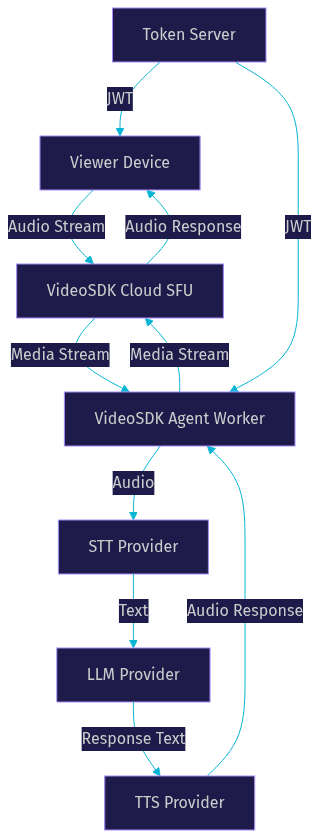
The architecture of an AI voice agent for live commerce relies on a continuous, low-latency media loop. When a viewer asks a question, their audio is captured by the client application and sent to a VideoSDK room. The VideoSDK Agent Worker, a Python process running in the cloud, picks up this audio stream and passes it to the configured STT provider. The transcribed text is then sent to the LLM, which generates a response based on the live product catalog and conversation context. Finally, the TTS provider converts the text response into natural-sounding audio, which the agent worker broadcasts back to the VideoSDK room for all viewers to hear.
VideoSDK Rooms act as the central hub, managing the media streams between the agent and the viewers. The VideoSDK AI Agent SDK orchestrates this entire pipeline, handling the complex timing and media routing required for a seamless experience. For structured flows like checkout or order tracking, developers can use VideoSDK's Conversational Graph to enforce deterministic state machines alongside the LLM.
Real-Time Media Path
The success of a live commerce voice agent depends entirely on latency. If the agent takes three seconds to answer a question about product sizing, the viewer has already scrolled past or lost interest. The target for a conversational voice agent is sub-500ms end-to-end latency, from the moment the viewer stops speaking to the moment the agent begins responding. VideoSDK achieves this through its global WebRTC infrastructure, which routes media over the shortest possible path.
Network conditions are unpredictable, especially on mobile devices. VideoSDK uses network-adaptive streaming, which automatically adjusts the audio bitrate in real time to prevent packet loss on poor connections. This ensures the agent's voice remains clear and intelligible even if the viewer is on a weak 4G connection.
Integration Points with Existing Platforms
A live commerce AI agent rarely operates in isolation. It needs to plug into existing social platforms like TikTok, YouTube, Instagram Live, or a custom Shopify storefront. VideoSDK supports RTMP output, allowing the agent's audio and video to be broadcast simultaneously to multiple social platforms. This means a single VideoSDK room can power a live stream that appears on YouTube and TikTok at the same time.
For product data, the agent connects to your e-commerce backend via REST APIs. The VideoSDK REST API allows you to manage rooms and sessions programmatically, while your agent worker can query your Shopify or custom database directly to sync inventory and pricing in real time.
Building an AI Voice Agent with VideoSDK
Building an AI voice agent with VideoSDK involves connecting your frontend client to a backend agent worker. First, choose the appropriate client SDK for your platform. VideoSDK offers SDKs for React, Flutter, Android, and iOS.
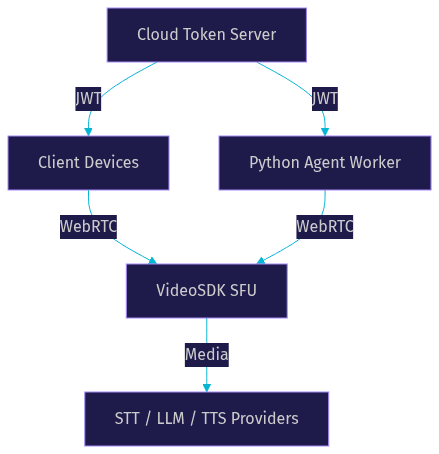
On the server side, you must generate a meeting token using your VideoSDK API key and secret. This token authenticates both the viewer and the agent into a VideoSDK Room. Never expose your API secret on the frontend. Always generate tokens on a secure backend server.
You then deploy the Python Agent Worker, which joins the room in voice-only mode to conserve bandwidth. The worker is configured with your chosen STT and TTS providers, such as OpenAI Whisper for transcription and ElevenLabs for speech synthesis. You can configure multilingual pipelines by setting the language parameters in your STT and TTS provider configurations. Developers can deploy this worker using VideoSDK Agent Cloud for a managed experience, or self-host it using a Docker container for maximum control.
Authentication & Security
Security is critical when handling live commerce transactions and customer data. VideoSDK uses token-based authentication, ensuring that only authorized clients and agents can join a room. Role-based access control lets you define what the agent and viewers can do, such as restricting who can publish audio or modify room metadata.
For sensitive transactions or private consultations, VideoSDK offers end-to-end encryption (E2EE) to protect media streams from interception. You can also use waiting rooms to screen viewers before allowing them to interact with the agent.
Choosing STT/TTS Providers
Selecting the right STT and TTS providers impacts both latency and user experience. For STT, look for providers with low word-error rates on conversational audio. Deepgram and OpenAI Whisper are popular choices for real-time transcription. For TTS, prioritize natural-sounding voices and low latency. ElevenLabs and Cartesia offer highly realistic voices that can match the energy of a live sales pitch.
Cost and language coverage are also important factors. Some providers charge per minute of audio, while others charge per character generated. For global live commerce, ensure your providers support the languages your target audience speaks.
Enhancing the Shopping Experience
An AI voice agent for live commerce does more than answer basic questions. It actively drives sales by creating a personalized shopping experience. By connecting the LLM to your product catalog via Retrieval-Augmented Generation (RAG), the agent can provide real-time product recommendations based on viewer preferences.
If a viewer asks, "Do you have this jacket in size M?", the agent queries the inventory database and responds instantly. The agent can also create urgency by announcing limited-time deals or low stock levels. Voice-driven cart actions allow viewers to add items to their cart or initiate checkout using simple voice commands. For global audiences, a multilingual pipeline lets the agent switch languages on the fly, handling FAQs and order status queries without missing a beat. This level of interaction transforms passive viewers into active buyers.
Operational Considerations
Scaling a live commerce stream means handling thousands of concurrent viewers. VideoSDK's low-latency SFU (Selective Forwarding Unit) architecture is designed for high concurrency. You can monitor agent performance through session analytics, recordings, and real-time transcription logs available via the VideoSDK dashboard.
If the AI agent encounters a complex query it cannot handle, you can configure a fallback mechanism to transfer the stream to a human host. This ensures the viewer is never left without support. Cost modeling should account for AI provider token usage, TTS character generation, and VideoSDK session minutes. VideoSDK offers a free tier to help you test your implementation before scaling to production.
Comparing AI Voice Agents to Human Hosts
AI voice agents and human hosts each have distinct advantages. AI agents offer infinite scalability, 24/7 availability, and consistent product knowledge. Human hosts provide emotional connection, spontaneity, and brand personality.
| Feature | AI Voice Agent | Human Host |
|---|---|---|
| Availability | 24/7 | Limited shifts |
| Scalability | Thousands of concurrent viewers | One stream at a time |
| Cost | Infrastructure and API costs | Salary and production costs |
| Consistency | High | Variable |
| Empathy | Low | High |
A hybrid approach often works best. Use the AI agent for overnight streams, high-volume Q&A, and multilingual support, while bringing in human hosts for flagship product launches and community building.
Real-World Success Stories
Consider a fashion brand that deployed an AI voice agent on TikTok Live. By running 24/7 streams with the agent handling sizing and inventory questions, they saw a 30% lift in conversion rates and significantly reduced staffing costs. The agent was able to answer questions in Spanish and English, broadening their audience reach.
Another electronics retailer used a VideoSDK-powered agent on YouTube Live to answer technical specs questions in real time. Viewers could ask about battery life or port compatibility and get instant answers. This resulted in a 25% increase in average order value as viewers felt more confident in their purchases.
Getting Started Checklist
- Set up a secure token server to generate VideoSDK meeting tokens.
- Choose your client SDK (React, Flutter, Android, iOS) and integrate the VideoSDK room.
- Deploy the Python Agent Worker via VideoSDK Agent Cloud or a self-hosted Docker container.
- Configure your STT, LLM, and TTS providers in the agent pipeline.
- Connect your product catalog to the LLM using a retrieval system.
- Test latency and audio quality under poor network conditions.
Definitions Glossary
Agent Worker: The Python process that runs a VideoSDK AI agent and manages its session lifecycle.
Interactive Live Streaming (ILS): VideoSDK's low-latency streaming mode where viewers can be promoted to active speakers.
Pipeline: The STT to LLM to TTS chain that processes speech and generates responses in a VideoSDK AI agent.
Room: A VideoSDK meeting room that participants join and share media streams within.
Turn Detection: The mechanism that decides when a user has finished speaking and the AI agent should respond.
Key Takeaways
- An AI voice agent for live commerce provides 24/7, scalable, real-time interaction with live stream viewers.
- VideoSDK's AI Agent SDK and real-time infrastructure handle the complex media routing required for sub-500ms latency.
- Connecting the agent to your product catalog enables dynamic recommendations and instant inventory checks.
- A hybrid approach using both AI agents and human hosts maximizes scalability and emotional engagement.
- You can deploy these agents using VideoSDK Agent Cloud or self-hosted Docker images.
Conclusion
Live commerce is shifting from a scheduled event to an always-on sales channel. An AI voice agent for live commerce removes the human bottleneck, allowing you to engage with viewers globally, answer questions instantly, and drive conversions around the clock. VideoSDK provides the real-time communication infrastructure and AI Agent SDK you need to build this experience. Ready to build your own AI sales host? Explore the VideoSDK AI Agents documentation and start your free tier today at app.videosdk.live/login. What are you building with VideoSDK? Drop a comment below.
FAQ