


TLDR: IT integrators serving BFSI clients can deploy white-label video KYC solutions by layering a branded interface over compliant video infrastructure and identity verification services. This allows banks, NBFCs, and insurers to onboard customers remotely without building the underlying technology stack themselves. The integrator captures implementation margin, recurring support revenue, and a defensible position in the client's compliance workflow.
Introduction
Digital onboarding in financial services is no longer optional. In India, the Reserve Bank of India (RBI) formalized Video KYC (V-CIP: Video-based Customer Identification Process) as a legally valid onboarding method in January 2020 through an amendment to the KYC Direction 2016. In MENA, central banks in the UAE, Saudi Arabia, and Egypt have published comparable frameworks for remote identity verification.
For IT agencies and system integrators, this regulatory shift creates a well-defined commercial opportunity. BFSI clients need compliant digital onboarding pipelines, but most lack the internal engineering capacity to build and maintain them. Integrators who can deliver a compliant, white-labelled video KYC product own a strategic position in their client's technology stack.
This guide covers how to structure that delivery: the architecture, the build-versus-partner decision, the compliance requirements, and the operational workflow that separates successful deployments from failed ones.
Regulatory and market context
What RBI V-CIP requires
V-CIP (Video-based Customer Identification Process) is the RBI-defined process for conducting KYC via a live, interactive video session. It is governed by the Master Direction, Know Your Customer (KYC) Direction, 2016, most recently updated in 2024 (source: rbi.org.in). Key requirements include:
- The video call must be live and interactive, not pre-recorded
- The customer must present original Aadhaar and PAN documents on camera
- A trained bank official must conduct the session (this cannot be fully automated under RBI rules as of publication)
- The session must be recorded and stored in India
- Geotagging of the customer location must be captured during the session
- The platform must be hosted on Indian servers or approved cloud regions
Regulated entities covered include scheduled commercial banks, NBFCs, insurance companies, and payment system operators.
Note: RBI guidelines are updated periodically. Integrators should confirm current requirements with a qualified compliance counsel before system design. Refer to the official source at https://www.rbi.org.in.
MENA regulatory context
Across MENA, the UAE's Central Bank and Abu Dhabi Global Market (ADGM), Saudi Arabia's SAMA, and Egypt's Central Bank have each published remote onboarding frameworks that share structural similarities with India's V-CIP:
- Live biometric verification required
- Document OCR and liveness detection mandated
- Session recording and audit trail requirements
- Data residency rules vary by country
IT integrators serving both India and MENA should architect their systems so that data routing, storage, and session logging can be configured per-jurisdiction without rebuilding the core product.
Market scale
India's fintech sector onboards tens of millions of new customers annually. NASSCOM estimates that digital financial services customer acquisition will exceed 300 million unique users by 2026 across banking, insurance, and lending categories. In MENA, the World Bank's 2023 Findex data shows that 48% of adults in the MENA region remain underbanked, representing a large addressable market for compliant digital onboarding.
Core framework for white-label video KYC delivery
White-label architecture
White-label video KYC is an architecture in which a rebranded customer-facing interface sits on top of modular, vendor-supplied infrastructure components that handle video transport, identity verification, and compliance storage.
The four functional layers are:
| Layer | What it does | Who typically owns it |
|---|---|---|
| Branded frontend | Customer-facing UI with BFSI client's logo, colors, domain | IT integrator |
| Video infrastructure | WebRTC session management, recording, NAT traversal | Video SDK vendor |
| Identity verification | OCR, face match, liveness detection | IDV vendor (e.g., DigiLocker-integrated APIs) |
| Compliance backend | Audit logs, session metadata, encrypted storage | Integrator or BFSI client's infrastructure |
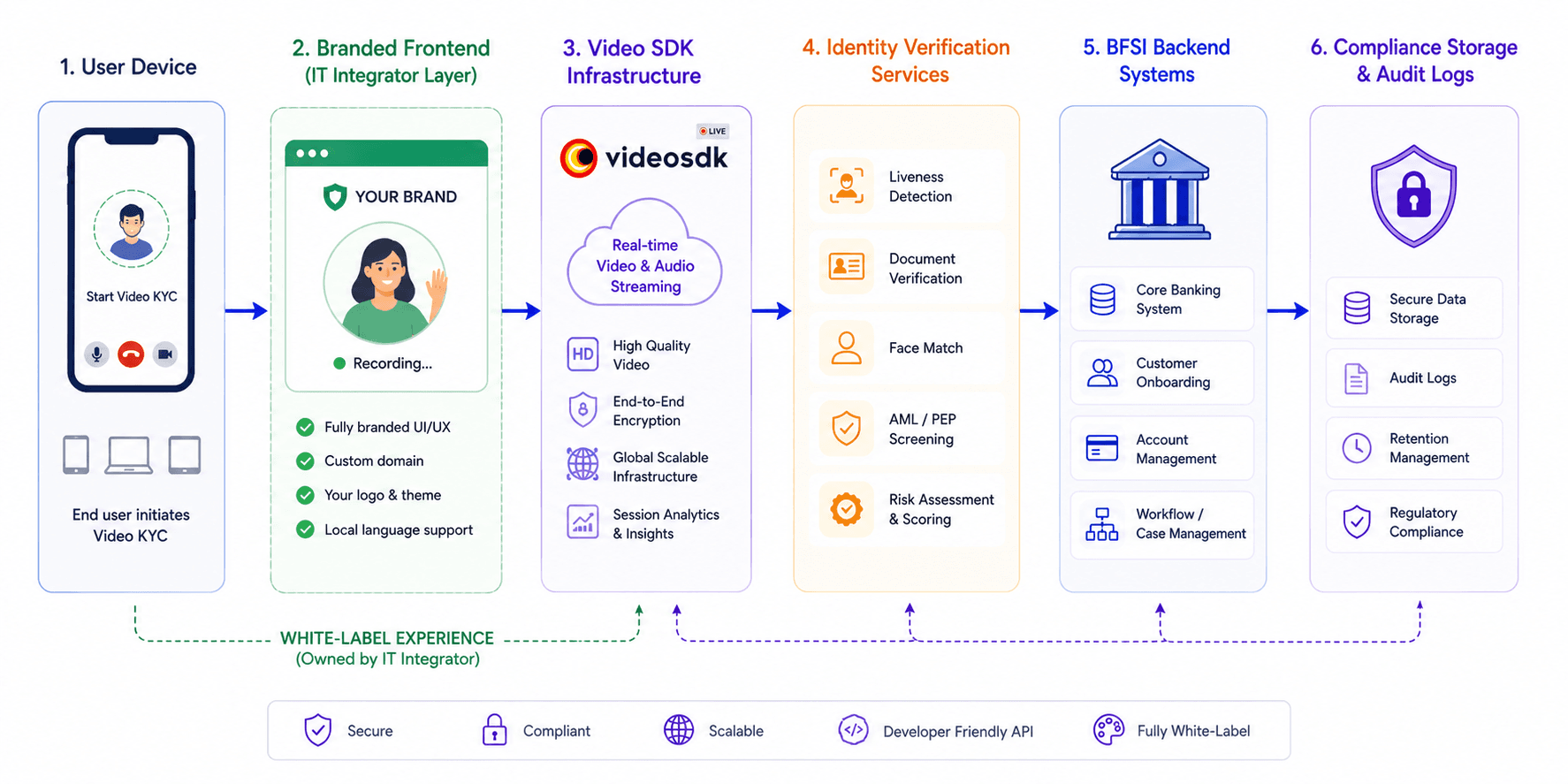
The integrator's value is in the assembly and configuration of these layers, the compliance mapping to the specific regulator's requirements, and the ongoing management of the system on behalf of the BFSI client.
Build versus partner decision
Before committing to an architecture, integrators must decide which components to build internally and which to source from partners. The decision framework below maps each component against the build complexity and the compliance risk of getting it wrong.
| Component | Build complexity | Compliance risk if wrong | Recommended approach |
|---|---|---|---|
| Branded UI/frontend | Low | Low | Build (core integrator IP) |
| Video session infrastructure | Very high | High (session integrity) | Partner with video SDK vendor |
| OCR document extraction | High | Very high (KYC accuracy) | Partner with certified IDV vendor |
| Liveness detection | Very high | Very high (fraud risk) | Partner with certified IDV vendor |
| Session recording and storage | Medium | Very high (audit requirement) | Partner or use regulated cloud |
| Audit log and reporting | Medium | High | Build on top of partner APIs |
| BFSI backend integration | Medium | Medium | Build (client-specific) |
The practical conclusion for most IT integrators: build the branded interface and the integration layer; partner for video infrastructure, liveness detection, and OCR. This is not a shortcut. Building compliant liveness detection from scratch requires months of ML model training and ongoing false-rejection rate optimization. The regulatory exposure from deploying an uncertified model is not worth the margin.
For video infrastructure specifically, vendors like VideoSDK provide real-time communication infrastructure including WebRTC session handling, server-side recording, and scalable session management. Integrators can use these APIs to handle the video transport layer while building the compliance and branding logic on top.
Read : WebRTC vs RTMP for Video Communication
Compliance design
Compliance design is not a phase at the end of development. It must be embedded in the system architecture from the start.
Compliance checklist for RBI V-CIP
- Video session is live and two-way interactive (no pre-recorded flows)
- Bank official or trained agent is present on the call
- Original Aadhaar and PAN captured on video (not just uploaded)
- Geotagging of customer location captured at session start
- Session recorded in full (video + audio) with tamper-evident storage
- Recordings stored on servers located in India
- Session metadata includes timestamp, agent ID, customer consent
- Customer consent is recorded verbally and logged
- Audit trail is immutable and accessible to the regulated entity for inspection
- System handles reconnection and session failure with a documented recovery process
- OVD (Officially Valid Document) verification completed per KYC Direction definitions
- Process for declining and re-initiating failed sessions is documented
Data residency architecture note: Most major cloud providers (AWS, Azure, GCP) offer India regions that satisfy RBI's data localization requirements. The integrator must confirm that all data paths, including session recordings, metadata, and identity verification outputs, remain within the approved geography. Review your IDV vendor's sub-processing agreements before deployment.
Must Read: Build vs Buy Video KYC Infrastructure
Operational workflow
A successful white-label video KYC deployment requires three operational workflows beyond the technical build:
1. Agent operations Under RBI V-CIP, a trained bank official must conduct the session. Some BFSI clients run this in-house; others outsource agent operations to the integrator or a third party. Integrators should clarify this before scoping. If managing agent operations, plan for shift coverage, training certification, and quality monitoring.
2. Exception handling Sessions fail. Customers have poor connectivity, documents are damaged, or liveness checks fail due to lighting. A production system needs a documented exception workflow: what happens when a session cannot be completed, how the customer is notified, and how the session is re-queued.
3. Audit and reporting The BFSI client's compliance team needs regular access to session logs, completion rates, rejection reasons, and exception records. Build a reporting layer into the product from the start. This is also a retention mechanism: clients who depend on your reporting interface are less likely to switch vendors.
Common mistakes IT integrators make
Treating compliance as a post-build checklist
The most expensive mistake is designing the system and then asking a compliance team to review it. Requirements like immutable audit logs, geotagging, and India-only data paths affect infrastructure decisions made early in the project. Retrofitting these after development is costly and sometimes requires re-architecting core components.
Underestimating session quality requirements
Video KYC API quality is not just about uptime. RBI requires that video and audio quality be sufficient to clearly identify the customer and document. Integrators often discover during UAT that the video infrastructure they selected struggles with low-bandwidth mobile connections common in tier-2 and tier-3 cities. Test across network conditions early, using real devices and real SIM connections.
Conflating white-label with rebranding only
Some integrators believe white-labelling is a UI exercise: apply the bank's logo, change the colors, and ship. In reality, the branded experience extends to agent scripts, consent language, session failure messages, email notifications, and the reporting dashboard. Clients notice when the product feels partially theirs.
Not defining the SLA for session availability
Video KYC is a blocking step in the customer onboarding journey. If the system is unavailable, the customer cannot be onboarded. Define session availability SLAs explicitly in the client contract, and ensure your infrastructure vendors' SLAs support what you commit to.
Using uncertified liveness detection
Liveness detection: liveness detection is a computer vision process that verifies a camera feed contains a live human face rather than a photograph or video replay. Using an uncertified or internally built liveness model exposes the BFSI client to fraud risk and potential regulatory findings. Use a vendor whose liveness detection has been independently tested and is referenced by the identity verification market.
Must Read: Video KYC Success Rate Optimization Guide
Key takeaways
- White-label video KYC for BFSI is an assembly and compliance problem, not primarily an engineering problem. Integrators who understand this win engagements faster.
- The RBI V-CIP framework requires live sessions, agent presence, India-based storage, and full session recording. These are non-negotiable and must be designed into the architecture from the start.
- Partner for video infrastructure and identity verification; build for the branded interface, compliance layer, and client-specific integrations.
- Data residency, audit logs, and exception workflows are recurring compliance requirements across both India and MENA deployments.
- Operational scope (agent management, exception handling, reporting) is as important as technical scope and should be defined clearly in the client contract.
FAQ
Q1. What is white-label video KYC and how does it differ from a licensed KYC platform?
White-label video KYC is a deployment in which the end BFSI client's branding appears throughout the customer experience, while the integrator or a technology vendor operates the underlying infrastructure. A licensed KYC platform typically carries the vendor's own brand and is sold directly to the BFSI institution. The white-label model allows the IT integrator to own the client relationship and present a unified product.
Q2. Do IT integrators need a license to deploy video KYC in India?
The regulated entity (the bank, NBFC, or insurer) holds the RBI license and is responsible for KYC compliance. The IT integrator is a service provider. However, the integrator is responsible for ensuring the technical system meets all regulatory requirements as specified in the KYC Direction 2016. Integrators should confirm their liability scope in the service agreement and seek qualified legal advice.
Q3. Can video KYC sessions be conducted by an agent outside the bank?
RBI V-CIP guidelines require the official conducting the session to be an employee of the regulated entity. Some interpretations allow outsourcing to a third-party agent under specific conditions, but this must be validated with a compliance advisor for the specific regulated entity in question. Do not assume outsourced agent operations are permitted without documented regulatory clearance.
Q4. What video infrastructure should an IT integrator use?
The video transport layer needs to support low-latency, two-way communication, server-side recording, and scalability for concurrent sessions. WebRTC-based infrastructure is standard for this use case. Vendors such as VideoSDK provide real-time communication APIs and session recording capabilities that integrators can incorporate into a white-label stack. Evaluate vendors on recording reliability, India-region availability, and API documentation quality.
Q5. How should session recordings be stored to meet RBI requirements?
Recordings must be stored on servers located in India. They must be encrypted, tamper-evident, and accessible to the regulated entity for audit purposes. The storage system should include metadata linking each recording to the customer's KYC record, the agent who conducted the session, the timestamp, and the geolocation data. Define a retention period aligned with the KYC Direction and the client's internal compliance policy.
Q6. What happens if a video KYC session fails mid-call?
The system must handle session failures gracefully. This means logging the failure with a timestamp and reason code, notifying the customer, and providing a path to reschedule. Under RBI guidelines, an incomplete session cannot be counted as a completed KYC. Document the exception workflow in the system design and test it before go-live.
Q7. How do MENA requirements differ from India's V-CIP?
MENA frameworks generally share V-CIP's requirement for live biometric verification and audit trails, but differ in data residency rules, the role of the agent, and specific document types accepted. The UAE's ADGM framework, for example, permits more automation in certain segments than RBI's current guidelines. Integrators serving both markets should parameterize jurisdiction-specific rules rather than hard-coding them.
Q8. What is the typical implementation timeline for a white-label video KYC deployment?
A deployment covering frontend branding, video infrastructure integration, IDV vendor integration, compliance configuration, and UAT typically takes 10 to 16 weeks for a first engagement. Repeat deployments for subsequent BFSI clients can be completed faster once the core white-label product is established. Compliance review and sign-off by the BFSI client's legal team is often the longest single step and should be planned early.