


Video PD (Video Personal Discussion) is a live, face-to-face video session between a business agent and a customer used to verify identity, conduct a regulated personal discussion, and complete onboarding without requiring branch visits or paper documents. Banks, insurers, and healthcare providers use this approach to cut onboarding time from days to minutes while meeting compliance requirements under India's RBI V-CIP, the EU's EBA guidelines, and FinCEN rules in the United States.
Regulated industries spend billions every year solving a problem that should have been solved years ago: how to verify a customer's identity securely, personally, and at scale without making them visit a physical location. Video pd is the approach most financial institutions have settled on, and adoption has moved from early experiment to regulatory expectation in under five years.
This guide explains exactly what video personal discussion is, how it works, which industries use it, how it compares to older methods, how to implement it, and what technology stack is required.
What Is Video PD?
Video personal discussion (video pd) is defined as a real-time, video-based interaction between a trained business agent and a customer, used to verify identity, collect required information, and complete regulated onboarding without physical presence.
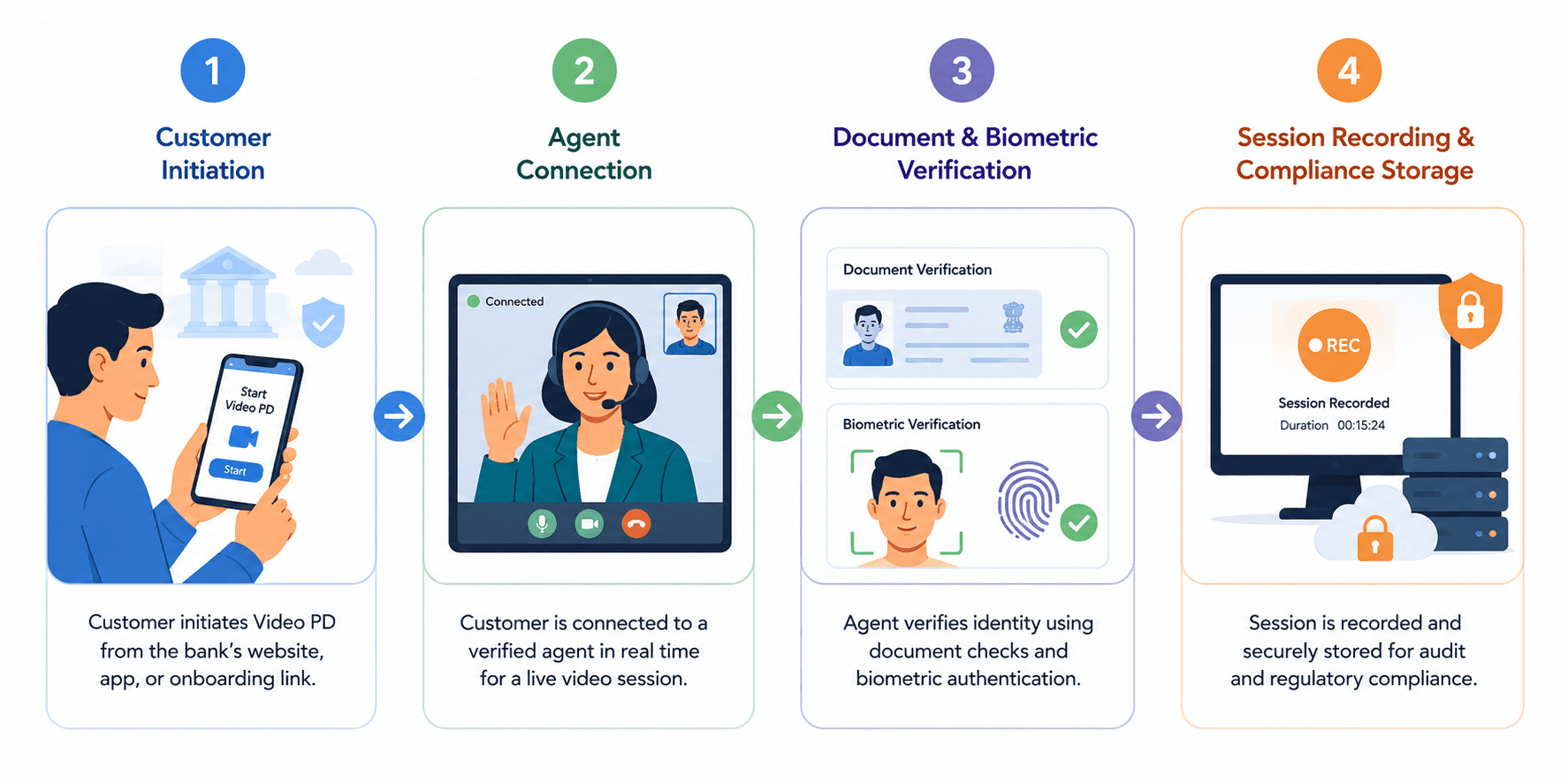
The process works by connecting the customer with a business agent through an encrypted WebRTC video call. During the session, the agent visually verifies the customer's government-issued identity document, captures a live photo or biometric data for liveness detection, asks the structured questions required by the applicable regulatory framework, and records the full session to create a tamper-evident compliance audit trail.
Video personal discussion builds directly on Video KYC (Know Your Customer) but extends it to cover the full personal discussion layer. Where Video KYC focuses specifically on identity verification (document check and liveness detection), the complete session encompasses needs assessment, product explanation, consent collection, and signature capture. Most enterprise deployments use Video KYC as phase one of the longer process.
How Video PD Differs from Video KYC
Video KYC and video pd are related but serve different scopes. Video KYC is defined as the process of confirming who the customer is. The personal discussion phase is the full regulated conversation that happens once identity is confirmed.
A bank onboarding a new loan customer needs Video KYC to establish that the person on the call is who they claim to be. It then needs the structured personal discussion to cover mandatory topics: needs assessment, terms explanation, risk disclosure, and consent capture. The two processes run sequentially in one session, but they carry distinct regulatory requirements in most jurisdictions.
Why Traditional Verification Methods Fail at Scale
Traditional customer verification fails modern financial institutions on four measurable dimensions: reach, speed, fraud resistance, and cost.
Geographical reach: In-person verification requires the customer to visit a branch, which hard-limits serviceable geography to areas within reach of physical infrastructure. According to the World Bank's 2021 Global Findex Database, approximately 1.4 billion adults globally remain unbanked, the majority in rural or underserved areas where branch access is structurally impossible. Remote video verification removes the geographic constraint entirely.
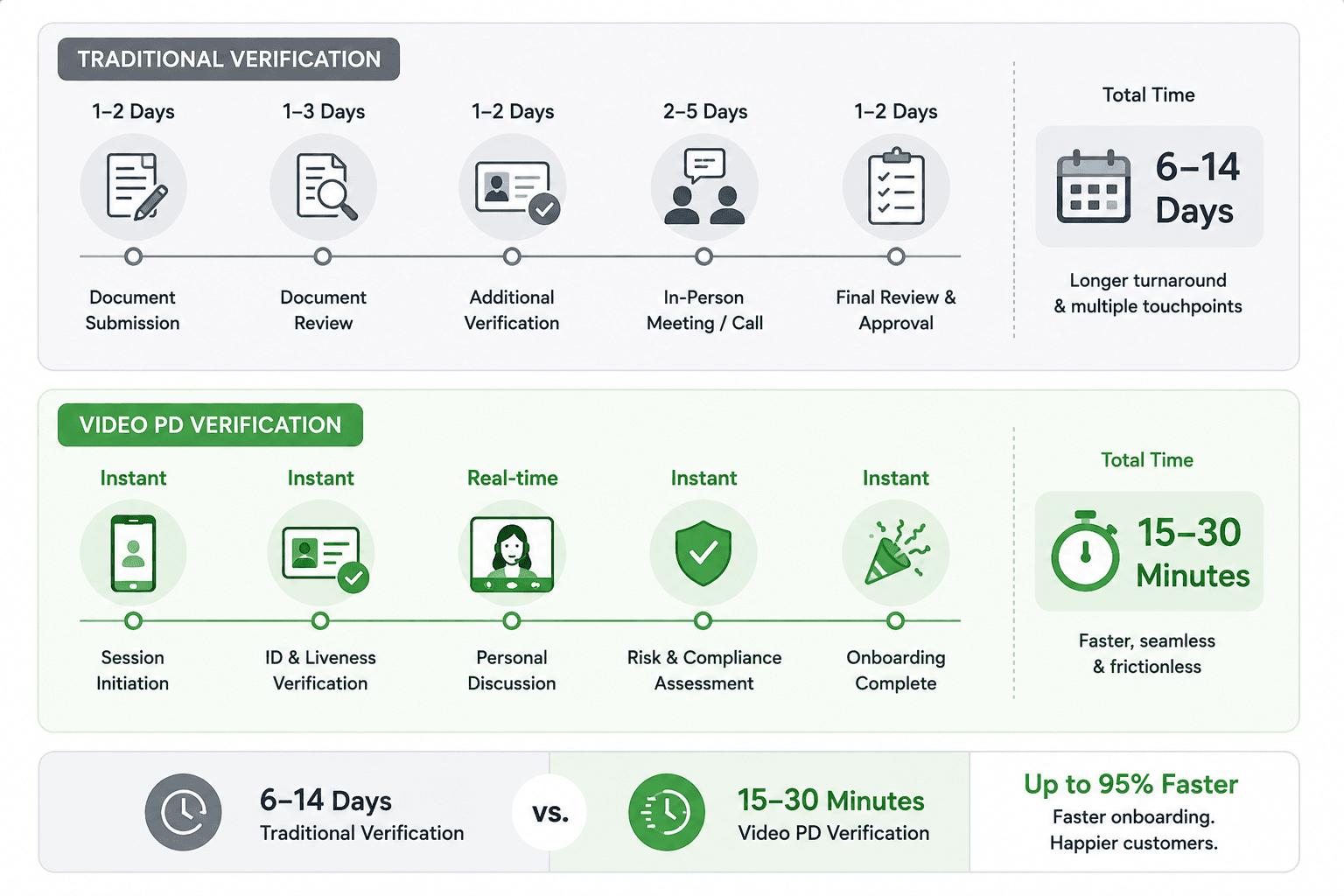
Onboarding speed: Physical document collection and manual review typically takes 3 to 7 business days, during which the customer can drop off or switch to a competitor. A typical video pd session completes the same process in 8 to 15 minutes.
Fraud vulnerability: Document scanning and manual authentication are susceptible to forgery and identity spoofing. According to a 2024 LexisNexis Risk Solutions report, financial services firms lose an average of $4.41 for every $1 of direct fraud loss when factoring in investigation and recovery costs. Combining liveness detection, AI-powered OCR, and immutable session recording makes document forgery significantly harder to execute undetected.
Operational cost: Sending field agents to customer locations for in-person verification costs an average of $50 to $200 per visit when accounting for agent time, travel, and administration. A managed video session typically costs under $5 at scale.
The cumulative effect of these four failure modes explains why adoption across the BFSI sector moved from optional to expected over a short period.
How a Video PD Session Works: The Step-by-Step Flow
A regulated video PD session follows a defined sequence that satisfies both the customer experience and the compliance requirements of the applicable regulatory framework.
Step 1: Customer initiation. The customer receives a link or app deep-link to begin the session. Modern platforms built on WebRTC run directly in a mobile browser without requiring an app installation, which reduces drop-off at this stage significantly.
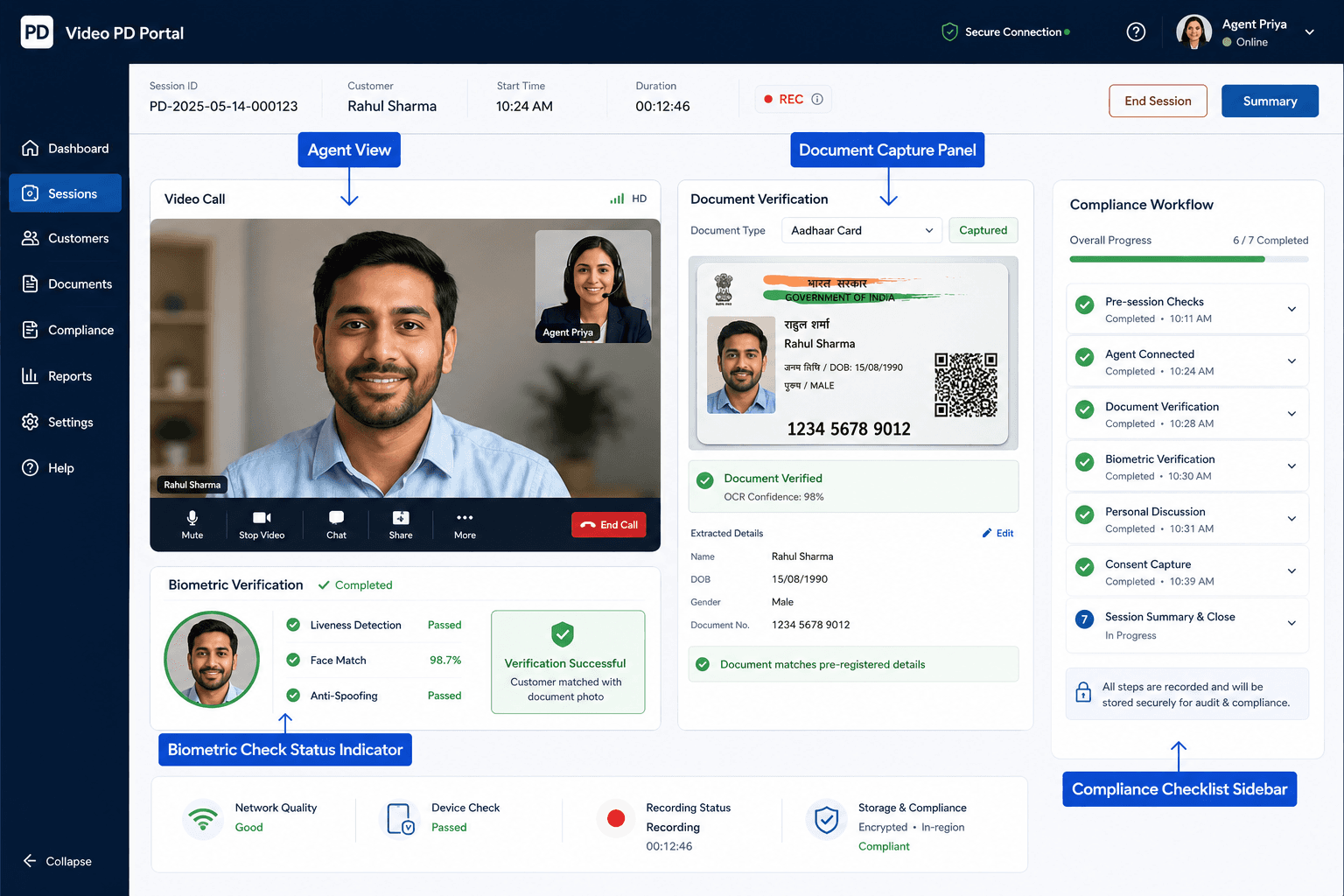
Step 2: Pre-session validation. Before the agent connects, automated checks run on the customer's device: camera and microphone permissions, network quality assessment, and an initial liveness check to confirm a real person is present.
Step 3: Agent connection. A trained agent joins the call. Recording begins from the moment both parties are connected, establishing the start of the audit trail.
Step 4: Document verification. The agent asks the customer to display their government-issued identity document to the camera. AI-powered OCR reads the document data, and a fraud detection layer checks for tampering or forgery. The system cross-references the document against the data the customer provided during pre-registration.
Step 5: Biometric verification. A liveness detection check confirms the customer on the call matches the photo on the identity document. This step uses facial geometry comparison, not just a static photo match.
Step 6: The personal discussion. The agent conducts the structured regulatory interview required by the applicable framework: needs assessment, product explanation, risk disclosure, and consent capture. This is the core "pd" component that distinguishes a complete video pd implementation from a Video KYC-only flow.
Step 7: Session close and audit trail. The recording, document captures, biometric data, and the full interaction log are stored in encrypted, jurisdiction-compliant storage. The audit trail is immutable and available for regulatory inspection.
Which Industries Use Video PD?
Video pd is most widely deployed in sectors where regulators require auditable, identity-verified customer interactions before a financial, insurance, or healthcare product can be issued.
Banking and Financial Services
Banks use video personal discussion for account opening, loan origination, credit card issuance, and investment product onboarding. India's Reserve Bank of India (RBI) Video Customer Identification Process (V-CIP) framework, introduced in 2020 and expanded since, explicitly defines this approach as a compliant method for banking KYC. ICICI Bank, one of India's largest private sector banks, has deployed video-based onboarding at scale across its retail banking division.
Insurance
Insurance providers require detailed customer information to assess risk and set premiums. Remote video personal discussion allows underwriters to conduct virtual risk assessments, verify customer declarations in real time, and collect informed consent for policy terms, all within a single recorded session. This is particularly valuable for life and health insurance products where regulators require evidence of disclosure.
Government and Public Sector
Government agencies use video-based personal discussions for identity verification when issuing documents, processing benefit applications, or conducting regulated interviews at distance. Several Indian state governments have piloted this approach for citizen services, reducing branch queues for document verification by significant margins.
Healthcare
Healthcare providers use the video personal discussion process for patient onboarding, telehealth intake, and consent capture before procedures. Under US HIPAA requirements, telehealth platforms that conduct these sessions must meet specific data security and retention standards, including encrypted transmission and secure storage with defined retention periods.
Live Commerce and Retail
Online retailers and live commerce platforms use video-based identity verification to validate high-value customer accounts, process age-restricted product onboarding, and provide personalized sales consultations that require identity confirmation before product fulfilment.
What Are the Regulatory Frameworks Governing Video PD?
Regulatory compliance is not optional in video pd deployments; it is the primary design constraint that determines every architectural decision.
The relevant frameworks by jurisdiction are:
- India (RBI V-CIP): The Reserve Bank of India's Video Customer Identification Process framework defines the exact technical and procedural requirements for video-based customer identification in banking and financial services, including mandatory session recording, defined liveness detection requirements, and specific data residency rules requiring customer data to remain within India.
- European Union (EBA Remote Onboarding Guidelines): The European Banking Authority's guidelines on remote onboarding specify the fraud risk controls, biometric verification standards, and audit documentation required for video-based customer identification across EU member states.
- United States (FinCEN CIP Rules): The Financial Crimes Enforcement Network's Customer Identification Program rules allow video-based identity verification as a compliant method under specific conditions, including defined record-keeping and audit trail requirements.
- Global (ISO/IEC 30107-3 Standard): The international standard for liveness detection and presentation attack detection defines the technical specifications that biometric verification systems must meet in compliant deployments.
Engineering teams building a solution must confirm which regulatory frameworks apply to their customer base before selecting a technology stack. A platform that meets RBI V-CIP requirements (Indian data residency, specific recording formats) may require additional configuration to meet GDPR's data minimization and portability requirements for EU customers.
How does VideoSDK help with the video PD solution?
VideoSDK is a leading and best video PD solutions provider across the globe that helps businesses streamline their personalized experience. We offer a comprehensive suite of features that cater to the diverse needs of businesses and their customers. Some of the key features include:
- Secure Video Conferencing: Provides a secure and reliable video conferencing solution that enables real-time, face-to-face interactions between customers and business representatives.
- Identity Verification: VideoSDK leverages advanced technologies, such as facial recognition, document verification, and QR codes for secure customer identification, ensuring the authenticity of customer identities during the onboarding process.
- Customizable Workflows: Our end-to-end customized SDK offers the flexibility to customize the onboarding workflow, allowing businesses to tailor the process to their specific requirements and customer needs.
- Compliance and Audit Trails: VideoSDK’s cloud recording feature for detailed audit trail purposes, ensures that businesses can meet regulatory requirements and provide evidence of their customer verification processes.
- Integrations: Our solutions often integrate with existing systems and identity management platforms, enabling seamless data flow and a unified customer experience.
- Analytics and Reporting: VideoSDK’s solutions provide businesses with valuable insights and analytics, allowing them to track key performance indicators, identify areas for improvement, and make data-driven decisions.
Features Offered By VideoSDK
VideoSDK solutions come with a range of features that enhance the customer experience and streamline the verification process:
- Accurate Geo-tagging: Precise location tracking to verify the customer's identity and the authenticity of the interaction.
- Image and Video Capture: The option to capture and store relevant documents, photographs, and video footage for future reference and compliance purposes.
- Storage Integration: Own storage integration option with an instant dump feature for real-time recording and audit.
- Secure Data Encryption: Robust data encryption protocols to protect sensitive customer information and ensure compliance with data privacy regulations.
- Analytics: Our analytics dashboard provides valuable insights that allow you to track key performance indicators and make data-driven decisions.
By leveraging these comprehensive features, businesses can enhance their customer onboarding experience, improve operational efficiency, and maintain regulatory compliance, all while strengthening their competitive position in the market.
Common Misconceptions About Video PD
Several widely-held misconceptions cause engineering teams to build incomplete solutions or compliance teams to reject valid implementations.
Misconception: Video PD and Video KYC are the same thing. Reality: Video KYC is a subset of video pd. Video KYC covers identity verification only. The full personal discussion includes the needs assessment, product disclosure, and consent capture that a KYC-only session does not address. A bank that deploys Video KYC without the personal discussion layer is not compliant with frameworks like RBI V-CIP for regulated products.
Misconception: Any video call platform works for video pd. Reality: A compliant implementation requires specific technical components that general-purpose tools (Zoom, Google Meet) do not provide out of the box: immutable session recording with audit trail, AI-powered document capture, liveness detection integration, and jurisdiction-specific data residency controls. The platform must be purpose-built or purpose-configured for this use case.
Misconception: This approach is only relevant for India. Reality: Video-based remote onboarding is deployed across regulated industries in the EU, the United States, Southeast Asia, and the Middle East. The RBI V-CIP framework has made India one of the highest-adoption markets, but this is a global regulatory trend across BFSI and healthcare.
Misconception: Video PD requires a native mobile app. Reality: Modern platforms built on WebRTC technology run directly in mobile browsers, eliminating the app installation requirement that causes significant drop-off in customer onboarding funnels. Native iOS and Android SDKs are available for businesses that prefer a fully branded in-app experience, but they are not a technical requirement.
Video PD vs. Traditional Verification: Side-by-Side Comparison
| Dimension | Traditional In-Person | Video PD |
|---|---|---|
| Onboarding time | 3-7 business days | 8-15 minutes |
| Geographic reach | Branch proximity required | Any internet connection |
| Fraud risk | High (document forgery, impersonation) | Low (liveness detection, AI OCR, session recording) |
| Per-session cost | $50-$200 (agent travel + admin) | Under $5 at scale |
| Audit trail | Paper-based, incomplete | Immutable digital recording |
| Customer drop-off | High (friction, travel, wait time) | Low (mobile-first, 15 minutes) |
| Regulatory compliance | Manual attestation | Automated, session-level audit log |
Definitions Glossary
Video PD (Video Personal Discussion): A live, regulated video session between a business agent and a customer used to verify identity and conduct the full structured onboarding discussion required by the applicable regulatory framework.
Video KYC (Know Your Customer): The identity verification phase of a video onboarding session, covering document capture and liveness detection. Video KYC is typically the first phase of a video pd session, not a standalone replacement for it.
V-CIP (Video Customer Identification Process): The Reserve Bank of India's regulatory framework defining the technical and procedural requirements for video-based customer identification in Indian banking and financial services.
WebRTC (Web Real-Time Communication): The open IETF/W3C standard protocol that enables encrypted, peer-to-peer video and audio communication directly in web browsers and native apps without plugins.
Liveness Detection: A biometric check that confirms the person on a video call is physically present and not a recorded video or photograph. Liveness detection is a mandatory component of compliant video pd and Video KYC systems.
AES-256 Encryption: The Advanced Encryption Standard with a 256-bit key length, widely adopted as the data-at-rest encryption standard for regulated session recording storage.
Key Takeaways
- Video pd (video personal discussion) is a live, regulated video session that combines identity verification with a structured agent-led personal discussion, completing the full onboarding process in 8 to 15 minutes instead of 3 to 7 business days.
- Video pd is not the same as Video KYC; Video KYC covers identity verification only, while the personal discussion layer adds needs assessment, product disclosure, and consent capture that regulators in most BFSI jurisdictions require separately.
- Traditional in-person verification costs $50 to $200 per session and limits serviceable geography to branch proximity; video-based sessions cost under $5 at scale and remove geographic constraints entirely.
- Regulatory compliance is the primary design constraint in any video pd implementation: India's RBI V-CIP, the EU's EBA guidelines, and US FinCEN rules each impose specific requirements on session recording, data residency, and biometric verification that standard video call tools do not meet.
- VideoSDK provides the encrypted video infrastructure, AES-256 cloud recording, and SDK components needed to build a production-ready video pd solution without building the video layer from scratch.
Conclusion
Video personal discussion has become the standard method for compliant, scalable remote customer onboarding in regulated industries because it solves four problems simultaneously: geographic reach, onboarding speed, fraud prevention, and operational cost. Any business that still requires customers to visit a branch for identity verification is leaving addressable market and operational efficiency unrealized.
If you are building a video pd solution, VideoSDK's real-time video infrastructure handles the encrypted session layer, cloud recording for compliance audit trails, and mobile-first delivery across browser and native app. Get started at Signup with $20 in free credit and no credit card required
Frequently Asked Questions
What is video pd in banking?
Video pd in banking is a live, regulated video interaction between a bank agent and a prospective customer, used to verify identity, conduct the mandatory personal discussion required by the applicable compliance framework, and complete account or product onboarding without requiring a branch visit. It is governed by jurisdiction-specific frameworks including India's RBI V-CIP, the EU's EBA remote onboarding guidelines, and FinCEN rules in the United States.
How is video pd different from Video KYC?
Video pd differs from Video KYC in scope. Video KYC is the identity verification phase of a video session, covering document capture and liveness detection to confirm who the customer is. Video pd extends the session to include the full agent-led personal discussion: product explanation, needs assessment, risk disclosure, and informed consent capture. Most enterprise deployments include Video KYC as the first phase of the video pd session.
Is video pd legally compliant for financial services?
Video pd is legally compliant for financial services when implemented according to the regulatory framework that governs the customer's jurisdiction. India's RBI V-CIP framework, the EU's EBA guidelines, and equivalent rules in over 40 countries explicitly permit video-based customer identification and onboarding for regulated financial products, provided specific technical requirements (session recording, liveness detection, data residency) are met.
How long does a video pd session take?
A video pd session typically takes 8 to 15 minutes from customer initiation to session close, including the identity verification phase, the personal discussion, and consent capture. This compares with 3 to 7 business days for traditional in-person or document-mail verification processes.
What technology is needed to build a video pd solution?
Building a compliant video pd solution requires four components: an encrypted WebRTC video platform for the live session, AI-powered OCR and liveness detection for document and biometric verification, cloud recording with jurisdiction-compliant data residency for the audit trail, and an agent portal for session management and compliance checklist workflows. VideoSDK provides the video infrastructure, recording, and SDK layer; document verification and liveness detection typically integrate via third-party APIs.
Can video pd sessions be conducted on mobile?
Video pd sessions can be conducted on mobile devices without requiring an app installation. Modern platforms built on WebRTC technology run directly in mobile browsers, eliminating the friction of app downloads and reducing customer drop-off in the onboarding funnel. Native iOS and Android SDKs are available for businesses that prefer a fully branded in-app experience.
What data security standards apply to video PD sessions?
Video pd sessions must meet the data security standards of the applicable regulatory framework. These typically include AES-256 encryption for video transmission, secure encrypted storage for session recordings, data residency requirements (RBI V-CIP requires data within India, GDPR applies across the EU, HIPAA governs US healthcare), and audit log retention for the periods each regulator specifies. VideoSDK's infrastructure supports configurable data residency and AES-256 encrypted session storage by default.