


PPMC full form in health insurance is pre-policy medical check-up: the tests and doctor's exam a health insurer may ask for before it issues a policy. The insurer's underwriting team orders it, usually for older applicants, larger covers or a declared illness, to price the risk. We found no rule of IRDAI (the Insurance Regulatory and Development Authority of India) that makes it compulsory; each insurer sets its own triggers.
Running pre-policy medicals online for an insurer, TPA or lab?
VideoSDK gives you the video layer: a waiting lobby where the doctor admits the applicant, call recording with a transcript and summary after the exam, and delivery of recordings to your own cloud bucket. A new account comes with a $20 credit.
What is PPMC in health insurance?
PPMC is part of underwriting, the insurer's risk assessment. After you submit the proposal form, the insurer decides whether it needs medical evidence, and a partner diagnostic centre runs the check-up, sometimes arranged by a TPA (third-party administrator).
| Check | Who asks for it | What it is for |
|---|---|---|
| PPMC | The insurer, before it issues the policy | To accept, price or decline your proposal |
| Annual health check-up | Your plan, if it includes one | Preventive care after you are covered |
| MER (medical examination report) | A doctor, inside a PPMC or a life cover medical | The doctor's record of your history and findings (MER guide) |
When is a pre-policy medical check-up required?
We found no IRDAI rule that makes a pre-policy medical check-up compulsory or sets an age for it. Regulation 6(1)(a) of the IRDAI (Insurance Products) Regulations, 2024 requires every insurer to have a board-approved underwriting policy. The product filing form in the Master Circular on Health Insurance Business asks the insurer to "specify when and what classes of lives would be subject to medical examination" (Annexure-3, item 4.2). Schedule III, para 6.1 requires products for all age groups but sets no age for a medical, so the age bands you see are insurer practice.
| Trigger | What insurers do | Example (insurer's own page) |
|---|---|---|
| Age | No medicals below a set age | HDFC ERGO: none till 45 on Health Suraksha, 50 on my:health Medisure Classic, 55 on Medisure Super top-up |
| Sum insured | More cover, more tests | ACKO: everyone 45 or over on its Rs 1 crore plan |
| Declared illness | A disclosed condition can trigger a check at any age | HDFC ERGO's no-medical limits do not apply once a PED (pre-existing disease) is declared |
| Lifestyle | Smoking or drinking alcohol | Star Health lists both, with age above 45 or 50 and covers of Rs 1 crore or more |
| Renewal | No fresh medical if the sum insured does not change | IRDAI rule: Schedule III, para 9.5 of the 2024 Regulations |
Which medical tests are done in a PPMC?
The insurer sets the medical test list for each age and cover band. These are the tests insurer and lab pages name most often.
| Test | What it checks | Usually asked |
|---|---|---|
| Physical exam: blood pressure, height, weight, BMI | General health | In almost every PPMC |
| CBC (complete blood count) | Anaemia, infection | In most bundles |
| Fasting blood sugar, HbA1c | Diabetes and average sugar over recent months | In most bundles |
| Lipid profile | Cholesterol | In most bundles |
| Liver and kidney function, urine routine | Organ function | Older applicants, higher covers |
| ECG | Heart rhythm | Often above a set age |
| Chest X-ray, TMT (treadmill test), ultrasound | Lungs, heart under exercise, abdomen | Higher covers, or after a finding |
| MER | The doctor's history and examination form | Whenever a doctor examines you |
"CAT 5", "CAT 6" and similar codes are test bundles that some insurers use. Aditya Birla Capital's guide ties CAT 5 to life cover and lists it as MER, blood profile, ECG, CBC and midstream urine (MSU). We found no IRDAI definition.
Who pays for the pre-policy medical check-up?
The IRDAI rule that made insurers pay at least half of some pre-policy check-ups was repealed from 1 April 2024, and we found no replacement; who pays now depends on the insurer and the product. Regulation 15 of the IRDAI (Health Insurance) Regulations, 2016 covered products of one year or less where the insured would otherwise pay. For those, "not less than 50% of such cost shall be borne by the insurer once the proposal is accepted".
Regulation 9(1)(d) of the 2024 Regulations repealed it with the rest of the 2016 Regulations, and we found no repeat of it in the 2024 text or the Health Master Circular. Instead, the filing form asks each insurer "whether full costs of pre policy medical check-up are borne by the Insurer" and, if not, what percentage it bears (Annexure-3, items 4.7 and 4.8).
Five ranking guides we read, from Aditya Birla Capital, ACKO, Medi Assist and Policybazaar, still say IRDAI makes insurers pay at least half.
In practice you will see three set-ups.
- Cashless: the insurer pays its partner centre.
- Pay and claim back: you pay, then get money back once the policy is issued; HDFC ERGO's terms reimburse 50% of standard test charges for applicants above its no-medical age or with a declared PED.
- Your cost if declined: some providers charge you when no policy is issued.
If you cancel in the 30-day free-look period (policies of one year or more), the Master Circular on Protection of Policyholders' Interests, 2024 lets the insurer deduct "the expenses, if any incurred by the insurer on medical examination of the proposer" from your refund.
What happens after the PPMC: results and decision
Typical insurer practice:
| Result | Usual decision | What it means for you |
|---|---|---|
| Normal | Standard premium | Policy issued as proposed |
| Minor finding, such as borderline blood pressure | Premium loading | You pay extra for the same cover |
| A condition found | Exclusion or a waiting period for it | Claims for that condition wait, or are excluded |
| Serious finding | More reports, or decline | A specialist's opinion may be needed |
Honest disclosure matters because the 2024 Regulations, Schedule III, fix three numbers. A pre-existing disease is one a doctor diagnosed, or advised or gave treatment for, within 36 months before the policy starts (para 1.6). Its waiting period can be at most 36 months of continuous cover (para 7). After 60 continuous months, no policy or claim can be contested for non-disclosure or misrepresentation "except on grounds of established fraud" (para 8). Permanent exclusions in the policy still apply. This post explains insurance practice; it is not medical or buying advice.
How a PPMC works: centre, home visit or video
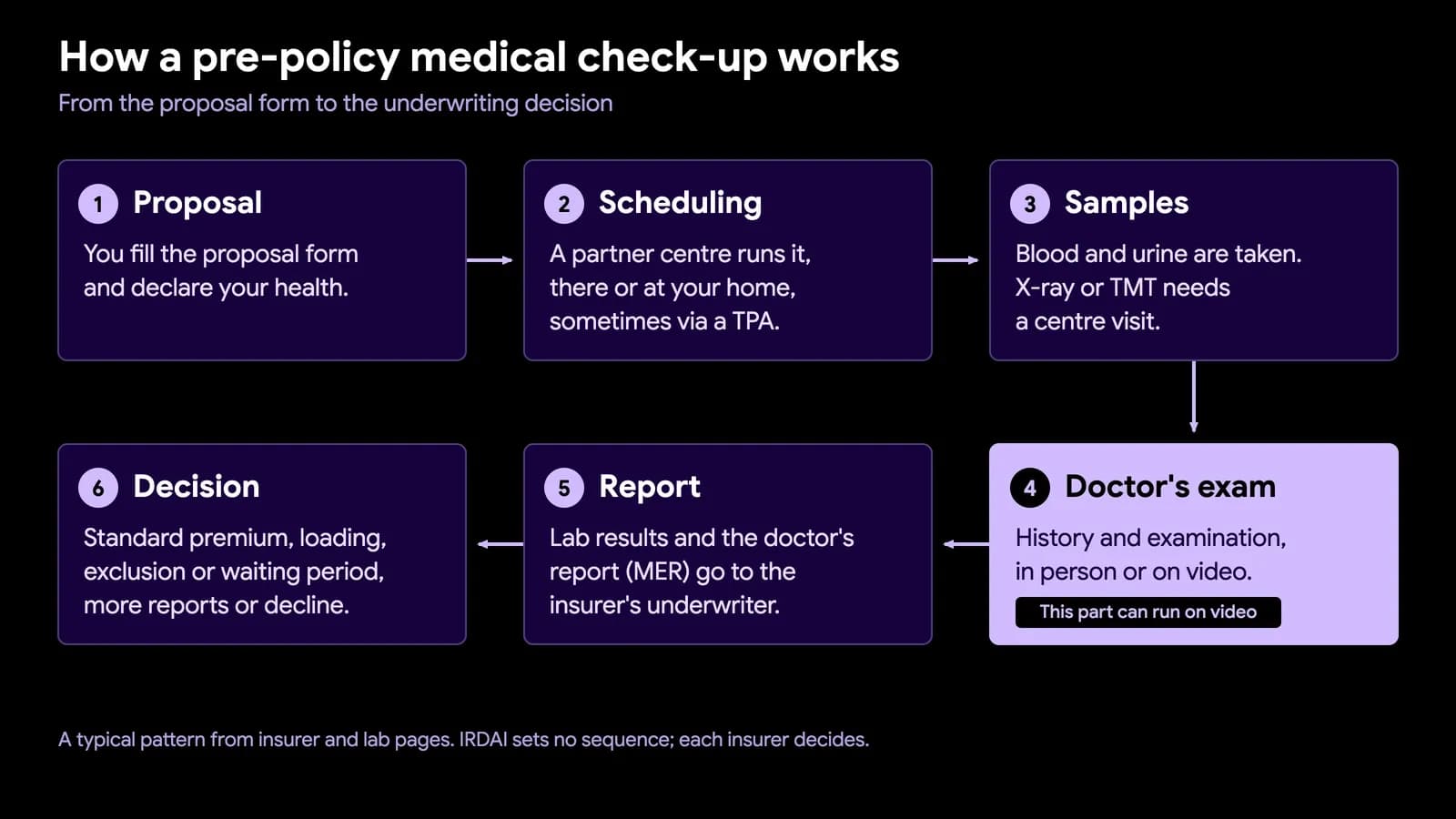
A centre runs every test in one visit. A home visit covers samples, blood pressure and the doctor's questions, but a chest X-ray or TMT needs a centre. For life policies, some insurers also make a pre-issuance verification call before they issue the policy.
Can the doctor's exam happen on video?
Yes, for the doctor's part. Diagnostics providers such as LabStack offer insurers and TPAs a "Digital MER" on a live video call. Samples still need a collection visit.
We found no IRDAI rule that allows, bans or sets a format for a video medical examination. The Telemedicine Practice Guidelines, 2020, written for registered medical practitioners, say telemedicine "cannot replace physical examination that may require palpation, percussion or auscultation" and do not address insurance medicals, so each insurer decides whether to accept a video exam. Identity checks under IRDAI's video-based identification process (VBIP) are a separate KYC process.
Our suggested design for a video exam an underwriter can rely on (not an IRDAI requirement):
- The right person: the doctor admits only the applicant from a waiting lobby.
- Consent first: section 6 of the Digital Personal Data Protection (DPDP) Act, 2023 describes valid consent as free, specific, informed, unconditional and unambiguous, with a clear affirmative action.
- Proof of place: a geo-tag on the recording.
- Records with the insurer: recordings in the insurer's own cloud.
How to build a video PPMC with VideoSDK
For insurers, TPAs and labs. Each step links to its VideoSDK docs page.
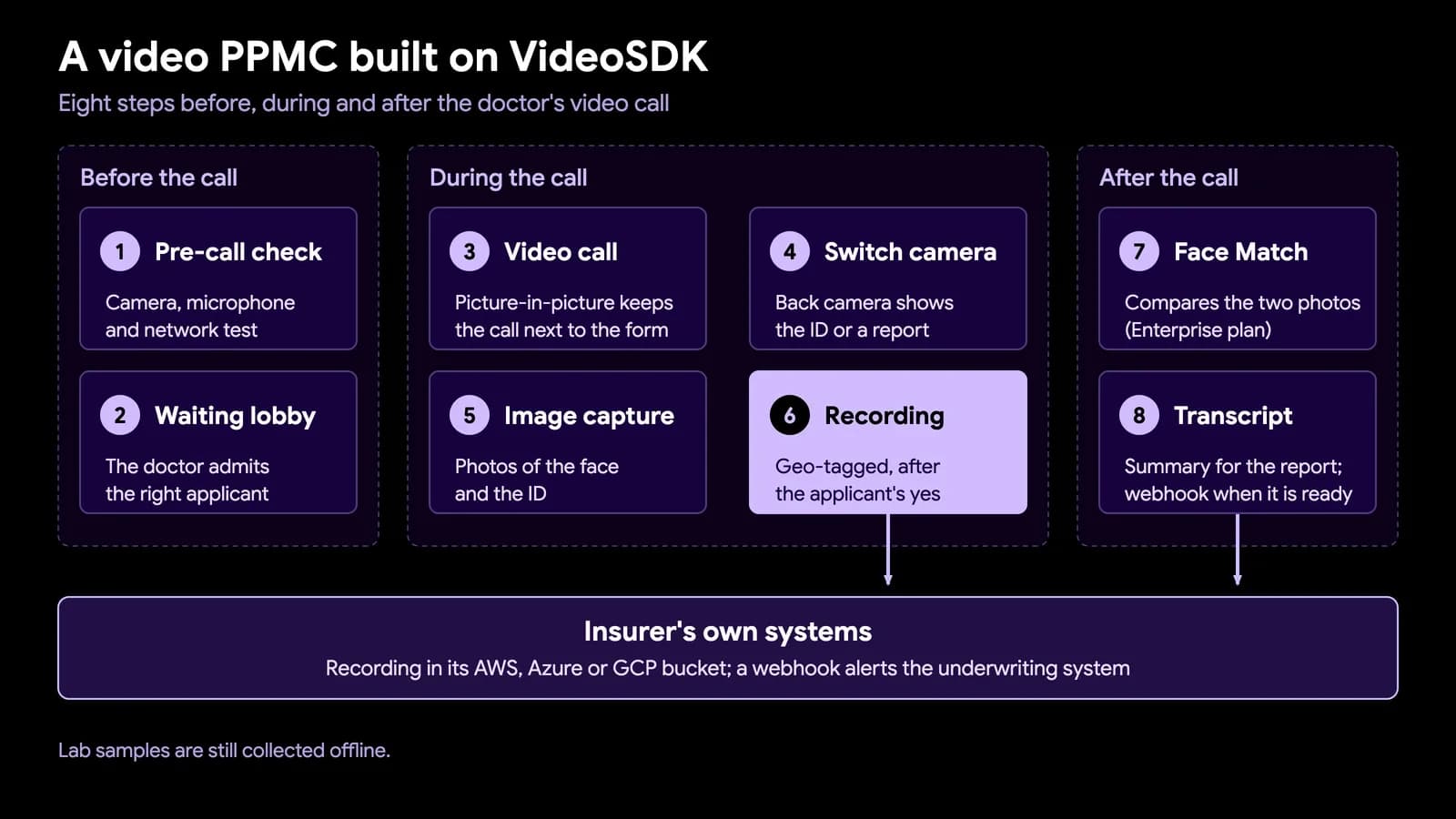
- Pre-call check: the applicant opens a link and runs a camera, microphone and network test.
- Waiting lobby: the applicant joins with an
ask_jointoken and the doctor admits or denies them. - The call: on audio and video, with picture-in-picture (in supported browsers) keeping the call in view while the doctor fills the form.
- Switch camera: the doctor switches the applicant's phone camera to the back camera to see an ID or a report.
- Image capture: the app captures images of the applicant and the ID.
- Consent, then recording: after the applicant says yes, the call is recorded with a geo-tag of the applicant's location, and the file goes to the insurer's own AWS, Azure or GCP bucket.
- Face Match: the Face Match API (Enterprise plan) compares the captured image with the ID photo, to help confirm the person on the call is the applicant.
- Transcript, summary and webhooks: a post-call transcript and summary help complete the report, and recording webhooks tell the underwriting system when the file is ready.
Lab samples stay offline. The sample covers step 2 and the consent gate in step 6: the doctor's console admits only the expected applicant and records, with a transcript and summary, only after the applicant's app sends "yes".
import { useMeeting, usePubSub } from "@videosdk.live/react-sdk";

export function DoctorControls({ applicantId, webhookUrl }) {
  const { startRecording, stopRecording } = useMeeting({
    // The applicant joins with an ask_join token and waits in the lobby
    onEntryRequested: ({ participantId, allow, deny }) =>
      participantId === applicantId ? allow() : deny(),
  });

  // The applicant's app publishes "yes" on CONSENT after the consent line is read
  usePubSub("CONSENT", {
    onMessageReceived: ({ senderId, message }) => {
      if (senderId !== applicantId || message !== "yes") return;
      startRecording(webhookUrl, null, null, {
        enabled: true,
        summary: {
          enabled: true,
          prompt: "List each medical question, the applicant's answer and the doctor's notes",
        },
      });
    },
  });

  return <button onClick={() => stopRecording()}>End exam</button>;
}
We ran this sample in a test room with two browsers, with startRecording stubbed so no billed recording started: the wrong applicant was denied, a "no" started nothing, and a "yes" from the right applicant triggered the call with the transcript settings. Wrap the component in MeetingProvider; the (webhookUrl, null, null, transcription) call shape is the one on the post-transcription docs page.
Can you buy health insurance without a medical test?
Yes, up to each insurer's no-medical limit. The filing form asks every insurer to state its "Non-medical Limit [Where no pre-medical examination is asked for]" (Annexure-3, item 4.1), and many plans need no medicals for younger applicants on smaller covers. You must still answer the health questions in the proposal form honestly.
PPMC FAQ
What is the PPMC full form in medical terms?
The PPMC full form in insurance is pre-policy medical check-up. In statistics, PPMC can mean Pearson product-moment correlation.
Is a medical check-up mandatory for health insurance?
Not by IRDAI rule; each insurer decides in its underwriting policy.
Does the insurer have to pay 50% of the PPMC cost?
Not any more. The 50% share came from the 2016 Health Insurance Regulations, repealed from 1 April 2024; each insurer now states its share in its product filing.
Is a medical check-up mandatory for term insurance?
Life insurers also set their own rules; IRDAI says only that certain products may require a medical examination. Insurer pages say term plans with a large sum assured usually need one.
What is the CAT 5 test for insurance?
A code some insurers use for a fixed test bundle; ask your insurer for its list.
How soon do PPMC results come?
Simple tests can be ready the same day; labs such as UrMediConnect quote 24 to 72 hours for full reports, then the insurer decides. Ask your insurer how long a report stays valid.
To try a video PPMC flow, sign up and get API keys (a new account comes with a $20 credit), or talk to us about your verification call design.