


Introduction
The telecommunications industry is at a crossroads, facing mounting challenges like low customer satisfaction due to prolonged wait times and fragmented support channels. As expectations for rapid, personalized, and 24/7 service grow, telecom companies must adapt. Conversational AI in telecom is emerging as a key solution, redefining customer experience, streamlining operations, and creating new revenue opportunities. Platforms like VideoSDK provide telecom leaders with the tools to develop agile, AI-driven solutions that meet these evolving demands.
Conversational AI in telecom leverages advanced AI-powered voice and chat systems to interact with customers, delivering personalized, efficient service that reduces wait times, enhances satisfaction, and enables telecom providers to meet modern expectations for always-on support.
Telecom Challenges Today
Telecom operators have long grappled with issues such as long call queues, inconsistent support quality, high churn rates, and complex technical queries. These challenges threaten customer loyalty and profitability. Traditional methods like manual support and legacy IVR systems fall short for today's digital-first customers who demand seamless, always-on engagement.
| Metric | Manual/IVR Methods | Conversational AI |
|---|---|---|
| Speed | Minutes to hours | Seconds to minutes |
| Satisfaction | Low (NPS < 30) | High (NPS > 50) |
| Cost per Interaction | High | 30-60% Lower |
| Scalability | Limited | Effortless |
The Evolving Telecom Landscape
The telecom industry is undergoing a digital transformation, driven by the need to meet customer expectations and operational efficiency. This shift is characterized by the integration of advanced technologies like 5G, IoT, and AI. Conversational AI plays a pivotal role in this transformation by enabling telecom companies to offer more personalized and efficient services. For instance, AI-driven chatbots and voice assistants can handle a multitude of customer interactions simultaneously, providing quick and accurate responses to queries. According to Gartner's research, AI adoption is accelerating telecom's ability to innovate and improve service delivery.
Customer Expectations and the Need for AI
Today's customers expect instant, personalized service across multiple channels. They are no longer satisfied with waiting in long queues or navigating complex IVR systems. Conversational AI addresses these expectations by providing seamless, omnichannel support that is available 24/7. This not only improves customer satisfaction but also reduces churn rates as customers feel more valued and understood. The demand for digital-first, frictionless experiences is pushing telecom operators to invest in AI-driven solutions that can keep pace with evolving customer needs.
How AI Voice Agents Work in Telecom
Conversational AI in telecom involves AI systems that engage with customers through voice, chat, or other digital channels. Unlike traditional chatbots, these systems utilize natural language processing (NLP) to understand context and integrate with CRM, BSS, and OSS systems, enabling omnichannel, proactive, and personalized support.
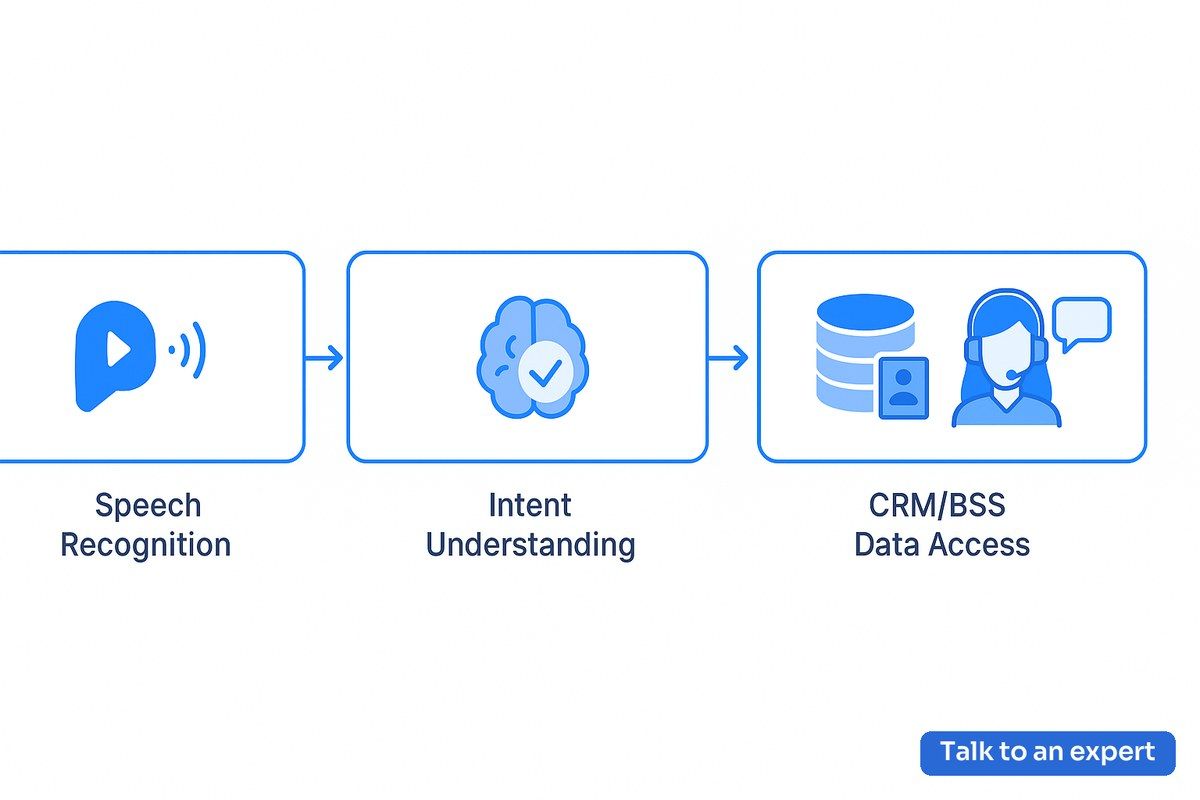
Key features include:
- NLP and intent recognition for contextual understanding
- Seamless omnichannel presence
- Real-time CRM/BSS/OSS data access
- Proactive engagement
Integration with Existing Systems
Integrating AI voice agents with existing telecom systems is crucial for delivering a seamless customer experience. This involves connecting AI solutions with CRM, BSS, and OSS platforms to ensure that customer data is readily accessible and interactions are personalized. VideoSDK offers comprehensive integration capabilities, allowing telecom operators to leverage existing infrastructure while enhancing it with AI-driven insights. Integration also ensures compliance with industry regulations and enables a unified view of customer journeys across all channels.
Enhancing Customer Interactions
AI voice agents are designed to enhance customer interactions by providing real-time support and personalized recommendations. They can analyze customer data to offer tailored solutions, such as suggesting the best plan based on usage patterns or providing proactive maintenance alerts. This level of personalization not only improves customer satisfaction but also increases the likelihood of upselling and cross-selling opportunities. By leveraging AI, telecoms can deliver a more human-like, empathetic experience at scale.
Key Benefits and Outcomes
Conversational AI is transforming telecom operations by enabling:
Personalization at Scale
AI agents provide tailored onboarding, plan recommendations, and proactive account management. New subscribers receive step-by-step guidance, while existing customers get optimal plan suggestions based on real-time data. Voice Agent Quick Start Guide offers practical steps for telecom teams. This personalization helps reduce churn and increases customer loyalty, as users feel their needs are understood and addressed promptly.
24/7 Self-Service and Automation
Routine tasks like balance checks and troubleshooting are automated, reducing human agent workload and empowering users. Tools like Google TTS Plugin enhance voice interactions. Around-the-clock availability ensures customers can resolve issues or get information at any time, improving overall satisfaction and reducing operational costs.
Proactive Customer Care
Operators can shift to proactive engagement, delivering outage notifications and personalized offers before issues arise. The OpenAI LLM Plugin enhances conversational capabilities. Proactive care not only prevents dissatisfaction but also builds trust, as customers perceive the brand as attentive and responsive to their needs.
Technical Support for Field Engineers
AI assistants provide instant access to network data and troubleshooting support, streamlining maintenance and reducing downtime. Field engineers can use AI-powered tools to quickly diagnose and resolve issues, ensuring network reliability and improving service quality for end users.
Case Study Snapshots
- Telenor Telmi: Resolved 80% of customer queries without human intervention, boosting CSAT.
- Vodafone/VOXI Gen Z Chatbot: Increased digital adoption and reduced support costs.
These real-world examples demonstrate the tangible impact of conversational AI in telecom, from reducing operational costs to improving customer satisfaction and digital engagement.
Expanding Use Cases
Beyond customer support, conversational AI in telecom can be applied to various operational areas. For example, AI can assist in network management by predicting outages and optimizing resource allocation. Additionally, AI-driven analytics can provide insights into customer behavior, helping telecom companies tailor their marketing strategies and improve service offerings. As AI capabilities expand, telecoms are exploring use cases in fraud detection, regulatory compliance, and even employee training, further amplifying the value of AI investments.
Implementation Path for Telecom Teams
Building conversational AI in telecom requires strategic planning:
- Identify High-Impact Use Cases: Focus on onboarding, troubleshooting, and upselling.
- Data Integration: Ensure seamless CRM, BSS, and OSS access.
- Compliance & Security: Prioritize data privacy and security.
- Choose the Right Platform: Opt for scalable solutions like VideoSDK.
- Pilot, Measure, Scale: Start with a pilot, refine, and expand.
Overcoming Implementation Challenges
Implementing conversational AI in telecom is not without challenges. Companies must address issues such as data privacy, integration complexity, and change management. It is essential to work with experienced partners like VideoSDK who understand the unique needs of the telecom industry and can provide tailored solutions that ensure a smooth transition to AI-driven operations. Change management is critical, as staff must be trained to work alongside AI agents and adapt to new workflows. Ensuring regulatory compliance, especially regarding customer data, remains a top priority throughout the implementation process.
Detailed Workflow for AI Integration
To successfully integrate AI into telecom operations, a detailed workflow is essential. This involves:
- Assessment and Planning: Evaluate current systems and identify integration points.
- Development and Testing: Develop AI models and rigorously test them in controlled environments.
- Deployment and Training: Deploy AI solutions and train staff on new processes.
- Monitoring and Optimization: Continuously monitor AI performance and optimize for efficiency.
A structured approach ensures that AI initiatives align with business goals and deliver measurable value. Collaboration between IT, operations, and customer experience teams is vital for a successful rollout.
ROI and Operational Impact
Conversational AI delivers significant benefits:
- Reduced Wait Times: Instant responses cut handling time.
- Lower Cost-to-Serve: Automation reduces costs by 30-60%.
- Higher CSAT/NPS: Fast, personalized service improves satisfaction.
- Increased Containment: Over 70% of queries resolved by AI.
- Employee Productivity: Agents focus on value-added tasks.
- Revenue Uplift: Proactive cross-selling increases ARPU.
| Metric | Pre-AI Implementation | Post-AI Implementation | |
|---|---|---|---|
| Average Wait Time | 10+ minutes | < 1 minute | |
| Cost per Query | $5-7 | $2-3 | |
| CSAT/NPS | < 30 | > 50 | |
| Automation/Containment Rate | < 30% | > 70% | |
| Churn Rate | 3-5% | < 2% | Leaders evaluating conversational ai in telecom often start with one high-volume workflow before scaling further. |
Measuring Success
To effectively measure the success of conversational AI implementations, telecom companies should establish clear KPIs aligned with their strategic goals. These might include metrics such as customer satisfaction scores, cost savings, and the rate of successful AI interactions. Regularly reviewing these metrics will help organizations refine their AI strategies and maximize their return on investment. Continuous improvement, based on data-driven insights, ensures that AI solutions remain effective and aligned with business objectives. McKinsey's report highlights the importance of monitoring operational impact for sustained competitive advantage.
Builder's Blueprint: VideoSDK Agents Framework for Telecom
VideoSDK equips telecom operators with tools for building next-gen conversational AI:
- Real-Time, Multi-Modal Engagement: Integrates voice, video, and chat.
- Scalable by Design: Supports millions of interactions.
- Developer-Friendly: Easy integration with existing stacks.
- Secure and Compliant: Telecom-grade privacy and compliance.
- Customizable and Robust Analytics: Tailor AI agents and track KPIs.
Partner with VideoSDK to accelerate your telecom AI initiatives and lead in the era of AI-powered customer experience. The platform's modular architecture allows telecoms to rapidly deploy, iterate, and scale AI solutions that address both customer-facing and operational challenges. By leveraging VideoSDK's robust analytics, telecom teams can continuously optimize agent performance and customer outcomes.
Future Prospects
As the telecom industry continues to evolve, the role of conversational AI will only grow in importance. Future developments may include more advanced AI capabilities such as emotion recognition and predictive analytics, which will further enhance customer interactions and operational efficiency. By staying ahead of these trends, telecom companies can ensure they remain competitive and continue to meet the ever-changing needs of their customers. Ongoing research from OpenAI and leading technology providers is expected to drive innovation in natural language processing and conversational intelligence, opening new possibilities for telecom operators in 2026 and beyond. For organizations exploring conversational ai in telecom, the priority is measurable ROI and practical deployment.
Step-by-Step AI Voice Agent Quickstart
FAQ