


Why the Sales Game Has Changed
In today's hyper-digital world, conversational AI for sales is redefining how businesses engage with buyers who now expect instant answers and personalized experiences at every touchpoint. The rapid growth of digital sales channels has fundamentally shifted the competitive landscape. Traditional sales methods struggle to keep up: scaling human teams to deliver high-touch interactions around the clock is costly and unsustainable. By adopting conversational AI for sales, businesses are not only meeting these new demands but also transforming their entire sales approach for 2025 and beyond. This technology brings together automation, intelligence, and a human-like touch, enabling organizations to deliver seamless, always-on engagement that drives results.
What is Conversational AI for Sales? Unpacking the Technology
Conversational AI for sales is an advanced technology that uses artificial intelligence to automate, enhance, and personalize sales interactions across chat, voice, and video channels. At its core, this technology empowers digital agents to understand, respond to, and learn from customer conversations in real time, making sales processes more intelligent and agile.
The foundational technologies behind conversational AI for sales include natural language processing (NLP), machine learning (ML), advanced speech recognition, and sophisticated dialogue management. These components work together to interpret customer intent, personalize responses, and guide conversations toward successful outcomes. Solutions span from AI-powered chatbots that engage website visitors, to voice assistants handling inbound calls, and video meeting bots that can actively participate in sales discussions. For a deeper understanding, explore conversational AI fundamentals and the AI voice Agent core components overview.
Conversational AI for sales is not just about automating routine tasks. It is about creating a seamless, engaging, and interactive customer journey. By integrating AI into existing sales strategies, companies can deliver more responsive and personalized experiences. This allows sales teams to focus on high-value activities, while AI agents handle repetitive inquiries and data collection. The result is increased productivity, higher customer satisfaction, and a sales process that is both scalable and adaptive to changing customer needs.
The Business Case: Tangible Benefits & ROI of Conversational AI
Integrating conversational AI for sales into your revenue engine delivers measurable value at every stage of the sales funnel. Here are the key benefits:
- 24/7 Coverage: AI agents provide round-the-clock engagement, qualifying and nurturing prospects no matter the time zone or hour.
- Personalization at Scale: AI leverages customer data to tailor every conversation, delivering bespoke experiences at a scale that human teams cannot match.
- Accelerated Lead Qualification & Conversion: Conversational AI rapidly evaluates inbound leads, prioritizes high-intent prospects, and nurtures them through the funnel, reducing the time from interest to action.
- Quantifiable Outcomes: Companies using conversational AI for sales report significant gains in pipeline value, reduced sales cycle times, and lower acquisition costs. According to a Forrester chatbot report, organizations have seen up to 30% higher lead conversion rates and as much as 50% reduction in support costs.
Traditional Sales vs. Conversational AI-Driven Sales
| Aspect | Traditional Sales | Conversational AI-Driven Sales |
|---|---|---|
| Availability | 9-5, business hours | 24/7 global coverage |
| Personalization | Manual, inconsistent | Automated, data-driven |
| Lead Qualification Speed | Slow, human-driven | Instant, AI-driven |
| Cost to Scale | High (hiring, training) | Lower (automation) |
| Data Capture & Insights | Fragmented | Real-time, unified |
| Response Consistency | Variable | Always on-brand |
| Integration with CRM | Manual entry | Seamless, automated |
Beyond these core advantages, conversational AI for sales provides a powerful competitive edge. By analyzing vast amounts of customer data, AI uncovers insights into buyer behaviors and preferences, enabling businesses to refine their sales strategies and respond quickly to shifting market dynamics. This agility is critical for organizations aiming to stay ahead in a rapidly evolving digital economy.
Real-World Use Cases: How Leaders Are Winning with Conversational AI
Conversational AI for sales is actively transforming how leading organizations drive revenue and customer engagement. Here are some practical applications:
- Automated Lead Conversion and Re-engagement: Platforms like Saleswhale and Oncourse.ai deploy AI agents to follow up with leads, re-engage cold prospects, and schedule meetings, freeing sales reps to focus on closing deals. To get started, consult the Voice Agent Quick Start Guide for launching your own AI-powered sales agent.
- AI-Powered Sales Coaching and Onboarding: Companies such as Maple and BAO utilize conversational AI to simulate sales scenarios, accelerate onboarding, and deliver personalized coaching at scale. Effective conversation flow in AI voice Agents is essential for these training and coaching solutions, ensuring natural and productive interactions.
- Real-Time Objection Handling and Data Capture: AI sales assistants (e.g., bao.ai) join live sales calls, surface relevant sales collateral instantly, and capture actionable data for post-call analysis. Leveraging AI voice Agent Session Analytics helps organizations measure agent performance and customer engagement in depth.
- Industry-Specific Impact:
- Real Estate: AI video agents qualify buyers and schedule property showings 24/7.
- SaaS: Chatbots nurture trial users, answer technical questions, and drive upgrades.
- Education: AI guides prospective students through complex application processes.
To further enhance AI voice agents, organizations can integrate plugins such as the OpenAI LLM Plugin for voice agent for advanced language understanding, the OpenAI STT Plugin for voice agent for accurate speech-to-text, and the ElevenLabs TTS Plugin for voice agent for natural-sounding voice responses. The Simli avatar plugin for AI voice Agents can also add a visual dimension, making AI interactions more engaging and human-like.
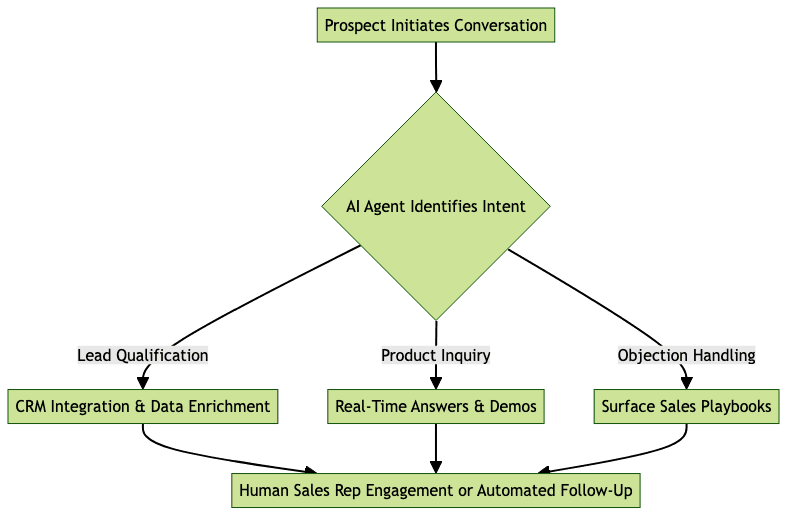
Conversational AI Workflow in Sales
Implementation Roadmap: From Vision to Results
Successfully implementing conversational AI for sales requires a strategic, phased approach:
- Assess Readiness: Evaluate your current technology stack, data quality, and sales workflows. Identify automation and integration gaps.
- Select High-Impact Use Cases: Focus on repetitive, high-volume interactions such as lead qualification and meeting scheduling for initial pilots. Prioritize areas with the strongest ROI potential.
- Integrate with CRM and Systems: Ensure seamless data flow between AI agents, CRM, marketing automation, and analytics platforms for a unified customer view.
- Train and Align Your Team: Invest in change management and upskill your sales teams to work alongside AI. Foster a culture of experimentation and continuous improvement.
- Measure, Iterate, Scale: Track key performance indicators like lead response time, conversion rates, and customer satisfaction. Use insights to refine conversational flows and expand AI adoption to new segments.
For a comprehensive guide on aligning technology with sales strategy, refer to this sales enablement technology guide.
The Builder’s Blueprint: Architecting Conversational AI for Sales Success
For product and technology leaders, building conversational AI for sales is about creating a robust, scalable platform that adapts to your unique sales processes and customer journeys, not just deploying a chatbot.
The Core Components You’ll Need
- Data Sources: Unified access to CRM, marketing automation, product usage, and customer interaction data enables AI-driven personalization.
- NLP Engine: Advanced natural language processing interprets customer intent and sentiment across channels.
- Orchestration Layer: This central layer synchronizes interactions, manages context, and routes tasks between AI agents and human sales representatives.
- User Interfaces: Omnichannel support via chat widgets, voice assistants, and video agents ensures prospects engage on their preferred platforms.
The Critical Challenge: Real-Time Orchestration
The most significant challenge in conversational AI for sales is managing seamless, context-rich conversations across multiple channels. Real-time orchestration requires:
- Coordinating chat, voice, and video interactions without losing context
- Ensuring data consistency and regulatory compliance
- Scaling to support thousands of concurrent conversations
- Rapidly iterating and integrating with evolving sales tools
Legacy solutions often fall short, resulting in fragmented customer experiences and limited impact.
The Solution: The VideoSDK Agents Framework
The VideoSDK Agents Framework is a powerful solution for builders seeking to deploy real-time, omnichannel intelligent virtual agents. VideoSDK Agents provides:
- Unified Orchestration: Centralized management of AI agents across chat, voice, and video channels, ensuring every interaction is context-aware and seamless.
- Plug-and-Play Integrations: Native connectors for leading CRMs, sales enablement platforms, and analytics tools accelerate deployment.
- Rapid Experimentation: Low-code tools and flexible APIs empower teams to design, test, and launch new AI flows without extensive AI expertise.
- Scalability and Compliance: Enterprise-grade security, privacy, and compliance features let you scale with confidence.
Example: Building a Custom AI Sales Assistant
Imagine deploying a digital sales assistant that joins video sales calls, answers product questions, and automatically logs key insights in your CRM, all in real time. With VideoSDK Agents, your team can:
- Define conversation flows and escalation logic visually
- Integrate with your sales stack for live data access
- Orchestrate seamless transitions between AI and human reps
- Continuously optimize interactions using analytics and feedback
To experiment with these capabilities, use the AI Agent playground to prototype, test, and refine your conversational AI sales solutions before scaling up.
The outcome is higher productivity, shorter sales cycles, and a differentiated customer experience, without the need for months of custom development.
Conclusion: The Future is Conversational, And It’s Within Reach
Conversational AI for sales is now a reality for forward-thinking organizations. By strategically leveraging frameworks like VideoSDK Agents, you can unlock efficiency, personalization, and scalable growth. The future of sales engagement is conversational, start your journey with VideoSDK today.
FAQ