


The AI Revolution in Real Estate
The real estate sector is undergoing a profound transformation as conversational AI for real estate reshapes every facet of property transactions. Traditionally, real estate workflows have been hampered by slow lead response times, inconsistent follow-ups, and labor-intensive processes. Agents and brokerages often struggle to keep pace with rising customer expectations for instant, personalized communication. In 2025, leaders are realizing that conversational AI for real estate is not just a trend, it's the new competitive imperative, driving exceptional customer experiences and unlocking sustainable growth.
The adoption of conversational AI in real estate is setting a new standard for efficiency and effectiveness. As the technology continues to evolve, it promises to further streamline operations, reduce costs, and enhance the overall client experience. The integration of AI-driven tools is not only transforming how agents interact with clients but also how they manage their internal processes, leading to a more agile and responsive business model. For real estate organizations aiming to stay ahead, embracing conversational AI for real estate is quickly becoming essential for long-term success.
What is Conversational AI for Real Estate?
Conversational AI for real estate refers to intelligent digital assistants, such as chatbots, voice agents, and analytics-driven platforms, that engage prospects, qualify leads, and automate tasks across multiple channels. Built on technologies like large language models (LLMs), natural language processing (NLP), and seamless CRM integrations, these AI solutions are designed for omnichannel engagement: web chat, voice calls, SMS, and mobile apps.
Key components include:
- AI-powered chatbots that handle buyer and seller inquiries in real time.
- Voice assistants that manage property tours and appointment scheduling.
- Analytics modules that surface actionable insights for agents and brokers.
For those interested in understanding the foundational elements, the AI voice Agent core components overview provides a detailed look at the essential building blocks that power these intelligent systems.
Real-world examples include AI-driven real estate chatbots that nurture leads 24/7, automated assistants streamlining appointment scheduling, and advanced analytics tools optimizing listing performance. These tools are redefining how agents interact with clients and manage workflows, making conversational AI for real estate a cornerstone of modern brokerage strategies.
The versatility of conversational AI extends beyond just handling inquiries. It enables real estate professionals to engage with clients in a more meaningful way, providing personalized recommendations and insights that are tailored to individual needs. This level of customization not only enhances customer satisfaction but also builds long-term loyalty, as clients feel understood and valued throughout their real estate journey. Conversational AI for real estate is fundamentally about delivering the right information, at the right time, on the client's preferred channel.
The Business Impact: Why Leaders are Investing in Conversational AI
Conversational AI for real estate is delivering measurable ROI for organizations willing to innovate. Automated lead capture and qualification accelerate response times, directly improving conversion rates and reducing operational overhead. AI-powered real estate assistants personalize customer journeys, maintain 24/7 engagement, and ensure no opportunity is missed, whether it’s a late-night inquiry or a routine follow-up.
Leading brokerages are leveraging conversational AI to:
- Increase lead generation and sales conversions by engaging every prospect instantly.
- Enhance agent productivity by automating repetitive tasks.
- Deliver data-driven insights that optimize marketing and listing strategies.
Case Study Snapshots
- Brokerages: Automated AI lead qualification doubled conversion rates and shortened sales cycles by 30%.
- Agents: AI for real estate agent productivity reduced administrative workload by 40%, freeing up time for high-value client interactions.
- Mortgage Services: AI in real estate sales increased loan application completion rates and improved customer satisfaction scores.
| Traditional Workflow | AI-Powered Workflow |
|---|---|
| Manual lead entry and follow-up | Automated lead capture and nurturing |
| Phone-tag for appointment setting | Instant AI-driven scheduling and reminders |
| Generic marketing blasts | Hyper-personalized, AI-driven engagement |
| Reactive customer service | Proactive, 24/7 AI support |
The shift towards AI-powered workflows is not just about automation; it's about creating a more dynamic and responsive real estate environment. By leveraging AI, brokerages can offer a level of service that is both comprehensive and highly efficient, ensuring that clients receive the attention and support they need at every stage of their property journey. According to Gartner, over 70% of organizations will use AI to automate workflows by 2025, making early adoption in real estate a clear competitive advantage.
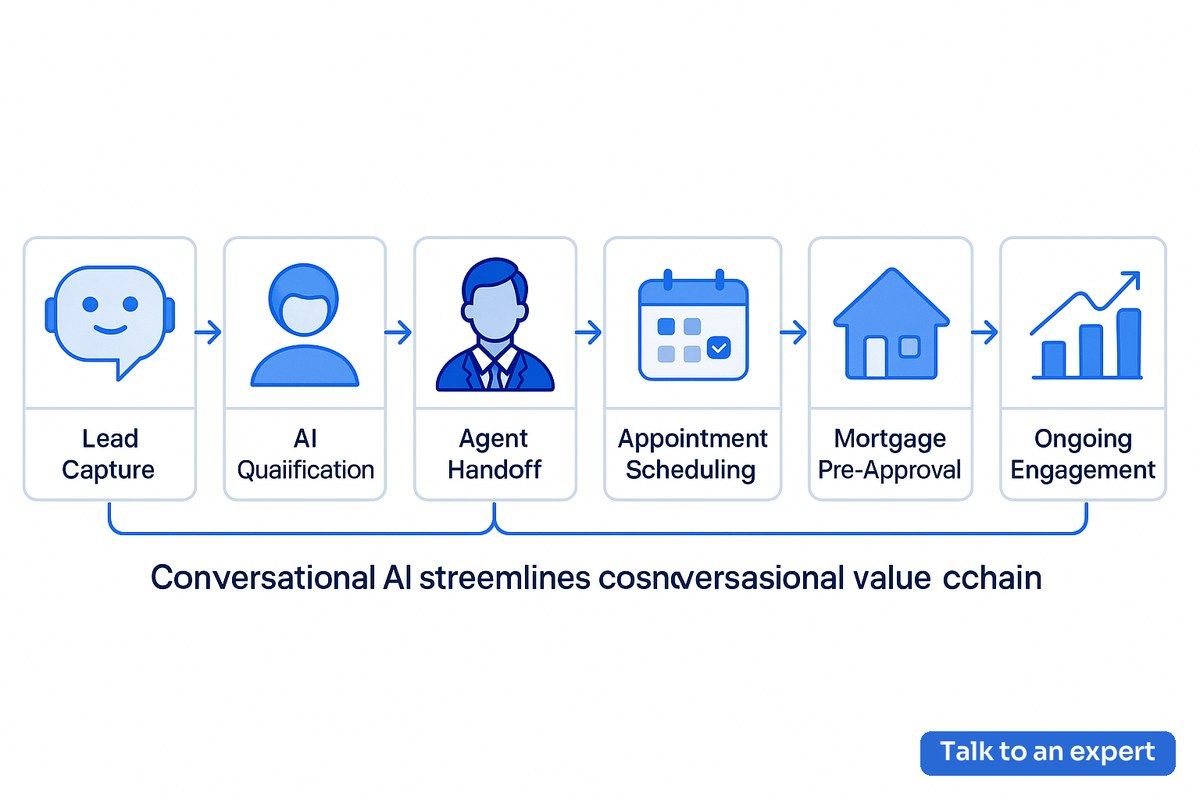
Practical Use Cases: Conversational AI Across the Real Estate Value Chain
Conversational AI is not confined to a single touchpoint, it powers the entire value chain, from lead generation to post-sale engagement. Here’s how innovative teams are building value:
AI for Lead Generation and Qualification
AI-powered real estate chatbots engage website visitors, capture essential details, and instantly qualify leads using intelligent conversation flows. This ensures every inquiry is addressed, and only high-intent prospects are routed to agents. For those looking to get started quickly, the Voice Agent Quick Start Guide offers step-by-step instructions to deploy your first AI voice agent.
The ability to qualify leads instantly not only saves time but also ensures that agents are focusing their efforts on the most promising opportunities. This targeted approach increases the likelihood of successful conversions and enhances the overall efficiency of the sales process. Leaders evaluating conversational AI for real estate often start with one high-volume workflow before scaling further.
Automating Appointment Scheduling & Showings
Conversational AI automates appointment booking, sends reminders, and even reschedules showings based on agent and client availability. This removes friction and streamlines the buyer journey. Leveraging a realtime pipeline in AI voice Agents ensures these interactions happen instantly and reliably, enhancing both client and agent experiences.
By automating these critical touchpoints, real estate professionals can focus more on building relationships and less on administrative tasks. This not only improves the client experience but also allows agents to operate more strategically, dedicating their time to activities that drive business growth.
Personalized Buyer/Seller Engagement
AI assistants for real estate customer service deliver tailored property recommendations, answer FAQs, and nurture relationships with dynamic, context-aware conversations, boosting engagement and satisfaction. Integrating the OpenAI LLM Plugin for voice agent enables more natural, human-like conversations that adapt to each client's unique needs.
Personalization is key in real estate, where understanding a client's specific preferences can make a significant difference in closing a deal. AI-driven solutions provide the tools necessary to deliver this level of service, ensuring that clients feel heard and valued throughout their interactions. Teams that adopt conversational AI for real estate typically measure success through faster response times and lower handle costs.
Data-Driven Listing Optimization and Analytics
AI-driven real estate analytics provide agents and brokerages with actionable insights, identifying which listings get the most traction, when to adjust pricing, and how to optimize marketing spend. Utilizing AI voice Agent Session Analytics empowers teams to track and refine every customer interaction for maximum impact.
With access to detailed analytics, real estate professionals can make informed decisions that enhance their marketing strategies and improve listing performance. This data-driven approach not only boosts efficiency but also helps agents stay ahead of market trends, ensuring they can offer the most competitive services to their clients. McKinsey highlights that data-driven decision-making is a key differentiator in modern real estate success.
Streamlining Brokerage, Mortgage, and Relocation Services
Intelligent virtual agents brokerages seamlessly connects buyers with mortgage advisors, relocation experts, and support staff, ensuring a frictionless, integrated customer experience. When multiple digital assistants need to collaborate, the Agent-to-Agent communication overview demonstrates how agents can work together to deliver a seamless service journey.
The integration of various services into a cohesive AI-driven system allows for a more streamlined and efficient process, reducing the complexity and stress often associated with real estate transactions. This holistic approach ensures that all client needs are met promptly and effectively.
Core Capabilities: What Makes a Great Conversational AI for Real Estate?
To maximize ROI, your conversational AI must be more than a simple chatbot. Leading solutions provide:
- Seamless CRM and website integration to unify customer data and automate lead flow.
- Omni-channel support across text, voice, web, and mobile, ensuring prospects can engage on their preferred platform.
- Analytics and performance dashboards that empower agents with real-time insights and optimization opportunities.
- Customization for agents, listings, and brokerages to reflect unique brand voices and adapt to various real estate niches.
For voice-based engagement, integrating the ElevenLabs TTS Plugin for voice agent delivers high-quality, natural-sounding speech, further enhancing the customer experience.
These capabilities drive exceptional customer experiences and empower teams to work smarter, not harder. The ability to customize AI solutions to fit specific business needs ensures that brokerages can maintain their unique brand identity while leveraging cutting-edge technology to enhance their operations. According to Google Cloud Research, advanced conversational AI platforms are rapidly becoming the backbone of digital transformation in real estate.
Overcoming Barriers: Implementation, Cost, and Security Concerns
Adopting conversational AI raises important questions about integration, cost, and data privacy. Forward-thinking leaders are addressing these challenges head-on:
- Integration fears are minimized with modern frameworks that enable plug-and-play connectivity with existing CRMs and listing platforms.
- Cost structures are increasingly ROI-driven; investments are recouped through higher conversion rates and lower operational costs.
- Data privacy and compliance are safeguarded by solutions built with GDPR, CCPA, and other regulations in mind.
| Common Barrier | Modern Solution |
|---|---|
| Data silos | API-driven integrations unify CRM, website, and analytics |
| Agent resistance | User-friendly interfaces and strong change management |
| Security concerns | End-to-end encryption and robust compliance controls |
| High upfront costs | Flexible, usage-based pricing aligns spend to outcomes |
By addressing these barriers, real estate firms can confidently integrate AI solutions into their operations, ensuring they remain competitive in an increasingly digital marketplace. The focus on security and compliance also reassures clients that their data is protected, fostering trust and confidence in AI-driven services. Industry leaders recommend piloting conversational AI for real estate in a controlled environment before scaling, to ensure seamless integration and measurable results.
The Builder's Blueprint: Creating Your Own Real Estate Conversational AI with VideoSDK
Building a robust conversational AI requires a strategic blueprint and the right enabling technology. In practice, conversational AI for real estate works best when integrated with existing CRM, telephony, and support tools.
The Core Components You'll Need
You’ll need large language models (LLMs) for natural conversations, orchestration layers for multi-agent workflows, CRM connectors for seamless data flow, and analytics modules for performance tracking. Each must work in real time to power responsive, intelligent interactions. For a smooth rollout, the AI voice Agent deployment guide walks you through launching and managing your AI agents in production environments.
The Critical Challenge: Real-Time Orchestration
In the fast-paced real estate environment, real-time, multi-agent orchestration is non-negotiable. Coordinating chat, voice, and backend systems, while adapting to constantly changing client needs, demands a platform capable of instant data flow and decisioning.
The Solution: The VideoSDK Agents Framework
This is where the VideoSDK Agents Framework delivers unmatched value. It’s purpose-built to accelerate the development of conversational AI by offering:
- Plug-and-play agent orchestration for chat, voice, and transactional workflows
- Native CRM and calendar integrations for seamless operational flow
- Real-time analytics dashboards to optimize customer journeys and agent performance
- Scalable, secure architecture that effortlessly adapts as your brokerage grows
With VideoSDK, your team gains the capabilities to build, deploy, and iterate conversational AI solutions, rapidly and reliably. It’s the essential foundation for any organization ready to unlock the true potential of AI in real estate.
The VideoSDK framework not only simplifies the development process but also provides the tools necessary to continuously improve and adapt AI solutions. By leveraging this powerful platform, real estate firms can ensure they remain at the forefront of innovation, delivering exceptional service and achieving sustained growth.
Conclusion: The Future-Proof Brokerage is AI-Powered
Conversational AI for real estate is more than a technology upgrade, it’s a competitive necessity for brokerages and agents in 2025. By embracing AI-driven customer engagement, automation, and analytics, you can deliver superior experiences, maximize ROI, and future-proof your business. Leaders who act now, with platforms like VideoSDK, will define the next era of real estate excellence.
As the industry continues to evolve, those who integrate conversational AI into their operations will be best positioned to meet the demands of modern consumers. The ability to offer personalized, efficient, and responsive service will set successful brokerages apart, ensuring they thrive in an increasingly competitive market. For organizations exploring conversational AI for real estate, the priority is measurable ROI and practical deployment.
FAQ